


Last Updated: September 2026
A Form 8283 business interest appraisal is a formal valuation that supports a charitable deduction for a gift of private business stock or units. Taxpayers report the gift on IRS Form 8283, the noncash charitable contributions form. The IRS requires this appraisal for any noncash gift worth more than $5,000. The report proves the fair market value the donor claims on the tax return.
A business interest has no public trading price, so its value is not obvious. A qualified appraiser must study the company’s finances, its industry, and the terms tied to the interest. This work protects the donor if the IRS reviews the gift. It also gives the charity a defensible number to record.
Sofer Advisors prepares these appraisals for business owners and their tax advisors. Its work centers on tax-related valuations that meet strict IRS reporting standards. Its senior staff has served as an expert witness in 11+ cases across Georgia, Florida, California, and New Mexico, and the practice holds 180+ five-star Google reviews. This guide explains when an appraisal is required and what Section B demands.
Key Takeaways
- Filing threshold is $500: Any taxpayer with noncash charitable gifts above $500 for the year must file Form 8283.
- Appraisal is mandatory: A donated business interest worth more than $5,000 needs a qualified appraisal from a qualified appraiser.
- Section B is required: Gifts above $5,000 use Section B, signed by both the appraiser and the receiving charity.
- Big gifts, more proof: When the deduction tops $500,000, the full appraisal must be attached to the return.
- Errors are costly: A missing appraisal, a late report, or an unsigned form can void the entire deduction.
These rules decide whether a charitable gift of a business interest holds up. The sections below cover the form, the appraisal, the signatures, and the costly errors to avoid.
What is IRS Form 8283?
IRS Form 8283 is the tax form that reports noncash charitable contributions to the IRS. A taxpayer files it with the return when total noncash gifts for the year top $500. The form has two parts. Section A covers property worth $500 to $5,000 and asks for a basic description. Section B covers property worth more than $5,000 and acts as the Appraisal Summary. A gift of a private business interest almost always lands in Section B.
The form links the deduction to real evidence of value. For a business interest, that evidence is a qualified appraisal signed by a qualified appraiser. The IRS uses the Form 8283 filing to check that the claimed deduction matches the fair market value of the gift. Filing the wrong section, or leaving fields blank, can trigger a review. Complete reporting keeps the deduction on solid ground.
When is a qualified appraisal required?
A qualified appraisal is required whenever a donated business interest is worth more than $5,000. That threshold covers closely held stock, partnership interests, and limited liability company units. Because these assets have no public market, the donor must hire an independent appraiser to set the value.
Timing matters as much as the report itself. The appraisal cannot be dated more than 60 days before the gift. It must also be complete by the filing deadline for the return that first claims the deduction. When the deduction tops $500,000, the donor must attach the full appraisal, not just the summary. The rules for valuing donated property appear in IRS Publication 561, which appraisers follow when they document the value.
Who qualifies as a qualified appraiser?
A qualified appraiser is a professional who holds a recognized valuation credential and appraises property for pay on a regular basis. For a business interest, that usually means an Accredited Senior Appraiser, or ASA, or a professional Accredited in Business Valuation, or ABV. The appraiser must show real education and experience in valuing the type of interest being donated. The IRS expects proof of both.
Independence is just as important. The appraiser cannot be the donor, the charity, or a party with a stake in the gift. A financial interest in the outcome disqualifies the report. Credible appraisers follow the Uniform Standards of Professional Appraisal Practice, or USPAP, published by The Appraisal Foundation. By signing the Declaration of Appraiser in Section B, the professional attests to these credentials and standards.
How is a business interest valued for Form 8283?
A business interest is valued at its fair market value on the date of the gift. Appraisers reach that value using the income approach, the market approach, or the asset approach. Many blend two of these for a private company. The analysis follows the factors in Revenue Ruling 59-60, the long-standing guide for valuing closely held stock.
Revenue Ruling 59-60 asks the appraiser to weigh earnings, dividend-paying ability, and the financial condition of the company. The market approach studies how similar interests trade. The income approach projects future cash flow and discounts it to present value. For a private interest, the appraiser often applies a discount for lack of marketability, or DLOM, because the interest cannot be sold quickly. A minority stake may also carry a discount for lack of control. These adjustments produce a value the IRS can accept.
What goes in Section B, the Appraisal Summary?
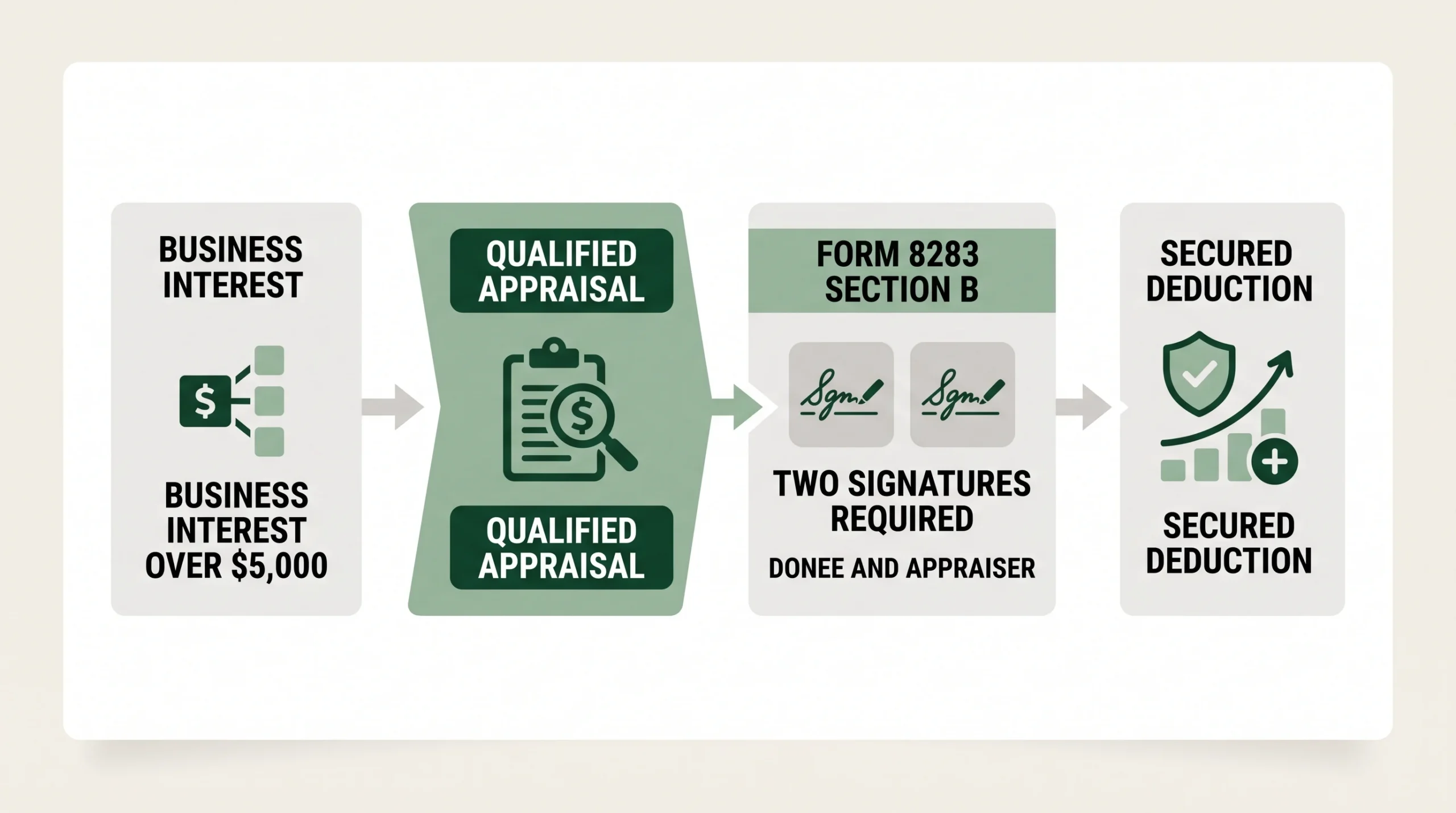
Section B, the Appraisal Summary, records the details the IRS needs to verify the gift. It lists a description of the interest, the date of the gift, the cost basis, and the appraised fair market value. It also carries two required signatures. The receiving charity signs the Donee Acknowledgement to confirm it received the described property. The qualified appraiser signs the Declaration of Appraiser to confirm the value and the credentials behind it.
- A clear description of the business interest and the date of the gift
- The donor’s cost basis and how the interest was acquired
- The appraised fair market value on the gift date
- The signed Donee Acknowledgement from the receiving charity
- The signed Declaration of Appraiser from the qualified appraiser
Every field on the summary matters. A missing signature is one of the most common reasons the IRS rejects a deduction, so the donor should confirm both are in place before filing. The description on the form should match the appraisal report. When the two agree, the IRS has a clear, consistent record of the gift and its value.
How does the appraisal process work?
The appraisal moves through a set sequence, from data gathering to a final, defensible value. Sofer Advisors runs this work through The Sofer Difference, a four-step method: Discovery, Diligence, Analysis, and Delivery. Discovery gathers the records. Diligence tests the data. Analysis applies the valuation methods. Delivery produces a report built to withstand IRS review. Each judgment is explained in plain terms, a Heart of a Teacher approach that helps owners and advisors follow the logic.
A clear process protects the deduction. The appraiser gathers financial statements, tax returns, and the agreements that govern the interest. The final report shows how the value was reached, step by step. That transparency is what lets the appraisal stand up if the IRS asks questions later.
What errors void a Form 8283 filing?
Common errors include missing the appraisal, hiring an unqualified appraiser, and filing Section B without both signatures. Any one of these can void the entire deduction. The IRS may then add accuracy penalties and interest on the tax due. A report that follows recognized standards is the best guard.
The appraiser you choose matters as much as the method. National firms such as Alvarez & Marsal, Stout, and Kroll handle large, complex engagements. Owners of middle market companies often want senior attention and a tax-focused report at a workable fee. The table below compares how different providers approach a business interest appraisal for a charitable gift.
| Provider | Primary focus | Best fit |
| Sofer Advisors | Business interest, tax, and estate appraisals | Middle market owners needing a defensible, IRS-ready report |
| Alvarez & Marsal | Large corporate and restructuring work | Enterprise clients and complex deals |
| Stout | Broad valuation and dispute advisory | Large companies and litigation matters |
| Kroll | Global valuation and risk advisory | Multinationals and institutional clients |
A provider focused on private business interests often gives the most direct help with a charitable gift. Large institutions offer wide services but may not center the granular data the IRS wants for illiquid interests. The right choice depends on the size of the gift and the complexity of the company.
The questions below cover what donors and their advisors ask most about Form 8283.
Frequently Asked Questions
What are the appraisal requirements for Form 8283?
Form 8283 requires a qualified appraisal for any noncash gift of property worth more than $5,000, including a business interest. A qualified appraiser must prepare the report and follow recognized standards such as USPAP. The appraisal must state the fair market value and the date of the gift. It must also be completed before the return is due, including extensions.
Who is required to file Form 8283?
Any taxpayer who claims a deduction for noncash charitable gifts of more than $500 in a year must file Form 8283. When a single item or group of similar items tops $5,000, the donor must also complete Section B. A gift of a business interest above $5,000 requires a signed appraisal summary attached to the return.
Do I need an appraisal for donations exceeding $5,000?
Yes. A qualified appraisal is mandatory for any noncash gift worth more than $5,000, including a closely held business interest. Without it, the IRS can deny the entire charitable deduction. The appraisal must come from a qualified, independent appraiser. It substantiates the fair market value the donor reports on the return.
What items should be included in Section B of Form 8283?
Section B must include a description of the donated interest, the date of the gift, the cost basis, and the appraised fair market value. It also needs two signatures. The receiving charity signs the Donee Acknowledgement, and the qualified appraiser signs the Declaration of Appraiser. Missing either signature is a common reason the IRS rejects a claim.
When must you attach the full appraisal to your return?
The full appraisal must be attached when the claimed deduction for a business interest tops $500,000. Below that amount, the signed Section B summary generally travels with the return, while the complete report stays on file. Either way, the appraisal must be finished before the filing deadline. Keeping the full report ready supports the deduction if the IRS asks for it.
Can my CPA act as the qualified appraiser for my donation?
A CPA may serve as the qualified appraiser only if they meet the IRS education and experience rules for the property being valued. That usually means a recognized credential such as the ABV or the ASA and regular appraisal work. The appraiser must also stay independent of the donor and the charity. Many CPAs refer this work to a dedicated valuation professional.
What is the deadline for obtaining a qualified appraisal?
A qualified appraisal must be dated no earlier than 60 days before the gift and no later than the due date of the return that first claims the deduction. That deadline includes any extensions. Starting early leaves time to gather records and finish the report. A late appraisal can cost the donor the deduction even when the value is correct.
What happens if the IRS disagrees with the appraised value?
If the IRS challenges the value, the taxpayer must support the original figure with evidence. A disagreement can bring penalties, interest, and a partial or full loss of the deduction. A substantial valuation misstatement, where the claimed value is well above the correct amount, carries its own penalty. A detailed, well documented report is the best defense.
How much does a qualified appraisal for a business interest cost?
Cost depends on the complexity of the company, the quality of the financial data, and the timeline. For standard business valuation engagements, fees generally range from $7,500 to $25,000, with larger or more complex interests toward the higher end. Sofer Advisors tailors each fee to the scope of a compliant, defensible report. Request a fee estimate for your specific gift.
Related Case Studies
- Valuation of Closely Held Business for Estate Tax Purposes
- FMV of Closely Held Business Stock: IRS Methods
- Applying IRS Revenue Ruling 59-60: 8 Factors in Every Valuation
Executive Summary
A gift of a business interest to charity can produce a fair market value deduction, but the IRS demands proof. Any noncash gift above $5,000 needs a qualified appraisal from an independent, credentialed appraiser, reported on Form 8283, Section B. The summary carries two signatures, one from the appraiser and one from the receiving charity. When the deduction tops $500,000, the full appraisal must be attached. The appraisal cannot predate the gift by more than 60 days and must be ready by the filing deadline. Gather your financials early, then engage a qualified appraiser well before the return is due to keep the deduction secure.
What Should You Do Next?
Confirm your gift needs Section B by checking whether the interest is worth more than $5,000. Gather three years of financial statements, recent tax returns, and the agreements that govern the interest so the appraiser can work without delay. Engage an independent, credentialed appraiser well before the filing deadline, and confirm both signatures are on the summary before you file.
David Hern CPA ABV ASA, founder of Sofer Advisors, guides owners through charitable gifts of business interests and the reporting the IRS expects. Schedule a consultation to discuss your situation.
People Also Read
- Fair Market Value Definition: IRS Standard Explained
- Cost Basis vs Fair Market Value: Key Differences Explained
About the Author
This guide was prepared by David Hern CPA ABV ASA, founder of Sofer Advisors, a business valuation firm headquartered in Atlanta, GA serving clients across the United States. David holds dual accreditations as an Accredited Senior Appraiser (ASA) and is Accredited in Business Valuation (ABV), credentials recognized by the IRS, SEC, and FINRA. He also holds the Certified Exit Planning Advisor (CEPA) designation. With 15+ years of valuation experience, David has served as an expert witness in 11+ cases across multiple jurisdictions and built Sofer Advisors into an Inc. 5000-recognized firm with 180+ five-star Google reviews. Its full W2 employee team maintains subscriptions to all major valuation databases and operates under a next business day response policy.
For professional business valuation services, visit soferadvisors.com/about-us/ or contact Sofer Advisors at soferadvisors.com/contact-us/.
Disclaimer: This content is for informational purposes only and does not constitute professional valuation advice. Business valuation conclusions depend on specific facts and circumstances. Contact Sofer Advisors for guidance regarding your specific situation.









