


Last Updated: September 2026
A donor-advised fund private stock appraisal is a formal valuation that sets the fair market value of non publicly traded shares gifted to a donor-advised fund. The IRS requires this appraisal for any noncash charitable gift worth more than $5,000. The report supports the deduction the donor claims on the return. It confirms that the deduction matches the real economic worth of the shares moved into the fund.
Private shares do not trade on a public market, so their value is not obvious. An appraiser must study the company finances, the industry, and the terms attached to the shares. This work protects the donor if the IRS reviews the gift. It also gives the sponsoring charity a defensible number to record when it accepts the stock.
Sofer Advisors prepares these appraisals for business owners and their tax advisors. Its work centers on tax-related valuations that meet strict IRS reporting standards. Its senior staff has served as expert witnesses in 11+ cases across Georgia, Florida, California, and New Mexico, and the practice holds 180+ five-star Google reviews. This guide explains when an appraisal is required, who may sign it, and how the process works.
Key Takeaways
- Double tax benefit: Donating private stock to a donor-advised fund can avoid capital gains tax while allowing a fair market value deduction.
- Appraisal is mandatory: The IRS requires a qualified appraisal from a qualified appraiser for any noncash gift valued above $5,000.
- Timing is strict: The appraisal cannot be dated more than 60 days before the gift, and it must be in hand by the return due date.
- Credentials matter: A qualified appraiser must be independent and hold a recognized designation such as the ABV or the ASA.
- Mistakes are costly: Poor timing, a weak report, or a filing error can cause the IRS to deny the entire deduction.
These five points decide whether a charitable gift of private stock holds up. The sections below cover each rule, the documents an appraiser needs, and the errors that put a deduction at risk.
What is a donor-advised fund?
A donor-advised fund is a charitable account held by a public charity that lets a donor give assets now and recommend grants over time. The donor makes an irrevocable gift to the sponsoring organization. That gift earns an immediate tax deduction. The sponsor then manages the funds and follows the donor’s grant recommendations. The structure offers the tax benefit of a private foundation with far less cost and paperwork.
Many owners choose a fund over a private foundation because it avoids separate legal filings. When a donor gives appreciated assets such as stock, the deduction is based on fair market value. The gift also skips the capital gains tax that a sale would trigger. The sponsoring charity handles the tax reporting and the eventual sale of the asset. This makes the fund a clean way to turn an illiquid holding into charitable impact.
Why donate private stock to a donor-advised fund?
Donating appreciated private stock lets an owner deduct the fair market value of the shares and skip the capital gains tax a sale would create. This gives two benefits at once. The owner avoids tax on the built in gain. More of the value reaches the charity than if the owner sold first, paid the tax, then gave the cash.
The deduction is the main draw. When an owner gives an illiquid asset like private stock, the deduction usually reflects the appraised value on the gift date. Because the shares go straight to the fund, no taxable sale occurs. The fund can later sell the stock, often free of tax, and direct the full proceeds to charity. Owners frequently use this method before a sale or a recapitalization, when the shares carry a large built in gain.
When does the IRS require a qualified appraisal?
The IRS requires a qualified appraisal whenever a noncash charitable gift is worth more than $5,000. A gift of private company stock nearly always crosses that line. The donor must also file Form 8283, Section B, with the return for the year of the gift. If the deduction tops $500,000, the full appraisal must be attached to the return.
The report must follow the rules in IRS Publication 561, which explains how to value donated property. The appraisal cannot be dated earlier than 60 days before the gift. It must also be received before the return is due, including extensions. A gift that misses these steps can lose its deduction even when the value is correct. The instructions to Form 8283 spell out the signatures and data the IRS expects.
Who counts as a qualified appraiser?
A qualified appraiser is a professional who holds a recognized valuation designation and appraises property for pay on a regular basis. For private stock, that usually means an Accredited Senior Appraiser, or ASA, or a professional Accredited in Business Valuation, or ABV. The appraiser must show real education and experience in valuing the type of property being donated.
Independence matters just as much. The appraiser cannot be the donor, the charity, or a party to the deal. A financial stake in the outcome disqualifies the report. Credible appraisers also follow the Uniform Standards of Professional Appraisal Practice, or USPAP, published by The Appraisal Foundation. These standards guide how the analysis is documented and defended.
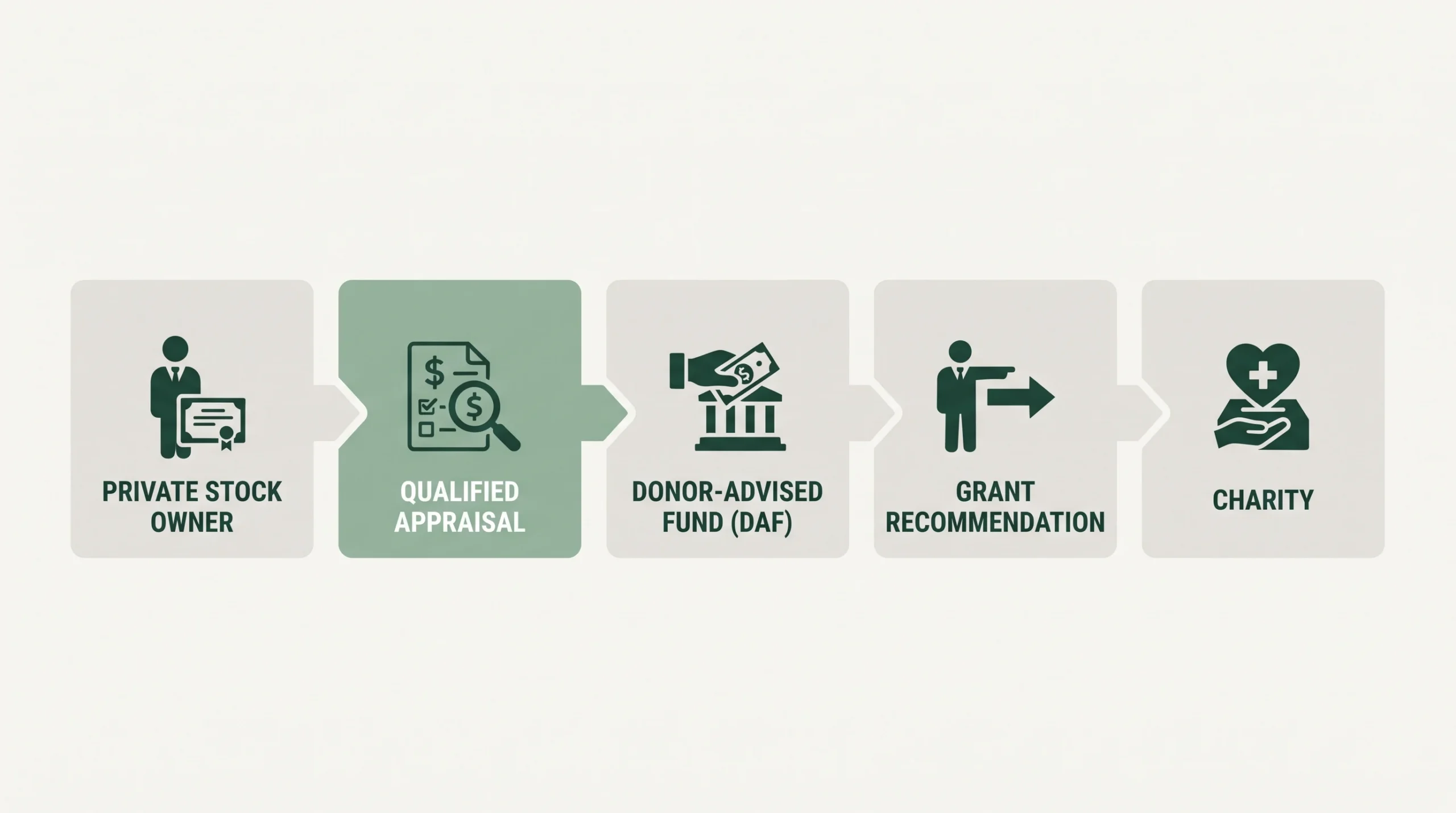
How does the appraisal process work?
The appraisal moves through a set sequence, from data gathering to a final, defensible value. Sofer Advisors runs this work through The Sofer Difference, a four-step method: Discovery, Diligence, Analysis, and Delivery. Each step gathers records, tests the data, applies valuation methods, then delivers a report built to withstand IRS review. Each judgment is explained in plain terms, a Heart of a Teacher approach that helps owners and advisors follow the logic.
Appraisers usually blend the income approach and the market approach to reach a value. For private shares, they often apply a discount for lack of marketability, or DLOM, because the stock cannot be sold quickly. They may also weigh a minority interest when the donor gives a small stake. This mix of methods, paired with a review of economic conditions, produces the fair market value the IRS expects. A clear report then shows how each number was reached.
What are common donor-advised fund appraisal mistakes?
Common mistakes include hiring an unqualified appraiser, missing the valuation date window, and filing Form 8283 incorrectly. Any one of these can void the deduction. The IRS may then add accuracy penalties and interest on the tax due. A report that follows recognized appraisal standards is the best guard against these outcomes.
The appraiser you choose matters as much as the method. National firms such as Alvarez & Marsal, Stout, and Kroll handle large, complex engagements. Owners of middle market companies often want senior attention and a tax-focused report at a workable fee. The table below compares how different providers approach a private stock appraisal for a fund.
| Provider | Primary focus | Best fit |
| Sofer Advisors | Private stock, tax, and estate appraisals | Middle market owners needing a defensible, IRS-ready report |
| Alvarez & Marsal | Large corporate and restructuring work | Enterprise clients and complex deals |
| Stout | Broad valuation and dispute advisory | Large companies and litigation matters |
| Kroll | Global valuation and risk advisory | Multinationals and institutional clients |
Owners often find that a provider focused on private company stock gives the most direct help with a fund contribution. Large institutions offer wide services but may not center the granular data the IRS wants for illiquid shares. The right choice depends on the size of the gift and the complexity of the company. Matching the engagement to the appraiser keeps the deduction defensible and the timeline realistic.
The questions below cover what donors ask most before they give private stock.
Frequently Asked Questions
Do you need a qualified appraisal for donated private stock?
Yes. The IRS requires a qualified appraisal for any noncash gift of private stock valued above $5,000. The appraisal substantiates the fair market value the donor claims. Form 8283, Section B, must be filed with the return for the year of the gift. When the deduction tops $500,000, the full appraisal report must be attached as well.
How do you determine the value of donated stock?
Determining the value calls for a formal valuation by a qualified appraiser, since the IRS uses fair market value for noncash gifts. The appraiser reviews financial statements, market data, and any restrictions on the shares. A discount for lack of marketability often applies to private stock. The result is a supportable figure that can withstand review during tax reporting.
Can you fund a donor-advised fund with appreciated stock?
Yes. A donor can fund a donor-advised fund with appreciated stock, which often brings strong tax advantages. Giving shares directly usually avoids the capital gains tax that a sale would create. The full value of the investment then benefits the chosen charities. This lets a donor increase charitable impact while managing the overall tax picture.
What is Form 8283 and when do you file it?
Form 8283 reports noncash charitable contributions to the IRS. A donor files it with the tax return when total noncash gifts for the year exceed $500. Gifts of private stock above $5,000 require Section B, which the qualified appraiser signs. The receiving charity also signs to confirm it accepted the described property.
Can you convert a donor-advised fund to a private foundation?
A donor-advised fund cannot be converted directly into a private foundation, because the two are separate legal entities. A donor who prefers a foundation would generally form a new one and move assets, which can raise tax and legal issues. Donors should consult tax counsel before any transfer. Understanding the difference first helps a donor pick the right vehicle.
What is the difference between a donor-advised fund and a private foundation?
The main differences involve control, cost, and disclosure. A donor-advised fund is run by a sponsoring charity, which handles the reporting and avoids public disclosure. A private foundation gives more control over investments and grants but carries heavy legal and accounting overhead. The right structure depends on how much control and privacy a donor wants.
What information does a private stock valuation require?
An appraiser needs several years of financial statements, tax returns, and any shareholder or operating agreements. Details about the industry, the management team, and the outlook also shape the fair market value. A current cap table helps confirm ownership and share class. Having these records organized before the engagement begins keeps the process efficient.
How long does a qualified appraisal for a donor-advised fund take?
A qualified appraisal for a private company usually takes 4 to 8 weeks from the receipt of complete data. That window allows time for research, analysis, and careful report drafting. Complex companies or urgent filing deadlines can shift the schedule. Starting early keeps the report ready well before the gift and the return are due.
How much does a qualified appraisal for a donor-advised fund contribution cost?
Cost depends on the complexity of the company, the quality of the financial data, and the required timeline. For standard business valuation engagements, fees generally range from $7,500 to $25,000. A larger or more complex company sits toward the higher end. Fees are tailored to the scope of work needed for a compliant, defensible report.
Related Case Studies
- Valuation of Closely Held Business for Estate Tax Purposes
- Valuation Discounts (DLOC and DLOM) on Estate and Gift Tax Returns
- FMV of Closely Held Business Stock: IRS Methods
Executive Summary
A gift of private company stock to a donor-advised fund can avoid capital gains tax and produce a fair market value deduction. The IRS requires a qualified appraisal for any noncash gift above $5,000, filed with Form 8283, Section B. The appraisal cannot predate the gift by more than 60 days, and gifts above $500,000 require the full report attached to the return. A qualified appraiser must be independent and hold an ASA or ABV credential. Gather your financial statements, tax returns, and cap table early, then engage an appraiser well before the filing deadline to keep the deduction secure.
What Should You Do Next?
Start the appraisal at least 60 days before your intended gift date. Gather three years of financial statements, recent tax returns, and a current cap table so the appraiser can work without delay. Confirm the appraiser is independent and holds an ASA or ABV credential recognized by the IRS.
David Hern CPA ABV ASA, founder of Sofer Advisors, guides owners through charitable gifts of private stock and the reporting the IRS expects. Schedule a consultation to discuss your situation.
People Also Read
- Cost Basis vs Fair Market Value: Key Differences Explained
- Using the Annual Gift Exclusion to Transfer Business Interests
About the Author
This guide was prepared by David Hern CPA ABV ASA, founder of Sofer Advisors, a business valuation firm headquartered in Atlanta, GA serving clients across the United States. David holds dual accreditations as an Accredited Senior Appraiser (ASA) and is Accredited in Business Valuation (ABV), credentials recognized by the IRS, SEC, and FINRA. He also holds the Certified Exit Planning Advisor (CEPA) designation. With 15+ years of valuation experience, David has served as an expert witness in 11+ cases across multiple jurisdictions and built Sofer Advisors into an Inc. 5000-recognized firm with 180+ five-star Google reviews. Its full W2 employee team maintains subscriptions to all major valuation databases and operates under a next business day response policy.
For professional business valuation services, visit soferadvisors.com/about-us/ or contact Sofer Advisors at soferadvisors.com/contact-us/.
Disclaimer: This content is for informational purposes only and does not constitute professional valuation advice. Business valuation conclusions depend on specific facts and circumstances. Contact Sofer Advisors for guidance regarding your specific situation.









