


Last Updated: August 2026
A discount for lack of marketability (DLOM) is a reduction in the value of an ownership interest that cannot be sold quickly for cash. Public shares trade in seconds at a known price. Private shares do not. Restricted stock studies size this gap by comparing restricted shares to freely traded shares of the same firm. That difference often runs 20 to 30 percent, per the Stout Restricted Stock Study. Sofer Advisors treats the discount as one of the most tested numbers in any private valuation.
The size of this discount can swing a valuation by six figures, so it draws close review from the IRS, opposing experts, and the courts. It applies whenever an interest lacks a ready market, from gift and estate filings to shareholder disputes. Because so much rides on it, the rate must trace back to evidence, not a rule of thumb.
Key Takeaways
- What a DLOM is: It is a value cut applied to an interest that is hard to turn into cash.
- Study evidence: Restricted stock studies compare restricted shares to public shares of the same company.
- Pre-IPO data: Pre-IPO studies add a second data set from private sales before a company goes public.
- Key drivers: Holding period, volatility, size, and dividend yield move the discount.
- Defensible support: A discount must tie the study data to the real facts of the business.
These points connect market evidence to risk. The sections below show how analysts read the studies, weigh the factors, and defend the number to a tax authority or a court.
What Is a Discount for Lack of Marketability?
A discount for lack of marketability lowers the price of an interest you cannot sell fast. A public share sells at once for a known amount. A private stake does not. The DLOM puts a number on that missing liquidity.
The discount matters because private owners carry real exit risk. Finding a buyer takes time, and the sale price stays unsure. Fair market value, the test in IRS Revenue Ruling 59-60, assumes a willing buyer and seller. That test forces the appraiser to price the liquidity a private share lacks. Sofer Advisors isolates this one factor. The final value then respects both the firm’s worth and the limits on the specific stake.
How Do Restricted Stock Studies Size a DLOM?
Restricted stock studies size a DLOM by comparing two prices for one company. One is the freely traded public share. The other is a restricted share sold in a private placement. Those shares carry a resale ban under SEC Rule 144. Since a holder cannot sell right away, the private deal clears at a lower price. That gap is the market’s own measure of the discount, drawn from real deals.
The size of the gap moves with the terms of each deal. A longer resale ban widens it. A steady dividend narrows it, because the cash return offsets the wait. Sofer Advisors reads these patterns across many deals. It then matches the evidence to the holding period and volatility of the stake under review. The result is a rate the market can support, not a generic average.
Which Restricted Stock Studies Do Analysts Use?
Analysts lean on a short list of well-known studies, each built from a different era of deals. The oldest is the SEC Institutional Investor Study, which looked at private placements from the late 1960s. Later work tracks more recent deals and sorts them by size and risk. The two most cited are the FMV Opinions Restricted Stock Study and the Stout Restricted Stock Study. Each study reports an average discount. The real work is matching the right sample to the subject firm.
| Study | What it covers | Typical discount | Notes |
|---|---|---|---|
| SEC Institutional Investor Study | Private placements, late 1960s | About 26 percent | The oldest baseline, now dated |
| FMV Opinions Restricted Stock Study | Later private placements | Roughly 20 to 25 percent | Sorts deals by size and risk |
| Stout Restricted Stock Study | Ongoing modern transactions | Often 15 to 25 percent | Current, searchable database |
The averages in the table are a starting point, not an answer. A firm with a short hold and steady dividends may sit well below the mean. A small firm with shaky earnings and no payout may sit well above it. Stout aims its large study team at big financial reporting jobs. Sofer Advisors brings the same senior-level rigor to middle-market owners. And unlike a solo practitioner, it backs each choice with subscriptions to the major deal databases.
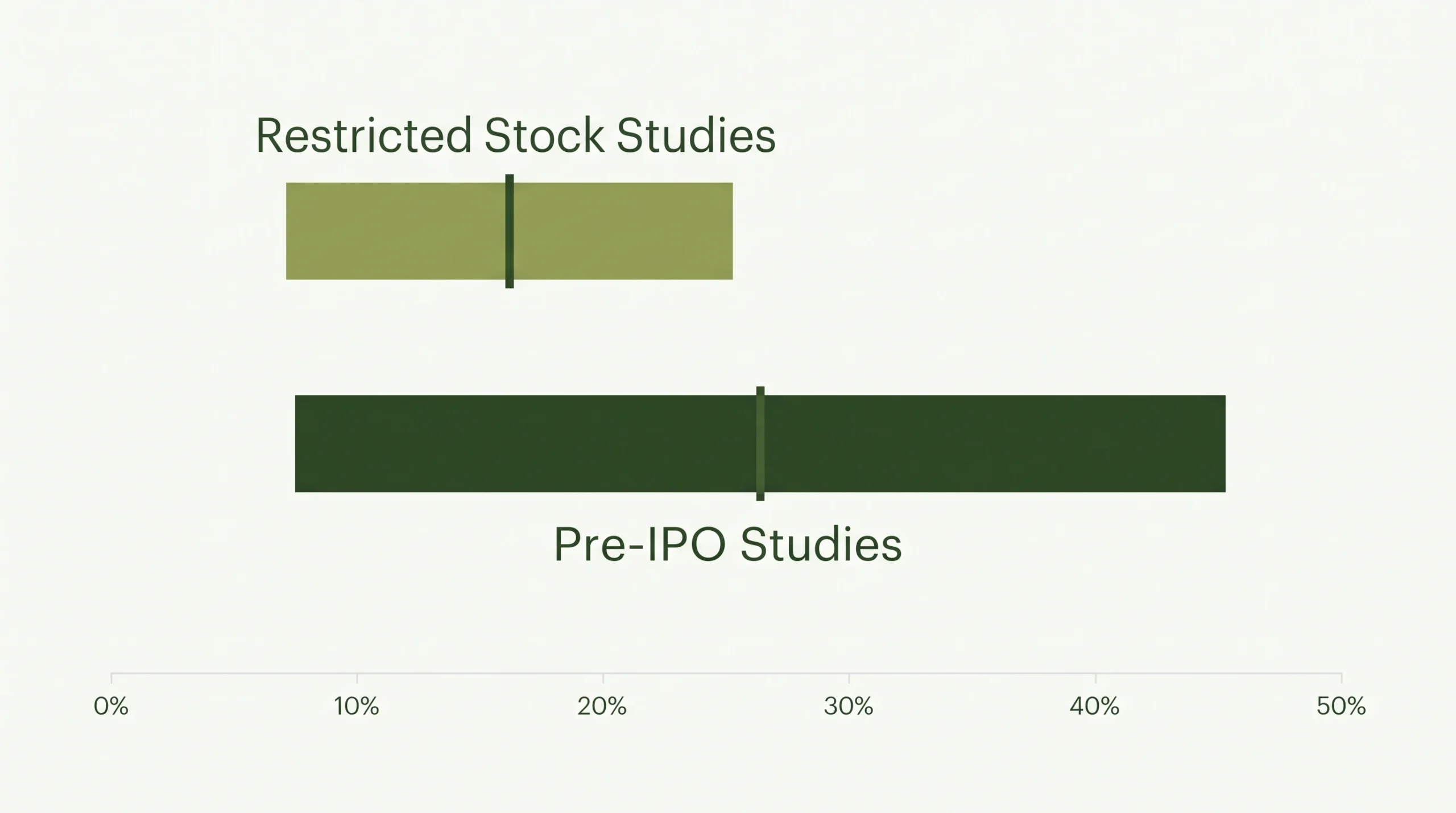
How Do Pre-IPO Studies Differ?
Pre-IPO studies differ because they use private sales, not public restricted shares. Each one looks at trades in a company’s stock in the months before it goes public. It then compares that private price to the later IPO price. The gap stands in for the discount. This method holds a risk that restricted stock studies miss. The deal may never reach the public market at all.
That extra risk tends to push pre-IPO discounts higher. Weaker financial reporting adds to the doubt. Because of this event risk, appraisers read pre-IPO data with care and rarely use it alone. Sofer Advisors weighs both study types against the growth stage of the interest. The discount then fits a mature firm or a pre-IPO one, not a blended guess.
What Factors Drive the Size of a DLOM?
The main drivers of a DLOM are the holding period, volatility, size, and dividend policy. A longer wait to sell raises the discount. Thin dividends offer no cash to offset the wait, so they push it up. Small firms with limited reporting often carry the widest discounts.
Courts group these drivers into a checklist known as the Mandelbaum factors:
- Financial statement quality and the firm’s earnings history
- Dividend policy and the cash return to holders
- The nature of the company, its outlook, and its position
- Management strength and any resale restrictions on the shares
- The size of the block and the cost of a future public sale
The list keeps the work honest, but a checklist alone does not set a number. Each factor must connect to the study evidence and to the facts of the subject firm. USPAP, the standard from The Appraisal Foundation, requires that link to be shown. Sofer Advisors documents how each factor moves the rate up or down. This is the Heart of a Teacher approach the firm brings to every job: show the owner the reasoning, not just the result.
How Do Quantitative Models Like the QMDM Work?
Quantitative models size a DLOM from a few forward inputs rather than past deals. The best known is the Quantitative Marketability Discount Model, or QMDM. It treats the private interest as a cash flow you must hold for a set span of years. You feed in the holding period, the growth in value, any dividend, and the return an investor wants. The model then solves for the discount that gap implies.
The strength is that it ties the discount to the specific interest, not a broad average. A three-year hold with a solid dividend yields a smaller discount than a ten-year hold with none. The weakness is that the output depends on the inputs. Weak assumptions give a weak answer, so good practice pairs the model with study data as a check. Sofer Advisors runs both, then reconciles them into one defensible range.
How Do You Defend a DLOM to the IRS or Court?
You defend a DLOM by linking the chosen rate to the real facts of the company, not a generic average. A strong report cites more than one study, explains why the sample fits, and walks through each Mandelbaum factor. It shows how the holding period and volatility shaped the final number. The AICPA SSVS and USPAP both call for this clear audit trail, so a reviewer can follow every step.
A vague discount invites challenge, and the IRS or an opposing expert will test it. This is where The Sofer Difference matters. It is a four-phase process of Discovery, Diligence, Analysis, and Delivery that produces an audit-ready report. Large firms such as Alvarez and Marsal or Kroll aim that rigor at enterprise clients. Sofer Advisors brings it to middle-market owners, backed by a full W2 team of 14 and 11+ expert witness cases across Georgia, Florida, California, and New Mexico. The goal is a discount that holds up when someone pushes back.
Frequently Asked Questions
What is a typical DLOM percentage?
A DLOM usually falls between 20 and 30 percent, though the facts of a case can move it well past that band. Restricted stock studies set the base range, and the specific factors adjust it. A firm with a short hold and steady dividends sits lower. A small, volatile firm with no payout sits higher. Sofer Advisors sets the figure from study data plus the real profile of the interest.
How do restricted stock studies measure the discount?
Restricted stock studies compare a public share to a restricted share of the same company. The restricted share carries a resale ban, so it sells for less in a private placement. That gap is the discount, drawn from actual deals. Because both shares hold one set of assets, the comparison is clean. Analysts then adjust for holding period and volatility to fit the subject firm.
How are pre-IPO studies different?
Pre-IPO studies use private sales that happen before a company goes public. They compare that early price to the later public offering price. Restricted stock studies, by contrast, use public firms whose shares carry a temporary ban. Pre-IPO data adds event risk, since the offering may never occur. Sofer Advisors uses both study types to triangulate a discount that suits a client’s growth stage.
What is the QMDM?
The QMDM, or Quantitative Marketability Discount Model, sizes a DLOM from forward inputs. It uses the expected holding period, growth in value, any dividend, and the return an investor wants. From those, it solves for the discount the interest implies. The model ties the number to the specific stake rather than a broad average. Sofer Advisors runs it as a cross-check against the study data for a fuller view.
What is SEC Rule 144?
SEC Rule 144 lets holders of restricted securities sell them publicly once they meet set holding periods and volume limits. Until those terms are met, the shares cannot trade freely, which creates the illiquidity a DLOM measures. Private shareholders face a similar lockup with no ready market. Sofer Advisors shows how these timing and volume limits translate into the discount on a private interest.
Does every private valuation need a DLOM?
Not every valuation needs a separate DLOM. Some income approach methods fold liquidity risk into the discount rate itself. But a market approach uses prices from liquid public deals, so a marketability adjustment is standard there to reach fair market value. The right call depends on the method and the purpose of the work. Sofer Advisors decides this for each engagement based on the standard of value in play.
Why can’t an owner just use an average discount?
An average discount ignores what makes a company unique. Two firms with the same earnings can carry different discounts once size, volatility, and dividends are weighed. Courts and the IRS look for a rate tied to specific, provable facts, not a round number. A generic figure is easy to attack and often fails review. Sofer Advisors builds each discount from the evidence so it stands up to scrutiny.
How much does a business valuation from Sofer Advisors cost?
A standalone DLOM analysis usually sits inside a full business valuation. Those jobs typically run from 7,500 to 25,000 dollars, depending on complexity and scope. Simpler work for planning or tax falls toward the lower end. Deals and litigation support need deeper work, so they fall higher. Contact Sofer Advisors for a fee quote matched to your situation.
Related Case Studies
- Holding Company Discounts: How DLOC and DLOM Apply to Holdcos
- Blockage Discounts: Valuing Large Stock Positions
- Revenue Ruling 93-12: Why Family Attribution Doesn’t Apply
Executive Summary
A DLOM lowers the value of a private interest because it cannot be sold fast. Restricted stock studies size the gap by comparing restricted shares to public shares of the same firm, and most results land between 20 and 30 percent, per DealStats deal evidence. Pre-IPO studies and the QMDM add supporting views. The final rate depends on holding period, volatility, size, and dividends, weighed through the Mandelbaum factors. A defensible discount ties that evidence to the specific company under IRS Revenue Ruling 59-60, USPAP, and the AICPA SSVS, so it holds up in a tax filing or a dispute.
What Should You Do Next?
Start by gathering recent financial statements and the terms that limit any resale of your shares. Then confirm the purpose of the work, since a discount for internal planning may not survive IRS or court review. Finally, insist on a rate that ties study data to your own facts, not a generic average.
For a discount you can stand behind, work with David Hern CPA ABV ASA. His W2 team of 14 has supported 11+ expert witness cases and earned 180+ five-star Google reviews. Schedule a consultation to size the DLOM for your interest.
People Also Read
About the Author
This guide was prepared by David Hern CPA ABV ASA, founder of Sofer Advisors, a business valuation firm headquartered in Atlanta, GA serving clients across the United States. David holds dual accreditations as an Accredited Senior Appraiser (ASA) and is Accredited in Business Valuation (ABV), credentials recognized by the IRS, SEC, and FINRA. He also holds the Certified Exit Planning Advisor (CEPA) designation. With 15+ years of valuation experience, David has served as an expert witness in 11+ cases across multiple jurisdictions and built Sofer Advisors into an Inc. 5000-recognized firm with 180+ five-star Google reviews. Its full W2 employee team maintains subscriptions to all major valuation databases and operates under a next business day response policy. For professional business valuation services, visit soferadvisors.com/about-us/ or contact Sofer Advisors at soferadvisors.com/contact-us/.
Disclaimer: This content is for informational purposes only and does not constitute professional valuation advice. Business valuation conclusions depend on specific facts and circumstances. Contact Sofer Advisors for guidance regarding your specific situation.









