


Last Updated: September 2026
A rebuttal business valuation of an opposing expert reviews the other side’s report and tests it for errors and weak support. It does not start over with a new opinion of value. It checks the choices the other expert made and shows where the work breaks down. The most common weak spots are normalization, the discount rate, the guideline companies, and the discounts applied.
In most disputes, both sides hire their own valuation expert. The two reports often reach very different values for the same company. A rebuttal helps counsel and the court see which choices hold up. This guide is a checklist of where opposing valuations fail and how a rebuttal exposes each flaw.
Sofer Advisors provides neutral, third party valuation analysis for litigation counsel across the United States. With 180+ five-star Google reviews and 15+ years of valuation work, the firm brings court tested experience to disputes. Its analysts have served as expert witness in 11+ cases across multiple jurisdictions.
Key Takeaways
- A critique tests reliability: it checks the opposing valuation for errors, not for a new number.
- Normalization is the first target: owner pay, one-time items, and related-party charges go wrong or run one-sided.
- The discount rate hides flaws: wrong risk premiums, a rate that does not match the cash flow, and unsupported company-specific risk.
- Comps and discounts get cherry-picked: non-comparable guideline companies and unsupported DLOM or DLOC percentages.
- Standards decide weight: tying each flaw to SSVS, USPAP, and FRE 702 shows why the opposing opinion is less reliable.
What does a rebuttal business valuation of an opposing expert test?
A rebuttal tests whether the opposing expert’s report is reliable, supported, and internally consistent. At every step it asks one question: is this choice backed by facts, data, and accepted method? The analyst checks the standard of value, the valuation date, the approach, and each major input. Where an input rests on a guess or a one-sided assumption, the rebuttal flags it and shows the effect on the value.
The goal is to test the work, not to attack the person. A good critique stays factual and points to specific pages, numbers, and sources. Our guide to expert witness business valuation covers how counsel and analysts prepare this testimony.
How is a critique different from an independent valuation?
A critique tests the other report, while an independent valuation reaches its own opinion of value. A critique focuses on the opposing expert’s method and inputs and measures how reliable they are. An independent valuation ignores the other report and builds a fresh number from the analyst’s own data. Many disputes call for both, so the analyst can show the flaws and also offer a defensible value.
Knowing which one you need matters for cost and strategy. A limited critique may be enough to support a motion that asks the court to limit or exclude weak testimony. A full re-valuation gives the court a competing number to weigh. The right path depends on the facts.
Where do opposing valuations most often fail?
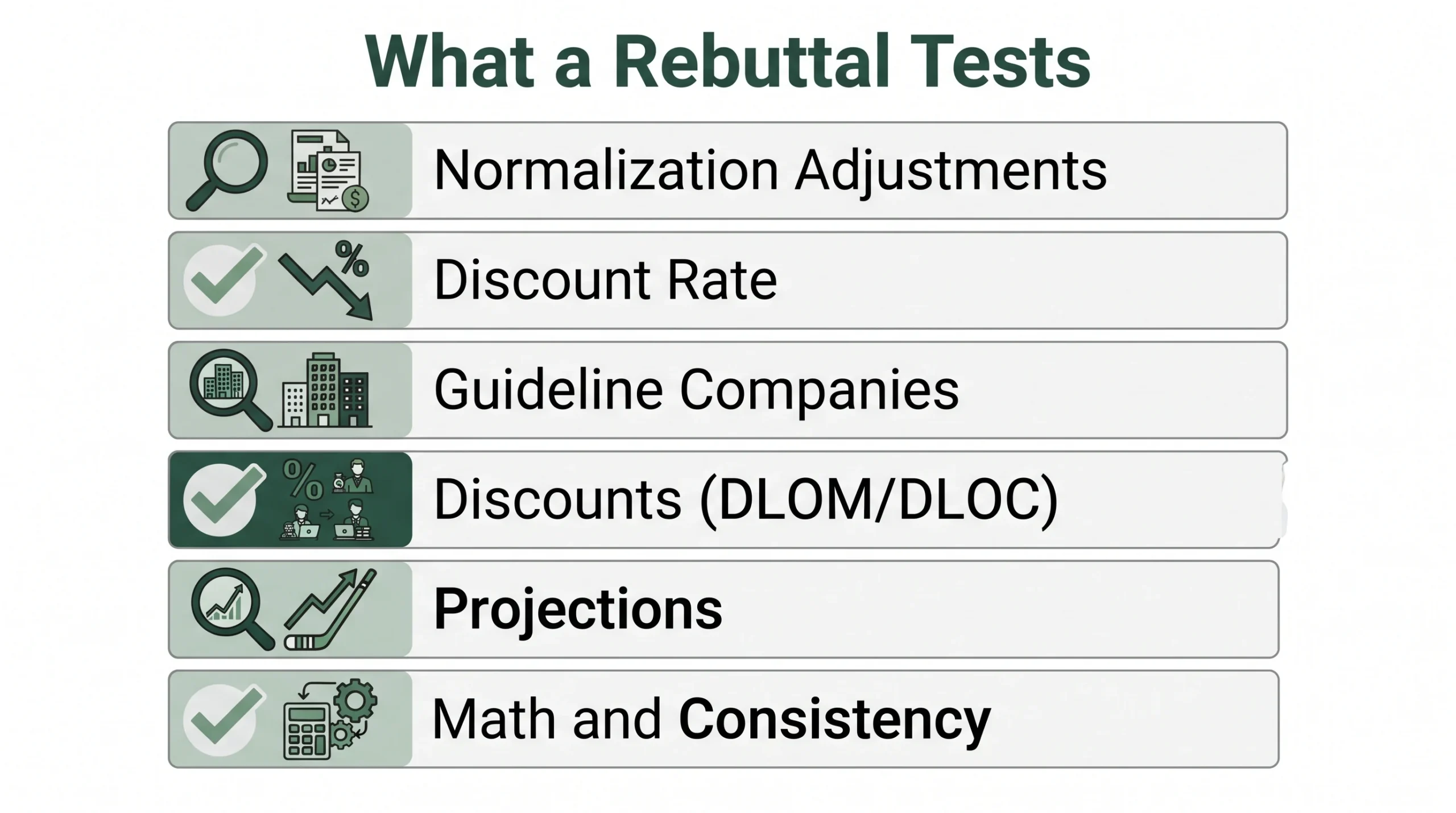
Opposing valuations most often fail at a short list of predictable points that appear across disputes. The recurring failure points are:
- Normalization adjustments: owner compensation, one-time or discretionary items, and related-party charges added back wrong or applied to only one side.
- Discount rate or cap rate build-up: wrong risk premiums, a rate that does not match the cash flow, or company-specific risk with no support.
- Guideline company selection: comps that are cherry-picked, not truly comparable, or based on stale multiples.
- Discounts: DLOM or DLOC applied where they do not belong, at unsupported percentages, or against the wrong standard of value.
- Projections and growth: assumptions that do not match the facts or the value as of the valuation date.
- Math and internal consistency: formula errors, mismatched inputs, and numbers that do not tie across the report.
How does a rebuttal test normalization and the discount rate?
A rebuttal tests normalization by checking each add-back for support and fair treatment of both sides. Normalization should show the company’s true, recurring earnings. Problems appear when the opposing expert adjusts owner pay to fit the answer they want, or removes costs that are not really one-time. An approach that only helps their own client is a sign of bias. The analyst checks each add-back against source documents and market pay data. Our guide to normalized EBITDA explains how these adjustments should work.
The discount rate hides some of the most common errors. A rebuttal checks the build-up piece by piece. It confirms the risk-free rate, the equity risk premium, the size premium, and any company-specific risk premium. Many reports add a large company-specific premium with no support, which lowers value unfairly. The rate must also match the cash flow, so an after-tax rate paired with pre-tax cash flow is a basic mismatch. Our overview of WACC in business valuation shows how these pieces fit together. The table below lists the top test points.
| Test point | What a rebuttal checks | Common flaw |
| Normalization | Support for each add-back; both sides treated the same | Owner pay set to fit the answer; one-sided adjustments |
| Discount rate | Each premium in the build-up; rate matches the cash flow | Unsupported company-specific risk; rate and cash flow mismatch |
| Guideline companies | True comparability; current multiples; selection method | Cherry-picked or stale comps that are not alike |
| Discounts | Basis for DLOM or DLOC; percentage support; standard of value | Discounts applied where they do not belong |
| Projections | Fit with facts and the valuation date | Growth that the record does not support |
| Math and consistency | Formulas, inputs, and numbers that tie across the report | Errors and figures that do not match |
How does a rebuttal challenge guideline companies and discounts?
A rebuttal challenges guideline companies by testing whether the comps are truly alike and current. The market approach only works when the comparable companies or deals match the subject in size, growth, risk, and industry. A common flaw is a set of comps chosen to push value up or down, not because they fit. The analyst reviews the selection method, checks the multiple dates, and asks whether stale deals still fit the valuation date. Our guide to the DCF method shows how the income approach can cross-check weak comps.
Discounts are the next target. A rebuttal tests whether a discount for lack of marketability or lack of control even applies to the interest being valued. It then checks the percentage against the studies the expert cites, since many reports pick a number with thin support. The discount also has to match the standard and level of value, so applying a minority discount to a controlling interest is a clear error. Our overview of the marketability discount covers how these should be supported. Each finding feeds conflict resolution and litigation support work.
How does a rebuttal connect to standards and admissibility?
A rebuttal connects each flaw to professional standards and to the rules that govern reliable testimony. When an opposing report skips a step the AICPA valuation standards require, the rebuttal points to the gap. The same is true for the Uniform Standards of Professional Appraisal Practice, which many analysts follow. A report that ignores these standards is easier to discount.
Reliability rules matter just as much. Under Federal Rule of Evidence 702 and the Daubert line of cases, the judge acts as a gatekeeper. The court asks whether the testimony rests on enough facts, uses sound method, and applies that method with care. A rebuttal that shows unsupported inputs and method errors gives counsel the record to argue that the other opinion should carry less weight. Whether a court excludes or limits testimony depends on the facts and the rules of each jurisdiction, so this guide does not give legal advice. The American Society of Appraisers sets the discipline standards a critique relies on. Our guide to USPAP compliance covers what makes a valuation court defensible.
Which firm should critique an opposing valuation?
The best firm to critique an opposing valuation is an independent one with court tested credentials and no stake in the deal. Large firms like Alvarez & Marsal, Stout, and Kroll serve the biggest matters, while a focused firm gives senior level attention on every engagement. The Sofer Difference runs through four stages: Discovery, Diligence, Analysis, and Delivery. The firm applies a “Heart of a Teacher” approach and explains each flaw in plain terms a judge and jury can follow.
| Provider type | Service focus | Fit for a rebuttal |
| Sofer Advisors | Neutral critique and, if needed, an independent re-valuation | Senior involvement; court tested testimony |
| Large advisory firm | Enterprise deals and broad consulting | Strong depth; often junior staff on the file |
| Regional CPA firm | Tax and audit with valuation as a side service | Varies; may lack litigation depth |
An independent firm gives a critique that counsel can defend, because its fee does not depend on the outcome. Our look at forensic accounting in business valuation shows when a critique must trace the numbers to their source.
The questions below cover what counsel and owners ask most.
Frequently Asked Questions
What is a rebuttal valuation report?
A rebuttal valuation report is a written critique of an opposing expert’s valuation. It tests the other report’s method, inputs, and math for errors and weak support, then explains how each problem affects the final value. It may stand alone or come with an independent re-valuation.
How do you challenge an opposing expert’s business valuation?
You challenge an opposing valuation by testing each major choice against the facts and accepted method. The review covers the standard of value, normalization, the discount rate, the guideline companies, and the discounts. Where an input rests on a guess or a one-sided assumption, the critique flags it and cites the specific pages and numbers.
How do you challenge a discount rate?
You challenge a discount rate by checking the build-up one piece at a time. The review confirms the risk-free rate, the equity risk premium, the size premium, and any company-specific risk premium. A large company-specific premium with no support is a common flaw. It also confirms the rate matches the cash flow, since a mismatch skews the value.
What is the difference between a critique and an independent re-valuation?
A critique tests the opposing report, while an independent re-valuation builds a fresh opinion of value. A critique measures how reliable the other work is and where it fails. A re-valuation reaches its own number. Many disputes use both, so counsel can show the flaws and offer a defensible value.
How do you challenge an expert witness?
You challenge an expert witness by focusing on the reliability of the method, not on the person. The critique shows where the analysis lacks support, uses the wrong standard, or contains errors that do not tie together. Counsel can use these findings on cross-examination and in a motion under the court’s reliability rules.
How do you discredit an expert witness in a valuation dispute?
You test the work, and the record does the rest. A rebuttal points to unsupported inputs, cherry-picked comps, and math that does not hold up, and ties each flaw to a standard the expert should have followed. A fact based critique carries more weight than a personal attack.
How much is a business worth with $500,000 in sales?
A business with $500,000 in sales does not have a fixed value, because sales alone do not set worth. Value depends on profit, growth, risk, and the assets in the business. An analyst normalizes earnings and applies the right method to reach a defensible range.
How much is a business worth that makes $300,000 a year?
A business that earns $300,000 a year is valued on that profit, its risk, and its growth, not on a single rule of thumb. The analyst normalizes the earnings, picks a suitable multiple or discount rate, and checks the result against the market. The value reflects how stable and transferable that $300,000 really is.
How much does a rebuttal valuation from Sofer Advisors cost?
A rebuttal or critique from Sofer Advisors falls under its Standard Business Valuation range of $7,500 to $25,000. A limited scope critique that reviews the other report without a full re-valuation can sit at the lower end. Courtroom testimony is billed separately as expert witness work at an hourly rate. For a quote tied to your matter, request a consultation with the opposing report and case details.
Related Case Studies
- Shareholder Dispute Valuation: Resolving Business Partner Conflicts
- Business Divorce in Georgia: Fair Distribution and Valuation
- Minority Oppression: Valuing a Squeezed-Out Shareholder Stake
Executive Summary
A rebuttal reviews an opposing expert’s report and tests it for errors and weak support rather than starting a fresh opinion. The recurring failure points are predictable: wrong or one-sided normalization, an unsupported discount rate, cherry-picked guideline companies, misapplied discounts, unsupported projections, and math that does not tie. A critique tests reliability; a re-valuation reaches its own number; many disputes need both. Each flaw ties back to standards like SSVS and USPAP and to reliability rules like FRE 702. Admissibility depends on the facts and the jurisdiction, so a critique frames the issues without giving legal advice.
What Should You Do Next?
Start by gathering the opposing expert’s full report, its exhibits, and the source documents behind the numbers. Next, have an independent analyst run the checklist: normalization, discount rate, guideline companies, discounts, projections, and internal math. Then decide whether a critique alone supports your motion, or whether you also need a re-valuation to give the court a competing number.
David Hern CPA ABV ASA, founder of Sofer Advisors, provides neutral, court tested critiques and valuations for litigation counsel. Schedule a consultation to discuss your case.
People Also Read
- Economic Damages Expert Witness: When Litigators Hire One
- Minority Interest and Marketability Discounts Guide
About the Author
This guide was prepared by David Hern CPA ABV ASA, founder of Sofer Advisors, a business valuation firm headquartered in Atlanta, GA serving clients across the United States. David holds dual accreditations as an Accredited Senior Appraiser (ASA) and is Accredited in Business Valuation (ABV), credentials recognized by the IRS, SEC, and FINRA. He also holds the Certified Exit Planning Advisor (CEPA) designation. With 15+ years of valuation experience, David has served as an expert witness in 11+ cases across multiple jurisdictions and built Sofer Advisors into an Inc. 5000-recognized firm with 180+ five-star Google reviews. Its full W2 employee team maintains subscriptions to all major valuation databases and operates under a next business day response policy.
For professional business valuation services, visit soferadvisors.com/about-us/ or contact Sofer Advisors at soferadvisors.com/contact-us/.
Disclaimer: This content is for informational purposes only and does not constitute professional valuation advice. Business valuation conclusions depend on specific facts and circumstances. Contact Sofer Advisors for guidance regarding your specific situation.









