


Last Updated: June 2026
Forensic accounting and business valuation are not the same. But they often work in the same courtroom. A forensic accountant checks financial records for fraud. A business valuator finds what a company is worth. When the books are unreliable, no valuation is accurate. Forensic work must come first.
That gap matters in contested cases. A valuation based on false records can misstate a company’s worth by millions. Attorneys, CPAs, and business owners in divorce, shareholder disputes, or M&A need to know when forensic work must come before, or run with, a valuation. Sofer Advisors helps owners and their advisors work through exactly these questions and turn the analysis into a defensible business valuation they can act on.
This guide covers the difference between these two fields. It covers when both are required, how forensic findings affect valuation results, and what credentials matter most.
The following takeaways summarize the key valuation and transaction factors covered in this guide.
Key Takeaways
- Forensic Accounting Checks Fraud – Forensic accounting checks for fraud. Business valuation finds fair market value. Both often run together in disputes.
- Hidden Assets Divorce Shareholder – Hidden assets in divorce, shareholder disputes, and M&A fraud all require forensic work first.
- Forensic Accountant Values New – A forensic accountant values a new business differently. No earnings history pushes analysis toward asset-based and market methods.
- Courts Expect Experts Keep – Courts expect experts to keep forensic findings separate from valuation results. Mixing the two hurts credibility.
- 3x Profit Rule Market – The “3x profit” rule is market shorthand. It ignores risk, growth rate, working capital, and asset base.
- Business 500000 Revenue Might – A business with $500,000 in revenue might be worth $150,000 to $2.5M+ depending on margins and industry.
Each of these factors is examined in depth in the sections that follow.
What Is the Difference Between Forensic Accounting and Business Valuation?
Forensic accounting applies accounting and investigative methods to legal disputes. A forensic accountant rebuilds financial records and traces cash flows. They find hidden assets and measure theft losses. They prepare findings for court. The work starts with suspicion, something in the numbers is off.
Business valuation finds the economic value of a business. It uses a defined standard of value, fair market, fair value, or investment value, and recognized methods. A valuator is not an investigator. They take financial records as given, unless forensic work has already restated them.
The credentials differ too. Forensic accountants often hold the CFE or CFF. Business valuators hold the ABV or CVA. Some hold both. This positions them well for complex disputes. Each credential signals a different set of skills. Courts weigh those differences carefully when reviewing expert testimony in disputes.
Firms like EisnerAmper, GRF CPAs, and Kaufman Rossin offer both services. The key is that the expert can explain clearly where forensic findings end and valuation results begin.
Engagements like this are performed under the AICPA Statement on Standards for Forensic Services, which sets enforceable standards for litigation and investigative work.
When Do You Need Both Forensic Accounting and Business Valuation?
Several cases require both:
- Divorce with suspected hidden assets. When one spouse controls the books, there is a chance to hide income or inflate expenses. A forensic accountant traces owner pay, related-party deals, personal costs run through the business, and cash revenue. Once adjusted, a valuator applies the right method to find the marital share.
- Shareholder disputes. A minority shareholder claiming the majority diverted value needs forensic work to document the diversion. A valuation then measures the economic harm.
- M&A due diligence fraud. When a buyer finds post-close that a seller manipulated revenue or hid debts, both are needed. Forensic work proves the misrepresentation. Valuation measures the difference between the price paid and true worth.
- Business interruption insurance claims. After a covered event, the insured must show prior financial performance was real (forensic review) and project lost earnings during the interruption (damages analysis).
- Embezzlement and economic damages. When an employee steals, forensic work measures the theft. If theft hurt business growth, a valuator may also estimate lost value.
What Does a Forensic Accountant Find That Changes a Valuation?
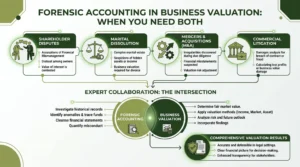
The most common forensic findings that affect valuation include:
- Hidden revenue. Cash-based businesses sometimes underreport sales. A forensic accountant uses indirect methods to rebuild true revenue. Higher revenue, once adjusted, raises valuation.
- Inflated expenses. Personal costs run through the business reduce reported earnings. These are added back. At a 5x multiple, $100,000 in addbacks raises value by $500,000.
- Related-party deals at non-market terms. Rent paid to a related entity above market rates distorts the income statement. These must be restated before applying valuation multiples.
- Revenue manipulation. In M&A, sellers sometimes accelerate revenue near a close date to inflate trailing EBITDA. Forensic analysis of shipping records and customer contracts can expose this.
| Forensic Finding | Valuation Impact | Typical Direction |
|---|---|---|
| Undisclosed cash revenue | Raises normalized EBITDA | Value up |
| Personal expenses in business | Raises normalized EBITDA (addback) | Value up |
| Above-market related-party rent | Raises normalized EBITDA | Value up |
| Accelerated revenue recognition | Lowers quality-of-earnings EBITDA | Value down |
| Contingent liabilities not disclosed | Raises total enterprise risk | Value down |
| Undisclosed debt | Reduces equity value directly | Value down |
How Does a Forensic Accountant Value a New Business?
A new business is a specific challenge. There is no reliable earnings history for an income approach. This is where forensic and valuation work overlap in startup disputes and fraud cases.
Without earnings history, the valuator relies on:
- Asset-based approach. The net asset value of what was invested, equipment, IP, technology, customer lists, minus debts. This sets a floor for value. But it often understates the going-concern premium for a business with traction.
- Market approach using guideline deals. If similar early-stage companies in the same sector have sold at revenue or asset multiples, those benchmarks can be applied. This requires solid comparables, which may be limited for niche businesses.
- Projected income approach with high discount rates. A startup DCF uses projected cash flows. But it applies risk-adjusted discount rates of 25%–50% or more. Courts review these projections closely. They must be grounded in signed contracts or market research, not hope.
In forensic cases involving a new business, the valuator must also address causation. Would the business have succeeded but for the wrongdoing? Courts have rejected projections that assume perfect results.
David Hern CPA ABV ASA, founder of Sofer Advisors, brings a Heart of a Teacher to every engagement – translating complex valuation methodology into clear, actionable guidance that clients can act on before and after the report is delivered. With 15+ years of valuation experience, 11+ expert witness cases across multiple jurisdictions, and 180+ five-star Google reviews, David built Sofer Advisors into an Inc. 5000-recognized firm. The Sofer Difference is a four-phase process of Discovery, Diligence, Analysis, and Delivery that ensures every conclusion is defensible, documented, and tied to the specific facts of the business.
While national firms like Stout and Kroll serve large enterprise clients, Sofer Advisors specializes in middle-market businesses that require personalized attention, direct access to credentialed professionals, and a next business day response policy.
Is a Business Worth 3 Times Profit? The Rule of Thumb Problem
The “3x profit” rule is common in small business brokerage. It is not entirely wrong, but it is not valuation. It is a starting point at best.
EBITDA multiples in the lower middle market typically range from 3x to 6x. A manufacturing firm with $500K in EBITDA and single-customer risk might fetch 3x. A SaaS firm with 90% gross margins and recurring revenue might command 8x–10x.
For a business with $500,000 in total revenue, value is highly context-dependent. If that $500K generates $150K in seller’s discretionary earnings (SDE), a 2.5x–3.5x SDE multiple yields $375K–$525K. A fast-growing tech or healthcare business at that level could attract buyers willing to pay 1x–3x revenue, pushing value to $500K–$1.5M+.
The rule of thumb ignores working capital needs, capital costs, debt structure, and key-person risk. No credentialed appraiser signs a report based on a multiple alone.
How Are Forensic and Valuation Experts Used in Court?
Courts qualify forensic accountants and business valuators as expert witnesses under Federal Rule of Evidence 702. Testimony must be based on sufficient facts, reliable method, and proper application.
The standard for valuations in court is clear. Experts must follow recognized methods and disclose their assumptions. They must also hold up to cross-examination. Forensic accountants face the same standard. Their methods must be explained and defended.
One recurring issue: the same expert doing both forensic and valuation work. Courts do not ban dual-role experts. But opposing counsel will challenge the independence of results when one person did both. Using separate experts, or having forensic work hand off clean restated financials to the valuation expert, creates cleaner testimony.
Sofer Advisors provides valuation support in litigation. This includes shareholder disputes, divorce, and commercial damages cases. Our team works with forensic accountants and legal counsel to deliver valuation results grounded in the financial record.
The questions below address the most common issues attorneys raise before engaging a qualified appraiser for a forensic accounting business valuation engagement.
Frequently Asked Questions
What credentials should I look for in a forensic accounting and valuation expert?
Look for the CFF or CFE for forensic work, and CVA or ABV for valuation. Dual-credentialed professionals exist but may raise independence issues in litigation.
How much does a combined forensic accounting and valuation engagement cost?
Costs vary by complexity. A contested divorce valuation with forensic reconstruction of a closely held business typically runs $15,000–$60,000. This depends on the number of entities and years reviewed. Shareholder litigation can exceed $100,000 when multiple depositions are involved.
How does a forensic accountant value a business differently than a standard valuator?
A forensic accountant first checks the integrity of the financial record. They restate income, find hidden assets, and note irregularities. The valuation then applies recognized methods to the restated data. In standard engagements, the valuator takes financials at face value with limited adjustments.
What is the best way to prepare for a forensic valuation in a shareholder dispute?
Keep all financial records, including QuickBooks files, bank statements, and related-party contracts, for at least five years before the dispute date. Engage counsel early and retain a valuation expert before depositions are set.
Can forensic findings increase the value of a business?
Yes. If forensic work finds understated revenue or addbacks not yet in the financials, restated EBITDA will be higher. This commonly occurs in divorce cases where an owner has been hiding taxable income.
What is the standard of value used in litigation valuations?
The standard depends on the legal case. Divorce often uses “fair value” as defined by state law, which may not allow minority discounts. M&A fraud and commercial damages cases typically use “fair market value.” The standard directly affects the result.
How does forensic work affect EBITDA multiples?
Forensic adjustments affect the quality-of-earnings score. This influences the multiple a buyer or court will apply. A business with restated EBITDA showing better reliability may command a higher multiple. A business where revenue was inflated will see both the base and multiple fall.
Is the 3x profit rule accurate for small businesses?
It is roughly right for some main-street businesses but not for services, healthcare, tech, or businesses with high recurring revenue. A credentialed valuation will nearly always produce a more defensible result.
How long does a forensic accounting investigation take?
Simple reconstruction of a closely held business with clean records can take four to eight weeks. Complex multi-entity structures or uncooperative parties can extend work to six months or more.
Do Georgia courts accept forensic-valuation hybrid expert testimony?
Georgia courts follow the Daubert standard. Experts must show their method is reliable and applied properly. Forensic and valuation experts testify regularly in Georgia courts. Rigorous records of assumptions and methods are the key.
Related Case Studies
- Expert Witness Business Valuation Georgia What Attorneys Need To Know
- Shareholder Dispute Valuation Atlanta Resolving Georgia Business Partner Conflicts
- Divorce Business Valuation Georgia What Business Owners Need To Know
Executive Summary
- Forensic accounting and business valuation are both required in divorce, shareholder disputes, M&A fraud, and insurance claims.
- Forensic findings – hidden revenue, inflated expenses, related-party deals – directly affect normalized EBITDA and the valuation result.
- New businesses without earnings history require asset-based or market approaches, often with high risk-adjusted discount rates.
- Courts require expert testimony grounded in reliable method. Dual-role forensic/valuation experts face scrutiny over independence.
What Should You Do Next?
If you are in a dispute, divorce, or M&A deal where the integrity of financial records is in question, engage a credentialed valuation expert before depositions are taken. David Hern CPA ABV ASA, founder of Sofer Advisors, holds dual ASA and ABV credentials recognized by the IRS, SEC, and FINRA, with 15+ years of valuation experience and 180+ five-star Google reviews. Schedule a consultation to discuss your business valuation needs.
People Also Read
- Why You Must Start Planning Your Business Exit Now With The Right Valuation Expert
- What To Expect During A Business Valuation Step By Step Process
About the Author
This guide was prepared by David Hern CPA ABV ASA, founder of Sofer Advisors – a business valuation firm headquartered in Atlanta, GA serving clients across the United States. David holds dual accreditations as an Accredited Senior Appraiser (ASA) and is Accredited in Business Valuation (ABV), credentials recognized by the IRS, SEC, and FINRA. He also holds the Certified Exit Planning Advisor (CEPA) designation. With 15+ years of valuation experience, David has served as an expert witness in 11+ cases across multiple jurisdictions and built Sofer Advisors into an Inc. 5000-recognized firm with 180+ five-star Google reviews. The firm’s full W2 employee team maintains subscriptions to all major valuation databases and operates under a next business day response policy.
For professional business valuation services, visit soferadvisors.com/about-us/ or schedule a consultation at soferadvisors.com/contact-us/.
This content is for informational purposes only and does not constitute professional valuation advice. Business valuation conclusions depend on specific facts and circumstances. Contact Sofer Advisors for guidance regarding your specific situation.









