


Last Updated: June 2026
When a valuation faces a legal challenge, attorneys ask one question first: did the appraiser follow USPAP? A report that skips required disclosures or leaves assumptions undocumented can be thrown out on procedural grounds. Sofer Advisors, based in Atlanta, GA, builds every valuation to USPAP standards from the first draft. That protects clients in litigation, IRS review, and any high-stakes transaction.
A USPAP compliance business valuation is an appraisal prepared under the Uniform Standards of Professional Appraisal Practice. These are the national ethics and performance rules for all professional appraisers in the United States. The Appraisal Foundation publishes and maintains these standards. Courts, the IRS, and federal agencies use USPAP to judge whether a valuation holds up. A report that fails USPAP can be excluded before a judge reads the financial analysis inside.
This article is for business owners, attorneys, and advisors who need a defensible valuation for court, estate planning, or a regulated transaction. After reading, you will know what USPAP requires, how reports are structured, and what to ask an appraiser before signing an engagement letter.
Key Takeaways
- USPAP Is the National Standard – All federally regulated appraisals require USPAP compliance, as authorized by Congress in 1989 through the Appraisal Foundation.
- Two Report Types Exist – Appraisal Reports give full detail for third-party use; Restricted Appraisal Reports limit use to the named client only.
- Market Value Has a Definition – USPAP requires a willing buyer, willing seller, reasonable exposure time, and no compulsion on either side.
- Scope of Work Must Be Documented – Every report must state the client, intended use, standard of value, and effective date before any conclusion is drawn.
- Independence Is Required – USPAP bans fees based on the value conclusion and requires disclosure of any prior services tied to the business being valued.
Each rule shapes how a valuation is built and how it performs under review. The sections below examine each in detail.
What Valuations Must Follow USPAP?
Any appraisal tied to a federally regulated transaction must comply with USPAP. This covers estate and gift tax filings, ESOP transactions, SBA loan applications, and business appraisals offered as expert testimony. State courts apply USPAP as a reliability benchmark too, even when not strictly required.
The American Society of Appraisers and the AICPA require USPAP compliance for appraisers holding the ASA and ABV credentials. These credentials are what courts check first when a report is challenged. An appraiser without them faces questions about methodology.
Here are the main situations where USPAP compliance is required or expected:
- Estate and gift tax returns filed with the IRS under Treasury Regulation 1.170A-13
- ESOP valuations reviewed by the Department of Labor under ERISA
- SBA 7(a) and 504 loan applications involving business acquisitions
- Expert witness testimony in federal and most state court proceedings
- Financial reporting under ASC 805 (purchase price allocation) and ASC 350 (impairment testing)
The list above is not exhaustive. A buy-sell agreement valuation done today may face a shareholder dispute in three years. An appraiser who followed USPAP will have documentation and signed certifications that survive any examination. The cost of getting it right upfront is far less than correcting a deficient report after a challenge is filed.
What Does USPAP Say About Market Value?
USPAP defines market value as the most probable price in an open, competitive market. Both parties must act with full knowledge of the facts. Neither party can be under pressure to close the transaction. The property must have had reasonable exposure time before the sale.
Courts use these four conditions to test arm’s-length status. An appraiser who skips any one gives opposing counsel an easy challenge. A distressed seller or a private transaction changes the analysis and must be explained in the report.
The USPAP market value standard differs from the IRS standard under Revenue Ruling 59-60. That ruling adds eight factors for closely held business stock, including earning capacity and book value. A court-defensible tax valuation must satisfy both. The appraiser must explain how the analysis meets each one.
Departing from market value to investment value or fair value under state law is allowed under USPAP. But it requires full disclosure of the definition used, its source, and why it applies. Omitting that disclosure is one of the most common reasons appraisals fail in court. Resources like learn.appraisers.org cover how these standards apply across industries. The standard of value is the foundation of every number in the report.
Why Do USPAP Reports Fail Legal Review?
Most USPAP failures come from missing documentation, vague scope statements, and certifications that skip required language. Courts and the IRS use these gaps to disqualify reports without ever examining the substance.
Here is how compliant reports compare to deficient ones:
| Report Element | Compliant (USPAP Standard 10) | Common Deficiency |
|---|---|---|
| Scope of Work | Named client, intended user, value definition, effective date | Missing intended user or effective date |
| Approaches Addressed | All three considered; exclusions explained in writing | One approach only; no explanation for exclusions |
| Certification | Signed; includes independence and prior services disclosure | Prior services disclosure missing or unsigned |
| Assumptions | Disclosed and labeled as extraordinary assumptions | Assumptions stated without labeling them |
| Credentials | Full credential disclosure; supervising appraiser noted | Credentials omitted or incomplete |
Attorneys at firms like trumanmox.com cite USPAP gaps as grounds for motions to exclude valuation evidence. Every deficiency above has appeared in published court opinions. An appraiser holding both ABV and ASA designations has tested knowledge of each requirement. Fixing a deficient report after a motion is filed is costly and often impossible. The right time to close compliance gaps is before the engagement begins.
How Does USPAP Apply in Litigation?
Courts apply the Daubert standard to expert testimony. The judge checks two things: is the appraiser qualified, and is the methodology reliable? USPAP compliance addresses both. An appraiser who followed USPAP has documented methodology, disclosed assumptions, and a signed certification of independence. Courts examine all three on admissibility rulings.
David Hern CPA ABV ASA, founder of Sofer Advisors, has served as an expert witness in 11+ cases across multiple jurisdictions. That experience shapes how every report is written. Each sentence can be challenged. Every number must trace to a documented source or a stated assumption.
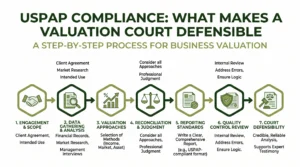
The Sofer Difference is the four-phase process of Discovery, Diligence, Analysis, and Delivery. Discovery identifies assignment conditions. Diligence gathers financial and operational data. Analysis applies the income, market, and asset approaches with complete documentation. Delivery produces a transparent, defensible report.
Larger firms like Kroll (formerly Duff and Phelps) serve enterprise clients. For middle-market businesses, the same rigor is available with direct access to the lead appraiser. David Hern brings a Heart of a Teacher to every court engagement. He breaks down EBITDA multiples, discounted cash flow, and goodwill into plain language that judges can follow.
When Is a Full Appraisal Report Required?
USPAP allows two report formats. An Appraisal Report includes full disclosure of all assumptions, data sources, and methods. Any intended user named in the report can rely on it. A Restricted Appraisal Report limits disclosure and restricts use to the named client only.
Courts, the IRS, and parties in regulated transactions require Appraisal Reports. A Restricted Report fits internal planning but not litigation, tax filings, or any engagement with third-party review.
Here is a quick guide to report format by purpose:
- IRS estate or gift tax filing: Full Appraisal Report required
- ESOP transaction (DOL review): Full Appraisal Report required
- Litigation and expert witness work: Full Appraisal Report required
- Internal strategic planning: Restricted Appraisal Report may be acceptable
- Buy-sell agreement (no pending dispute): Confirm with your appraiser based on agreement terms
Choosing the wrong report format at the start is a common and expensive mistake. Full Appraisal Reports are required for litigation, estate, tax, and transaction engagements. Restricted reports are appropriate only for internal planning. A signed engagement letter that specifies the report format protects both parties. Confirm the format in writing before work begins.
The questions below address common points of confusion about USPAP compliance in litigation, tax, and transaction settings.
Frequently Asked Questions
How much does a USPAP-compliant valuation from Sofer Advisors cost?
A USPAP-compliant business valuation from Sofer Advisors typically costs between $7,500 and $25,000. The price depends on business size, industry complexity, and the purpose of the engagement. Litigation and estate tax engagements often fall at the higher end. Most standard engagements complete in four to eight weeks. Rush engagements are available at a 25 to 50 percent premium. Schedule a free consultation to receive a scoped estimate for your specific situation.
Which type of valuation must be performed in accordance with USPAP?
Any appraisal used in a federally regulated transaction must follow USPAP. This includes estate and gift tax returns, ESOP valuations, SBA loan applications, and business appraisals introduced as expert testimony in court. Appraisers holding the ASA or ABV credential are bound by USPAP through their professional ethics codes. Most state courts apply USPAP as the reliability benchmark for business appraisals as well.
What is the rule of thumb for business valuation?
Rules of thumb use simple multiples of revenue or EBITDA to estimate value quickly. A common example is one times annual revenue for a professional services firm. USPAP does not ban rules of thumb, but they cannot substitute for a full appraisal. A compliant appraiser uses them only as a cross-check after completing the income, market, and asset approaches. Courts exclude reports that rely on a shortcut as the primary method.
What does USPAP say about market value?
USPAP defines market value as the most probable price in an open, competitive market. Both parties must act with knowledge of relevant facts. Neither can be under compulsion, and the property must have had reasonable exposure time. Courts use this definition to test arm’s-length status. An appraiser must address all four conditions in the written report. If any condition is absent, the appraiser must explain how that changes the conclusion.
What is the difference between USPAP Standard 9 and Standard 10?
USPAP Standard 9 governs appraisal development. It requires considering all three approaches to value and documenting the reasoning for any exclusion. Standard 10 governs the written report. It sets requirements for scope of work disclosure, assumptions, limiting conditions, and the signed certification. Both must be satisfied for a report to hold up in court or before the IRS. Failing either gives opposing counsel a basis to challenge admissibility.
Can a calculation of value satisfy USPAP for court use?
A calculation of value is allowed under USPAP but restricts the scope of work. The report must disclose those limits in writing. Courts and the IRS require a full Appraisal Report for litigation and tax filings. A calculation may work for internal planning or settlement. Using a calculation report for court is a mistake that forces a costly re-engagement. Confirm your report format in writing before the engagement starts.
What credentials should a USPAP-compliant business appraiser hold?
The two most recognized credentials are the ABV from the AICPA and the ASA from the American Society of Appraisers. Both require a rigorous exam, sample work review, and ongoing USPAP education. The IRS recognizes both for estate and gift tax appraisal purposes. Holding dual credentials provides broad coverage across IRS, SEC, FINRA, and court contexts. Verifying credentials before hiring an appraiser is basic due diligence.
What happens if a business appraisal is not USPAP compliant?
A non-compliant appraisal can be excluded from evidence in court. In tax matters, the IRS can impose a 20 to 40 percent accuracy-related penalty on top of unpaid tax. In ESOP transactions, the Department of Labor can challenge the deal and seek damages from trustees who relied on a deficient report. The cost of non-compliance almost always exceeds the cost of a credentialed, USPAP-compliant engagement from the start.
Related Case Studies
Sofer Advisors has applied USPAP standards across estate planning, litigation support, and M&A engagements. See detailed case examples at Business Valuation for Litigation Support, Estate Planning Business Valuation Georgia Gift Tax, and Business Valuation for ESOPs.
Executive Summary
USPAP compliance separates a defensible valuation from one that fails under scrutiny. Every court-bound, IRS-filed, or transaction-related appraisal must meet the Uniform Standards of Professional Appraisal Practice. Key requirements include a documented scope of work, a clear standard of value, an independent appraiser with no contingent fee, and a signed certification. Two report formats exist: Appraisal Reports for broad third-party use and Restricted Reports for named clients only. Courts disqualify reports that skip these steps. Sofer Advisors builds every engagement to full USPAP standards, backed by dual credentials and 180+ five-star Google reviews.
What Should You Do Next?
If you need a court-defensible valuation, confirm your appraiser holds a recognized credential (ABV, ASA, or CVA) and builds reports to full USPAP standards. Ask for a written scope of work before signing any engagement letter. Ask about prior expert witness experience.
David Hern CPA ABV ASA, founder of Sofer Advisors brings dual credentials, 11+ expert witness cases, and a next business day response policy to every engagement. Schedule a consultation to discuss your USPAP valuation needs.
People Also Read
- Estate Planning Business Valuation Georgia Gift Tax Compliance Guide
- Why You Must Start Planning Your Business Exit Now With The Right Valuation Expert
About the Author
This guide was prepared by David Hern CPA ABV ASA, founder of Sofer Advisors – a business valuation firm headquartered in Atlanta, GA serving clients across the United States. David holds dual accreditations as an Accredited Senior Appraiser (ASA) and is Accredited in Business Valuation (ABV), credentials recognized by the IRS, SEC, and FINRA. He also holds the Certified Exit Planning Advisor (CEPA) designation. With 15+ years of valuation experience, David has served as an expert witness in 11+ cases across multiple jurisdictions and built Sofer Advisors into an Inc. 5000-recognized firm with 180+ five-star Google reviews. The firm’s full W2 employee team maintains subscriptions to all major valuation databases and operates under a next business day response policy.
For professional business valuation services, visit soferadvisors.com or schedule a consultation.
This content is for informational purposes only and does not constitute professional valuation advice. Business valuation conclusions depend on specific facts and circumstances. Contact Sofer Advisors for guidance regarding your specific situation.