


Last Updated: June 2026
This article is for minority shareholders, their legal counsel, and business owners who want to understand how a squeezed-out stake is valued. By the end, you will know which methods apply, how courts treat discounts, what triggers a required appraisal, and how to choose the right expert.
A minority oppression valuation is the process of finding the fair value of a shareholder’s interest after that owner has been forced out, frozen out, or harmed by the controlling owners of a private company. Courts and mediators rely on this figure to set the dollar amount the majority must pay. Uses range from family businesses where a sibling is cut out to corporate partnerships where a founding shareholder is stripped of duties and income.
When majority shareholders squeeze out a minority owner, the damage goes well beyond lost income. The minority owner also loses future distributions, accumulated goodwill, and a seat at the table in a business they helped build. An independent, credentialed appraisal is the centerpiece of every oppression claim. Sofer Advisors, headquartered in Atlanta, GA, handles these projects for business owners and attorneys across the United States, producing defensible valuations that hold up under cross-examination.
Key Takeaways
- Fair Value vs. Fair Market Value – Most state statutes require “fair value” in oppression cases, which typically eliminates minority and marketability discounts, protecting the squeezed-out owner from a 25-40% reduction in payout.
- Three Valuation Approaches – Appraisers consider the income, market, and asset approaches, weighting each based on the company’s industry and financial profile.
- Dissenter Rights Trigger Appraisals – When a controlling group merges or sells without minority consent, statutory dissenter rights in most states give minority owners the right to demand an independent appraisal.
- Discount Battles Are Common – The biggest litigation flashpoint is whether a DLOM or DLOC applies, and courts have split on this issue across jurisdictions.
- Expert Credentials Matter – Judges scrutinize appraiser qualifications; ABV and ASA designations carry much weight in expert testimony and Daubert challenges.
The sections below examine each factor in detail, covering the legal framework, valuation methods, the discount debate, and how the appraisal process works.
What Is Minority Oppression in Business Law?
Minority oppression occurs when majority shareholders use their control to harm minority owners of a closely held company. Courts recognize that minority shareholders in private companies lack the protections public market investors enjoy. They cannot sell shares freely, cannot force a dividend, and have no exit except through agreement or litigation.
Common oppressive acts include terminating the minority owner’s employment without cause and withholding distributions while paying the majority large salaries. Courts also recognize exclusion from management decisions and denial of information rights as oppression.
The legal remedy in most states is a court-ordered buyout. That price is set by a valuation, and a single method choice can shift the payout by hundreds of thousands of dollars.
Sofer Advisors focuses on closely held middle-market businesses. The right appraiser brings technical skill and the ability to explain findings clearly to a judge with limited financial background.
Why Does Fair Value Differ from Fair Market Value?
Fair value and fair market value sound similar, but the gap can equal six figures. Fair market value assumes a hypothetical willing buyer and seller and supports applying a DLOC and DLOM, which can reduce a minority stake’s value by 25-40% or more.
Fair value is the statutory standard in oppression proceedings. Most state statutes define it as the proportionate share of the enterprise as a going concern, without discounts.
Here is a simplified comparison:
| Standard | Minority Discount | Marketability Discount | Typical Use Case |
|---|---|---|---|
| Fair Market Value | Applied (10-20%) | Applied (15-25%) | Tax, transactional, gift/estate |
| Fair Value | Not applied | Not applied (usually) | Dissenter rights, oppression buyouts |
| Investment Value | Not applicable | Not applicable | Strategic M&A, strategic-buyer deals |
An owner with a 30% stake in a $5 million enterprise receives $1.5 million under fair value. Under fair market value with standard discounts, that owner might receive $900,000 to $1.1 million. Some courts allow partial discounts when the claim is weak.
How Do Appraisers Value a Squeezed-Out Stake?
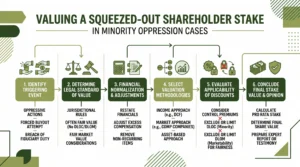
Appraisers use three recognized approaches. The income approach estimates value based on earning power. The market approach compares the business to similar sold or publicly traded companies. The asset approach values the company on the fair market value of underlying assets minus liabilities.
The income approach usually carries the most weight. Discounted cash flow (DCF) projects future free cash flows and discounts them back to present value. Capitalization of earnings divides normalized earnings by a cap rate. A 1% shift in the discount rate can change the concluded value by 10-15%.
The Sofer Difference is a four-phase process – Discovery, Diligence, Analysis, and Delivery – designed to give business owners and counsel a clear picture of what a minority stake is worth. We collect records, normalize earnings, apply the correct methods, and deliver a written report that stands up to opposing expert review.
What Role Do Discounts Play in Oppression Cases?
Discounts are the central battleground in these disputes. The DLOC reflects the reduced value of a stake that cannot direct operations. The DLOM reflects the difficulty of selling a private company interest at full value. Combined discounts in a fair market value context often range from 25% to 45%.
Most courts applying fair value eliminate both discounts. However, some distinguish between a dissenter rights proceeding – where no discounts apply – and a common-law oppression claim where the court has more flexibility.
Three scenarios show how this plays out:
- A controlling shareholder merges the company at below-market price. Under dissenter rights, no discounts apply, and the minority receives their pro-rata share of enterprise value.
- A majority partner withholds distributions while paying themselves large management fees. The court orders a buyout and must decide whether DLOM applies.
- A family business removes the minority sibling from payroll. The claim succeeds, but value is tied to the majority sibling’s client relationships, raising a personal goodwill question.
Each scenario requires a different response.
How Does the Valuation Date Affect the Outcome?
The valuation date is a strategic issue that lawyers and appraisers must address before the analysis begins. Three common dates arise: the date of the oppressive act, the filing date, and the trial date. Each can produce a different number depending on business performance during the dispute.
Courts prefer the date that makes the minority owner whole, preventing the majority from benefiting from post-oppression growth. Georgia and New York courts have addressed this question in published opinions.
Because financial statements may not exist for the exact date, appraisers often use the most recent fiscal year-end before the triggering event and adjust for known changes. Selecting and defending the right date separates a litigation appraiser from one who primarily handles deal work.
What Should You Look for in an Expert Appraiser?
Not all business appraisers have experience in contested litigation settings. Look for the ABV designation from the AICPA Forensic and Valuation Services or the ASA designation from the American Society of Appraisers. Both require rigorous testing and adherence to USPAP.
Expert witness experience matters equally. David Hern CPA ABV ASA, founder of Sofer Advisors, has served as an expert witness in more than 11 cases across many jurisdictions and built a firm recognized on the Inc. 5000 list with 180+ five-star Google reviews.
David Hern brings a Heart of a Teacher approach to every project. He breaks complex valuation methods into clear terms that judges and business owners can follow without a finance degree.
When Is an Independent Appraisal Required by Law?
An independent appraisal is legally required – or practically unavoidable – in several scenarios. Statutory dissenter rights are the clearest trigger. When a corporation approves a merger, shareholders who vote against the deal typically have the right to demand appraised fair value within 30 to 60 days.
Court-ordered buyouts almost always require independent expert testimony. Buy-sell agreements are another trigger: if the agreement calls for a third-party appraisal rather than a formula price, the parties need a credentialed appraiser who can deliver within the contractual deadline.
Once a dispute triggers a valuation requirement, the parties usually have weeks – not months – to engage an appraiser and prepare for testimony.
Frequently Asked Questions
What is a minority oppression valuation?
A minority oppression valuation is an independent appraisal of a shareholder’s interest in a closely held company after that owner has been harmed or forced out by the controlling shareholders. The appraiser finds value under the applicable legal standard – typically fair value – for use in court, mediation, or a negotiated buyout. That figure sets what the majority must pay.
How much does a minority oppression valuation from Sofer Advisors cost?
A minority oppression valuation from Sofer Advisors typically ranges from $7,500 to $25,000 depending on company complexity, volume of records, and whether expert testimony is included. Most standard projects complete in four to eight weeks. Rush work is available at a 25-50% premium. Schedule a free consultation for a scoped estimate.
What is the difference between fair value and fair market value?
Fair market value allows appraisers to apply minority and marketability discounts that can reduce the payout by 25-45%. Fair value is the statutory standard in most oppression proceedings. It generally excludes those discounts, resulting in a higher payout for the minority owner. The applicable standard depends on the state statute and the legal theory driving the claim.
Do minority discounts always get eliminated in oppression cases?
No. Most states eliminate minority and marketability discounts under a fair value standard, but courts keep discretion in some jurisdictions. Courts have allowed partial discounts when value is tied to the majority owner’s relationships or when the claim is weak. Delaware courts have a well-developed body of case law on this. An appraiser with jurisdiction experience can advise on likely outcomes.
How long does a minority oppression valuation take?
A standard minority oppression valuation takes four to eight weeks from when the appraiser receives complete financial records. Complex cases with many years of contested earnings or expert witness preparation can take ten to sixteen weeks. Timeline also depends on how cooperative the majority shareholders are with records production.
What financial records does the appraiser need?
The appraiser needs three to five years of income statements and balance sheets, federal tax returns, the operating or shareholder agreement, any prior valuations, and records of owner pay and distributions. In oppression cases, records of majority owner pay, management fee arrangements, related-party deals, and any dilution actions are equally important. These records are typically obtained through litigation discovery.
Can the valuation date be disputed in court?
Yes, and it frequently is. A later date produces a higher number for the minority owner. An earlier date benefits the majority. Courts typically select the date that makes the injured party whole and prevents the majority from benefiting from post-oppression growth. Georgia and New York courts have addressed this question directly in published opinions.
What happens if both sides have conflicting appraisals?
When each party produces an expert appraisal with different conclusions, the court evaluates the method, credentials, and assumptions of each expert. The judge may accept one opinion in full, blend the two, or appoint a neutral appraiser. The expert’s ability to explain complex methods clearly under cross-examination often determines which opinion prevails.
Does a buy-sell agreement affect the valuation in an oppression case?
It can, but not always as parties expect. Courts sometimes use a formula price in the buy-sell agreement as a floor. If the court finds the conduct made that formula unfair, or that the majority manipulated finances to depress it, the court may set the agreement aside. Contract law and oppression remedies interact differently by state.
What is DLOM and does it apply to squeezed-out owners?
DLOM stands for discount for lack of marketability – the reduced value of a private company interest that cannot be sold quickly at full value. In fair market value contexts, DLOM ranges from 15-30%, supported by restricted stock and pre-IPO studies. In most oppression cases, courts exclude DLOM. The majority forced the exit and should not benefit from the discount.
Related Case Studies
- Shareholder Dispute Valuation Atlanta Resolving Georgia Business Partner Conflicts
- Minority Interest And Marketability Discounts In Business Valuation
- Strategic Succession: Navigating Family Business Buyouts and Ownership Transfers
Executive Summary
Minority oppression valuation sits at the intersection of corporate law, accounting standards, and financial analysis. When controlling shareholders freeze out or harm a minority owner, the court-ordered remedy is almost always a buyout at fair value. The dollar amount hinges entirely on the quality of the appraisal. Key variables include the standard of value, the valuation date, the treatment of discounts, and the credibility of the expert witness. Owners and their counsel should engage a credentialed, litigation-experienced appraiser early.
What Should You Do Next?
If you are a minority shareholder who has been frozen out, demoted without cause, or denied distributions you were promised, get an independent valuation before committing to any settlement number. Gather your financial records, your shareholder agreement, and correspondence showing the majority’s actions. Do not accept a formula-based number without knowing what an independent analysis would produce.
David Hern CPA ABV ASA, founder of Sofer Advisors, works directly with minority shareholders and their counsel on oppression valuations and dissenter rights appraisals. Schedule a consultation to understand what your stake is actually worth.
People Also Read
- Minority Interest And Marketability Discounts In Business Valuation
- Why You Must Start Planning Your Business Exit Now With The Right Valuation Expert
About the Author
This guide was prepared by David Hern CPA ABV ASA, founder of Sofer Advisors – a business valuation firm headquartered in Atlanta, GA serving clients across the United States. David holds dual accreditations as an Accredited Senior Appraiser (ASA) and is Accredited in Business Valuation (ABV), credentials recognized by the IRS, SEC, and FINRA. He also holds the Certified Exit Planning Advisor (CEPA) designation. With 15+ years of valuation experience, David has served as an expert witness in 11+ cases across multiple jurisdictions and built Sofer Advisors into an Inc. 5000-recognized firm with 180+ five-star Google reviews. The firm’s full W2 employee team maintains subscriptions to all major valuation databases and operates under a next business day response policy.
For professional business valuation services, visit soferadvisors.com or schedule a consultation.
This content is for informational purposes only and does not constitute professional valuation advice. Business valuation conclusions depend on specific facts and circumstances. Contact Sofer Advisors for guidance regarding your specific situation.









