


Last Updated: October 2026
A charitable lead annuity trust, or CLAT, is a rate bet. It wins when the trust assets outgrow the IRS Section 7520 rate locked in at funding. But the bet runs on an asset that must be valued on its own. The 7520 rate prices the annuity the charity receives. The appraisal prices the asset the grantor puts in. Confuse the two and the gift tax math breaks.
The team at Sofer Advisors values the funding asset for business owners, CPAs, and estate attorneys, backed by Inc. 5000 recognition in both 2024 and 2025. A CLAT often holds a closely held business interest, not cash. That interest needs an independent fair market value before the annuity math can run. Get the appraisal wrong and the deduction, the gift, and the remainder all move with it.
This guide explains what a CLAT is, how the 7520 rate drives the charitable deduction, and how the funding asset is appraised. It also covers the forms, the tables, and the questions owners ask most.
Key Takeaways
- What a CLAT does: it pays a fixed annuity to a charity for a set term, and whatever is left passes to the grantor’s heirs.
- The 7520 rate is the hurdle: the charitable deduction is the present value of the annuity, computed with the Section 7520 rate set the funding month.
- The asset is valued separately: a closely held interest funding the trust gets an independent fair market value, often with a DLOM and a DLOC.
- Zeroing out is the goal: many grantors size the annuity so the taxable gift to heirs rounds to near zero, letting future growth pass tax free.
- No 10% rule here: the 10% minimum remainder test belongs to charitable remainder trusts, not to a CLAT, so a CLAT can be fully zeroed out.
The sections below take these one at a time.
Why Is Charitable Lead Annuity Trust Valuation Important to Understand?
A CLAT valuation decides how large a gift the grantor reports and how much growth escapes tax later. The grantor wants the asset, and its future growth, out of the estate at the lowest cost. The annuity to charity is priced off the 7520 rate, but the asset going in is priced by an appraisal. If the appraisal is too high, the reported gift and the gift tax rise. If it is too low, the IRS can adjust it on audit and add penalties.
What Is a Charitable Lead Annuity Trust?
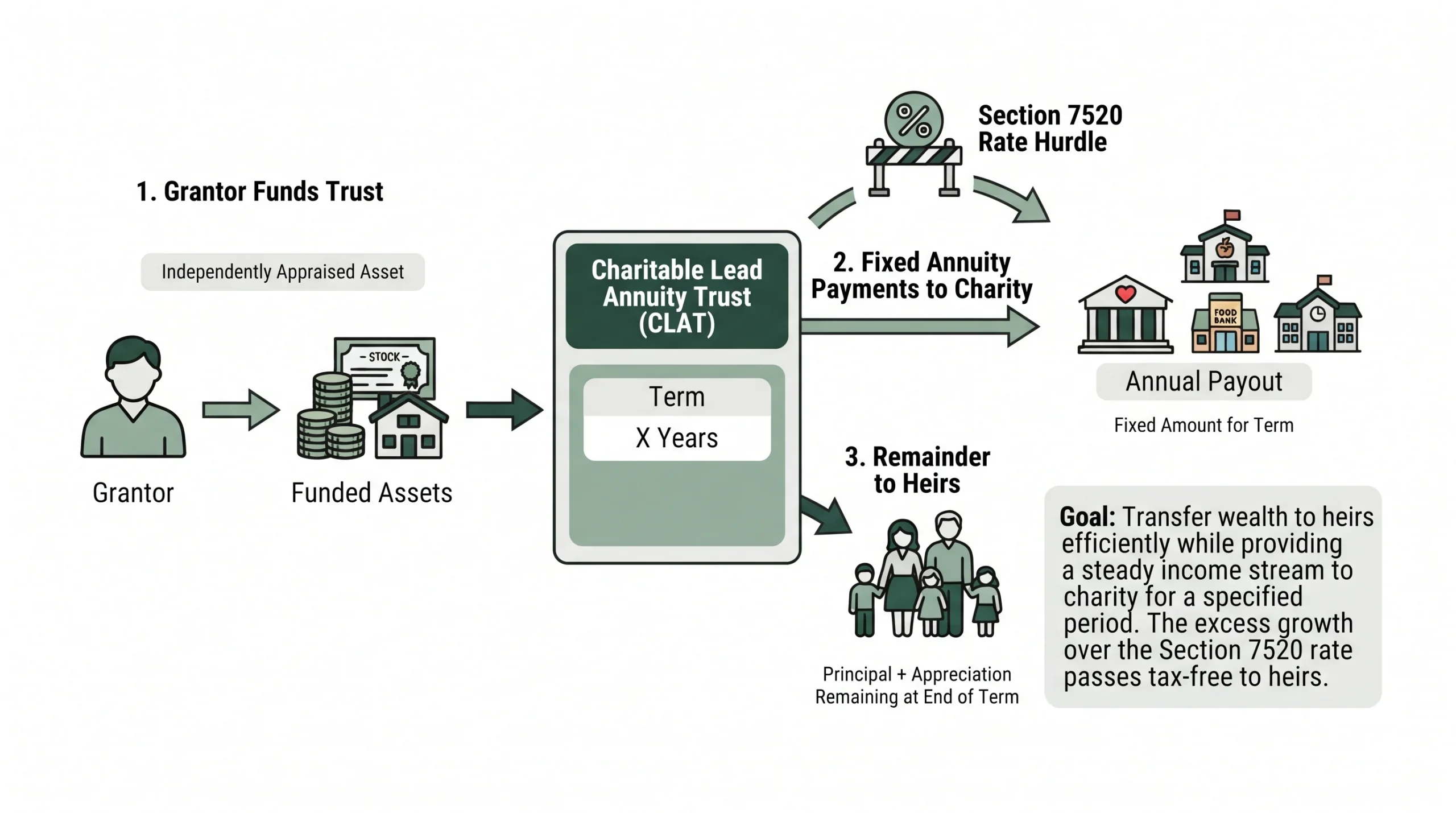
A charitable lead annuity trust is an irrevocable split-interest trust. The grantor transfers an asset into the trust and gives up control to a trustee. For a fixed term of years, the trust pays a set dollar annuity to one or more charities. When the term ends, the remaining assets pass to the non-charitable beneficiaries, usually the grantor’s children. The charity holds the lead interest, and the heirs hold the remainder. That split is what the valuation prices.
Tax treatment turns on whether the CLAT is a grantor trust or a non-grantor trust. A grantor CLAT gives the grantor an upfront income tax deduction, but the trust’s income is then taxed to the grantor each year. A non-grantor CLAT takes no upfront deduction and instead deducts against its own income as it pays the charity. Both produce a gift tax charitable deduction under Section 2522. The structure fits an asset expected to outgrow the 7520 rate, such as a closely held business interest.
How Does the Section 7520 Rate Drive the Charitable Deduction?
The charitable deduction equals the present value of the annuity the charity will receive. That present value is computed with the IRC Section 7520 rate, a figure the IRS publishes every month at 120 percent of the federal midterm rate. The relationship runs one way. A lower 7520 rate raises the present value of the annuity, which raises the charitable deduction and shrinks the taxable gift to the heirs. A higher rate does the reverse. A grantor may use the rate for the funding month or either of the two prior months, so timing matters.
This is where the phrase zeroed out comes in. A grantor can set the annuity and the term so the present value of the charity’s payments equals the full value of the asset transferred. The taxable gift to the heirs then rounds to almost nothing. If the asset later grows faster than the 7520 rate used at funding, that excess growth lands with the heirs free of gift and estate tax. That spread is the whole bet, and a low rate makes it easier to win. The income tax deduction for a grantor CLAT follows IRC Section 170 and its percentage limits.
How Is the Funding Asset Valued at Fair Market Value?
The 7520 rate prices the annuity, but says nothing about what the asset is worth. That number comes from a separate appraisal. When a CLAT holds cash or marketable securities, the value is obvious. When it holds a closely held business interest, it is not, and the IRS requires a qualified appraisal to support the figure claimed on the return. The appraiser measures fair market value as of the funding date, the price a willing buyer and seller would agree on.
A minority interest in a private company rarely trades at its pro rata share of the whole. Two adjustments usually apply. A discount for lack of control, or DLOC, reflects that a minority owner cannot direct distributions or a sale. A discount for lack of marketability, or DLOM, reflects that there is no ready market for the interest. Both lower the value that funds the trust, which lowers the gift and the annuity the charity can be promised. The appraisal must follow USPAP and document every adjustment, since a thin file is the first thing an examiner challenges. See how Sofer Advisors approaches tax and estate reporting valuations for these transfers.
What Forms, Tables, and Precedent Govern a CLAT?
The compliance trail starts at funding. The grantor reports the transfer on Form 709, the gift tax return, and claims the charitable deduction there. The trust itself files Form 5227, the split-interest trust information return, every year it operates. A grantor CLAT also reports its income on the grantor’s own return. Each filing has to agree with the appraisal and the 7520 math behind it.
The annuity present value is built from the IRS actuarial tables in Publication 1457, which give the term-certain annuity factors keyed to the 7520 rate. On the precedent side, Revenue Procedure 2007-45 supplies IRS sample forms for an inter vivos CLAT, and following them keeps the trust inside safe-harbor language. One point matters for owners who have read about charitable remainder trusts. The 10% minimum remainder test under Section 664 applies to those remainder trusts, not to a CLAT. A CLAT has no required remainder, which is why it can be zeroed out. See the IRS Form 5227 guidance for the annual reporting rules.
Who Values a CLAT Asset, and How Do the Options Compare?
Owners pick a valuation partner based on the size of the interest, the audit exposure, and the budget. Large national firms such as Alvarez & Marsal, Stout, and Kroll serve big public companies with broad advisory teams. Sofer Advisors focuses on defensible, partner-led valuations for closely held and middle-market businesses, with expert witness testimony in 11+ cases behind its reports and 180+ five-star Google reviews. The table below sets out the options.
| Provider | Typical role | Best for |
|---|---|---|
| Specialized valuation firm (e.g. Sofer Advisors) | Appraises the funding interest at fair market value with DLOM and DLOC and documents the support | Closely held interests funding a CLAT that need audit-ready evidence |
| Large national firm | Broad advisory plus valuation at enterprise scale | Large public companies with complex, multi-entity plans |
| Estate attorney | Drafts the trust and sizes the annuity; does not value the asset | Families needing the legal structure built and reviewed |
Sofer Advisors runs each engagement through a four-phase process it calls The Sofer Difference, moving from Discovery to Diligence to Analysis to Delivery. That structure keeps every discount tied to the facts behind it. It reflects the Heart of a Teacher approach, which means explaining the reasoning behind a number rather than just handing over a figure. For a CLAT that stands up to review, an independent appraisal supplies both the value and the evidence behind it.
Frequently Asked Questions
What is a charitable lead annuity trust?
A charitable lead annuity trust is an irrevocable split-interest trust. It pays a fixed annuity to a charity for a set term of years, and the remaining assets then pass to the grantor’s heirs. The grantor claims a charitable deduction equal to the present value of that annuity stream. Sofer Advisors values the asset that funds the trust, so both the deduction and the reported gift rest on a defensible fair market value rather than a guess.
What are the disadvantages of a charitable lead trust?
The main drawback is giving up control. The trust is irrevocable, so the grantor cannot reclaim the asset. The annuity is fixed, which can strain the trust if the asset does not produce enough cash to pay the charity each year. Compliance adds its own burden through yearly filings. Sofer Advisors flags these cash flow and valuation risks early, so owners fund a CLAT with an interest that can realistically carry the annuity.
Does a charitable lead trust have to pay out annually?
A CLAT must pay a fixed annuity on a set schedule, and most are written to pay at least once a year. The trust document controls the exact frequency, which can be annual, quarterly, or monthly, but the amount is locked at funding and does not change with asset performance. Sofer Advisors makes sure the valuation model matches the payment schedule in the governing document, so the deduction and the annuity factors line up.
Does the 10% rule apply to a CLAT?
No. The 10% minimum remainder test is a charitable remainder trust rule under Section 664, where at least 10% of the value must be projected to reach the remainder beneficiary. A CLAT has no equivalent floor, which is precisely why a grantor can zero it out and drive the taxable gift to near zero. Sofer Advisors keeps the two structures straight so the deduction claimed matches the vehicle actually used.
How does the Section 7520 rate affect a CLAT deduction?
The 7520 rate sets the present value of the annuity going to charity, and that present value is the charitable deduction. A lower rate raises the deduction and shrinks the taxable gift to the heirs, while a higher rate does the opposite. A grantor may use the funding month’s rate or either of the two prior months. Sofer Advisors times the appraisal to the funding window so the asset value and the chosen rate agree.
What does it mean to zero out a CLAT?
Zeroing out means sizing the annuity and the term so the present value of the charity’s payments equals the full value of the asset transferred. The taxable gift to the heirs then rounds to almost nothing. Any growth above the 7520 rate used at funding passes to the heirs free of gift and estate tax. Sofer Advisors appraises the funding asset first, because the zero-out math only holds if that starting value is correct.
Which IRS forms report a CLAT?
The grantor reports the transfer and the charitable deduction on Form 709, the gift tax return, in the funding year. The trust then files Form 5227, the split-interest trust information return, every year it operates. A grantor CLAT also reports its income on the grantor’s personal return. Sofer Advisors prepares appraisals that support each figure these forms carry, so the gift reported and the asset value behind it stay consistent across filings.
How is a closely held business interest valued for a CLAT?
An appraiser measures fair market value as of the funding date, then applies a discount for lack of control and a discount for lack of marketability where the interest is a minority stake. Those adjustments lower the value that funds the trust and the annuity it can promise. The work follows USPAP and documents every step. Sofer Advisors builds that record so the figure survives an IRS review of the gift tax return.
How much does a CLAT funding valuation cost?
Most CLAT funding valuations run from $7,500 to $25,000 and take about two to six weeks, depending on the business interest and the deadline. The range covers the appraisal work needed to support the asset value, the discounts, and the reported gift. A flat fee is quoted up front, so the cost is clear before the work starts. Request a fixed-fee estimate through the Sofer Advisors contact page for your situation.
Related Case Studies
- CLAT Business Interest Valuation: A Guide for Owners
- Donating Private Company Stock to a Donor-Advised Fund
- Valuing a Business Interest to Fund a SLAT
Executive Summary
A CLAT pays a fixed annuity to charity for a term, then passes the remainder to the grantor’s heirs. The charitable deduction is the present value of that annuity, computed with the Section 7520 rate set at funding, and a lower rate makes it larger. Many grantors zero the trust out so the taxable gift to heirs is near zero, which lets later growth pass tax free. There is no 10% remainder rule for a CLAT; that test belongs to charitable remainder trusts. The asset going in is valued separately by appraisal, with a DLOM and a DLOC on a closely held interest. The forms are Form 709 at funding and Form 5227 each year.
What Should You Do Next?
Gather the entity’s financials, the operating agreement, and the draft trust terms, since a clean file supports a defensible appraisal. Confirm the current and two prior months’ Section 7520 rates before funding, and pin the annuity and term to the value the appraisal produces. This guide was prepared by David Hern CPA ABV ASA, founder of Sofer Advisors, an Inc. 5000 firm specializing in neutral third-party valuations for tax and estate reporting. Schedule a free consultation to discuss your specific situation.
People Also Read
- What Is a GRAT and How Does It Transfer Business Value to Heirs?
- Valuation Discounts (DLOC and DLOM) on Estate and Gift Tax Returns
About the Author
This guide was prepared by David Hern CPA ABV ASA, founder of Sofer Advisors, a business valuation firm headquartered in Atlanta, GA serving clients across the United States. David holds dual accreditations as an Accredited Senior Appraiser (ASA) and is Accredited in Business Valuation (ABV), credentials recognized by the IRS, SEC, and FINRA. He also holds the Certified Exit Planning Advisor (CEPA) designation. With 15+ years of valuation experience, David has served as an expert witness in 11+ cases across multiple jurisdictions and built Sofer Advisors into an Inc. 5,000-recognized firm with 180+ five-star Google reviews. Its full W2 employee team maintains subscriptions to all major valuation databases and operates under a next business day response policy.
For professional business valuation services, visit soferadvisors.com/about-us/ or contact Sofer Advisors at soferadvisors.com/contact-us/.
This content is for informational purposes only and does not constitute professional valuation advice. Business valuation conclusions depend on specific facts and circumstances. Contact Sofer Advisors for guidance regarding your specific situation.









