


Last Updated: September 2026
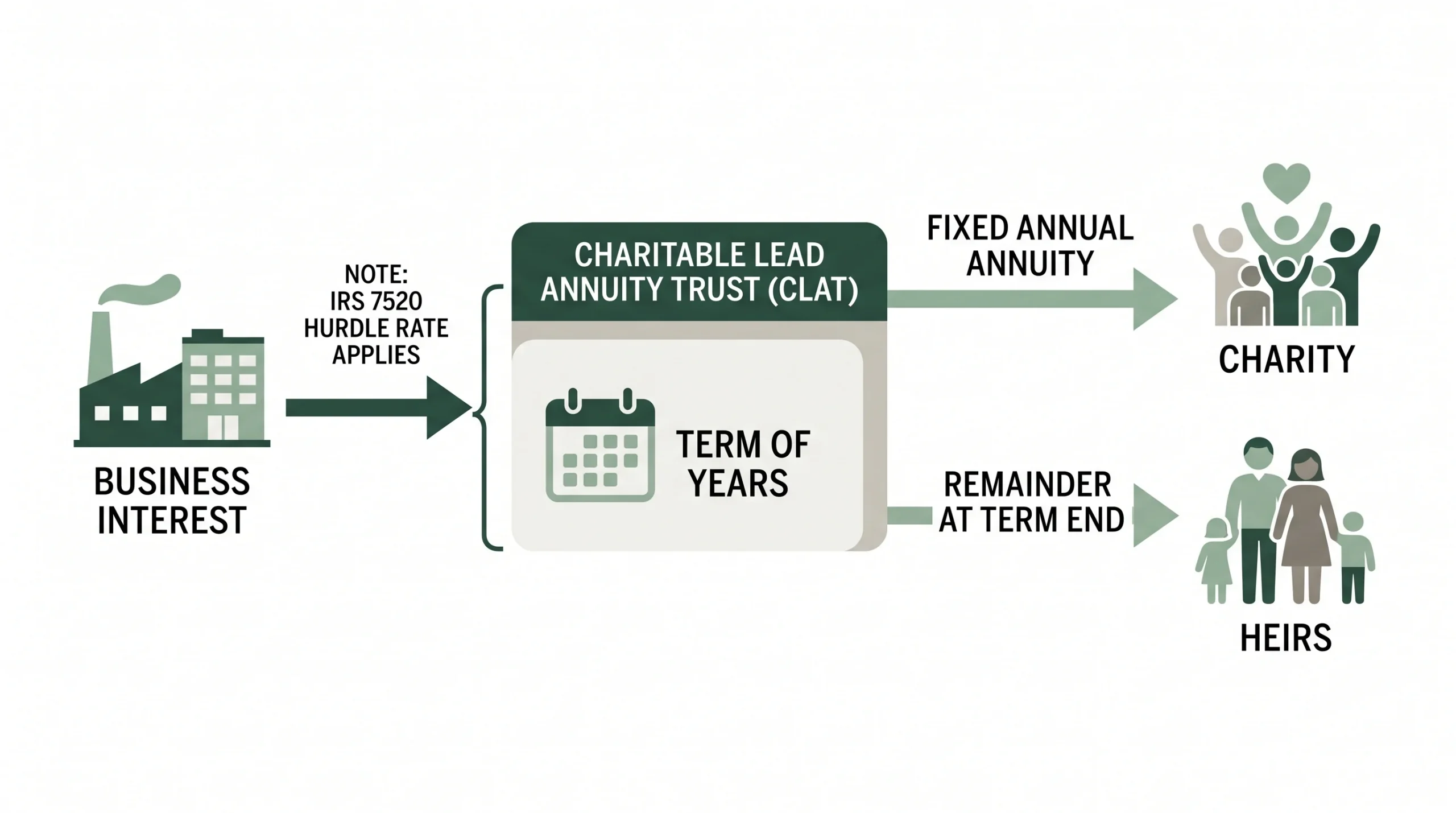
A CLAT business interest valuation sets the fair market value of a company stake placed into a Charitable Lead Annuity Trust. The owner moves shares into the trust. The trust then pays a fixed yearly amount to a charity for a set term. When the term ends, the remaining assets pass to the owner’s heirs. The appraised value drives both the charitable deduction and the gift tax result, so an accurate number matters. The IRS requires a qualified appraisal for any business interest worth more than $5,000.
Business owners use this structure to support a charity and shift future growth to heirs at a low tax cost. The value of the interest must hold up under IRS review, so the appraisal cannot be an afterthought. Sofer Advisors provides independent appraisals for estate and gift matters and explains each assumption to owners and their attorneys, an approach it calls the Heart of a Teacher.
Key Takeaways
- How a CLAT works: the trust pays a fixed annuity to charity for a term, then the remaining business value passes to heirs.
- Qualified appraisal is required: the IRS demands a report from a qualified appraiser for any business interest worth more than $5,000.
- Value sets the tax result: the appraised fair market value drives the charitable deduction, the annuity amount, and the gift value.
- Discounts apply: a minority stake often earns a discount for lack of control and a discount for lack of marketability.
- Watch the risks: weak liquidity, unrelated business taxable income, and self-dealing rules can all create trouble.
These points frame a compliant charitable transfer. The sections below walk through why owners use the structure, how the interest is valued, and what the IRS expects.
Why fund a CLAT with a business interest?
Owners fund a CLAT with a business interest to move future company growth to heirs while paying little or no gift tax. The trust pays a fixed annuity to a charity for a term of years. The present value of those payments offsets the value of the gift. In a zeroed-out CLAT, that offset can reduce the taxable gift to nearly zero. Any growth above the IRS Section 7520 rate then passes to the heirs free of extra gift or estate tax.
The Section 7520 rate acts as a hurdle. The IRS sets it each month at 120% of the federal midterm rate. If the business grows faster than that rate over the term, the extra value lands with the heirs at no added tax cost. A private company poised to grow can make this a strong fit. The current estate and gift tax exemption is $15 million per person and $30 million per married couple. The 2025 federal tax law made these amounts permanent, with no scheduled sunset, so the choice can rest on the plan itself rather than a deadline.
How is a business interest valued for a CLAT?
A business interest that funds a CLAT must be valued at fair market value by a qualified appraiser. Fair market value is the price a willing buyer and seller would agree on, with neither under pressure. Because private shares do not trade on an open market, the appraiser builds the value from the company’s own facts. The IRS expects the report to follow Revenue Ruling 59-60.
Appraisers weigh three approaches: the income approach, the market approach, and the asset approach. The income approach turns projected cash flow into a present value. The market approach compares the company to similar businesses that have sold. The asset approach looks at the net value of what the company owns. For a minority stake, the appraiser often applies a discount for lack of control and a discount for lack of marketability. These discounts lower the reported value because a small and hard-to-sell stake is worth less than full control. The report should also meet USPAP, the appraisal profession’s standard.
Sofer Advisors follows a four-step process it calls The Sofer Difference: Discovery, Diligence, Analysis, and Delivery. Discovery gathers the financials and the deal facts. Diligence tests the numbers. Analysis applies the three approaches and any discounts. Delivery produces a report an owner can hand to the IRS or a court.
What are the IRS rules for a CLAT valuation?
The IRS requires a qualified appraisal from a qualified appraiser for any business interest worth more than $5,000 that funds a CLAT. The appraisal supports the charitable deduction tied to the trust. Under Treasury Regulation 1.170A-13(c), the report must meet set content rules. It must be dated no earlier than 60 days before the gift.
The owner reports the value on Form 8283 and files it with the federal return. A missing or weak appraisal can trigger valuation misstatement penalties. The IRS reviews these filings to confirm the annuity rate fits the value of the interest. A clear, well-supported report is the best defense if questions arise. You can review the agency’s charitable contribution rules for the deduction basics.
What are the risks of funding a CLAT with a business?
The main risks are weak liquidity, unrelated business taxable income, and self-dealing rules. Each can create tax or compliance trouble if the interest does not fit the trust’s needs. Owners should weigh these points before they move an illiquid stake into a trust. The three risks work like this:
- Liquidity: the trust must pay a fixed annuity each year, so the business needs steady cash or the trust may have to sell part of the interest.
- Unrelated business taxable income: income that is not tied to an exempt purpose can create a tax bill for the trust.
- Self-dealing: Section 4941 bars most deals between the trust and the donor or family, and a breach can bring excise taxes.
These risks do not rule out a business interest. They simply call for planning with tax counsel before funding. A careful review of cash flow and entity type keeps the trust on solid ground. The valuation should also model the annuity against expected earnings so the trust can meet each payment.
How does a CLAT differ from a CRT?
A CLAT pays a charity first and sends the remainder to heirs, while a Charitable Remainder Trust does the reverse. A CLAT pays a fixed annuity to charity for the term, then the remaining assets go to the family. A CRT pays income to the family first, then the remainder goes to charity. The order of payments shapes the tax result and the goal each trust serves.
| Feature | CLAT | CRT |
| Paid first | Charity | Family beneficiary |
| Remainder goes to | Heirs | Charity |
| Best for | Shifting growth to family | Current income plus a later gift |
Owners who want to move business growth to the next generation tend to favor a CLAT. Those who want income now often choose a CRT. The right pick depends on the goal, the interest, and the family’s plan. A valuation of the funding interest is central to both.
Which firm should value a CLAT business interest?
An owner should choose an independent appraiser whose only job is the value, not the deal or the estate plan. Large firms such as Alvarez & Marsal, Stout, and Kroll serve the biggest engagements. Middle market owners often want senior attention and a report built for IRS review. The table below compares the common options.
| Provider type | Focus | Independence |
| Independent valuation firm | Defensible fair market value for tax | High; no stake in the deal |
| Large advisory firm | Enterprise and deal support | Varies with the engagement |
| Wealth or legal advisor | Strategy and structure | The appraisal is usually outsourced |
An independent report gives owners a neutral number they can defend. A firm that keeps the appraisal separate from any brokering or legal work produces a value that reflects the business, not a target price. That neutrality is what holds up when the IRS asks questions. Owners planning a transfer of a closely held business should confirm their appraiser meets this standard.
Frequently Asked Questions
What are the disadvantages of funding a CLAT with a business interest?
The main drawbacks are valuation complexity and liquidity risk. The trust must make a fixed annuity payment each year, so the business needs steady cash or reserves. If the company cannot produce enough liquid capital, the trust may have to sell part of the interest. The value of a private stake can also be hard to pin down and defend.
What is the difference between a charitable lead trust and a charitable remainder trust?
A charitable lead trust pays a charity first, then passes the remaining assets to heirs. A charitable remainder trust pays income to the family first, then sends the remainder to charity. The direction of the lead interest sets the primary tax benefit. The choice depends on whether the goal is family wealth transfer or current income.
Does a CLAT funded with a business interest have to pay out annually?
Yes, a charitable lead annuity trust must make a fixed payment at least once a year to the charity. This payment is due whether or not the business interest produces income. Missing the required payment can bring penalties or put the trust status at risk. Owners often model the annuity against expected cash flow to confirm the plan works.
What is the purpose of a charitable lead annuity trust?
The main purpose is to lower the transfer tax cost of passing a business to the next generation. The charitable interest reduces the taxable value of the remainder that goes to family. This can shift future growth out of the taxable estate. It also lets an owner support a cause during the trust term.
How is a business interest valued when it funds a CLAT?
A qualified appraiser sets the fair market value using the income, market, and asset approaches. The work follows Revenue Ruling 59-60 and applies discounts for lack of control and lack of marketability where they fit. These discounts can lower the value of a minority stake. A defensible report supports the deduction and the gift value reported to the IRS.
How is a charitable lead annuity trust taxed?
A non-grantor CLAT is a separate taxpayer that claims a deduction for the payments it makes to charity. A grantor CLAT lets the donor take an income tax deduction in the funding year, but the donor then reports the trust income. The structure chosen sets who receives the tax benefit. Each path fits a different planning goal.
Can an S corporation interest be used to fund a CLAT?
An S corporation interest can fund a CLAT, but it takes care to protect the tax status. The trust must be an eligible shareholder, such as an electing small business trust or a grantor trust. A misstep can end the S corporation election. Owners should work with tax counsel to set the right ownership before funding.
What happens to the business interest after the CLAT term ends?
At the end of the term, the remaining assets, including the business interest, pass to the named heirs. Those heirs become the new owners and take on the rights and duties of the equity. If the value grew during the term, that growth passes with reduced tax exposure. A fresh valuation helps keep records accurate for the new owners.
How much does a tax and estate valuation cost?
A tax and estate valuation from Sofer Advisors generally ranges from $7,500 to $25,000. Most engagements take four to eight weeks. The final fee depends on the number of entities involved and the depth of the analysis. To get a quote for your situation, contact the team with your financials and trust details.
Related Case Studies
- Estate Planning Business Valuation Georgia: Gift & Tax Compliance Guide
- Using the Annual Gift Exclusion to Transfer Business Interests
- Estate Freeze Strategies: How Valuations Lock In Today’s Value
Executive Summary
A CLAT funded with a business interest pays a fixed annuity to charity for a set term, then passes the remainder to heirs. A qualified appraiser sets the fair market value of the interest, which drives both the charitable deduction and the gift value. Discounts for lack of control and lack of marketability often lower that value. The IRS requires a qualified appraisal for any interest worth more than $5,000, reported on Form 8283. Growth above the Section 7520 rate passes to heirs at little or no extra tax. A tax and estate valuation runs $7,500 to $25,000 over four to eight weeks.
What Should You Do Next?
Start by gathering three years of financial statements, your capitalization table, and the trust documents. Ask a qualified appraiser to confirm that your interest needs a formal report and to set the timeline. Model the annuity against your expected cash flow so the trust can meet its yearly payments.
David Hern CPA ABV ASA, founder of Sofer Advisors, provides independent valuations for owners and their legal teams. Schedule a consultation to discuss your situation.
People Also Read
- How Family Limited Partnerships Are Valued for Gift and Estate Tax
- Cost Basis vs Fair Market Value: Key Differences Explained
About the Author
This guide was prepared by David Hern, CPA ABV ASA, founder of Sofer Advisors, a business valuation firm headquartered in Atlanta, GA, serving clients across the United States. David holds dual accreditations as an Accredited Senior Appraiser (ASA) and is Accredited in Business Valuation (ABV), credentials recognized by the IRS, SEC, and FINRA. He also holds the Certified Exit Planning Advisor (CEPA) designation. With 15+ years of valuation experience, David has served as an expert witness in 11+ cases across multiple jurisdictions and built Sofer Advisors into an Inc. 5000-recognized firm with 180+ five-star Google reviews. Its full W2 employee team maintains subscriptions to all major valuation databases and operates under a next-business-day response policy.
For professional business valuation services, visit soferadvisors.com/about-us/ or contact Sofer Advisors at soferadvisors.com/contact-us/.
Disclaimer: This content is for informational purposes only and does not constitute professional valuation advice. Business valuation conclusions depend on specific facts and circumstances. Contact Sofer Advisors for guidance regarding your specific situation.









