


Last Updated: August 2026
A stock based compensation valuation is the process of setting the fair value of equity awards, such as stock options and RSUs, that a company grants to its employees. Under ASC 718, that value becomes a non-cash cost on the income statement. No cash changes hands, yet the cost is real. One wrong input can move the reported cost by six figures. So Sofer Advisors treats each input as a choice that must hold up in an audit.
The stakes run high because this cost hits reported earnings for years, not just once. Investors, lenders, and auditors all read the result. Fast-growing private firms feel it most, since equity often makes up a large part of how they pay and keep their best people. A sound valuation is what keeps those numbers credible.
Key Takeaways
- Definition: A stock based compensation valuation sets the grant-date fair value of employee equity awards.
- Required cost: ASC 718 makes every equity award a non-cash cost on the income statement.
- Pricing models: Black-Scholes and lattice models produce the fair value the rule demands.
- Volatility input: Private firms build volatility from a peer group of public companies.
- Statement impact: The cost spreads over the vesting period. It lowers net income and lifts paid-in capital.
- Defensible reports: An outside appraiser guards against restatement and audit challenge.
These points show how one grant turns into a reported cost. The sections below explain the models, the inputs auditors question most, and how the cost lands on your books.
Why does ASC 718 valuation matter?
An ASC 718 valuation matters because GAAP makes firms record a non-cash cost for each equity award. The Financial Accounting Standards Board’s Topic 718 guidance sets this rule. The charge must reflect fair value on the grant date. That figure flows into net income and earnings per share. A weak number distorts both. Auditors, lenders, and investors all read those statements. So the value has to be clean and easy to defend.
Public and private firms face the same test. A shaky report can force a costly restatement. It can also shake investor trust. The goal is a clear view of true labor cost, backed by proof a reviewer can follow. This is where the Heart of a Teacher approach shows up. Sofer Advisors walks each owner through the model, not just the final cost. The logic stays plain to every auditor and board member who later reads it.
What models value stock options?
Two models carry most ASC 718 work. The first is the Black-Scholes-Merton model. It fits plain vanilla options with a clear exercise path. It uses six inputs: the share price, the strike price, volatility, the risk-free rate, the dividend yield, and the expected term. When an award adds performance targets or early exercise rights, a lattice model fits better. It maps many price paths over time, so it captures terms a single formula would miss.
The choice is not a matter of taste. It follows the features written into the award. A grant with a market condition or a vesting hurdle needs the flexible path a lattice gives. A simple option does not. The table below lines up the two main models against the awards they suit best.
| Model | Best suited to | Key strength | Main inputs |
|---|---|---|---|
| Black-Scholes-Merton | Plain vanilla options | Fast, clear, widely accepted | Share price, strike, volatility, term, rate, yield |
| Binomial lattice | Options with performance or early exercise terms | Models many price paths and conditions | Same inputs plus a defined price tree |
| Monte Carlo | Awards tied to market conditions | Handles complex payout rules | Simulated price paths and links |
Picking the wrong model creates real risk. A plain formula on a complex award can misstate the cost, and an auditor will catch it. The right model matches the terms of the grant. That keeps the reported number both accurate and easy to defend. Sofer Advisors reads the award agreement first. Then it builds the model that fits those exact terms, so the result rests on the award itself rather than on habit.
How do you set expected volatility?
Volatility is set by studying the past price swings of a peer group of public companies. A private firm has no traded share price. So it cannot use its own data. Instead, the analyst builds a group of public firms with similar size, sector, and risk. Their price movement becomes the proxy. This input carries heavy weight. A small change in it can swing the value of an option by a wide margin.
The peer group is one of the most tested parts of the whole job. Analysts must explain why each firm is a fair stand-in for the subject company. Gaps in debt, growth, or size can skew the result. So each choice needs a written reason. Auditors and the IRS both probe this logic. A careful pick, backed by the AICPA Accounting and Valuation Guide, keeps the final figure tied to real market data rather than a handy guess.
Which inputs change at each grant date?
Almost every key input must be refreshed for each new grant date. Markets and company results shift over time. So a figure from last year rarely holds. Three inputs move the most: the fair market value, volatility, and the risk-free rate. The share price usually comes from a recent 409A valuation. That value sets the fair market value the model starts from. It anchors the whole math.
Rate moves change the risk-free rate the model applies. Shifts in the market or the peer group change volatility. Each one makes a new grant its own event, not a copy of the last. So the provider must update the model to match the grant date. Using a stale 409A value is a common error. It can leave the reported cost open to challenge in a year-end audit.
How does the cost hit your statements?
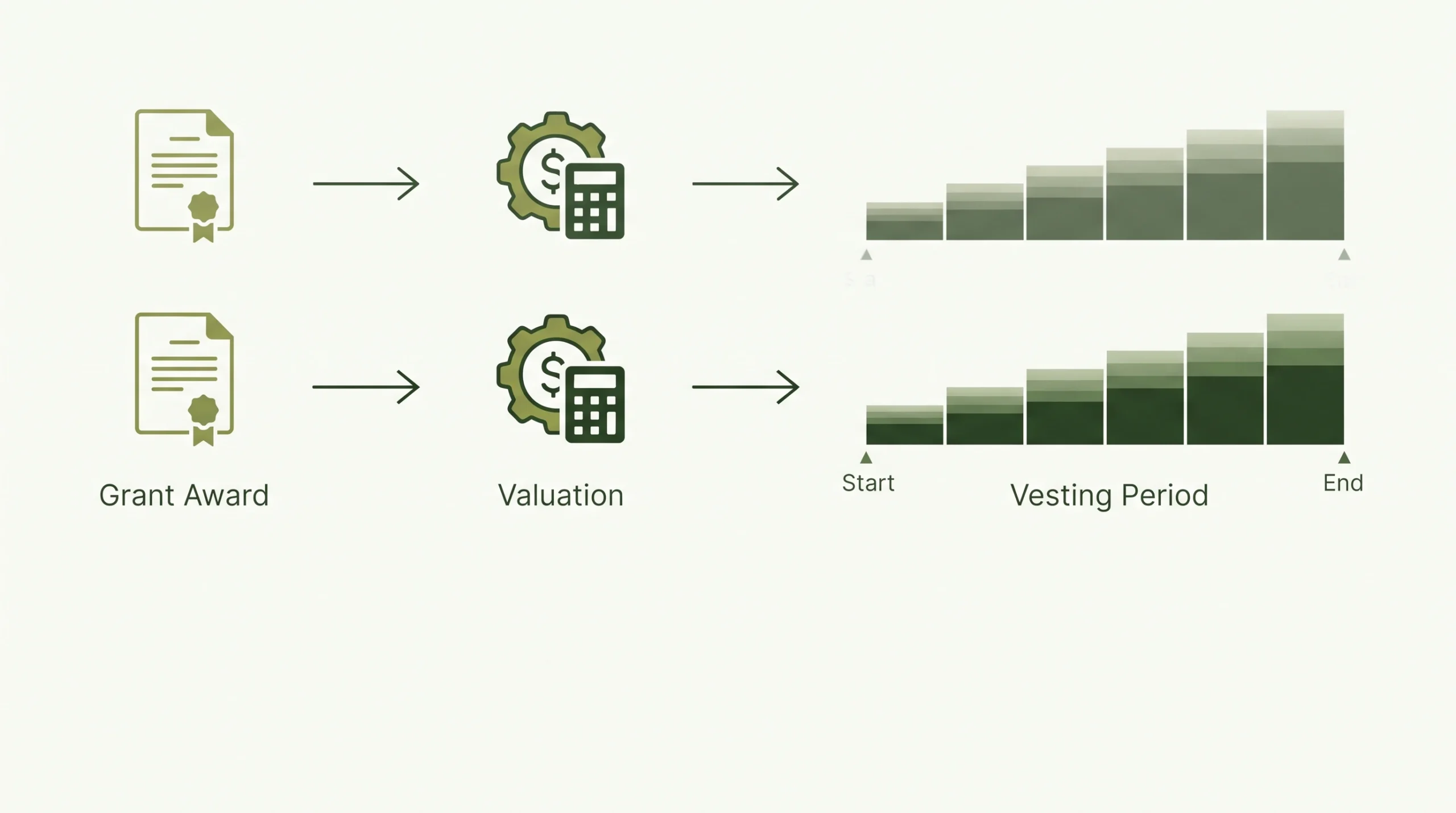
ASC 718 makes the full fair value of an award a non-cash cost, spread across the vesting period. That ties the cost of equity to the years the employee earns it. No cash leaves the business. So the offset is a rise in paid-in capital in the equity section. On the cash flow statement, the charge is added back to net income, since it never drained cash.
That add-back makes stock pay a familiar line for analysts building Adjusted EBITDA. Removing the non-cash charge gives a cleaner read on operating cash. Forfeitures add one more layer. A forfeiture rate estimates how many awards never vest because staff leave first. Firms may estimate it up front or record it as it happens. Either way, the choice changes the cost booked each period. Getting it wrong misstates both net income and the equity accounts reviewers examine.
Who should perform the valuation?
Choosing a provider comes down to independence and audit support. A Big 4 firm may fold the work into a larger audit, though that can stretch timelines. An investment bank offers deal-time help, but its view is often tied to a closing. A specialized firm focuses on independence. That is what an external auditor wants to see. The right partner delivers a standalone report built to survive review.
Large advisors such as Alvarez and Marsal or Kroll serve big enterprise clients well. Sofer Advisors brings that same senior-level rigor to middle-market firms. And unlike a solo practitioner, it backs each conclusion with a full team. The Sofer Difference is a four-phase process: Discovery, Diligence, Analysis, and Delivery. It yields an audit-ready report. A full W2 team of 14, subscriptions to major valuation databases, and a next business day response stand behind every job. That structure is why 180 plus five-star Google reviews and Inc. 5000 honors in 2024 and 2025 follow the work.
Frequently Asked Questions
Is stock-based compensation included in EBITDA?
Stock-based pay is a non-cash cost, so firms usually add it back when they figure Adjusted EBITDA. It is a real cost to shareholders through dilution. Yet no cash leaves the business in the period. Sofer Advisors applies careful add-backs. That way the value reflects the true cash-earning power of your operations, not a book charge that never touched cash.
What does stock-based compensation mean?
Stock-based pay is a reward given to staff or directors as company equity instead of cash. It covers stock options, restricted stock units, and stock appreciation rights. These awards reward long service and tie staff to growth. Sofer Advisors helps owners see how each plan affects the cap table, the income statement, and the total cost the firm must report under ASC 718.
What is the difference between ASC 718 and 409A valuations?
ASC 718 governs financial reporting. It sets the pay expense a firm records for equity awards. IRC Section 409A governs tax. It sets the fair market value used for an option strike price. The two serve different ends but share inputs, since the 409A value often feeds the ASC 718 model. Sofer Advisors prepares both, so your books and tax stay aligned.
How often do I need an ASC 718 valuation?
You need a fresh ASC 718 value whenever a major event hits, such as a new grant or a change in capital structure. Many firms also refresh the work each year to match audit cycles. Waiting too long leaves the model resting on stale inputs. Sofer Advisors helps set the right pace, based on your grant activity and funding events.
Can a company perform an ASC 718 valuation in-house?
An internal team can run basic math. But ASC 718 calls for complex models and judgment that auditors often challenge. An outside appraiser brings the independence and written support that satisfy review. That split matters most when a firm faces an audit or plans to raise money. Sofer Advisors delivers reports built to stand up to auditors, lenders, and other stakeholders.
Does ASC 718 apply to awards for non-employees?
Yes. ASC 718 also covers equity given to consultants and contractors, not just staff. The accounting follows the same rules as employee awards. So the fair value still becomes a cost over the service period. Sofer Advisors reviews every equity recipient. That way your books capture the full cost of each plan, and no grant slips through unreported.
What is a forfeiture rate?
A forfeiture rate estimates the share of awards that never vest because staff leave before the vesting date. Setting it takes past turnover data and a view of future staffing. A rate too low overstates the cost. One too high understates it. Sofer Advisors derives these rates from proven methods, so your reported pay rests on evidence, not a rough guess.
What is a stock appreciation right under ASC 718?
A stock appreciation right, or SAR, pays a worker the rise in the share price over a set period, often in cash. Under ASC 718, a cash-settled SAR is a liability award. So it must be remeasured to fair value at each reporting date, not just at grant. Sofer Advisors runs these repeat updates, so your balance sheet shows an accurate liability every period.
How much does a business valuation from Sofer Advisors cost?
Cost depends on your company stage and the shape of your cap table. A 409A or equity-pay valuation usually runs 2,500 to 9,000 dollars. More tranches and complex terms push toward the higher end. Full business valuations for deals or lawsuits run higher, since they need deeper work. Contact Sofer Advisors for a fee quote matched to your reporting needs.
Related Case Studies
- Secondary Sales of Private Stock: Valuation and 409A Implications
- Section 83(b) Elections: Timing, Risk, Valuation
- Rollover Equity in PE Deals: Valued and Taxed
Executive Summary
A stock based compensation valuation turns employee equity into a reported cost under ASC 718. The fair value comes from an option-pricing model. Black-Scholes fits simple options, while a lattice fits complex terms. Private firms build volatility from a public peer group, the input auditors probe most. The cost spreads over the vesting period. It lowers net income and raises paid-in capital. A stale 409A value or a wrong forfeiture rate can force a restatement. Sofer Advisors builds each model against AICPA valuation guidance and IRS standards, so the result holds up in an audit.
What Should You Do Next?
Start by gathering your board minutes, current cap table, and the terms of any performance or acceleration clauses in your awards. Confirm that your 409A value reflects your latest funding and capital structure. Then match each award to the model its terms require, not one formula for all.
For a report built to survive audit, work with David Hern CPA ABV ASA. His team has given expert witness testimony in 11+ cases across Georgia, Florida, California, and New Mexico. Schedule a consultation to discuss the equity awards you need to value this cycle.
People Also Read
- Owner Compensation Normalization: Why Salary Affects Sale Value
- S Corp vs C Corp: How Entity Choice Affects Business Value
About the Author
This guide was prepared by David Hern CPA ABV ASA, founder of Sofer Advisors, a business valuation firm headquartered in Atlanta, GA serving clients across the United States. David holds dual accreditations as an Accredited Senior Appraiser (ASA) and is Accredited in Business Valuation (ABV), credentials recognized by the IRS, SEC, and FINRA. He also holds the Certified Exit Planning Advisor (CEPA) designation. With 15+ years of valuation experience, David has served as an expert witness in 11+ cases across multiple jurisdictions and built Sofer Advisors into an Inc. 5000-recognized firm with 180+ five-star Google reviews. Its full W2 employee team maintains subscriptions to all major valuation databases and operates under a next business day response policy. For professional business valuation services, visit soferadvisors.com/about-us/ or contact Sofer Advisors at soferadvisors.com/contact-us/.
Disclaimer: This content is for informational purposes only and does not constitute professional valuation advice. Business valuation conclusions depend on specific facts and circumstances. Contact Sofer Advisors for guidance regarding your specific situation.









