


Last Updated: July 2026
An S Corp election is a tax label that lets a business pass income, losses, deductions, and credits straight to its shareholders for federal tax purposes, which avoids the double tax that hits many standard corporate models. The IRS treats the firm as a flow-through vehicle, so profits move through the company to the owners.
Owners must file Form 2553 with the IRS to claim this status. The choice between an S Corp and a C Corp is a big one, since it shapes how a firm is taxed and how buyers and the IRS see its ownership and value.
Picking an entity means weighing quick tax goals against long-term plans, so owners should study how each label affects capital, payroll, and pay. Each choice comes with its own set of rules that govern how the firm works as a legal and financial unit in your market. Sofer Advisors offers independent valuation work for the choices we cover here.
Key Takeaways
- Taxation impacts entity choice: S Corps use pass-through tax to avoid double tax on profits and dividends.
- Capital raising considerations: C Corps work better for many stock classes, venture funds, and QSBS rules.
- Valuation method adjustments: Analysts often tax-affect S Corp earnings to match standard C Corp benchmarks.
- Sale and exit advantages: S Corps often allow one level of tax and a basis step-up for buyers.
- Conversion rules and risks: Moving from a C Corp to an S Corp brings strict rules and tax risk.
These structural effects shape how owners manage capital, tax, and equity. The sections below cover the planning steps each entity moves needs.
What’s the core difference: S Corp vs. C Corp?
The main split between the two lies in federal tax. An S Corp is a pass-through entity, while a C Corp faces double tax. A pass-through entity skips corporate income tax and reports all profits and losses on the owners’ personal tax returns, per the IRS. A C Corp pays tax at the corporate level on its earnings, and shareholders pay tax again when those earnings go out as dividends.
Tax aside, a C Corp gives more room in its ownership setup, since it allows an unlimited number of shareholders and permits many classes of stock, such as preferred and common shares. These traits draw big investors and venture funds. An S Corp caps out at 100 shareholders and must follow strict rules on who can own it and what stock it issues. Sofer Advisors often reviews these choices during Transaction and M and A Advisory work.
How does entity choice affect business valuation?
Entity choice shapes value directly by deciding whether a firm must count corporate income taxes in the cash flow to owners. Because a C Corp pays tax at the entity level, analysts subtract that cost before they find the value left for shareholders. An S Corp and other pass-through firms skip that corporate tax burden, creating a gap in cash flow forecasts that calls for careful fixes.
Valuation experts often use a step called tax-affecting to normalize S Corp earnings. The analyst estimates the tax as if the firm were a C Corp, which builds a level basis to compare with public company data. This method aims to follow the ideas in IRS Revenue Ruling 59-60 when sizing up private firms, consistent with the professional valuation standards published by the AICPA. Analysts must also weigh a Built-In Gains tax, or BIG tax. This applies if an S Corp sells assets soon after it converts from C Corp status, and skipping these traits can push the final value too high.
Which structure is better for raising capital?
A C Corp is the top pick for firms that seek venture funds and big investors. Its structure allows complex equity deals, and investors in these firms often want many classes of stock, such as common and preferred shares, to spell out their rights and control. An S Corp is limited to one class of stock, so it cannot issue the separate tiers of ownership that venture funds need.
C Corps carry another perk, since they allow the tax benefits of Qualified Small Business Stock, or QSBS. Under IRS guidance for Section 1202, eligible investors may exclude a large share of their capital gains when they sell their holdings. This edge makes a C Corp far more appealing to big investors, while firms that do not qualify for these federal breaks fall behind.
What are the tax implications during a business sale?
Tax results in a sale hinge on one choice: an asset sale or a stock sale. In a C Corp asset sale, double tax strikes, because the firm pays tax on the gain from asset growth and shareholders pay tax again when the proceeds go out. An S Corp asset sale usually skips that corporate-level tax, so profits pass straight to shareholders instead.
Buyers often prefer an asset sale because it secures a stepped-up basis in the assets they buy. This allows larger future depreciation write-offs to trim their tax bill. To reach this result when buying an S Corp, the parties may make an IRC Section 338(h)(10) election. This treats a stock buy as an asset sale for tax purposes. The buyer gains a stepped-up basis, while the seller still pays just one level of tax. Owners should review these outcomes with advisors so their exit plan protects the most value.
Can I change my corporation’s tax status?
A firm can change its tax status. But the process follows strict rules and set filing dates. A C Corp may elect S Corp status by filing IRS Form 2553, though it must meet the ownership and capital rules first. An S Corp may also end its status through a voluntary revocation of the S election.
Timing matters: to take effect for the current tax year, the IRS wants the election within the first two months and 15 days. A move from a C Corp to an S Corp can trigger a Built-In Gains tax. This applies if the firm sells grown assets within a five-year wait after the switch. Because S Corp owner basis drives the tax owed at a later sale, owners should track it from the switch onward. A move back from an S Corp to a C Corp is more direct, but the change may be locked in for five years, so owners should study these timelines to dodge tax surprises.
How does valuation differ for S Corps vs C Corps in M&A?
Value differs for S Corps and C Corps in M and A because buyers weigh tax perks. A buyer often pays more for an S Corp, since the draw is the chance for a stepped-up basis in assets through an asset sale or a Section 338(h)(10) election. By writing up the asset basis, the buyer claims higher depreciation and a tax amortization benefit, lifting cash flow and pushing valuation multiples higher than a C Corp. Many buyers also require an F reorganization before an S Corp sale to lock in these benefits cleanly.
A stock buy of a C Corp usually forces the buyer to inherit the seller’s original basis and gain no tax amortization benefit on existing goodwill, which caps the buyer’s tax shield. The Sofer Difference accounts for these gaps, so we model tax impacts for all parties and show owners where they stand before they sign binding terms.
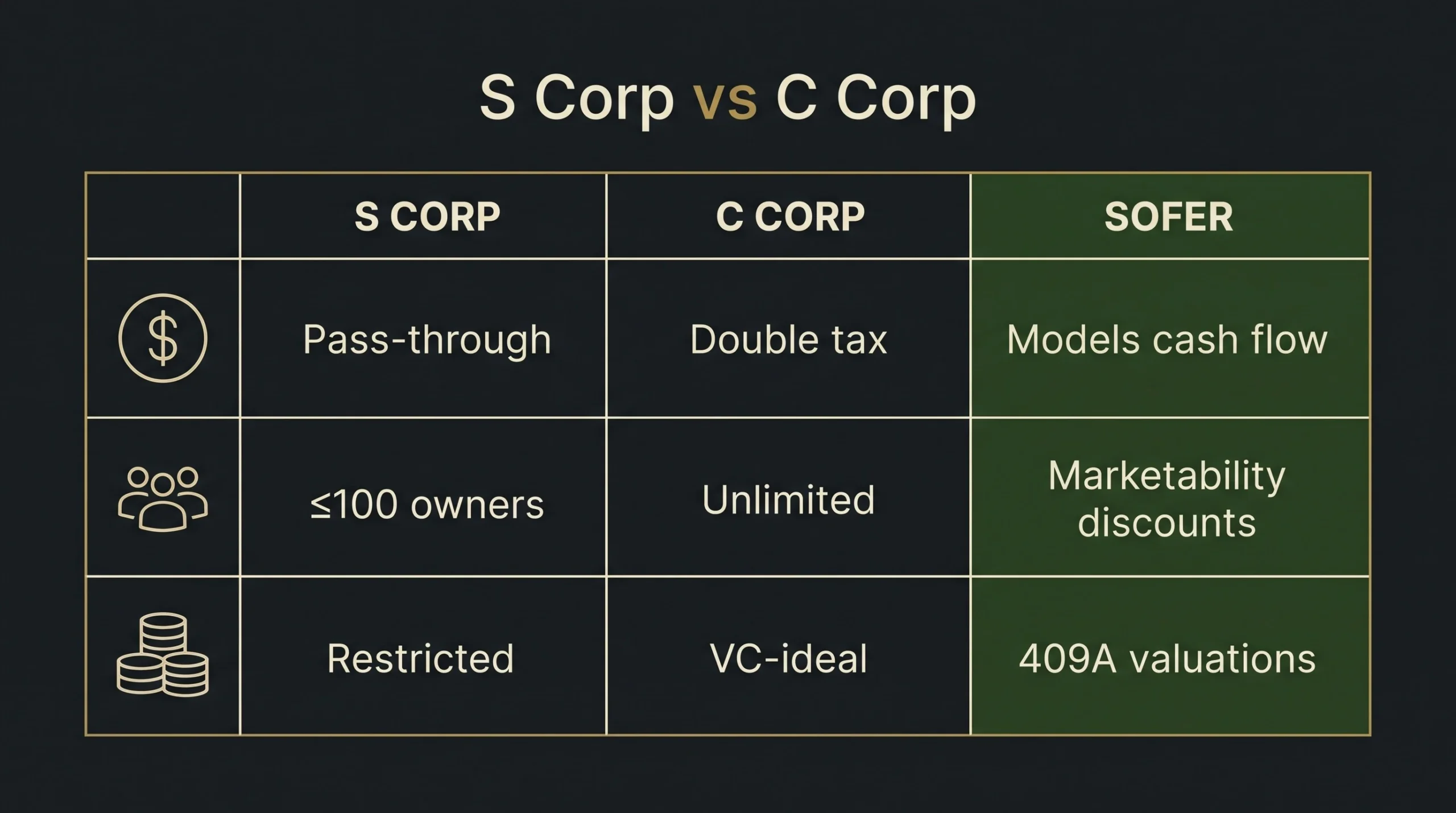
| Feature | S Corporation (S Corp) | C Corporation (C Corp) | Sofer Advisors’ Role |
|---|---|---|---|
| Taxation | Pass-through to owners; no corporate-level federal tax. | Taxed at the corporate level; dividends taxed again at shareholder level. | Models after-tax cash flows under different structures to find valuation impact. |
| Ownership | ≤100 shareholders (US citizens/residents). One class of stock only. | Unlimited shareholders. Multiple classes of stock (common, preferred) allowed. | Assesses how ownership restrictions impact transferability and marketability discounts. |
| Raising Capital | Difficult; ownership restrictions often deter venture capital interest. | Ideal; preferred by venture capital and private equity investors. | Provides 409A valuations for C Corps issuing stock options to attract talent. |
The table shows why some structures back big investments, while others favor tax savings for solo owners. Weigh these factors against your current entity to avoid shocks during tax audits or a sale.
Frequently Asked Questions
Which one is better?
No entity type is better in a flat sense. The right choice hinges on your goals for capital, tax, and ownership. An S Corp suits owners who want to skip double tax on profits and dividends. Meanwhile, a C Corp gives the share-class flexibility that big investors need for growth.
What is the difference between a C Corp, S Corp, and LLC?
A C Corp is a separate legal entity taxed at the corporate level. An S Corp is a tax label that passes income straight to shareholders. Meanwhile, an LLC defaults to partnership status unless you elect otherwise with the IRS. The main downside of an S Corp is the limit, since it cannot have more than 100 shareholders or many stock classes.
Which is better for small business, S Corp or C Corp?
Small business owners often prefer S Corps. This helps them skip double tax on their earnings. Meanwhile, a C Corp can help those who plan a fast exit or seek venture funds. But it means managing corporate tax filings and possible dividend tax, so the choice hinges on your revenue and growth needs.
How does an S Corp vs C Corp affect employee stock options?
C Corps are standard for stock options. They allow complex equity setups and tax-friendly perks. Meanwhile, S Corps do not fit well with stock options, since they are held to one class of stock and few shareholders. Issuing options in an S Corp could cost the firm its tax status by mistake.
What is the main disadvantage of a C Corp?
The main downside of a C Corp is double tax. The firm pays tax on its profits, and shareholders pay tax again on dividends they get. This layer of tax can cut the cash left for owners, while a pass-through entity avoids that layer.
What is tax-affecting in an S Corp valuation?
Tax-affecting is a step analysts use to normalize S Corp earnings. The analyst estimates the tax as if the firm were a C Corp, which builds a level basis to compare with public company data. This method aims to follow the ideas in IRS Revenue Ruling 59-60 when sizing up private firms, so the final value stays accurate.
What is the Built-In Gains tax?
The Built-In Gains tax, or BIG tax, applies when an S Corp sells grown assets within a five-year wait after it converts from C Corp status. Analysts must weigh this tax when they figure value, since skipping it can push the final result too high or off the mark. Sofer Advisors reviews these tax traits to keep the number accurate.
What is a Section 338(h)(10) election?
A Section 338(h)(10) election lets the parties treat a stock buy of an S Corp as an asset sale for tax purposes. The buyer gains a stepped-up basis in the assets, which allows larger future depreciation write-offs, while the seller still pays just one level of tax. This can help both sides protect value in an exit.
What is Qualified Small Business Stock?
Qualified Small Business Stock, or QSBS, is a tax perk tied to C Corps. Under IRS guidance for Section 1202, eligible investors may exclude a large share of their capital gains when they sell their holdings. This edge makes a C Corp more appealing to big investors, while firms that do not qualify for these federal breaks fall behind.
Related Case Studies
- Section 338(h)(10): Tax Implications for Buyer and Seller
- Section 1202 QSBS: Qualifying for the $10M Capital Gains Exclusion
- Asset Sale vs Stock Sale: Tax and Deal Structure Guide
Executive Summary
The primary difference between an S Corp and a C Corp is federal taxation: S Corps are pass-through entities, while C Corps face double taxation at the corporate and shareholder levels. This distinction affects valuation because analysts must decide whether to subtract corporate income tax before calculating the cash flow left for owners. To compare an S Corp against public C Corp data, valuation experts tax-affect its earnings following IRS Revenue Ruling 59-60, and weigh a Built-In Gains tax on assets sold within five years of a conversion. C Corps are preferred for venture capital because they permit unlimited shareholders, multiple stock classes, and QSBS treatment under Section 1202, whereas S Corps are capped at 100 shareholders and one class of stock. In a sale, S Corps often deliver a single level of tax and a stepped-up basis that buyers secure through a Section 338(h)(10) election, frequently pushing S Corp multiples above comparable C Corps. Sofer Advisors models these after-tax cash flows for every party to show how entity choice moves the final price.
What Should You Do Next?
Start by confirming your current entity status and reviewing your most recent Form 2553 or election records against your long-term capital and exit goals. Next, ask your valuation analyst to tax-affect your earnings and model both asset-sale and stock-sale outcomes, including any Built-In Gains exposure or a possible Section 338(h)(10) election. Finally, weigh whether a conversion or a specific deal structure protects the most after-tax value before you commit to binding terms. David Hern CPA ABV ASA, founder of Sofer Advisors provides neutral, defensible valuations for S Corp and C Corp entity choices. Schedule a free consultation to discuss your situation.
People Also Read
- Tax Implications of Selling a Business: Owner’s Guide
- Business Valuation for Mergers: Buy-Side vs Sell-Side
About the Author
This guide was prepared by David Hern CPA ABV ASA, founder of Sofer Advisors, a business valuation firm headquartered in Atlanta, GA serving clients across the United States. David holds dual accreditations as an Accredited Senior Appraiser (ASA) and is Accredited in Business Valuation (ABV), credentials recognized by the IRS, SEC, and FINRA. He also holds the Certified Exit Planning Advisor (CEPA) designation. With 15+ years of valuation experience, David has served as an expert witness in 11+ cases across multiple jurisdictions and built Sofer Advisors into an Inc. 5000-recognized firm with 180+ five-star Google reviews. Its full W2 employee team maintains subscriptions to all major valuation databases and operates under a next business day response policy.
For professional business valuation services, visit soferadvisors.com/about-us/ or contact Sofer Advisors at soferadvisors.com/contact-us/.
Disclaimer: This content is for informational purposes only and does not constitute professional valuation advice. Business valuation conclusions depend on specific facts and circumstances. Contact Sofer Advisors for guidance regarding your specific situation.









