
Last Updated: July 2026
Rollover equity is part of the payment an owner gets as stock instead of cash during a private equity deal, which we will call a PE deal. The setup asks the owner to put a set share of their proceeds back into the new company that a private equity firm, or PE firm, buys and forms. The aim is to keep the owner tied to how the business does later.
Owners look at these terms when they want to stay invested yet still cash out some value at a liquidity event. This is a sale or other moment when owners turn shares into cash. Sofer Advisors gives the neutral view you need before a deal closes.
You must weigh the upside of new stock against the safety of cash today. This means you study the buyer’s debt and the way the business may grow. You also need to grasp the tax effects and the rights that come with the new shares.
Key Takeaways
- Tax Deferral Opportunity: Rollover equity lets a seller delay capital gains tax by taking shares instead of cash.
- Valuation Importance: The valuation sets the sale price and the base for the rollover shares.
- Second Bite Benefits: Sellers get a possible second bite of the apple when the new company grows.
- Structuring Requirements: Proper tax treatment under IRC Section 351 or 721 needs careful setup to avoid a tax bill now.
- Independent Valuation Necessity: An independent valuation sets fair market value and holds up under IRS review.
Each of these parts links to the wider goals of a PE deal, and the sections below look at the valuation, tax, and deal steps in detail.
Why is rollover equity used in PE transactions?
Rollover equity keeps the owner and the PE firm pulling in the same direction. The owner reinvests part of the proceeds, keeping a stake in the company’s performance while funding part of the buy, so the buyer needs less cash at closing.
It also gives the seller a shot at a second bite of the apple when the PE firm sells the business later, a span called the holding period. Holding shares, the seller shares in that growth, signaling they trust the road ahead.
How is rollover equity valued for a deal?
Rollover equity uses the same enterprise value set for the whole deal. It is the total worth of the business, but you must still set a solid fair market value to meet IRS rules.
This gives the shares a true price per share at deal time; without care, tax officials may question the deal. That price also sets the seller’s tax basis, the starting value used to figure gain when shares sell.
An independent valuation sets these shares’ value, cuts future tax risk, and stays in line with the valuation standards issued by the AICPA. We work by the Heart of a Teacher idea, breaking down each hard step for owners, which forms the base for solid Business Valuation Services during a change in ownership and guards every party’s tax interests.
What are the primary tax implications of a rollover?
The main tax effect is deferral on the share of proceeds taken as equity — you delay the tax rather than pay it now, while a full cash exit triggers tax right away.
When an owner swaps their interest for stock in the buyer, the deal can be built to defer tax and block the instant hit of capital gains on the equity part. Capital gains are the profit when you sell for more than your basis, and the IRS explains the rates and rules for a taxable sale.
For corporations, the swap often uses IRC Section 351, a rule that lets you move property for stock without tax now. For partnerships, the swap often follows IRC Section 721.
Owners should also check if their shares are Qualified Small Business Stock, or QSBS, which can bring real tax relief when the equity later sells. Because tax rules hold tricky limits, review these points with tax and legal counsel; the wider tax implications of selling a business also shape how much you keep.
How do you calculate the amount of rollover equity?
The rollover value uses a simple formula: Total Enterprise Value times the Rollover Percentage, minus Allocated Debt. This figure is the value of the new stake the seller holds after closing.
The rest is usually cash paid for the part of the business the new buyers take, so all stockholders share the same base at the start.
For example, take a company with a $50M Total Enterprise Value. A 20% rollover gives the seller $10M in equity value as their new stake.
That 20% interest means the seller keeps part of the company while receiving $40M in cash, sharing in future growth while cashing out most of the current stake.
The right approach depends on the deal structure and your goals, so talk through yours with an advisor to keep your interests safe. Sofer Advisors has earned 180+ five-star Google reviews for clear, defensible valuations.
What are the key risks of accepting rollover equity?
The main risks are loss of control, weaker share rights, hard-to-sell shares, and missed growth. You often get a minority stake in a company the PE firm controls, which is why buyers weigh minority interest and marketability discounts when they price the shares.
Your new shares often sit below the preferred shares the investor holds, called subordination, so the investor’s money gets paid first in a liquidity event.
As a minority holder, you cannot steer big choices or time a future exit, and your shares are hard to sell since no public market exists before a final sale, a trouble called illiquidity.
If the business misses its goals, your rollover equity could lose all value, so a solid valuation makes sure your first trade reflects the real risk of these terms.
How does Sofer Advisors assist in these deals?
Sofer Advisors gives a defensible valuation that anchors the talks from start to end and holds up under tax review, keeping every party aligned.
The Sofer Difference process moves through Discovery, Diligence, Analysis, and Delivery, so each party works from the same set of checked facts. That protects the seller by meeting strict IRS rules and the USPAP reporting standards set by The Appraisal Foundation.
Because these valuations stay neutral, they back positions in complex deal work, and precision cuts down fights between buyers and sellers over worth.
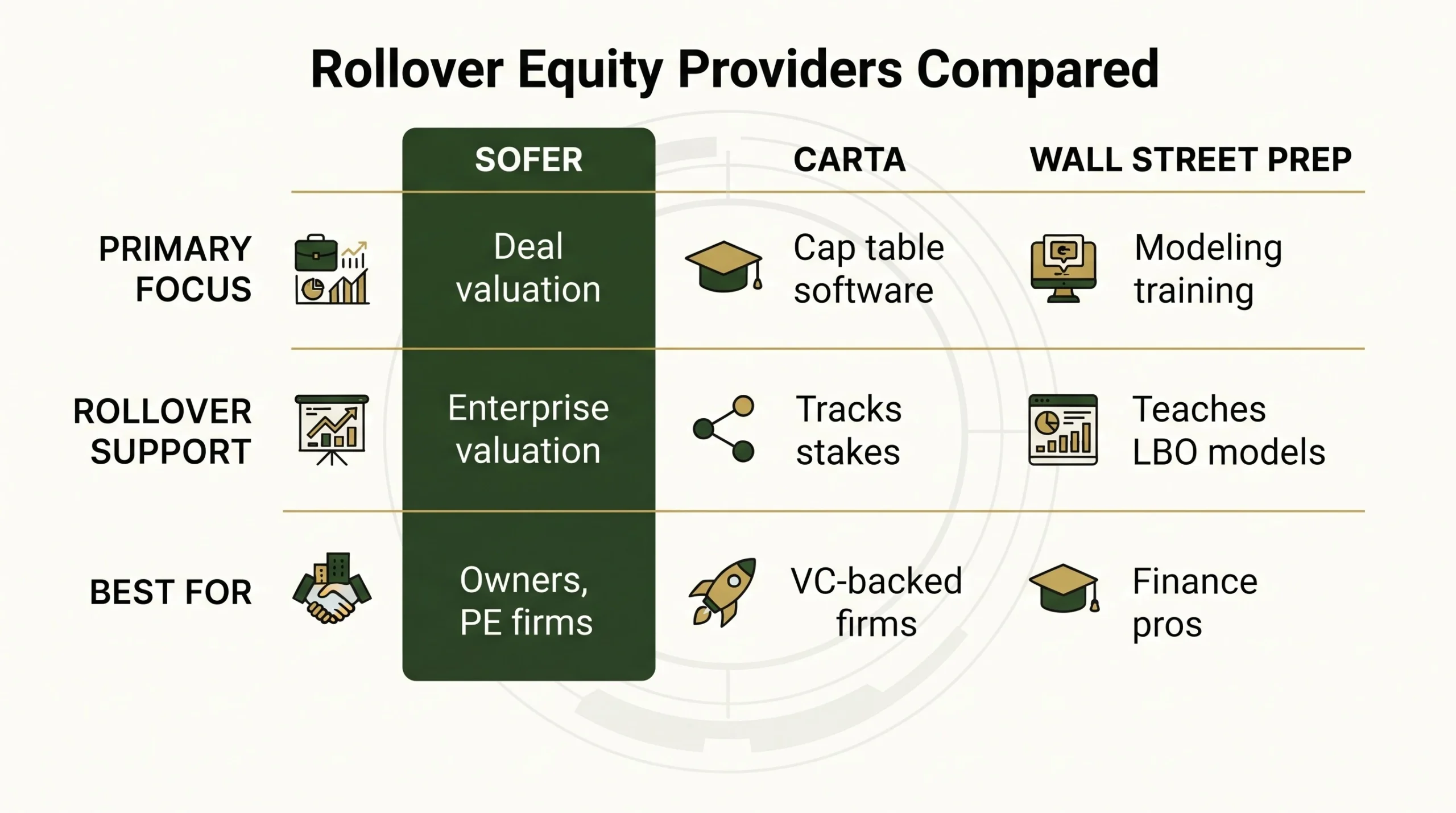
| Service Component | Sofer Advisors (Transaction Advisory) | Carta (Platform Solution) | Wall Street Prep (Training) |
|---|---|---|---|
| Primary Focus | Defensible, third-party valuation and deal structure analysis for specific transactions. | Cap table management software and 409A valuations for ongoing compliance. | Financial modeling training courses for individuals and teams. |
| Rollover Equity Support | Provides the enterprise valuation that underpins the rollover calculation and IRS compliance. | Tracks the resulting ownership stakes and complex securities on the cap table post-deal. | Teaches analysts how to model LBOs and rollover scenarios in Excel. |
| Best For | Business owners and PE firms needing an objective valuation to execute a transaction. | VC-backed companies managing complex equity and compliance over time. | Finance professionals looking to build technical modeling skills. |
Each provider works in its own part of the finance world, so knowing these lines helps you assign the right task. A cap-table platform tracks who owns what but lacks the judgment needed for high-stakes talks.
Training platforms build skills for your team but do not do the independent analysis the IRS or SEC asks for.
Your choice starts with a clear goal. A merger or purchase needs an advisor who knows deal valuation standards like ASC 805 or Revenue Ruling 59-60.
If instead you must manage employee options across a growing firm, software gives the speed you need for daily admin. Weigh these needs against your business cycle to get the right support.
What should the valuation review compare?
A solid analysis links each big judgment to the records and market proof on the valuation date.
| Decision area | Evidence and review focus |
|---|---|
| Why is rollover equity used in PE transactions | Rollover equity is used in private equity transactions to ensure the interests of the business owner and the private equity firm remain aligned through the transition. |
| How is rollover equity valued for a deal | Rollover equity is typically valued using the same enterprise valuation calculated for the overall transaction, but it remains critical to establish a defensible fair market value to satisfy IRS requirements. |
| What are the primary tax implications of a rollover | The primary tax implication of a rollover is tax deferral on the portion of sale proceeds received as equity, rather than the immediate tax impact associated with a full cash exit. |
The final report should tie these areas together, not treat any method or input on its own.
Frequently Asked Questions
What is rollover equity in PE?
Rollover equity is the part of sale proceeds that a seller reinvests as common or preferred stock. That stock goes into the new company built by a PE firm. And instead of taking all cash at closing, the seller keeps a stake that keeps their interests in line with the new owners.
What is a PE rollover?
A PE rollover is a deal term where an owner swaps part of their current equity for a share of the buyer. Because the PE firm often uses debt to fund the purchase, the rollover cuts the cash the deal needs while keeping the founder invested. Sofer Advisors checks the math behind these rollover shares to make sure the deal reflects the agreed value.
How to calculate rollover equity in an LBO?
To find rollover equity, multiply the enterprise value by the share the seller keeps. Then adjust for any debt or preferred positions, and what remains is paid in cash to the seller. Owners often find this math hard due to debt floors and common changes. So Sofer Advisors gives an independent valuation that sets fair market value as the starting point for these sums.
Is rollover equity good for the seller?
It depends on the odds of a second exit and the terms of the new security. You weigh those against the cash choice, since it offers tax deferral and a second bite at the apple. But the seller takes on minority risk and possible dilution, which means later share sales shrink your slice.
How is rollover equity taxed when I eventually sell it?
Rollover equity is usually taxed as a capital gain when the new company has a liquidation event. That event could be a full sale or an IPO, and the tax basis for the shares is usually their fair market value when the rollover took place.
Which tax code sections apply to a rollover?
The right section depends on the entity. For corporations, the swap often uses IRC Section 351, a rule that lets you move property for stock without tax now. For partnerships, the swap often follows IRC Section 721. Owners should also check if their shares count as Qualified Small Business Stock, or QSBS, since that label can bring real tax relief when the equity later sells.
What are the main risks of taking rollover equity?
The main risks are loss of control, weaker share rights, hard-to-sell shares, and missed growth. You often get a minority stake, so you cannot steer big choices or set the timing of a future exit. Your shares usually sit below the investor’s preferred shares, and no public market exists before a final sale. If the business misses its goals, the equity could lose all value.
In a $50M deal with a 20% rollover, how much cash does the seller get?
Take a company with a $50M Total Enterprise Value. If the deal has a 20% rollover, the seller gets $10M in equity value as their new stake and receives $40M in cash. This setup lets the seller share in future growth while cashing out most of the current stake. The exact split still depends on any allocated debt in the structure.
What process does Sofer Advisors follow on these deals?
The Sofer Difference process moves through Discovery, Diligence, Analysis, and Delivery, so each party works from the same set of checked facts. This delivers a defensible valuation that anchors the talks and holds up under tax review. By meeting strict IRS rules and reporting standards, Sofer Advisors keeps every party aligned and cuts down fights between buyers and sellers over worth.
Related Case Studies
- What Is a Leveraged Buyout? LBO Structure Explained
- Asset Sale vs Stock Sale: Tax and Deal Structure Guide
- Management Buyout Process: Steps, Financing and Valuation
Executive Summary
Rollover equity is the portion of sale proceeds an owner reinvests as stock in the new company a PE firm forms, rather than taking the full amount in cash. It aligns the seller with the buyer, funds part of the purchase, and defers capital gains tax on the equity share, often structured under IRC Section 351 for corporations or Section 721 for partnerships. The value flows from the same enterprise value used for the whole deal, calculated as Total Enterprise Value times the Rollover Percentage minus Allocated Debt, so a defensible fair market value is essential for IRS review. In a $50M deal with a 20% rollover, the seller keeps $10M in equity and takes $40M in cash. The main risks are a minority stake, subordination below preferred shares, illiquidity, and total loss if the business underperforms. An independent, neutral valuation sets a true price per share and protects every party’s tax position.
What Should You Do Next?
Look at your current equity and the proposed rollover terms to make sure the deal fits your long-term wealth goals. Read the purchase agreement for key triggers, such as drag-along or tag-along rights, since these shape how your retained shares work after the deal. Ask for a full breakdown of the post-closing capital structure so you can confirm your ownership stays safe from dilution later.
David Hern CPA ABV ASA, founder of Sofer Advisors provides neutral, defensible valuations for rollover equity and private equity transactions. Schedule a free consultation to discuss your situation.
People Also Read
- What Is Equity Compensation? Types and How They Are Valued
- Cost Approach vs Income Approach: Complete Guide
About the Author
This guide was prepared by David Hern CPA ABV ASAc, founder of Sofer Advisors, a business valuation firm headquartered in Atlanta, GA serving clients across the United States. David holds dual accreditations as an Accredited Senior Appraiser (ASA) and is Accredited in Business Valuation (ABV), credentials recognized by the IRS, SEC, and FINRA. He also holds the Certified Exit Planning Advisor (CEPA) designation. With 15+ years of valuation experience, David has served as an expert witness in 11+ cases across multiple jurisdictions and built Sofer Advisors into an Inc. 5000-recognized firm with 180+ five-star Google reviews. Its full W2 employee team maintains subscriptions to all major valuation databases and operates under a next business day response policy.
For professional business valuation services, visit soferadvisors.com/about-us/ or contact Sofer Advisors at soferadvisors.com/contact-us/.
Disclaimer: This content is for informational purposes only and does not constitute professional valuation advice. Business valuation conclusions depend on specific facts and circumstances. Contact Sofer Advisors for guidance regarding your specific situation.