Last Updated: July 2026
A private company secondary sale valuation finds the fair market value of shares sold by existing stakeholders, such as employees or early investors, to third parties before an IPO or acquisition. It sets a defensible price for equity that has no public ticker or active exchange. Analysts must reconcile the company’s internal stage with external pricing to give stakeholders a clear, supportable price.
Sofer Advisors works to bring transparency to these complex ownership changes. With seven years of experience, its analysts bring real rigor to every project. That work rests on 180+ five-star Google reviews and 11+ expert-witness cases, which helps every report hold up under scrutiny.
Owners, attorneys, and early investors rely on these valuations to stay compliant and tax-efficient during private transfers. The analysis must weigh specific risk factors, company history, and future prospects to reach an outcome all parties accept. That clarity is the foundation for secondary deals that keep private companies moving toward a liquidity event.
Key Takeaways
- Liquidity without dilution: a secondary sale lets a shareholder sell stock while the total share count stays the same.
- 409A impact: a secondary price is direct market evidence the IRS may weigh when testing fair market value for option strike prices.
- Price variance: buyer strategy, seller motivation, and information gaps often move a secondary price away from the 409A.
- Formal documentation: an independent report sets a clear fair market value and helps hold the 409A safe harbor.
- Professional oversight: a qualified appraiser manages Right of First Refusal terms and lowers tax risk for all parties.
These factors shape how a company prepares for audits and stakeholder questions. The sections below show how to reconcile these signals with your existing equity structure.
How does a secondary sale differ from primary issuance?
A secondary sale is when existing shareholders transfer their stakes to other investors. A primary issuance is when the company sells new equity to raise capital. In a secondary deal, ownership changes hands without creating new shares, so the share count stays the same and current holders see no dilution. A primary issuance adds shares to the cap table to bring cash into the business.
The key difference is where the money goes. In a secondary sale, the cash goes to the selling shareholder as a liquidity event. In a primary issuance, capital flows into the company treasury to fund growth. Owners weigh these paths when planning a long-term equity strategy. Sofer Advisors helps firms analyze how each option affects their ownership structure.
What triggers the need for a secondary sale valuation?
A secondary sale valuation is needed when private shareholders want to convert equity into cash before a formal liquidity event like an IPO or acquisition. The value must be current and defensible so pricing is fair to all parties. Common triggers include:
- Employees needing liquidity to cover the cost and taxes of exercising vested options
- Early investors reaching the end of their investment cycle and seeking an exit
- Professionals diversifying personal wealth before a public offering
- Companies running periodic programs to offer staff a cash-out window
Holding equity represents value, but that wealth stays locked until a transaction occurs. Giving holders a path to realize gains takes a standard of value consistent with regulatory expectations. Each of these pressures calls for a defensible transaction advisory perspective so the valuation holds up under review.
What are the IRC Section 409A implications?
IRC Section 409A implications arise when a secondary transaction suggests the company’s fair market value has moved well above the strike price used for employee grants. If the internal valuation behind the strike price looks too low against actual secondary sales, the IRS may treat those options as deferred compensation. That misclassification can bring severe penalties for employees: immediate income tax, a 20 percent additional tax, and possible interest. Our guide to skipping a 409A valuation covers the penalties in detail.
Secondary sales give empirical evidence of value that regulators may weigh alongside a formal report. When an outside deal closes above the most recent valuation, it draws scrutiny on whether the prior strike price was reasonable. When a company fails to account for these market signals in time, the case for a defensible value gets harder. Without accurate reconciliation, a company risks noncompliance with IRS standards.
What valuation methods are used for secondary sales?
Secondary sales are valued by applying the income and market approaches to the enterprise, then adjusting the equity value for the specific interest sold. Because these interests are usually non-controlling and illiquid, valuators apply a discount for lack of control (DLOC) and a discount for lack of marketability (DLOM) to reach a defensible price. These adjustments reflect what a buyer would pay for a minority share that cannot steer company policy or exit timing. Our comparison of 409A methods shows how OPM and PWERM fit in.
Valuators often analyze recent funding rounds and secondary market data as primary inputs. Using Business Valuation Resources (BVR / DealStats) data alongside current venture financing trends grounds the work in observable evidence. This takes a careful balance between the company’s internal earnings and the broader liquidity conditions in the private market.
Talk to a Sofer Advisors specialist about which approach fits your secondary sale.
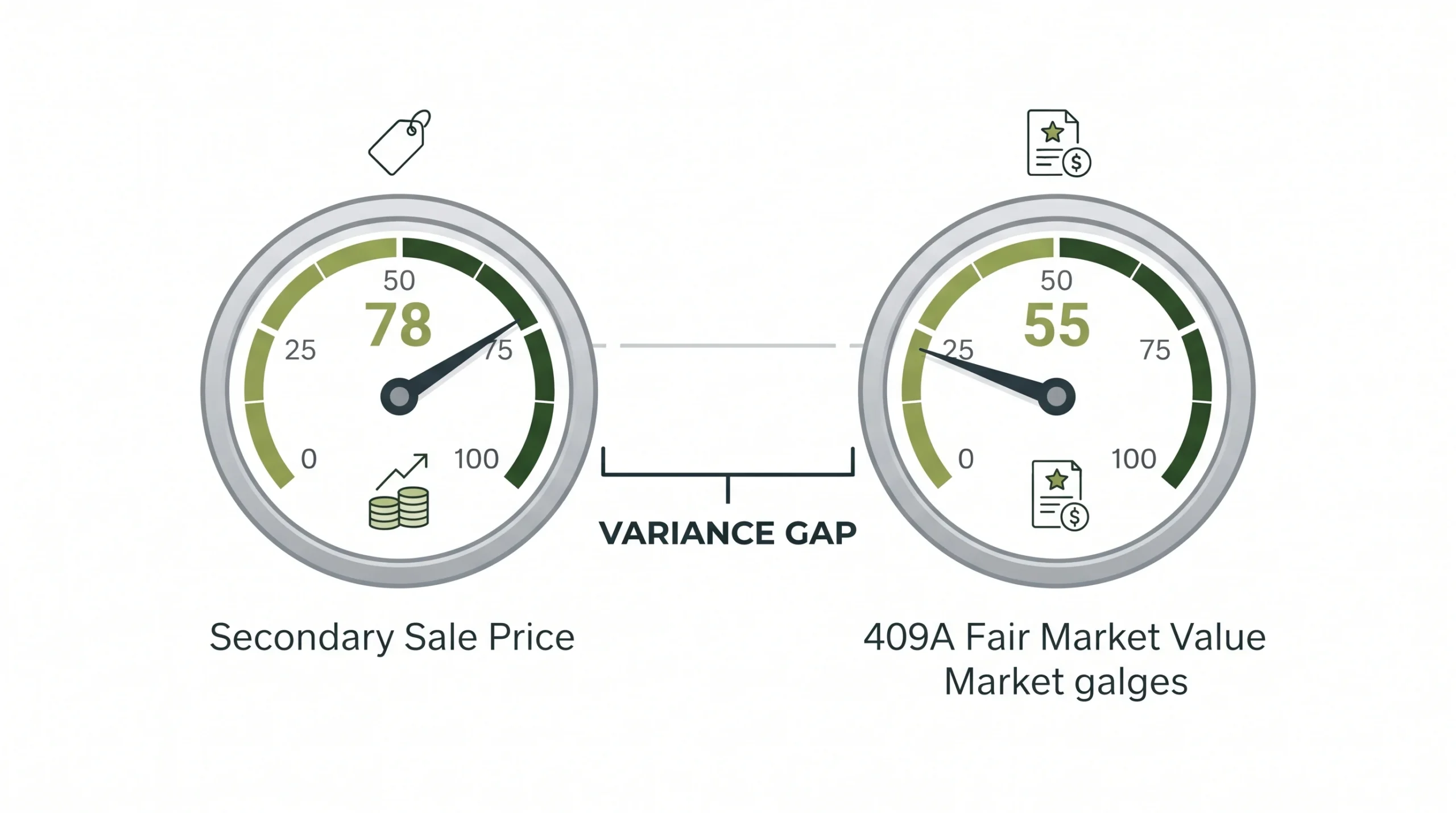
Why might a secondary sale price differ from 409A FMV?
A secondary price often differs from 409A fair market value, because these deals carry premiums or discounts unique to the participants. A 409A aims for a neutral fair market value for options, while a secondary sale is a negotiated event shaped by personal cash needs or strategy.
A strategic buyer might pay a premium to gain specific technology insight or long-term control. That price reflects value to that buyer, not a broad market baseline. A seller who needs cash fast might accept a steep discount for a quick exit. These individual motives do not reflect the general value of common stock. Information gaps also drive price differences, since buyers and sellers rarely hold identical data. A Right of First Refusal can restrict liquidity and lower what an outside party will pay. Sofer Advisors weighs these factors when judging how relevant a market transaction is to a formal 409A.
How do you document the valuation for compliance?
A defensible report for a secondary sale needs a full analysis from an independent appraiser that lays out the methods, key assumptions, and transaction-specific adjustments. That work documents fair market value and gives the board a safe harbor under IRC Section 409A. By showing a good-faith effort to reach a reasonable price, the board protects the company and its employees from future IRS scrutiny.
The report must detail how the appraiser weighed market data and internal financials to reach the conclusion. When secondary shares trade at prices that differ from standard valuations, the appraiser explains the logic behind the gap. Following the uniform standards of professional practice is essential for integrity in tax reporting. Sofer Advisors helps companies make sure their reporting meets the expectations of the AICPA and tax authorities.
Which valuation provider is best for a secondary sale?
The right provider depends on how audit-ready you need to be. Legal templates help with contract language but give no formal opinion on value. Secondary platforms provide liquidity but act as brokers, not valuation experts. Large advisory practices like Alvarez & Marsal, Stout, and Kroll serve big late-stage programs. For a defensible fair market value, an independent valuation firm fills the gap. The table below compares the options.
| Provider type | Typical scope | Best for |
| Sofer Advisors | Neutral, defensible report reconciling deal prices with FMV | Companies managing structured liquidity or facing an audit |
| Legal template service | Document templates and structuring guides | Early-stage startups with simple, friendly-party deals |
| Secondary market platform | Marketplace connecting sellers to buyers | Shareholders at late-stage firms seeking liquidity |
Specialized support gives the strongest defense during a tax review. Legal templates help with basic contract language, but they do not offer the formal opinion on fair market value the IRS expects when deals happen at prices different from recent 409A reporting. Platforms offer liquidity, yet they work as brokers, not valuation experts. An independent firm reconciles current transaction activity with your equity grant history, so public-facing deals and internal records stay consistent. This matters most for companies facing AICPA valuation standards or a later equity review by the SEC. Engaging analysts early avoids the pitfalls of self-reporting.
Secondary sales reward independent evidence and clear reconciliation. The questions below cover what stakeholders ask most.
Frequently Asked Questions
What is a secondary sale in private equity?
A secondary sale is when an existing shareholder transfers equity to a new or current investor in a private company. It gives the seller liquidity, while the company issues no new shares and receives no capital. Sofer Advisors determines the fair value of these interests so the deal reflects current market conditions and tax compliance standards.
Do I have to sell my stock if a company goes private?
Shareholders are generally not required to sell when a company goes private, though the bylaws or shareholders agreement set the specific rights. Companies often offer a cash-out option during the transition, which needs a formal valuation to confirm the price is fair. Sofer Advisors values these interests so participants understand the impact of selling versus holding.
Who benefits from the sale of shares in the secondary market?
Sellers benefit by getting cash without waiting for an IPO or acquisition, while buyers gain access to private equity at a potentially discounted rate. Existing investors may benefit by setting a price point for future rounds or compensation plans. Sofer Advisors provides neutral reports so all parties confirm the terms are fair for tax and financial reporting.
How does a Right of First Refusal affect a private stock sale?
A Right of First Refusal lets the company or its current shareholders buy the stock before an outside buyer can complete the deal. That barrier often affects the final price, since liquidity stays restricted rather than open. Sofer Advisors accounts for ROFR terms by applying appropriate discounts to reflect the limited transferability of the shares.
Can a secondary transaction set a new 409A price for my company?
A secondary deal often gives empirical evidence regulators may weigh when testing a strike price under IRC Section 409A. It does not automatically reset a formal 409A, but any large price variance in open-market sales needs careful reconciliation to avoid penalties. Sofer Advisors evaluates these signals so clients keep a defensible position for future grants.
What are the tax implications for an employee selling private stock?
Employees usually face capital gains tax on the difference between their cost basis and the sale price. If the sale price is well above the latest 409A, the IRS may look for hidden compensation, which could trigger higher rates. Sofer Advisors provides clear, objective reports that document the basis for the price to reduce tax exposure.
What is a tender offer in the context of secondary sales?
A tender offer is a formal proposal by a company or outside investor to buy a set number of shares from existing holders at a set price. It standardizes the process by offering all eligible holders the same terms at once. Sofer Advisors determines fair market value for these offers so the price aligns with performance and standards like ASC 820.
What is the difference between preferred and common stock in a secondary sale?
Preferred stock usually carries liquidation preferences and dividend rights that give it a higher value than common stock in most secondary sales. Valuing these interests means accounting for the specific rights on each class, which often leads to different per-share pricing. Sofer Advisors analyzes the share rights in detail to give a precise value for each security type.
How much does a secondary sale valuation from Sofer Advisors cost?
A secondary sale valuation from Sofer Advisors runs $7,500 to $25,000, based on its published engagement data, with multiple share classes reaching the higher end. Cost depends on the ownership structure, the number of share classes, and the documentation required. For a quote tied to your cap table, request a valuation estimate with your share structure and recent transactions.
Related Case Studies
- How Often Do You Need a 409A Valuation Update?
- What Is Equity Compensation? Types and How They Are Valued
- Restricted Stock Units vs Stock Options: Key Differences
Executive Summary
A secondary sale gives an existing shareholder liquidity by selling private stock to another investor, with no new shares and no dilution. Because the price is real market evidence, the IRS may weigh it against your 409A fair market value when testing option strike prices. Deals carry buyer premiums, seller pressure, information gaps, and Right of First Refusal terms, so the secondary price often differs from a neutral 409A. Analysts value the interest with the income and market approaches, then apply DLOC and DLOM. An independent report reconciles the two figures and protects the 409A safe harbor. To prepare, assemble your cap table, recent funding rounds, and the specific terms of the shares being sold.
What Should You Do Next?
Assemble your cap table, recent funding rounds, and the terms of the shares being sold, including any Right of First Refusal. Confirm how the secondary price compares to your most recent 409A, since a large gap needs reconciliation. An independent valuation can then document a defensible fair market value and protect your safe harbor.
David Hern CPA ABV ASA, founder of Sofer Advisors, guides owners and investors through these complex equity events. Schedule a free consultation to discuss your situation.
People Also Read
About the Author
This guide was prepared by David Hern CPA ABV ASA, founder of Sofer Advisors, a business valuation firm headquartered in Atlanta, GA serving clients across the United States. David holds dual accreditations as an Accredited Senior Appraiser (ASA) and is Accredited in Business Valuation (ABV), credentials recognized by the IRS, SEC, and FINRA. He also holds the Certified Exit Planning Advisor (CEPA) designation. With 15+ years of valuation experience, David has served as an expert witness in 11+ cases across multiple jurisdictions and built Sofer Advisors into an Inc. 5000-recognized firm with 180+ five-star Google reviews. Its full W2 employee team maintains subscriptions to all major valuation databases and operates under a next business day response policy.
For professional business valuation services, visit soferadvisors.com/about-us/ or contact Sofer Advisors at soferadvisors.com/contact-us/.
Disclaimer: This content is for informational purposes only and does not constitute professional valuation advice. Business valuation conclusions depend on specific facts and circumstances. Contact Sofer Advisors for guidance regarding your specific situation.