


Last Updated: August 2026
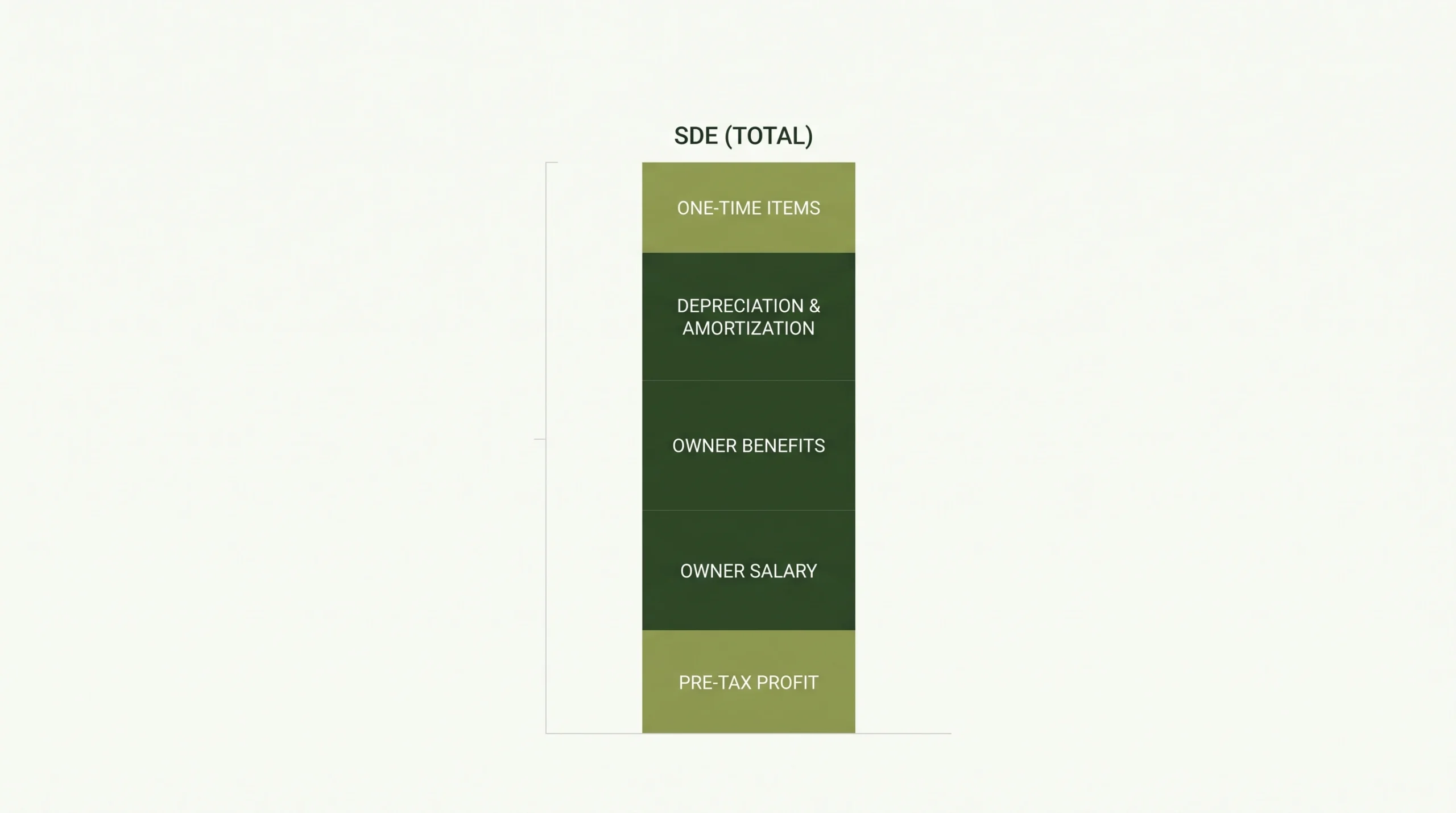
Seller’s discretionary earnings (SDE) is the full cash benefit one owner draws from a small business in a year. You start with pre-tax profit, then add back the owner’s pay, perks, interest, depreciation, amortization, and one-time costs. Sofer Advisors uses this figure to price owner-run firms. Deal data in the BizBuySell business valuation multiples by industry report shows most small firms sell for two to four times SDE. A clean number keeps buyer and seller close on price.
This figure matters because it sets the asking price on most main-street sales and shapes what a bank will lend against the deal. It also decides which businesses draw serious buyers, since offers track a multiple of it. Owners who understand how it is built can defend their number when a buyer starts trimming add-backs during diligence.
Key Takeaways
- What it measures: SDE shows the total cash one owner-operator earns from a small firm each year.
- How you build it: Start with pre-tax profit. Add back owner pay, perks, interest, depreciation, amortization, and one-time items.
- Not EBITDA: SDE adds back one owner’s salary. EBITDA does not, so it fits larger firms with hired managers.
- Multiples set price: Buyers pay a multiple of SDE. Risk, size, and owner reliance move that number.
- Add-backs get tested: Every claimed add-back needs proof. Weak ones get struck during due diligence.
These points show how one figure ties earnings to price. The sections below walk through the build-up. They also cover SDE versus EBITDA, typical multiples, and the add-backs that spark disputes.
What is seller’s discretionary earnings?
SDE is the total financial benefit a single owner takes from a small business in one year. It answers a simple question for a buyer: how much cash would I earn by running this firm myself? The metric fits owner-operated companies, usually those under 5 million dollars in revenue. In these firms, one person often does the work of several hired roles. SDE captures that full reward in a single, clear number.
The figure matters most when an owner plans to sell. A buyer wants the true earning power, not a tax-shaped profit line. Many owners run personal costs through the business to lower taxes. SDE strips those out to show what the company really earns. This is the Heart of a Teacher approach that Sofer Advisors brings to each job: show the owner the math, not just the result.
How do you calculate SDE?
You calculate SDE by starting with pre-tax profit, then adding back owner costs and non-cash charges. The goal is normalized earnings, the cash a new owner would keep. The build-up follows a set order, and each line needs support from the books. Analysts call this recasting the financial statements. Done well, it turns a messy tax return into a figure both sides can trust.
The common add-backs fall into a few groups:
- One owner’s pay: The full salary, bonus, and payroll taxes for a single owner-operator.
- Owner perks: Personal auto use, travel, meals, and health costs run through the company.
- Interest: Loan interest, since a buyer may finance the deal on different terms.
- Depreciation and amortization: Non-cash charges that do not use current cash.
- One-time items: A lawsuit, a move, or another cost that will not repeat.
Each entry needs a source in the general ledger or tax return. A buyer will ask for proof, so guesses do not survive review. Say a firm reports 300,000 dollars in pre-tax profit. Add back an 80,000 dollar owner salary, 15,000 in perks, and 5,000 in one-time legal fees. The SDE climbs to 400,000, and that larger figure drives the sale price.
How is SDE different from EBITDA?
The core difference is owner pay. SDE adds back one owner’s full salary, while EBITDA does not. That single choice decides which metric fits a business. SDE suits small, owner-run firms where the buyer will step into the owner’s seat. EBITDA suits larger firms that already pay a hired management team. In those companies, the owner earns a market wage, so their exit does not free up extra cash.
| Metric | Adds back owner salary? | Best suited to | Typical use |
|---|---|---|---|
| SDE | Yes, one owner | Owner-operated firms under 5 million in revenue | Main-street sales, SBA loans |
| EBITDA | No | Larger firms with hired managers | Mid-market and larger deals |
| Adjusted EBITDA | No, but strips one-time items | Growing firms with clean books | Private equity, lender review |
The right metric depends on how the business runs, not just its size. A firm with a full manager team fits EBITDA, since a buyer keeps paying those wages. A firm that leans on one owner fits SDE, since that role frees up cash after a sale. Pick the wrong metric and the price can swing far from fair value. Sofer Advisors helps owners choose the measure that matches how their company actually works.
What are typical SDE multiples?
A multiple is the number of years of SDE a buyer will pay up front. Most small firms trade between two and four times SDE, based on private deal data from DealStats. The exact figure reflects risk more than anything else. Steady earnings, a broad customer base, and low owner reliance lift the multiple. Thin margins, a single big client, or heavy owner dependence pull it down.
Size and industry also shape the number. A larger, well-run firm often earns a higher multiple than a tiny shop with the same margins. Buyers pay more when future income looks safe. They pay less when the earnings hinge on one person who is leaving. This is why generic multiple tables mislead so often. Sofer Advisors sets each multiple against current market evidence, so the price reflects the real business rather than a broad average.
What add-backs cause disputes?
Add-back fights are the most common source of friction in a small-firm sale. A seller wants every possible cost added back to lift SDE. A buyer wants to strip out anything a new owner would still have to pay. The gap between those views can move the price by six figures. Clear proof settles most of these disputes before they stall a deal.
The entries buyers question most include:
- Excess family wages: Pay to relatives who do little real work.
- Blended perks: Costs that mix business and personal use, like a family vehicle.
- Repeat “one-time” items: Charges labeled one-time that show up year after year.
A defensible SDE keeps only the add-backs a new owner would truly skip. Sofer Advisors documents each one in a formal schedule, tied to the general ledger. That record follows AICPA SSVS practice and the guidance in IRS Revenue Ruling 59-60. A clean schedule speeds due diligence and builds trust with the buyer. It also holds up if a lender, tax authority, or court reviews the numbers later.
Who should prepare an SDE valuation?
An SDE valuation should come from an independent expert, not a broker with a stake in the sale. A broker sets a list price to attract offers. An appraiser builds a defensible figure that survives outside review. Those are different jobs with different goals. For a loan, a tax filing, or a dispute, owners need the second kind of work. That means a full add-back schedule backed by market data and clear standards.
This is where The Sofer Difference matters. It is a four-phase process of Discovery, Diligence, Analysis, and Delivery that yields an audit-ready report. Large firms such as Alvarez and Marsal or Kroll aim their work at enterprise clients. Sofer Advisors brings that same senior-level rigor to owner-run companies. And unlike a solo practitioner, it backs every figure with a full W2 team of 14 and subscriptions to all major deal databases. The firm has earned 180+ five-star Google reviews and Inc. 5000 recognition in 2024 and 2025.
Frequently Asked Questions
What is an example of a seller’s discretionary earnings?
Picture a firm with 250,000 dollars in pre-tax profit. It pays the owner a 90,000 dollar salary and runs 12,000 in personal car costs through the books. It also records 8,000 in one-time legal fees. Add those back, and SDE reaches 360,000 dollars. Sofer Advisors checks the general ledger in every job to confirm each add-back is a real owner benefit.
Is SDE the same as net profit?
No. Net profit is the bottom line after all costs, including the owner’s pay. SDE is an adjusted figure that shows the full cash one owner-operator takes home. It adds back that salary, plus perks and non-cash charges, before tax. The two answer different questions. Sofer Advisors separates true operating costs from owner benefits, so buyers see the cash flow they would actually keep.
How is SDE different from EBITDA?
The key gap is owner pay. SDE adds back one owner’s full salary, while EBITDA leaves it in place. SDE fits small firms where a buyer steps into the owner’s role. EBITDA fits larger firms that already pay hired managers a market wage. Sofer Advisors picks the metric that matches how a business runs, so the resulting value reflects its real earning power.
What is a typical SDE multiple?
Most small businesses sell for two to four times SDE, based on private deal data from DealStats. The exact number tracks risk, size, and owner reliance. Steady earnings and a broad customer base raise it. Heavy dependence on one owner lowers it. Sofer Advisors sets each multiple against current market evidence rather than a generic table, so the price fits the specific company under review.
Can a business have negative SDE?
Yes. A firm has negative SDE when its losses run deeper than the owner’s benefits added back. This signals the business is not producing positive cash for an owner right now. In that case, an appraiser may turn to asset-based methods instead. Sofer Advisors flags these shortfalls early in due diligence, so owners understand the true economic picture before they talk with a buyer or partner.
Why is only one owner’s salary added back?
A small firm needs just one person in the owner-operator seat. Adding two salaries would overstate the cash a single buyer could keep. So SDE adds back the pay for one owner only. Sofer Advisors follows recognized valuation standards on this point, keeping the salary add-back in line with the market cost of hiring a manager to fill that role.
What documents support an SDE calculation?
An appraiser needs at least three years of tax returns, current profit and loss statements, and a balance sheet. Access to the general ledger is vital, since it lets the analyst audit each expense line. The owner also supplies a list of costs they view as personal or one-time. Sofer Advisors reviews this evidence closely, so every add-back rests on a verifiable record rather than a guess.
How much does a business valuation from Sofer Advisors cost?
Business valuations from Sofer Advisors typically run 7,500 to 25,000 dollars. The price depends on how complex your books are and the purpose of the report. Simpler jobs for planning or tax sit near the lower end. Deals and litigation support need deeper work, so they fall higher. Contact Sofer Advisors for a fee quote matched to your specific situation and goals.
Related Case Studies
- EBITDA Add-Backs: What Buyers Accept and What They Reject
- Owner Compensation Normalization: Why Salary Affects Sale Value
- Excess Earnings: Valuing Goodwill and Assets
Executive Summary
SDE is the full cash benefit one owner earns from a small business in a year. You build it from pre-tax profit by adding back owner pay, perks, interest, depreciation, amortization, and one-time costs. It differs from EBITDA, which leaves owner pay in place and fits larger firms with hired managers. Most small firms sell for two to four times SDE, per DealStats data, with risk and owner reliance moving the figure. Add-back disputes can swing a price by six figures. A defensible schedule, built under AICPA SSVS practice and IRS Revenue Ruling 59-60, keeps the number credible with buyers, lenders, and courts.
What Should You Do Next?
Start by recasting your financial statements so personal and one-time costs do not distort earnings. Then confirm whether SDE or EBITDA fits how your business runs. Finally, back each add-back with a source in the general ledger, since unsupported items rarely survive due diligence.
For an SDE figure you can stand behind, work with David Hern CPA ABV ASA. His team has given expert witness testimony in 11+ cases across Georgia, Florida, California, and New Mexico. Schedule a consultation to discuss the earnings figure that fits your business.
People Also Read
- Customer Concentration: Why It Cuts Sale Price 10 to 30 Percent
- Precedent Transaction Analysis: Deal Comps
About the Author
This guide was prepared by David Hern CPA ABV ASA, founder of Sofer Advisors, a business valuation firm headquartered in Atlanta, GA serving clients across the United States. David holds dual accreditations as an Accredited Senior Appraiser (ASA) and is Accredited in Business Valuation (ABV), credentials recognized by the IRS, SEC, and FINRA. He also holds the Certified Exit Planning Advisor (CEPA) designation. With 15+ years of valuation experience, David has served as an expert witness in 11+ cases across multiple jurisdictions and built Sofer Advisors into an Inc. 5000-recognized firm with 180+ five-star Google reviews. Its full W2 employee team maintains subscriptions to all major valuation databases and operates under a next business day response policy. For professional business valuation services, visit soferadvisors.com/about-us/ or contact Sofer Advisors at soferadvisors.com/contact-us/.
Disclaimer: This content is for informational purposes only and does not constitute professional valuation advice. Business valuation conclusions depend on specific facts and circumstances. Contact Sofer Advisors for guidance regarding your specific situation.









