


Last Updated: October 2026
A WARA reconciliation is a short test with a sharp edge. If the WARA does not tie to the WACC, one of the intangible rates is wrong. WARA stands for weighted average return on assets. In a purchase price allocation, or PPA, it checks one thing. The return on each acquired asset, blended by value, should match the return on the whole deal. When the two numbers drift apart, the model has a flaw that an auditor will find.
Sofer Advisors builds and tests these models for acquirers, CPAs, and auditors, backed by Inc. 5000 recognition and 180+ five-star Google reviews. The reconciliation proves the parts add up to the price paid. Set one intangible rate too low, and the WARA falls below the WACC. Set it too high, and it climbs past it. Either way, the gap is a question waiting to be asked.
This guide explains what a WARA is, how the WACC, the WARA, and the deal IRR reconcile, and how each asset class earns its return. It also covers the guidance behind the test, the market data behind the rates, and why auditors read the schedule closely.
Key Takeaways
- The WARA is a reasonableness test: it confirms that the asset rates in a PPA blend back to the return for the whole business.
- Three rates should agree: the WACC, the WARA, and the internal rate of return on the deal should land close to each other.
- Weight by fair value: each asset class carries its own required return, weighted by its share of total fair value, and the weighted result equals the WACC.
- Goodwill is the shock absorber: it usually carries the highest rate, so a thin goodwill return is often the first sign of a problem.
- Auditors expect a clean tie-out: a documented reconciliation, framed by AICPA and Appraisal Foundation guidance, keeps the allocation defensible.
Each point feeds the wider valuation model. The sections below take them one at a time.
Why Is WARA Reconciliation Important to Understand?
A WARA reconciliation matters because it is the math that proves a PPA is internally consistent. An acquirer pays one price, and that price implies one blended return on the business. The PPA splits the price across cash, working capital, fixed assets, identifiable intangibles, and goodwill. Each piece gets its own discount rate. The WARA adds those rates back up, weighted by value, and compares the total to the WACC. If the test fails, the asset values do not sum to the deal, and the balance sheet rests on a number that does not hold.
What Is a WARA, and What Does It Prove?
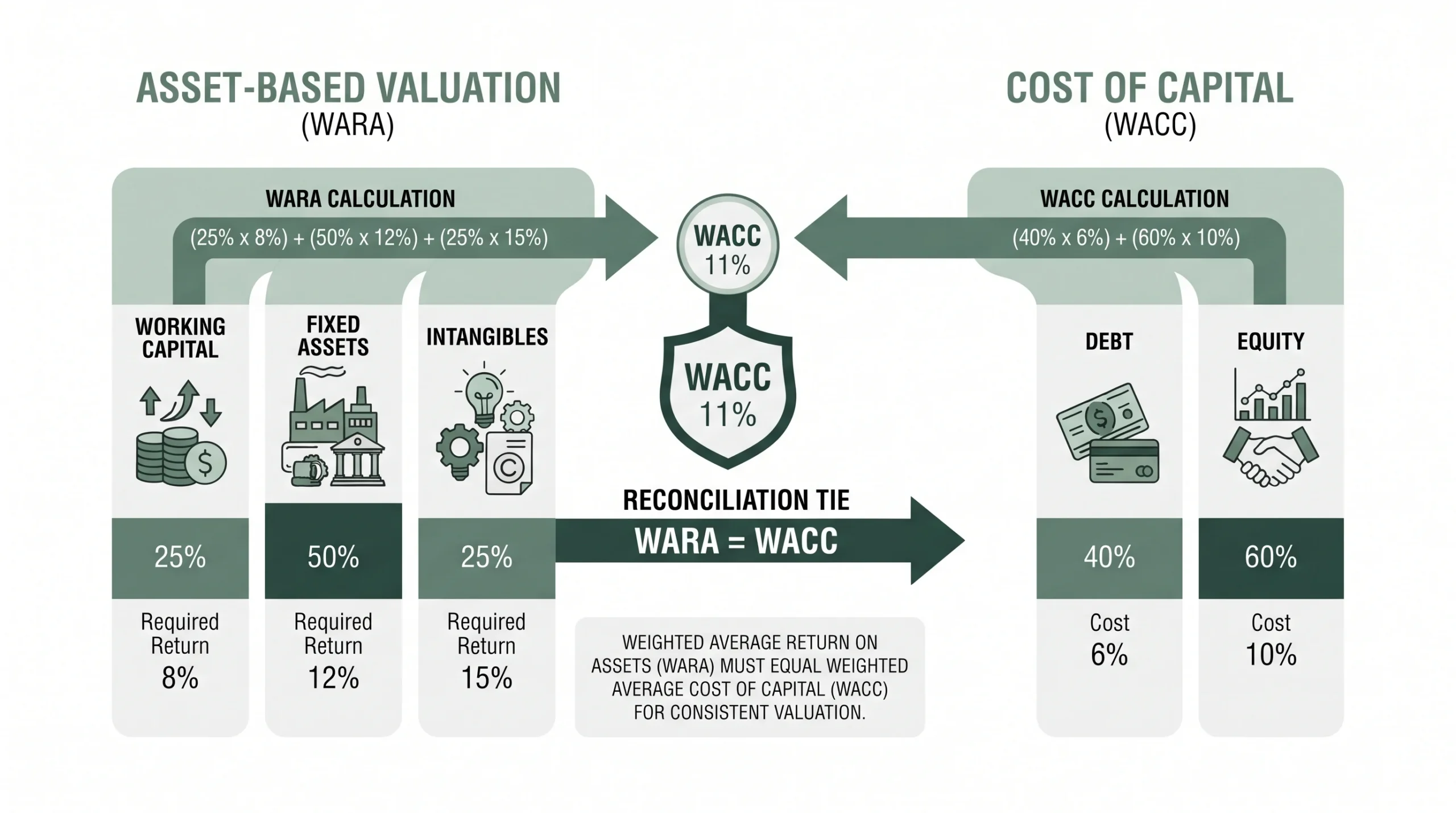
The WARA is the fair-value-weighted average of the returns on every acquired asset. You take each asset class, multiply its fair value by its required rate of return, add the products, and divide by total fair value. The result is a single blended rate. In a clean allocation, that rate sits right next to the WACC for the acquired business.
The test proves the rates behave as a set, not a loose pile of guesses. Low-risk assets earn low returns. A trade receivable sits near a short-term market rate. Higher-risk assets earn more. Developed technology or customer relationships carry rates well above the WACC. Goodwill sits at the top, since it absorbs the rest of the deal risk. When the weighted blend of these returns equals the WACC, the logic is sound.
How Do the WACC, WARA, and Deal IRR Reconcile?
Three rates frame a purchase price allocation. The WACC is the market cost of capital for the acquired business. The internal rate of return, or IRR, is the rate that sets the deal’s projected cash flows equal to the price paid. The WARA is the blended return on the assets. In a well-priced, arm’s length deal, all three land close together.
When they diverge, each gap tells a story. If the IRR sits far above the WACC, the buyer may have paid below value, or the forecast is too rich. If the WARA drifts from the WACC, the asset rates need another look. Many analysts anchor the test to the deal IRR, since it reflects the actual bargain struck. The three rates need not match to the decimal. They do have to tell the same story about risk.
How Does Each Asset Class Earn Its Required Return?
Every asset on the opening balance sheet earns a return that fits its risk. The reconciliation stacks those returns in order and weights each by its share of fair value. Working capital, such as receivables and inventory, earns the least. It is liquid and close to cash, so its rate tracks a short-term market rate. Fixed assets earn a bit more, roughly a secured financing rate, because equipment and real estate can back a loan.
Identifiable intangibles earn more still. A trade name valued by relief from royalty, or a customer base valued by the multi-period excess earnings method, carries a rate above the WACC. These assets are harder to finance and replace. Goodwill takes the highest rate of all, since it is what remains after every identified asset is priced. When you weight each rate by relative fair value and add them, the sum should equal the WACC. That single line is the reconciliation.
What Guidance and Market Data Stand Behind the Rates?
The WARA test is a practice expectation, not a line in the codification. The AICPA accounting and valuation guide on business combinations treats it as a core reasonableness check. The Appraisal Foundation’s Mandatory Performance Framework raises the bar on documentation, so the rates and the weights need a written trail. Appraisers who hold the CEIV credential are expected to meet that framework on financial reporting work.
The rates draw on public market data. The risk-free rate comes from the Treasury yield curve. Equity risk premiums and industry betas come from sources such as the Kroll Cost of Capital Navigator and published academic datasets. Size and company-specific adjustments round out the WACC. On the tax side of an allocation, the rules in IRC Section 1060 govern how the price is spread across asset classes on IRS Form 8594, and IRC Section 197 sets the amortization of acquired intangibles. See how Sofer Advisors handles financial reporting valuations when the reconciliation has to satisfy an audit.
Why Do Auditors Scrutinize the WARA?
Auditors scrutinize the WARA because most of a PPA rests on unobservable inputs. Intangible values come from internal forecasts and chosen discount rates, not quoted prices. That subjectivity invites skepticism. The reconciliation is the one control that forces those private assumptions to agree with the public price of the deal.
A reviewer reads the schedule for a few tells. A goodwill rate below the identified intangible rates is a red flag, since goodwill should carry the most risk. A WARA that misses the WACC by a wide margin points to a forecasting or weighting error. Overstated growth on one intangible can pull the whole blend off. A clear tie-out, with each rate and weight shown, moves the review along instead of stalling it.
Who Performs a WARA Reconciliation, and How Do the Options Compare?
Buyers pick a valuation partner based on deal size, audit exposure, and budget. Large national firms such as Alvarez & Marsal, Stout, and Kroll serve big public filers. Sofer Advisors focuses on defensible, partner-led PPAs for middle-market acquirers, with expert witness work in 11+ cases behind its reports. The table below sets out the common options.
| Provider | Typical role | Best for |
|---|---|---|
| Specialized valuation firm (e.g. Sofer Advisors) | Builds the PPA and documents the WARA tie-out for audit | Middle-market acquirers needing a defensible, well-explained model |
| Large national firm | Broad advisory plus valuation at enterprise scale | Large public filers with complex, multi-entity deals |
| Internal finance team | Prepares a first draft, then seeks outside review | Routine deals where an independent opinion still backstops the audit |
Sofer Advisors runs each engagement through a four-phase process it calls The Sofer Difference, moving from Discovery to Diligence to Analysis to Delivery. That structure keeps every asset rate tied to the market data and the weights behind it. It reflects the Heart of a Teacher approach, which means explaining why each rate sits where it does, not just handing over a schedule. For an allocation that holds up on review, an independent reconciliation supplies both the numbers and the trail behind them.
Frequently Asked Questions
What is a WARA reconciliation?
A WARA reconciliation is a check in a purchase price allocation. It confirms that the weighted average return on the acquired assets matches the weighted average cost of capital for the business. You weight each asset’s required return by its fair value, add the results, and compare the blend to the WACC. A close match shows the model holds together. Sofer Advisors runs this test on every PPA so the asset rates and the deal price agree.
What is the difference between the WARA and the WACC?
The WACC is the market cost of capital for the whole business, built from the cost of debt and equity. The WARA is built from the bottom up, by blending the required return on each acquired asset by its fair value. One looks at the business as a single unit, the other at its parts. In a clean allocation the two land close together. Sofer Advisors reconciles them so a gap gets explained before the audit does.
How is the WARA calculated in a PPA?
You take each acquired asset, multiply its fair value by its required rate of return, and add the products across every asset class. Then you divide that sum by the total fair value of the assets. The result is one blended rate, the WARA. It should sit next to the WACC for the acquired business. Sofer Advisors documents each rate and weight in the schedule so the calculation is easy for an auditor to follow.
What discount rate is the WARA reconciled against?
The WARA is reconciled against the WACC for the acquired business, and often against the internal rate of return on the deal. The WACC reflects broad market data. The deal IRR reflects the actual price the buyer paid for the projected cash flows. Many analysts prefer the IRR as the benchmark, since it captures the specific bargain. Sofer Advisors compares the WARA to both so the asset rates track the real economics of the transaction.
How does each asset class earn its required return?
Each class earns a return that fits its risk. Working capital earns the least, near a short-term rate, because it is close to cash. Fixed assets earn a bit more, around a secured financing rate. Identifiable intangibles earn above the WACC, since they are hard to finance or replace. Goodwill earns the most, as the residual risk of the deal. Sofer Advisors weights each return by fair value so the blend equals the WACC.
What causes a WARA reconciliation to fail?
A reconciliation usually fails for three reasons. The benchmark WACC may be built on the wrong inputs. A high-value intangible may carry a rate that is too low or too high. Or the growth and attrition forecasts for one asset may be off. Any of these pushes the blended return away from the WACC. Sofer Advisors reviews the inputs for each asset, finds the rate that is out of line, and corrects it before finalizing the model.
What is a contributory asset charge?
A contributory asset charge is the return other assets require for helping produce an intangible’s cash flow. When you value customer relationships, the working capital and fixed assets that support those sales also deserve a return. You subtract that charge so the cash flow left reflects only the intangible being valued. This prevents double-counting across the allocation. Sofer Advisors builds these charges into every excess earnings model so each intangible carries only the value it truly earns.
What guidance frames the WARA test?
No single accounting rule mandates a WARA by name. The test comes from practice and from the AICPA guide on valuing a business combination, which treats it as a core reasonableness check. The Appraisal Foundation’s Mandatory Performance Framework adds a documentation standard for financial reporting work. Together they set the expectation that the rates are supported and tied out. Sofer Advisors prepares each reconciliation to meet that framework so the schedule reads as audit-ready.
How much does a WARA reconciliation or PPA valuation cost?
A full purchase price allocation with a WARA tie-out generally runs from $15,000 to $50,000, depending on the number of intangibles and the deal’s complexity. The work usually takes six to twelve weeks, which leaves room for documentation and auditor review. A flat fee is quoted up front, so the cost is clear before the work begins. Sofer Advisors scopes the engagement first, then sets a fixed price. Request a free estimate for your deal.
Related Case Studies
- Purchase Price Allocation ASC 805 and IFRS 3: Complete Guide for Business Leaders
- WACC for Business Valuation: Calculation and Application
- The Multi-Period Excess Earnings Method (MPEEM) Explained
Executive Summary
A WARA reconciliation tests whether a purchase price allocation hangs together. You weight the required return on each acquired asset by its fair value, blend the results, and compare the total to the WACC for the business. Working capital earns the least, intangibles earn more, and goodwill earns the most as the residual. When the blend equals the WACC, the asset rates are consistent with the price paid. Many analysts also check the blend against the deal IRR. The AICPA guide and the Mandatory Performance Framework set the documentation standard, and auditors read the tie-out closely because so much of a PPA rests on unobservable inputs. If the WARA misses the WACC, one rate is wrong, and the fix is to find and correct it before the balance sheet is final.
What Should You Do Next?
Gather the deal model, the asset fair values, and each discount rate, since a clean file supports a clean tie-out. Confirm the WACC inputs and the deal IRR before the allocation is locked. This guide was prepared by David Hern CPA ABV ASA, founder of Sofer Advisors, an Inc. 5000 firm specializing in neutral third-party valuations for financial reporting. Schedule a free consultation to discuss your specific transaction.
People Also Read
About the Author
This guide was prepared by David Hern CPA ABV ASA, founder of Sofer Advisors, a business valuation firm headquartered in Atlanta, GA serving clients across the United States. David holds dual accreditations as an Accredited Senior Appraiser (ASA) and is Accredited in Business Valuation (ABV), credentials recognized by the IRS, SEC, and FINRA. He also holds the Certified Exit Planning Advisor (CEPA) designation. With 15+ years of valuation experience, David has served as an expert witness in 11+ cases across multiple jurisdictions and built Sofer Advisors into an Inc. 5,000-recognized firm with 180+ five-star Google reviews. Its full W2 employee team maintains subscriptions to all major valuation databases and operates under a next business day response policy.
For professional business valuation services, visit soferadvisors.com/about-us/ or contact Sofer Advisors at soferadvisors.com/contact-us/.
This content is for informational purposes only and does not constitute professional valuation advice. Business valuation conclusions depend on specific facts and circumstances. Contact Sofer Advisors for guidance regarding your specific situation.









