


Last Updated: November 2026
The Retire Through Ownership Act creates a good-faith reliance safe harbor for the valuation step in an ESOP transaction. It was signed into law on 15 October 2026 as bill S. 2403. A plan fiduciary who obtains a qualified, independent appraisal may rely on it in good faith to support the price paid for company stock. That reliance satisfies the adequate-consideration requirement, the rule that an ESOP may not pay more than fair market value. The safe harbor is narrow by design, and it does not erase the broader ERISA fiduciary duties a trustee owes.
The team at Sofer Advisors builds ESOP valuations for owners, trustees, CPAs, and attorneys, work that aims to meet this standard.
This guide explains what the law does, what it leaves in place, and what owners and trustees should do now.
Key Takeaways
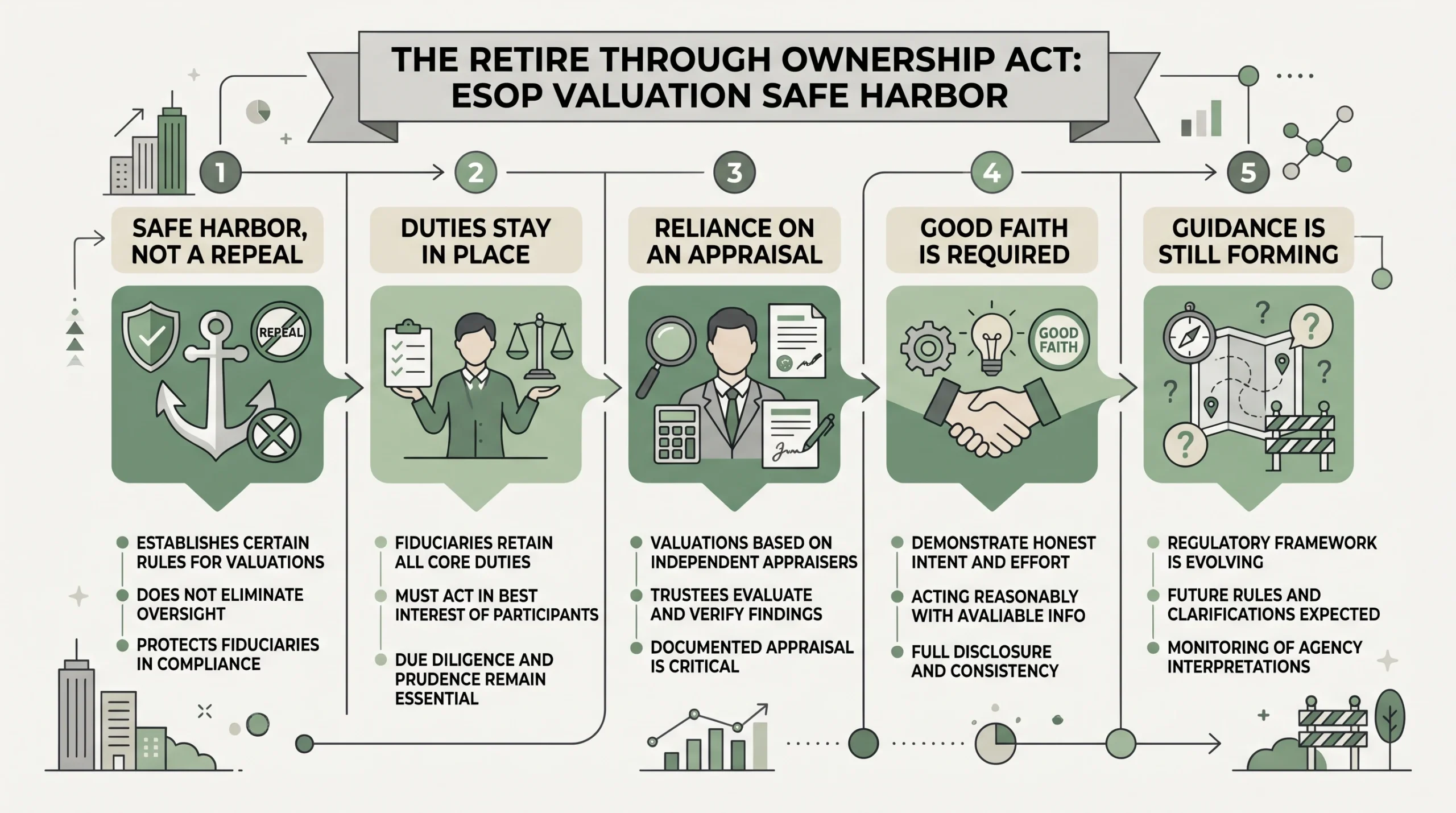
- Safe harbor, not a repeal: The Act creates a good-faith reliance safe harbor for the “adequate consideration” step in an ESOP valuation.
- Duties stay in place: It does not eliminate or change the broader ERISA fiduciary duties that trustees owe plan participants.
- Reliance on an appraisal: A fiduciary may rely in good faith on a qualified, independent appraisal to support the price.
- Good faith is required: The protection depends on an honest, careful process, not a rubber stamp.
- Guidance is still forming: This law is very recent. Implementing rules may still develop, so confirm current requirements with ERISA counsel.
What is the Retire Through Ownership Act?
The Retire Through Ownership Act is a federal law that supports employee ownership. It was signed into law on 15 October 2026. The bill number is S. 2403. Its core change is a safe harbor for the valuation step in an ESOP transaction.
An ESOP is a qualified retirement plan. It buys and holds stock in the company for employees. The price the plan pays matters a great deal. Pay too much, and the plan and its participants lose value. Federal law has long guarded against that risk. The new safe harbor adds a clear way for fiduciaries to show they met the standard.
The law is narrow by design. It focuses on how a fiduciary supports the price paid for employer stock. It does not rewrite the rest of the ESOP rulebook.
Employee ownership has broad appeal across the political spectrum. It lets workers build wealth through their jobs. It also gives owners a path to retire while keeping the business local. The Act reflects that shared interest. It tries to make the valuation step feel less risky for everyone involved.
What does “adequate consideration” mean?
Adequate consideration is the legal limit on what an ESOP may pay for company stock. Under ERISA, the plan may not pay more than fair market value for employer shares. That value is not obvious for a private company. Private stock does not trade on a public market. So someone must estimate the price a willing buyer and seller would reach.
An independent appraiser does that work. The appraiser studies the business, its earnings, and its risks. The result is a fair market value opinion. The trustee uses that opinion to set the transaction price.
The U.S. Department of Labor has long enforced this rule. It reviews whether plans overpaid for stock. One point adds to the history here. The Department proposed an adequate-consideration regulation in 1988. That proposal was never finalized. For years, trustees had to work without a final rule on this exact question.
How does the new safe harbor work?
The safe harbor sets a good-faith reliance standard. A fiduciary who obtains a qualified, independent appraisal may rely on it in good faith. If the fiduciary does that, the law treats the adequate-consideration requirement as met. The goal is to give trustees a clear, defensible path.
Good faith is the key phrase. The fiduciary must engage a qualified, independent appraiser. The fiduciary must give that appraiser accurate information. The fiduciary must actually read and consider the report. A trustee cannot ignore clear warning signs and still claim the protection. The process has to be honest and careful.
What does the safe harbor not change?
The safe harbor is narrow. It addresses the adequate-consideration determination. It does not eliminate or change the broader ERISA fiduciary duties. Those duties remain fully in force.
A trustee must still act with prudence. A trustee must still act with loyalty. A trustee must still act solely in the interest of plan participants. The trustee must still follow the plan documents. The safe harbor helps on the price question alone. It does not excuse weak oversight elsewhere.
This limit matters. Some may read the word “safe harbor” as full protection. It is not that. It is a shield for one specific duty, earned through a good-faith process.
Think of it as a floor, not a ceiling. The safe harbor sets a clear way to meet the price requirement. It does not lower the bar on everything else. A trustee who runs a sloppy process can still face claims. The claims would just rest on other duties, not on the price itself.
Why does this matter for trustees and owners?
The valuation has long been the main flashpoint in ESOP disputes. Many claims center on the price the plan paid for stock. Trustees carried real risk on that single number. The unfinished 1988 proposal left a gap in clear guidance.
The new safe harbor speaks directly to that gap. It gives trustees a defined way to support the price. A trustee who follows a sound, good-faith process has a stronger position. That can lower the uncertainty around a transaction.
For owners, the effect is practical. A clearer valuation standard can make an ESOP feel less risky as an exit path. It does not remove the need for care. It does make the price step easier to plan around. Sofer Advisors builds valuations that aim to meet this standard.
There is a broader goal here as well. Fewer disputes over price can mean lower legal costs. Lower costs can make employee ownership more workable for smaller companies. A clearer rule can also speed up a deal. Both sides can plan around a known standard rather than guess. That said, the safe harbor rewards good work, not shortcuts. A trustee still needs a real appraisal and a real review. The reward is a stronger defense if the price is ever questioned later.
What makes an appraisal qualified and independent?
A qualified appraiser has real training and credentials in business valuation. The appraiser follows recognized professional standards. One common standard is the Uniform Standards of Professional Appraisal Practice, or USPAP. These standards guide the analysis and the report.
Independence is just as important. The appraiser must be free of conflicts with the company and the trustee. The opinion must rest on the facts, not on a desired result. A report that lacks independence will not support the price.
The work is not a one-time task. An ESOP is valued every year while it holds employer stock. Each annual update should reflect the latest results and risks. Good records support each step. Strong documentation makes the conclusion easier to defend.
The trustee has a role here too. The trustee should pick the appraiser with care. The trustee should check the appraiser’s credentials and independence. The trustee should share full and accurate information. Then the trustee should read the report and ask questions. A thoughtful review is part of the good-faith standard. It shows the fiduciary did more than accept a number on paper.
Here is a simple view of what changes and what stays the same.
| Area | The long-standing rule | Under the new safe harbor |
|---|---|---|
| Price limit | Plan may not pay more than fair market value | Same limit still applies |
| Valuation | Independent appraiser estimates the value | A good-faith reliance on that appraisal is protected |
| Fiduciary duties | Prudence, loyalty, and care are required | Unchanged and still fully in force |
What should owners and trustees watch now?
This law is very recent. The statute sets the framework. The detailed rules often come later. Implementing regulations and Department of Labor guidance may still be developing. Those details can shape how the safe harbor works in practice.
Because of that, confirm the current requirements before you act. Check whether new regulations or guidance have been issued. Review how any guidance defines a qualified, independent appraisal. Speak with ERISA counsel about your specific plan. A valuation advisor and legal counsel should work together here.
Keep your documentation in order while the rules settle. Save the engagement terms, the data you shared, and the final report. A clean record helps you show a good-faith process if questions arise later.
Treat the current rules as a starting point. Agencies can add detail over the coming months. A plan built on sound process should hold up well. Still, a quick check with counsel before each transaction is wise. The cost of that check is small next to the risk of a misstep.
Frequently Asked Questions
What is an ESOP?
An ESOP is an employee stock ownership plan. It is a qualified retirement plan that buys and holds stock in the company for its employees. It gives workers an ownership stake. It also gives owners a way to transition the business over time.
What does “adequate consideration” mean for an ESOP?
Adequate consideration is the price limit set by ERISA. The plan may not pay more than fair market value for employer stock. An independent appraiser estimates that value. The trustee uses the appraisal to support the transaction price.
Does the Retire Through Ownership Act remove ERISA fiduciary duties?
No. The Act creates a safe harbor for the adequate-consideration step only. It does not eliminate or change the broader fiduciary duties under ERISA. Trustees must still act with prudence, loyalty, and care for plan participants.
What is a good-faith reliance safe harbor?
It is a defined, protected path for one duty. A fiduciary who obtains a qualified, independent appraisal may rely on it in good faith. If the process is honest and careful, the law treats the adequate-consideration requirement as met.
Does the safe harbor mean any appraisal is accepted?
No. The appraisal must come from a qualified, independent appraiser. The fiduciary must share accurate facts and actually consider the report. A trustee who ignores clear warning signs cannot claim the protection.
Who determines the value of ESOP shares?
An independent appraiser determines the value. Private company stock does not trade on a public market. So the appraiser estimates fair market value from the company’s earnings, assets, and risks. The trustee relies on that opinion.
How often must an ESOP be valued?
An ESOP is valued every year while it holds employer stock. The annual update reflects the company’s latest performance and outlook. This yearly valuation supports plan recordkeeping and participant account values.
Who enforces ESOP valuation rules?
The U.S. Department of Labor has historically enforced the adequate-consideration rule. It reviews whether a plan overpaid for employer stock. Private lawsuits by participants can also challenge a valuation.
Are the rules under the new law final?
Not necessarily. The law is very recent. Implementing regulations and agency guidance may still be developing. Confirm the current requirements with ERISA counsel before you rely on any detail.
Related Case Studies
- Annual ESOP Valuation and DOL Adequate Consideration
- Valuing a Profits Interest: Safe Harbor and Hurdle
- CARES Act May Increase Your Business Valuation
Executive Summary
The Act creates a good-faith reliance safe harbor for the “adequate consideration” step in an ESOP valuation. It does not eliminate or change the broader ERISA fiduciary duties that trustees owe plan participants. A fiduciary may rely in good faith on a qualified, independent appraisal to support the price. The protection depends on an honest, careful process, not a rubber stamp. This law is very recent. Implementing rules may still develop, so confirm current requirements with ERISA counsel.
What Should You Do Next?
Start with your most recent ESOP valuation. Check that it comes from a qualified, independent appraiser and rests on a clear, good-faith process. Then confirm current requirements with ERISA counsel, since guidance under this new law may still be developing. For a defensible valuation that supports the adequate-consideration standard, Sofer Advisors provides independent ESOP valuations led by David Hern CPA ABV ASA CVA. Schedule a free consultation to discuss your plan.
People Also Read
- ESOP Trustee Valuation: Setting and Testing Adequate Consideration
- How to Boost Stakeholder Confidence Through Transparency in Business Valuation/Planning
About the Author
This guide was prepared by David Hern CPA ABV ASA CVA, founder of Sofer Advisors, a business valuation firm headquartered in Atlanta, GA serving clients across the United States. David holds accreditations as an Accredited Senior Appraiser (ASA) and is Accredited in Business Valuation (ABV), credentials recognized by the IRS, SEC, and FINRA, and is also a Certified Valuation Analyst (CVA). David has served as an expert witness in dozens of cases across multiple jurisdictions, and Sofer Advisors is an Inc. 5000 honoree in 2024 and 2025 with 240+ five-star Google reviews.
For professional business valuation services, visit soferadvisors.com/about-us/ or contact Sofer Advisors at soferadvisors.com/contact-us/.
Disclaimer: This content is for informational purposes only and does not constitute professional valuation advice. Business valuation conclusions depend on specific facts and circumstances. Contact Sofer Advisors for guidance regarding your specific situation.









