


Last Updated: September 2026
An accretion dilution analysis is a quick test that shows whether an acquisition will raise or lower the buyer’s earnings per share (EPS) after the deal closes. If pro forma EPS goes up, the deal is accretive. If it goes down, the deal is dilutive. You combine the two companies’ earnings, adjust for how the purchase is paid for, then divide by the new share count. Many buyers treat a deal that lifts EPS by even 2 percent as clearly accretive.
Buyers run this test early because it hints at how the market may greet a deal. But EPS is only one lens. How you pay, cash, stock, or debt, changes the result. So treat accretion and dilution as a check on price, not as proof that the deal is wise.
Sofer Advisors gives buyers and boards an independent read on deal price and financing. The firm brings a Heart of a Teacher approach to the math, so owners see the EPS figure and what moves it. With 180+ five-star Google reviews and 11+ expert witness cases, its team helps clients tell an accretive headline from real value creation.
Key Takeaways
- Accretive lifts EPS, dilutive cuts it: the test compares the buyer’s EPS before and after close.
- Pro-forma EPS is a simple ratio: combined net income, adjusted for financing, divided by the new share count.
- Financing mix decides the result: stock adds shares, while cash and debt add an after-tax cost.
- The exchange ratio sets new shares: it fixes how many buyer shares each target share receives.
- EPS is not value: an accretive deal can still destroy value if the buyer overpays.
These points frame every deal review, from the math to the financing to the traps.
What is accretion dilution analysis in an acquisition?
Accretion dilution analysis measures whether an acquisition raises or lowers the buyer’s EPS after the deal closes. Accretive means per-share earnings go up. Dilutive means they go down. The test blends the target’s earnings into the buyer’s income statement, then reflects the cost of paying for the deal. It gives boards a fast read on whether a price and payment plan help or hurt reported earnings. Our guide to business valuation for mergers covers the wider deal view.
“Pro-forma” means “as if the deal had already happened.” Analysts add the two net income figures, then subtract any cost from the payment method. The result is one new EPS figure, set against the buyer’s standalone EPS. Under SEC guidance on earnings per share, public buyers report both basic and diluted EPS, so the effect shows up plainly in later filings.
How do you calculate pro-forma EPS after a deal?
You calculate pro-forma EPS by dividing combined net income, adjusted for financing, by the new share count. Start with the buyer’s net income and add the target’s, then adjust for how the deal is paid. A stock deal adds new shares. A cash or debt deal keeps shares flat but subtracts an after-tax cost. The final EPS, against the old EPS, tells you if the deal is accretive or dilutive.
Here is a short example. Say the buyer earns $100 million on 50 million shares, so EPS is $2.00 and the share price is $40, a price to earnings (P/E) ratio of 20. The target earns $20 million, and the buyer pays $240 million in stock, a purchase P/E of 12. That issues 6 million new shares. Pro-forma EPS is $120 million divided by 56 million shares, about $2.14, a 7 percent gain. The deal is accretive because the buyer’s P/E of 20 tops the purchase P/E of 12. A clean read on the target’s earnings matters here, which is why buyers order a quality of earnings report first.
How does the financing mix change accretion or dilution?
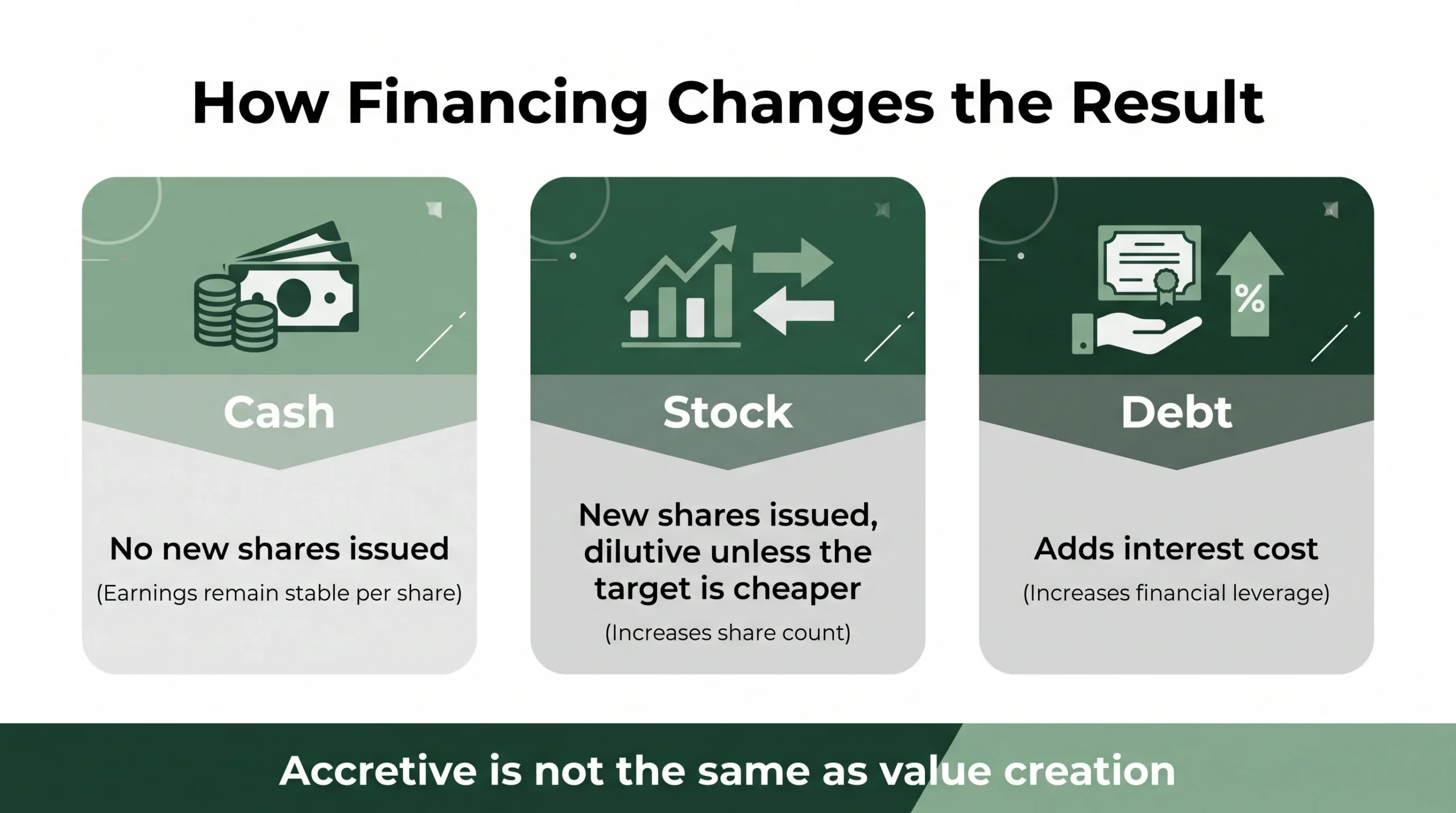
The financing mix changes the result by trading share count against earnings cost. A stock deal raises the share count but adds no interest. A cash deal keeps shares flat but gives up the interest the cash could have earned. A debt deal keeps shares flat but adds after-tax interest expense. So the same price can look accretive one way and dilutive another, and structure matters as much as price, a point our review of asset sale vs stock sale structures also stresses.
A rule of thumb sorts most deals. An all-stock deal tends to be accretive when the buyer’s P/E is higher than the target’s purchase P/E, because expensive shares are buying cheaper earnings. A cash or debt deal tends to be accretive when the target’s earnings yield, earnings divided by price, beats the after-tax cost of the funding. The table below sums up the three paths.
| Financing method | Effect on share count | Main earnings cost | Tends to be accretive when |
| All stock | Rises; new shares issued | None, but earnings are split more ways | Buyer P/E is above the target purchase P/E |
| All cash | Flat | Forgone after-tax interest on the cash | Target earnings yield beats the cash yield given up |
| All debt | Flat | After-tax interest on the new loan | Target earnings yield beats the after-tax loan rate |
Cash and debt often look more accretive than stock, since they avoid new shares, but that does not make them safer. Debt adds fixed payments and balance-sheet risk, and spending cash drains a needed buffer. A choice that flatters near-term EPS can still weaken the company, so the EPS read must sit beside a full view of risk and cash flow.
How does the exchange ratio affect the result?
The exchange ratio sets how many buyer shares each target shareholder receives in a stock deal. It equals the offer price per target share divided by the buyer’s share price. A higher ratio means more new shares, a larger denominator, and more downward pressure on EPS. A lower ratio issues fewer shares and protects EPS. So the ratio is the lever that turns a stock deal accretive or dilutive.
The ratio also shifts risk. A fixed ratio locks in the share count, so the target bears the risk if the buyer’s stock falls before close. A fixed-value deal locks in the dollar amount, so the buyer issues more shares if its stock drops, deepening dilution. Because the buyer’s share price feeds the ratio, an overvalued stock funds a deal cheaply. Our look at the EBITDA multiple by industry grounds the ratio in real value, not market mood.
Can an accretive deal still destroy value?
Yes, and this is the heart of the analysis. EPS accretion measures accounting earnings per share, not the economic worth a deal creates. A buyer can overpay, fund the deal with cheap debt, and still post higher EPS on day one. The number looks good while the buyer has quietly handed most of the deal’s upside to the seller.
Value depends on price paid against value received, plus the combined cost savings and revenue gains that actually appear. If those deal benefits never arrive, or the buyer pays far above fair market value, the deal erodes wealth no matter what EPS does. This is why The Sofer Difference, the four-step Discovery, Diligence, Analysis, and Delivery process, pairs the EPS test with a proper valuation, such as a discounted cash flow model. A fairness review under standards like the AICPA guidelines and USPAP treats accretion as one signal among many.
Which valuation provider should cross-check your deal?
The best choice is an independent valuation firm whose fee does not depend on the deal closing. A sell-side banker or broker earns more when the deal happens, so their EPS story can lean bright. Large advisory names like Alvarez & Marsal, Stout, and Kroll serve the biggest transactions with deep teams. An independent opinion is built on professional standards that boards can defend if the price is later questioned. The table below compares the options.
| Provider type | Service focus | Conflict of interest |
| Sofer Advisors | Neutral EPS and value cross-check | None; fee is flat, not tied to a close |
| Sell-side banker or broker | Marketing and closing the deal | High; success fee based on the sale |
| Large advisory firm | Big-deal consolidation support | Moderate; success fees on large mandates |
An independent opinion keeps the EPS test honest and ties it to fair market value, so the price stands up to review. For deal-stage work, the transactional advisory team keeps the appraisal separate from any brokering, so buyers see the true economics of price and payment.
Frequently Asked Questions
What is accretion dilution analysis?
Accretion dilution analysis is a test of whether an acquisition raises or lowers the buyer’s earnings per share after the deal closes. Accretive means EPS rises; dilutive means it falls. The test combines both firms’ earnings, adjusts for how the deal is paid, and divides by the new share count. Boards use it as an early read on a proposed price and financing plan.
How do you calculate accretion vs dilution?
Build a pro-forma EPS and compare it to the buyer’s standalone EPS. Add the target’s net income to the buyer’s, then adjust for financing. A stock deal adds new shares; a cash or debt deal subtracts an after-tax cost. Divide adjusted combined income by the new share count. If the result tops the old EPS, the deal is accretive. If it falls short, the deal is dilutive.
What is the formula for calculating accretion?
The core formula is pro-forma EPS equals combined net income, adjusted for after-tax financing effects, divided by the pro-forma share count. Accretion is then pro-forma EPS minus standalone EPS, often shown as a percent of the old figure. A positive number is accretion; a negative number is dilution. The financing adjustment captures new interest on debt, forgone interest on cash, or extra shares issued in stock.
How can I tell if an acquisition is accretive or dilutive?
For a stock deal, compare the buyer’s P/E to the target’s purchase P/E. If the buyer’s P/E is higher, the deal is usually accretive, because expensive shares are buying cheaper earnings. For a cash or debt deal, compare the target’s earnings yield to the after-tax cost of the funding. If the yield is higher, the deal tends to be accretive.
What are the four types of M&A?
The four common types are horizontal, vertical, conglomerate, and congeneric mergers. A horizontal deal joins two rivals in the same market. A vertical deal links a firm with a supplier or a customer. A conglomerate deal combines unrelated businesses. A congeneric deal joins firms that share a customer base but sell different products. The type shapes the cost savings and revenue gains that support the price.
Does stock or cash financing dilute EPS more?
Stock usually dilutes EPS more than cash, because it issues new shares that split earnings among more owners. Cash and debt keep the share count flat, so they often look more accretive in the near term. That flattery has a price, though. Debt adds fixed interest and balance-sheet risk, and spending cash drains a reserve. The cheaper-looking option on EPS is not always the safer one for the business.
How does the exchange ratio affect EPS?
The exchange ratio sets how many buyer shares each target share receives, so it drives the new share count in a stock deal. A higher ratio issues more shares, enlarges the denominator, and pushes EPS down. A lower ratio issues fewer shares and protects EPS. Because the ratio uses the buyer’s own share price, a richly priced stock funds a deal with fewer shares than a depressed stock would.
Can an accretive deal still destroy value?
Yes. EPS accretion measures accounting earnings per share, not the value a deal creates. A buyer can overpay, fund the purchase with cheap debt, and still report higher EPS on day one while handing most of the upside to the seller. Real value depends on price paid against value received. Accretion is a useful signal, but a cross-check, not proof of a good deal.
How much does an accretion dilution analysis cost?
A transaction-advisory valuation engagement from Sofer Advisors that includes an accretion dilution cross-check generally runs $7,500 to $25,000, with a typical timeline of four to eight weeks. The final fee depends on deal size, the number of financing scenarios, and the depth of the supporting valuation work. For a quote tied to your deal, request a consultation estimate with your model and proposed terms.
Related Case Studies
- Business Valuation for Mergers: Buy-Side vs Sell-Side
- Fairness Opinion in M&A Atlanta: What Georgia Business Owners and Boards Need to Know
- Mid-Market M&A Due Diligence Checklist: 14 Categories Buyers Review
Executive Summary
An accretion dilution analysis tests whether an acquisition raises or lowers the buyer’s EPS after close. You add the target’s earnings, adjust for financing, and divide by the pro-forma share count. Financing drives the answer: stock adds shares, while cash and debt add an after-tax cost. A rough rule says a stock deal is accretive when the buyer’s P/E tops the target’s purchase P/E, near a 20 versus 12 gap. The key warning is that an accretive deal can still destroy value if the buyer overpays, so treat the EPS test as a cross-check beside a full valuation.
What Should You Do Next?
Build a pro forma EPS for each financing path, cash, stock, and debt, and compare it to your standalone EPS. Stress-test the exchange ratio and the interest rate, since small shifts can flip the result. Then set the EPS read next to a proper valuation of the target, so you know whether an accretive number reflects real value.
David Hern CPA ABV ASA, founder of Sofer Advisors, provides neutral, defensible deal-price cross-checks for buyers and boards nationwide. Schedule a consultation to discuss your acquisition.
People Also Read
- Quality of Earnings Reports: What Buy-Side QofE Actually Tests
- EBITDA Multiple for Business Valuation by Industry
About the Author
This guide was prepared by David Hern, CPA ABV ASA, founder of Sofer Advisors, a business valuation firm headquartered in Atlanta, GA, serving clients across the United States. David holds dual accreditations as an Accredited Senior Appraiser (ASA) and is Accredited in Business Valuation (ABV), credentials recognized by the IRS, SEC, and FINRA. He also holds the Certified Exit Planning Advisor (CEPA) designation. With 15+ years of valuation experience, David has served as an expert witness in 11+ cases across multiple jurisdictions and built Sofer Advisors into an Inc. 5000-recognized firm with 180+ five-star Google reviews. Its full W2 employee team maintains subscriptions to all major valuation databases and operates under a next-business-day response policy.
For professional business valuation services, visit soferadvisors.com/about-us/ or contact Sofer Advisors at soferadvisors.com/contact-us/.
Disclaimer: This content is for informational purposes only and does not constitute professional valuation advice. Business valuation conclusions depend on specific facts and circumstances. Contact Sofer Advisors for guidance regarding your specific situation.









