


Last Updated: September 2026
Warrants and synthetic equity in a leveraged ESOP are two option-based instruments that help fund a debt-financed employee buyout and keep managers motivated after it. A warrant attaches to the selling shareholder’s subordinated note and lets the holder buy stock later at a fixed exercise price. Synthetic equity, usually stock appreciation rights (SARs) or phantom stock, gives managers a cash payout tied to share value. In many deals, warrants and management incentives together reach 20% to 30% of fully diluted equity, so their effect on the ESOP is large.
These instruments matter because they move value. Every year, the appraiser must value the warrants and the synthetic equity, then measure the ESOP’s per-share value after those claims. The sections below explain what each instrument does, how it is priced, and how both reach the annual ESOP valuation.
Sofer Advisors provides independent valuations for ESOP transactions and the annual updates that follow them. With 180+ five-star Google reviews and 11+ expert witness cases across Georgia, Florida, California, and New Mexico, the firm applies fair market value standards to complex capital structures. Its Heart of a Teacher approach means owners understand the numbers, not just receive them.
Key Takeaways
- Warrants pay for subordinated risk: a seller note in a debt-financed ESOP often carries a below-market rate, and warrants make up the gap.
- Synthetic equity retains managers: SARs or phantom stock reward leaders with cash tied to share value, without giving them real shares.
- Option-pricing models set the value: Black-Scholes or a lattice model prices both warrants and synthetic equity using stock value, strike, term, volatility, and the risk-free rate.
- Both are dilutive: on a fully diluted basis, warrants and synthetic equity reduce the value that belongs to the ESOP’s shares.
- The annual valuation must reflect them: the ESOP per-share value is measured after these claims, not before.
Each point ties back to one question: how much value truly belongs to the employees’ shares? The answer starts with the seller note.
What are warrants in a debt-financed ESOP?
A warrant in a debt-financed ESOP is a right to buy company stock at a set exercise price for a set term. It is issued alongside the selling shareholder’s seller financing, so the seller holds both a note and warrants. In a leveraged ESOP, the trust borrows from a bank and often from the seller too, whose note is subordinated and gets paid after the bank. To accept that risk, the seller receives warrants that share in future growth. A warrant is a separate claim, not the ESOP’s stock. Advocacy groups such as The ESOP Association support owners who use these structures.
The structure keeps the day-one price fair while giving the seller upside. If the company grows, the warrants become valuable. If it does not, they may expire worthless. Our guide to how seller financing works in a business sale covers the note side. The warrant side is what this article prices.
Why does seller financing carry warrants?
Seller financing carries warrants because the seller note is subordinated and pays a below-market stated rate. The bank takes first position on the company’s assets, so the seller’s note sits behind it and carries more risk. A below-market coupon keeps early cash flow healthy, which the lender wants. The warrants compensate the seller for both the junior position and the low rate.
The stated interest is modest, but the warrants add equity-like upside, so together they give the seller a market return for the risk taken. This design also helps the ESOP: lower cash interest in the first years leaves more room to repay the bank. A leveraged ESOP is overseen by the U.S. Department of Labor under ERISA, and the trustee must confirm the whole package is fair to the plan. As the National Center for Employee Ownership explains, an ESOP may pay no more than fair market value, so the warrant terms must be reasonable, not a giveaway.
How are ESOP warrants valued?
ESOP warrants are valued with option-pricing models, most often Black-Scholes or a lattice (binomial) model. A warrant is a call option, so the same math applies. The appraiser gathers five inputs: the stock value, the exercise price, the term, the expected volatility, and the risk-free rate. A lattice model handles features a simple formula cannot, such as vesting steps or early exercise. The output is a fair market value for the warrant claim.
Volatility is the hardest input, since a private company has no public trading history. Appraisers estimate it from comparable public firms. The table below shows the standard inputs and their sources.
| Model input | What it measures | Typical source |
| Stock value | Current per-share value of the company | The annual ESOP appraisal |
| Exercise price | Price to buy stock under the warrant | The warrant agreement |
| Term | Time until the warrant expires | The warrant agreement |
| Volatility | Expected swing in share value | Comparable public companies |
| Risk-free rate | Return on safe government debt | Treasury yield for the term |
Each input shapes the result. A longer term, higher volatility, or a lower exercise price all raise the warrant value. Sofer Advisors runs these models each year so the warrant value stays current with the company’s performance and the standards that govern the appraisal.
What is synthetic equity for management?
Synthetic equity is a cash-settled right that tracks share value without giving managers real stock. In an ESOP-owned company, the trust holds the shares for employees, so leaders cannot receive founder-style equity. Synthetic equity fills that gap. The two forms are stock appreciation rights, which pay the growth in share value over a starting price, and phantom stock, which pays the full value of a set number of notional shares. Both settle in cash and both align managers with the same share price the ESOP cares about.
The goal is retention without issuing new real shares, so managers share in growth while the ESOP keeps 100% of the actual stock. Like warrants, these grants are priced with option-type or appreciation models. Our explainers on how SARs work and are valued and the phantom stock plan structure go deeper on each form.
How do warrants and synthetic equity dilute the ESOP shares?
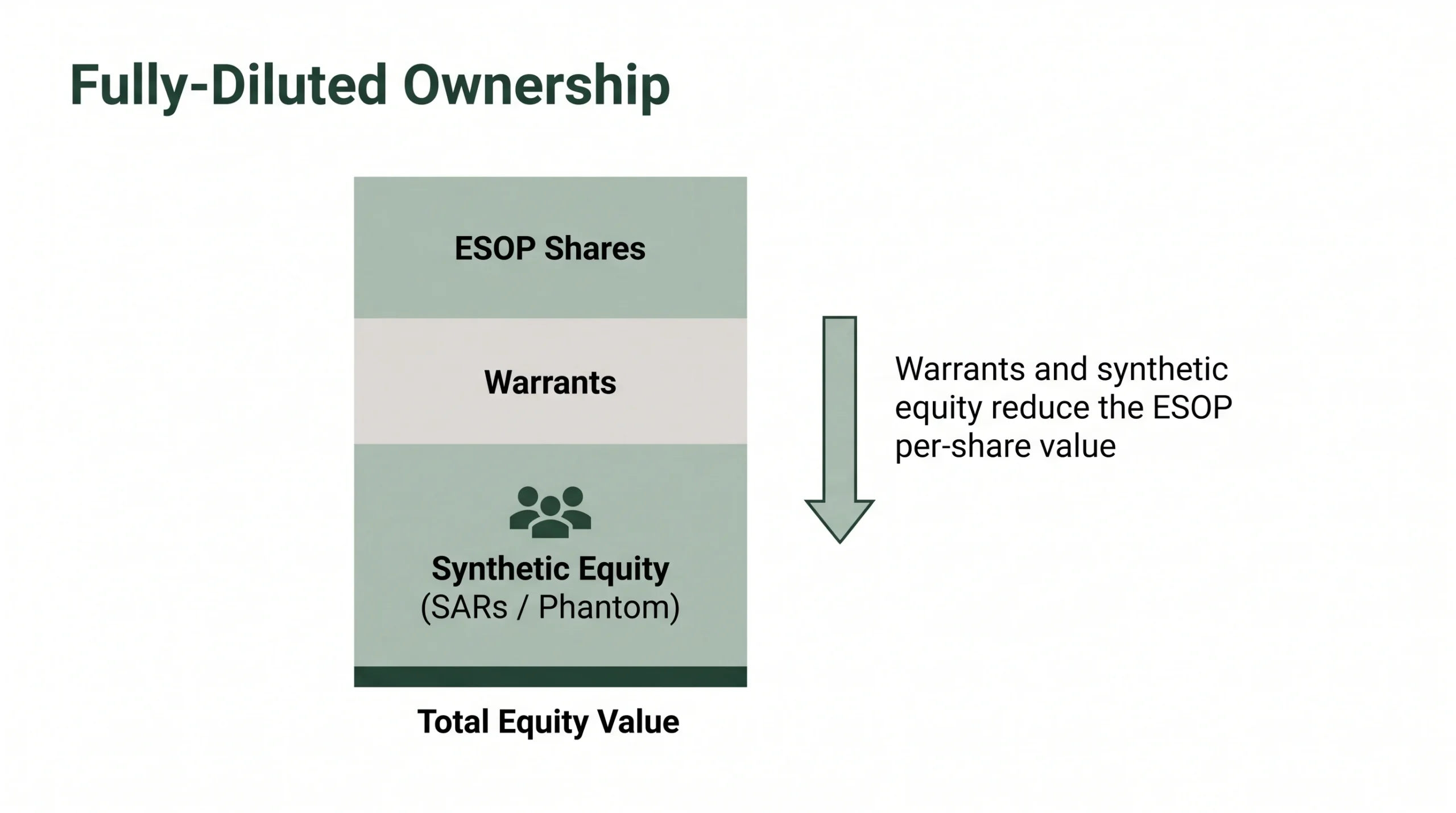
Warrants and synthetic equity dilute the ESOP shares because they are claims on the same equity value, so on a fully diluted basis less value remains for the trust’s stock. Picture total equity as one pie: the ESOP shares are the largest slice, but the seller warrants and management synthetic equity are slices too. When the appraiser divides equity value across all the slices, the ESOP’s per-share value comes out lower than a simple headcount of shares would suggest.
This is why the annual ESOP valuation must account for both instruments. The appraiser first finds the enterprise value and the equity value. The value of the warrants and the synthetic equity is then spread across the fully diluted share base. Only after that does the ESOP per-share value emerge. Skipping this step overstates the price and can lead the trustee to overpay. The ESOP transaction process sets these claims in motion, and every annual update must carry them forward. Sofer Advisors treats the fully diluted calculation as a core step in each ESOP engagement.
Which valuation firm should handle ESOP warrants?
The right firm is an independent appraiser that prices the warrants, the synthetic equity, and the ESOP shares under one consistent method. Large firms such as Alvarez & Marsal, Stout, and Kroll serve big ESOP transactions. Middle-market companies often need senior attention and a faster response. The table below compares the common options.
| Provider type | Best fit | Trade-off |
| Sofer Advisors | Middle-market ESOPs needing senior involvement | Not built for mega-cap deals |
| National firm (Alvarez & Marsal, Stout, Kroll) | Very large or public-adjacent transactions | Higher cost, junior-staff review layers |
| Solo appraiser | Simple, single-instrument work | Limited data and option-pricing depth |
An independent appraiser keeps valuation separate from any party selling the deal, which protects the trustee. Because warrants, SARs, and phantom stock draw on the same share value, one firm pricing all of them keeps the math consistent. That reflects The Sofer Difference, a four-phase process of Discovery, Diligence, Analysis, and Delivery. Owners can start with transaction advisory support and keep the same firm for annual updates.
The questions below cover what owners, trustees, and managers ask most about these instruments.
Frequently Asked Questions
How do warrants work in an ESOP?
Warrants in an ESOP are rights to buy company stock at a fixed price for a set term, issued to the selling shareholder alongside a seller note. The seller note is subordinated to the bank, so it carries extra risk. The warrants give the seller equity-like upside as pay for that risk. If the company grows, the warrants gain value; if it does not, they can expire worthless.
Why does seller financing carry warrants?
Seller financing carries warrants because the seller note is junior to the bank and pays a below-market rate. The low coupon protects early cash flow, which the lender wants. The warrants make up the difference by adding upside tied to future growth. Together they give the seller a market return for holding subordinated debt.
What does it mean when an ESOP is leveraged?
A leveraged ESOP is one where the employee trust borrows money to buy company stock, rather than paying cash it already holds. The loan usually comes from a bank, the selling shareholder, or both. The company then makes contributions that the trust uses to repay the debt over time. This lets employees acquire the business without funding the full price up front.
How is synthetic equity valued in an ESOP?
Synthetic equity is valued with option-pricing or appreciation models tied to the company’s share value. A stock appreciation right behaves like a warrant, so Black-Scholes or a lattice model fits. Phantom stock tracks the full share value, so it is priced closer to the underlying stock. The appraiser uses the same per-share value that drives the ESOP shares.
Is it good to buy warrant stock?
In an ESOP setting, warrants are usually held by the selling shareholder, not bought by employees. Whether a warrant is attractive depends on the exercise price, the term, and the company’s growth outlook. A warrant only pays off if the share value rises above the exercise price before it expires, and it can expire worthless if the stock does not appreciate.
Do warrants and synthetic equity dilute the ESOP’s shares?
Yes. Warrants and synthetic equity are claims on the same equity value, so on a fully diluted basis less value remains for the ESOP shares. The appraiser measures the ESOP per-share value after these claims, not before. If the calculation ignored them, the share price would look too high, and the trustee could overpay. Reflecting both instruments each year keeps the employees’ share value accurate and defensible.
What option-pricing models value ESOP warrants?
Appraisers value ESOP warrants with the Black-Scholes model or a lattice (binomial) model. Black-Scholes fits a straightforward warrant with a fixed term. A lattice model handles features like vesting steps, changing volatility, or early exercise. Both use the stock value, exercise price, term, volatility, and risk-free rate. Appraisers document the method to meet fair market value and USPAP standards.
How do SARs differ from phantom stock?
Stock appreciation rights pay only the growth in share value above a starting price, while phantom stock pays the full value of a set number of notional shares. A SAR rewards appreciation alone. Phantom stock tracks the whole share value, like owning the stock in cash form. Both settle in cash and align managers with the ESOP’s share price without issuing real shares.
How much does an ESOP valuation from Sofer Advisors cost?
An ESOP valuation from Sofer Advisors runs $15,000 to $35,000, with a typical timeline of six to ten weeks. Cost depends on company size, the number of instruments to price, and the complexity of the warrants and synthetic equity. Deals with layered seller notes and management plans sit at the higher end. For a quote tied to your structure, request an ESOP valuation estimate with your term sheet and plan documents.
Related Case Studies
- Leveraged Recapitalization: How to Take Cash Out Without Selling
- Management Buyout Process: Steps, Financing and Valuation
- ESOP Feasibility Study: Is Your Business a Good Candidate?
Executive Summary
A debt-financed ESOP is often funded with a seller note that carries warrants, plus synthetic equity for management. The warrants pay the seller for taking subordinated risk and accepting a below-market coupon. Synthetic equity, in the form of stock appreciation rights or phantom stock, retains managers with cash tied to share value while the trust keeps every real share. Both instruments are priced with option-pricing models, and both are dilutive. On a fully diluted basis, the appraiser measures the ESOP per-share value after these claims, often 20% to 30% of equity, so the trust does not overpay. Sofer Advisors prices all three claims under one consistent method.
What Should You Do Next?
Start by gathering the deal documents: the seller note and its warrant terms, the bank loan agreement, and any SAR or phantom stock plan. Confirm the exercise price, term, and vesting for each, since these drive the math. Then engage an independent appraiser to value all three together, so the fully diluted per-share value is correct before signing off.
David Hern CPA ABV ASA, founder of Sofer Advisors, provides independent ESOP valuations for middle-market companies and their trustees. Schedule a consultation to discuss your structure.
People Also Read
- What Is Equity Compensation? Types and How They Are Valued
- ESOP Tax Benefits: What Owners and Employees Gain
About the Author
This guide was prepared by David Hern CPA ABV ASA, founder of Sofer Advisors, a business valuation firm headquartered in Atlanta, GA serving clients across the United States. David holds dual accreditations as an Accredited Senior Appraiser (ASA) and is Accredited in Business Valuation (ABV), credentials recognized by the IRS, SEC, and FINRA. He also holds the Certified Exit Planning Advisor (CEPA) designation. With 15+ years of valuation experience, David has served as an expert witness in 11+ cases across multiple jurisdictions and built Sofer Advisors into an Inc. 5000-recognized firm with 180+ five-star Google reviews. Its full W2 employee team maintains subscriptions to all major valuation databases and operates under a next business day response policy.
For professional business valuation services, visit soferadvisors.com/about-us/ or contact Sofer Advisors at soferadvisors.com/contact-us/.
Disclaimer: This content is for informational purposes only and does not constitute professional valuation advice. Business valuation conclusions depend on specific facts and circumstances. Contact Sofer Advisors for guidance regarding your specific situation.









