


Last Updated: August 2026
Developed technology intangible valuation sets a fair value on a company’s software, source code, and know-how when a buyer acquires it. It treats the software as a separate asset, apart from goodwill, under ASC 805. In many deals, royalty rates for the technology run from about 8 to 12 percent of sales. That one input can move the value by millions. Sofer Advisors builds each figure on market proof, not a rule of thumb.
The value matters because a buyer must split the price paid across each asset it gains. The software often carries a big share of that price. That share is then written off over its useful life. A number set too high or too low reshapes future profit and taxes for years. So the method and the inputs must hold up under audit.
Key Takeaways
- Separate asset: The software is valued apart from goodwill under ASC 805, not lumped in.
- Two income methods: MPEEM and relief-from-royalty are the main ways to price it.
- Key inputs: The discount rate, useful life, and royalty or growth rate drive the result.
- Aging counts: A fast switch to newer tools shortens the life and lowers the value.
- Not IPR&D: Finished, revenue-earning code differs from in-process R&D and from goodwill.
These points tie method to proof. The sections below show how each approach works, what drives the numbers, and how a sound report tells finished software apart from in-process R&D and goodwill.
What is developed technology intangible valuation?
A developed technology intangible is the finished software, code, and know-how a company already sells or uses to earn money. Its valuation sets a fair value on that asset the day a deal closes. The work falls under ASC 805. That rule lists the software on its own, apart from goodwill. Analysts price it with an income method, then test it against market data. The aim is a number a buyer, an auditor, and the IRS can all follow.
Fair value means the price a market buyer would pay for the asset alone. It is not the cost to build the code, though cost can serve as a check. Standards such as IRS Revenue Ruling 59-60 and AICPA guidance shape how the value is judged. A clear scope keeps the work honest. Analysts name the exact asset, the sales it supports, and the years it will last.
Why value developed technology in an acquisition?
Buyers value the technology because ASC 805 requires it. When one firm buys another, it must spread the price paid across each asset it gains. This step is the purchase price allocation. The software usually takes a large slice. That slice is then written off over its life. Set it wrong, and reported profit and taxes shift for years. A sound value gives both the balance sheet and the tax return a base that will hold.
The stakes rose as software became the core of more deals. Recent guidance, summed up in KPMG’s review of the 2024 AICPA business combinations guide, calls for careful, asset-by-asset work. Auditors now expect each intangible to stand on its own proof. That is where The Sofer Difference comes in. It is a four-phase path of Discovery, Diligence, Analysis, and Delivery that yields an audit-ready report.
How does the multi-period excess earnings method work?
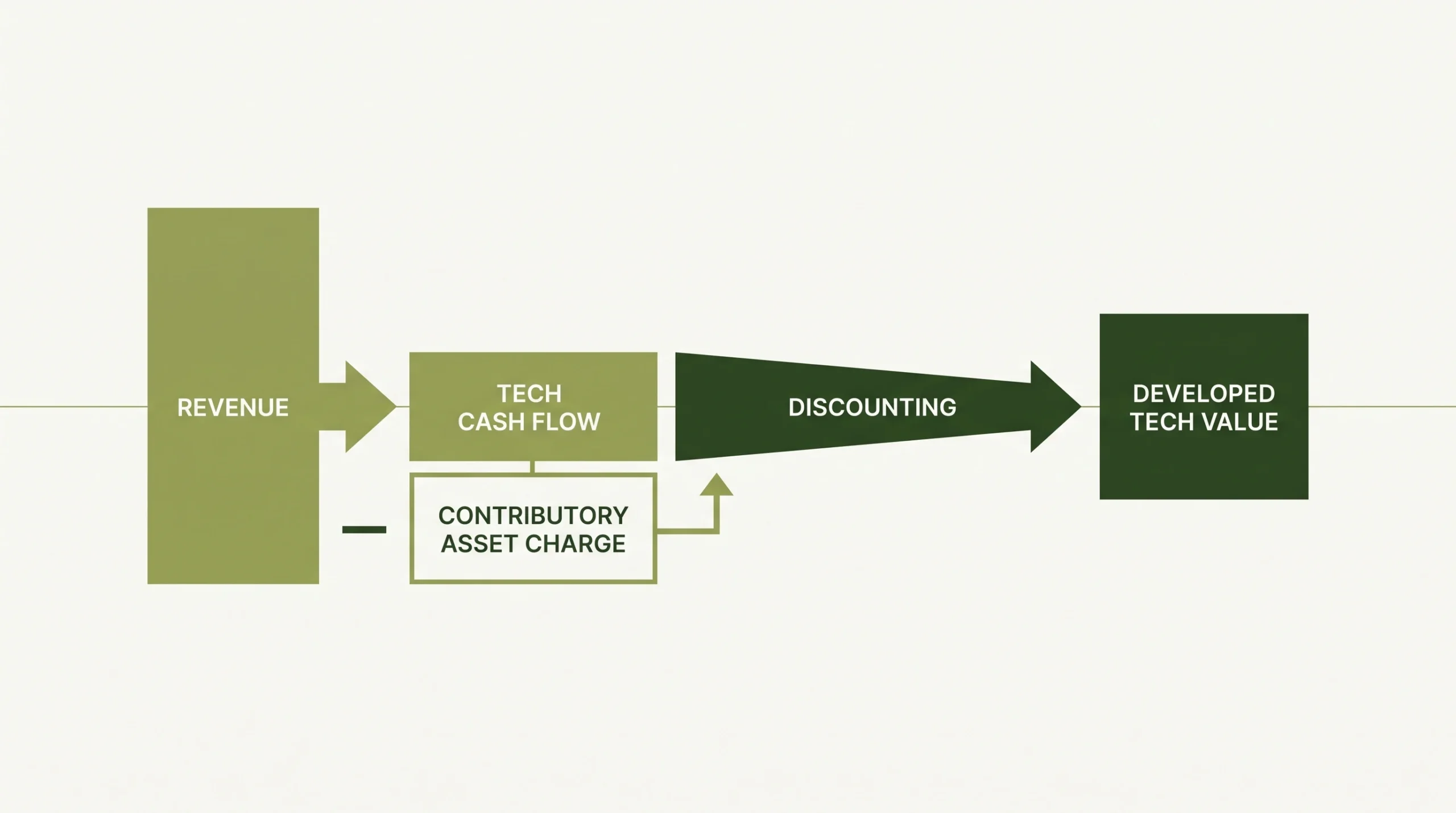
The multi-period excess earnings method, or MPEEM, isolates the cash flow that only the software earns. Analysts start with the sales the asset supports. They subtract operating costs. Then they subtract contributory asset charges. Those charges are the fair returns owed to other assets, such as working capital, equipment, and the workforce. What is left is the extra earning tied to the software. That stream is then discounted to present value.
MPEEM fits the main asset in a deal, the one that drives most of the profit. Core software in a tech firm is a common case. A guide from PCE Companies on the excess earnings method shows how the charges keep the result honest. Skip them, and the value comes out too high. The rate used is often the WACC plus a premium for the added risk the asset carries.
When is relief-from-royalty the better method?
Relief-from-royalty fits software a firm could license rather than own. The idea is simple. Owning the asset saves the royalty a licensee would pay. Analysts find a market royalty rate for technology. They apply that rate to the sales the asset supports. The saved payments are then discounted to present value. Software royalty rates often run from about 8 to 12 percent of sales, so the rate choice carries real weight.
| Method | What it measures | Best suited to | Key input |
|---|---|---|---|
| MPEEM | Extra cash flow after charges for other assets | The primary, profit-driving software | Contributory asset charges |
| Relief-from-royalty | Royalty payments avoided by owning the asset | Technology with a license market | Market royalty rate |
| Cost approach | Cost to rebuild the software today | Early-stage or internal-use software | Replacement cost |
The right method depends on the asset and the data at hand. A mature platform that drives most of a firm’s profit usually calls for MPEEM. Software with a clear license market often suits relief-from-royalty. The cost approach works as a check, or for early software with no steady cash flow. Analysts at Sofer Advisors often run a second method to confirm the first. That cross-test is what separates a defensible number from a guess. It is the standard large firms like Alvarez and Marsal apply to big deals.
How do useful life and obsolescence affect value?
Useful life sets how many years the software will earn money, and it drives the value at once. A longer life means more years of cash flow and a higher figure. Fast aging cuts that life short. New tools, code rewrites, and user switching all pull buyers toward the next product. Analysts study the migration curve, the pace at which old software fades, to set a fair life. A short curve raises the rate too.
Fast change is the risk that defines software value. A platform strong today may fade in three years in one market, yet last a decade in another. Past update records and adoption data help set the curve. The value then falls off as the asset ages toward the end of its life. This is why a generic benchmark fails. Life must fit the exact asset.
How does developed technology differ from IPR&D and goodwill?
Developed technology is finished and already earns revenue. In-process R&D, or IPR&D, is not done yet, so it earns nothing on the deal date. Goodwill is the value left over after every named asset is priced. Analysts must keep the three apart. The AICPA guide sets rules for each, and mixing them fails an audit. Proper contributory asset charges pull the software’s own earnings out of the total.
The line between these assets shapes the whole allocation. AICPA guidance on assets acquired for research and development explains how IPR&D is valued, then reclassified once the project ships. Goodwill is never written off, though it is tested for impairment. Developed technology is written off over its life. Placing value in the wrong bucket changes both profit and tax, so the split must be clear.
Why choose Sofer Advisors for an ASC 805 valuation?
Sofer Advisors brings senior-level valuation work to middle-market deals. The firm applies the same rigor that large advisors like Kroll and Stout save for enterprise clients. Every job follows The Sofer Difference and the Heart of a Teacher approach, so owners see the math, not just the answer. A full W2 team of 14 keeps subscriptions to the major royalty and deal databases.
A strong record backs the work. Sofer Advisors holds 180+ five-star Google reviews and earned Inc. 5000 spots in 2024 and 2025. Its team has served as expert witness in 11+ cases across Georgia, Florida, California, and New Mexico. Unlike a solo practitioner, the firm pairs a deep bench with a next business day response policy. David Hern CPA ABV ASA leads each review, so the report carries accredited sign-off.
Frequently Asked Questions
What is developed technology in a valuation?
Developed technology is the finished software, source code, and know-how a company already uses or sells to earn money. In a deal, it counts as a named intangible asset. Analysts value it apart from goodwill under ASC 805. The value rests on the cash flow the software supports, its useful life, and the risk that newer products replace it before that life ends.
How is developed technology different from goodwill?
Developed technology is a named asset with a set life that earns clear, traceable cash flow. Goodwill is the value left after every named asset is priced. It reflects things like reputation and market spot that have no clear path to sales. Analysts write off the software over its life, while goodwill is not written off but tested for impairment. Keeping the two apart is required for any audit.
Is internally developed software an intangible asset?
Internally developed software can be an intangible asset once it meets the rules under the accounting standards. The project must pass its early planning stage, and the software must be built for sale or in-house use. In a deal, such software is often valued with the cost approach or an income method. The choice depends on whether the asset earns steady, traceable cash flow on its own.
What is a contributory asset charge?
A contributory asset charge is the fair return owed to assets that help the software earn money, such as working capital, equipment, and the workforce. In an MPEEM analysis, analysts subtract these charges from total cash flow. The step makes sure the value reflects only what the software earns. Leaving them out overstates the asset.
How is the useful life of technology set?
Analysts set useful life by studying how long the software will keep earning money before a newer product replaces it. They review update records, adoption trends, and the migration curve for like assets. A platform may last a decade in one market, yet fade in three years in another. The life sets the cash flow years in the model, so a careful estimate is key.
When do you use relief-from-royalty instead of MPEEM?
Relief-from-royalty suits software with a clear license market, such as patented processes or code others pay to use. It prices the royalty a firm avoids by owning the asset. MPEEM suits the main asset that drives most of a company’s profit, where a royalty rate is hard to observe. Many jobs run both methods, using one as a cross-check on the other for a sound result.
What is IPR&D and how does it differ?
In-process research and development, or IPR&D, is technology that is not finished on the deal date, so it earns no revenue yet. Developed technology, by contrast, is complete and already brings in cash flow. Analysts value IPR&D with care, since its worth depends on the project finishing. Once the product ships, the asset is reclassified and written off. The AICPA guide sets rules for both.
What standards govern an ASC 805 technology valuation?
The main standard is ASC 805, which makes a buyer record each named intangible at fair value in a purchase price allocation. AICPA valuation guidance details the methods and the contributory asset charges. USPAP, from The Appraisal Foundation, governs how the appraiser documents the work. IRS Revenue Ruling 59-60 informs the broader view of fair value. Together, they keep the report sound for auditors.
How much does an ASC 805 intangible valuation from Sofer Advisors cost?
Purchase price allocations and ASC 805 intangible valuations from Sofer Advisors often run from 15,000 to 50,000 dollars. The range depends on the size of the deal and the number of intangibles that need separate values. A single software asset sits toward the lower end. A deal with several technologies, customer lists, and trade names falls higher. Contact the firm for a fee quote matched to your deal.
Related Case Studies
- Valuing Contingent Consideration (Earnouts) under ASC 805
- Excess Earnings: Valuing Goodwill and Assets
- Reasonable Royalty: Valuing IP Infringement Damages
Executive Summary
Developed technology intangible valuation sets a fair value on software, code, and know-how bought in a deal. Under ASC 805, the buyer must value the asset apart from goodwill in a purchase price allocation. Two income methods lead the work. The multi-period excess earnings method strips out contributory asset charges. Relief-from-royalty prices the license fees avoided. Software royalty rates often run 8 to 12 percent of sales. Useful life and aging set how long the cash flow lasts. Sofer Advisors builds each figure on market proof and cross-tests the result, so the value holds under audit.
What Should You Do Next?
Start by listing each technology asset in the deal and the sales it supports. Then confirm the purpose of the valuation, since an audit and a tax filing need different proof. Finally, gather development records, license terms, and update history to support the life.
For a value you can defend, work with David Hern CPA ABV ASA. His team applies AICPA and ASC 805 standards to every technology valuation. Schedule a consultation to discuss your acquisition.
People Also Read
- The Net Asset Value Method: Balance Sheet Over Earnings
- When the Cost Approach Wins: Valuing Asset-Heavy Businesses
About the Author
This guide was prepared by David Hern CPA ABV ASA, founder of Sofer Advisors, a business valuation firm headquartered in Atlanta, GA serving clients across the United States. David holds dual accreditations as an Accredited Senior Appraiser (ASA) and is Accredited in Business Valuation (ABV), credentials recognized by the IRS, SEC, and FINRA. He also holds the Certified Exit Planning Advisor (CEPA) designation. With 15+ years of valuation experience, David has served as an expert witness in 11+ cases across multiple jurisdictions and built Sofer Advisors into an Inc. 5000-recognized firm with 180+ five-star Google reviews. Its full W2 employee team maintains subscriptions to all major valuation databases and operates under a next business day response policy. For professional business valuation services, visit soferadvisors.com/about-us/ or contact Sofer Advisors at soferadvisors.com/contact-us/.
Disclaimer: This content is for informational purposes only and does not constitute professional valuation advice. Business valuation conclusions depend on specific facts and circumstances. Contact Sofer Advisors for guidance regarding your specific situation.









