


Last Updated: August 2026
A profits interest valuation is the process of finding the fair market value of an LLC interest that pays its holder a share of future profits and growth. It gives service providers upside without a claim on today’s assets. Under IRS Revenue Procedure 93-27, a qualified grant can carry a value of zero at the grant date. Sofer Advisors values these interests for equity plans, drawing on 11+ expert witness cases across Georgia, Florida, California, and New Mexico.
Owners use these grants to reward key people without handing over cash or a share of today’s equity. The tax result is the draw. Done right, the holder owes no tax at grant and pays only later, at capital gains rates. A sound valuation is what proves the grant earns that treatment.
Key Takeaways
- What it is: A profits interest pays future growth, not current capital. The holder shares upside earned after the grant date.
- Safe harbor: IRS Revenue Procedure 93-27 lets a qualified grant stay tax-free when it is issued.
- The hurdle: A distribution threshold set at today’s value gives the interest a zero liquidation value at grant.
- How it is valued: An option pricing method, often Black-Scholes, prices the claim on future growth above the hurdle.
- Compliance: A written report supports 409A, 83(b), and financial reporting, and it lowers audit risk.
These points tie tax policy to equity design. The sections below show how each partnership term and each method shapes your value and your reporting.
What is a profits interest?
A profits interest is an equity grant in an LLC or partnership. It gives the holder a right to future profits and growth, but not to current capital. A capital interest is different. It hands the recipient a share of today’s assets, so it is taxed at grant. A profits interest is not taxed at grant when it meets the safe harbor. The holder gains only from value built after the grant date. That feature makes it a common tool for rewarding key people.
The split matters for tax. A capital interest triggers ordinary income equal to its fair market value on day one. A profits interest can avoid that result. Because it holds no claim on current assets, its value at grant can be zero. Sofer Advisors reviews the operating agreement and the waterfall to confirm the interest fits this profile. Clean documents protect the tax treatment the owner wants.
How does the safe harbor work?
IRS Revenue Procedure 93-27 gives a safe harbor for a granted profits interest. If the grant qualifies, the IRS treats the receipt as a non-taxable event. Revenue Procedure 2001-43 extends that relief to interests that still vest over time. The interest must not track a sure, steady income stream, such as high-grade debt. The holder must also keep it for at least two years. Meet these tests, and the grant stays tax-free at issue.
The rules reward a clear structure. The interest cannot carry a fixed claim on near-term profit. The partner cannot sell it within the two-year window. Sofer Advisors checks each term against the guidance before the grant goes out. We flag any feature that could break the safe harbor. Simple fixes early cost far less than an audit later. This care reflects the Heart of a Teacher approach the firm brings to every job: show the owner the risk, then the fix.
What is a hurdle amount?
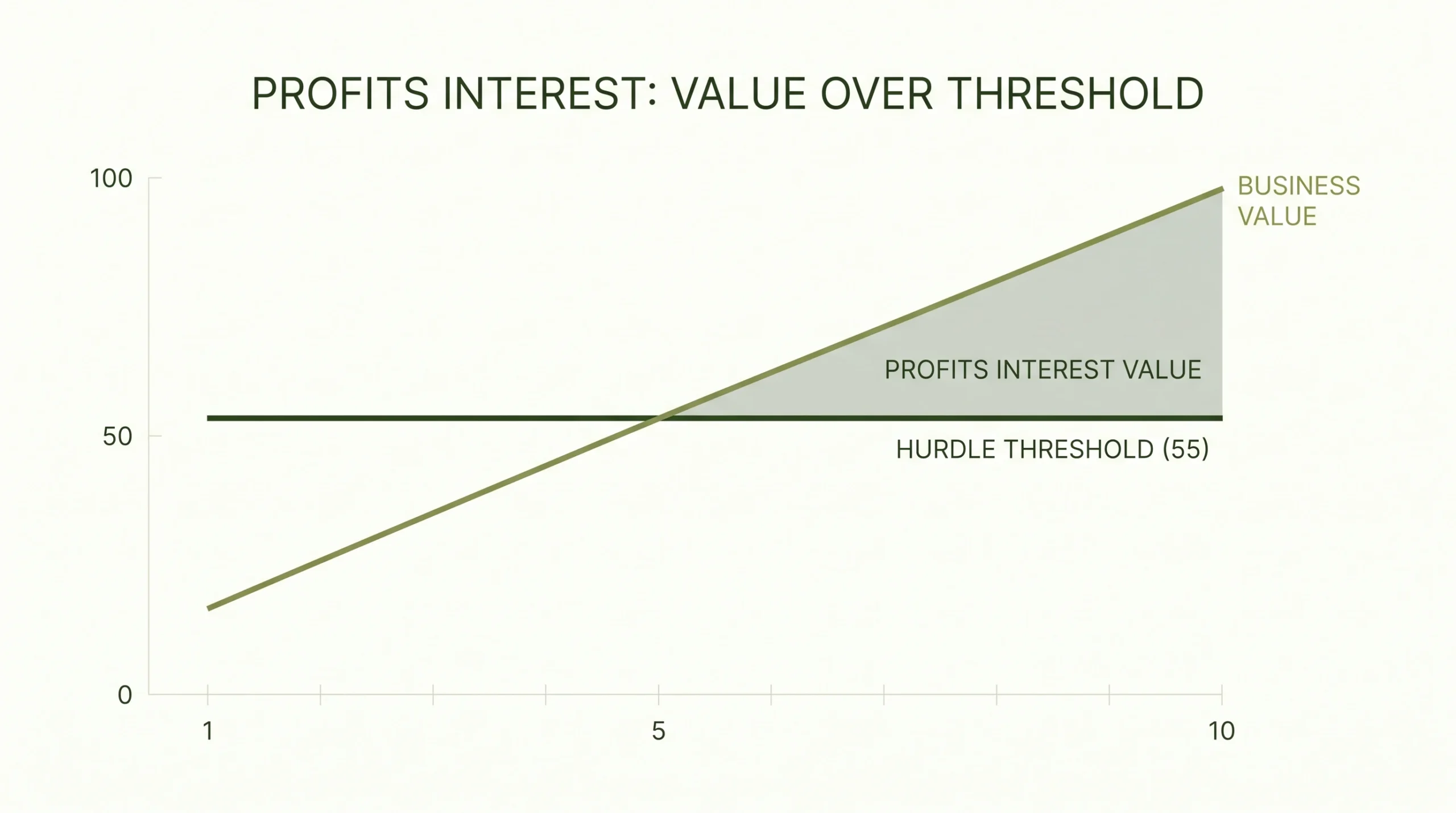
A hurdle amount is the value the business must pass before the holder earns a dime. It is also called the distribution threshold. Firms set it equal to the company’s fair market value on the grant date. If the business sold that same day, the interest would pay nothing. That zero payout is the point. It proves the grant is a profits interest, not a capital interest, and it keeps the safe harbor intact.
The hurdle also shapes value. A higher threshold pushes the interest behind other equity, such as preferred units. That lower priority cuts the odds of a payout, so it cuts the value. A high bar also delays any return, which trims the present value again. Sofer Advisors models these effects for each grant. We help owners set a bar that rewards real growth without blocking the holder from ever sharing in it.
How do you value a profits interest?
When the safe harbor does not apply, or when reporting rules require a number, you value the interest directly. The most common tool is an option pricing method. It treats the interest as a call option for the whole company. Black-Scholes then prices that option above the hurdle. For a layered cap table, a probability-weighted method can fit better. The AICPA Accounting and Valuation Guide backs these methods for equity awards.
| Method | What it does | Best suited to |
|---|---|---|
| Option pricing method (Black-Scholes) | Prices the interest as a call option above the hurdle | Simple cap tables with one growth threshold |
| Probability-weighted method (PWERM) | Weights value across several exit scenarios | Complex cap tables with many share classes |
| Current-value (liquidation) method | Tests the payout in a same-day sale of the business | Confirming a zero value at the grant date |
Each method starts with the total equity value of the business. An analyst then splits that value across the share classes. The profits interest gets only what sits above its hurdle. Volatility, the expected term, and the discount rate all move the answer. Small input changes can swing the result, so the support behind each one matters. Sofer Advisors documents every assumption against market data. That record is what lets a value stand up to IRS or auditor review.
How do 409A and 83(b) rules apply?
Two more rules shape a profits interest grant. IRC 409A governs deferred pay and can apply if the interest looks like hidden pay. A clean profits interest usually sits outside 409A, but the terms decide that. An 83(b) election is a separate tax filing. The holder files it within 30 days of the grant. It fixes the taxable value at grant, which is often zero for a qualified interest.
Vesting ties these rules together. A grant that vests over time carries a risk of forfeiture. If the holder leaves early, the interest is lost. That risk lowers the grant-date value in the model. The 83(b) election matters most here. It locks in the low grant value before the business grows. Skip it, and the holder can owe tax on a much larger value later. Sofer Advisors builds the valuation, then points owners to tax counsel for the filing itself.
Why work with Sofer Advisors?
A profits interest valuation only helps if it survives review. Automated equity platforms run fast, standard 409A reports. They fit early startups that track shares in an app. A custom LLC waterfall often needs hands-on work instead. Large firms such as Alvarez and Marsal or Kroll bring that rigor, but they aim at enterprise clients. Sofer Advisors brings the same senior-level care to middle-market owners.
The difference shows in the file. A solo practitioner may lack the databases and the review layers. Sofer Advisors runs a full W2 team of 14 and holds 180+ five-star Google reviews. Its work follows The Sofer Difference, a four-phase process of Discovery, Diligence, Analysis, and Delivery. David Hern CPA ABV ASA leads each engagement. The result is an audit-ready report, not a black-box number. That paper trail is what protects the owner and the holder if the IRS ever asks.
Frequently Asked Questions
What is a profit interest?
A profits interest is an equity grant in an LLC or partnership. It gives the holder a share of future profits and growth. It carries no claim on the current assets of the business. Because it holds no value in a same-day sale, it can be granted tax-free. Owners use it to reward key people. Sofer Advisors helps define the terms so the interest is classified correctly for tax.
How is a profits interest valued?
Valuation starts with the liquidation value on the grant date. If that value is zero, the grant qualifies as a profits interest. When a direct number is needed, analysts use an option pricing method or Black-Scholes. A probability-weighted method fits more layered cap tables. Sofer Advisors builds a supportable grant-date value and documents each input, so the figure holds up under audit review for tax and financial reporting.
What is the Rev. Proc. 93-27 safe harbor?
Revenue Procedure 93-27 is IRS guidance that makes qualified profits interest tax-free at grant. To qualify, the interest cannot track a sure, steady income stream. The holder must also keep it for at least two years. Revenue Procedure 2001-43 extends the relief to interests that still vest. The firm reviews the operating agreement to confirm the grant meets each of these tests before it goes out.
What is a hurdle amount on a profits interest?
A hurdle amount is the value the company must pass before the holder shares in any proceeds. It is usually set to the fair market value of the business on the grant date. That setting gives the interest a zero payout in a same-day sale. The zero result supports the tax-free treatment. Sofer Advisors models the hurdle so the grant meets the safe harbor and still rewards future growth.
How is a profits interest taxed?
A qualified profits interest is not taxed when granted. The holder owes no ordinary income on day one. Later, when the business sells or distributes profit, the holder usually reports capital gains instead. That treatment is a main reason owners choose this structure over other awards. Our team reviews each grant so the intended tax result is supported by a clear, documented valuation.
Do you need a valuation if you use the safe harbor?
Yes. The safe harbor points to a zero value, but you still need a report to prove it. The valuation shows that the hurdle equals or tops the current fair market value of the business. Without that proof, the IRS can argue the grant was really a capital interest. That change creates tax for the holder. Sofer Advisors provides the report that builds a defensible paper trail.
What is an 83(b) election for a profits interest?
An 83(b) election is a tax filing with the IRS. It lets the holder be taxed on the grant-date value of the interest. For a qualified profits interest, that value is often zero. The holder must file within 30 days of the grant. The election matters most when the interest vests over time, since it locks in the low value early. Sofer Advisors points owners to tax counsel for the filing.
How does 409A apply to a profits interest?
IRC 409A governs deferred compensation. It can apply if a grant looks like disguised pay rather than true equity. A clean profits interest usually sits outside 409A, but the specific terms decide. Related company stock grants often need a separate 409A valuation for the strike price. Sofer Advisors reviews the structure and prepares the 409A analysis when the cap table calls for one.
How much does a 409A or equity valuation from Sofer Advisors cost?
409A and equity-compensation valuations from Sofer Advisors typically run from $2,500 to $9,000. The price depends on the company stage and the complexity of the cap table. Simpler early-stage grants fall toward the lower end. Layered structures with many shared classes need deeper work, so they run higher. Full business valuations run higher still. Contact Sofer Advisors for a fee quote matched to your situation.
Related Case Studies
- Section 83(b) Elections: Timing, Risk, Valuation
- Secondary Sales of Private Stock: Valuation and 409A Implications
- Reasonable Compensation and S-Corp IRS Scrutiny
Executive Summary
A profits interest gives service providers a share of future growth in an LLC, not a claim on current assets. Under IRS Revenue Procedure 93-27, a qualified grant can carry a zero value and stay tax-free at issue. A hurdle set to the company’s fair market value protects that result. When a direct value is needed, an option pricing method or Black-Scholes prices the claim above the hurdle. Vesting, 409A, and the 83(b) election each shape the outcome. Sofer Advisors builds these valuations under the AICPA cheap stock guide and IRS standards, with every input documented for audit review.
What Should You Do Next?
Start by reviewing your operating agreement and the waterfall that governs distributions. Confirm the hurdle equals the current fair market value of the business. Then decide whether an 83(b) election fits before the interest grows in value.
For a valuation you can stand behind, work with David Hern CPA ABV ASA. His team has given expert witness testimony in 11+ cases across Georgia, Florida, California, and New Mexico. Schedule a consultation to discuss the profits interest grant that fits your plan.
People Also Read
- Rollover Equity in PE Deals: Valued and Taxed
- Owner Compensation Normalization: Why Salary Affects Sale Value
About the Author
This guide was prepared by David Hern CPA ABV ASA, founder of Sofer Advisors, a business valuation firm headquartered in Atlanta, GA serving clients across the United States. David holds dual accreditations as an Accredited Senior Appraiser (ASA) and is Accredited in Business Valuation (ABV), credentials recognized by the IRS, SEC, and FINRA. He also holds the Certified Exit Planning Advisor (CEPA) designation. With 15+ years of valuation experience, David has served as an expert witness in 11+ cases across multiple jurisdictions and built Sofer Advisors into an Inc. 5000-recognized firm with 180+ five-star Google reviews. Its full W2 employee team maintains subscriptions to all major valuation databases and operates under a next business day response policy. For professional business valuation services, visit soferadvisors.com/about-us/ or contact Sofer Advisors at soferadvisors.com/contact-us/.
Disclaimer: This content is for informational purposes only and does not constitute professional valuation advice. Business valuation conclusions depend on specific facts and circumstances. Contact Sofer Advisors for guidance regarding your specific situation.









