


Last Updated: November 2026
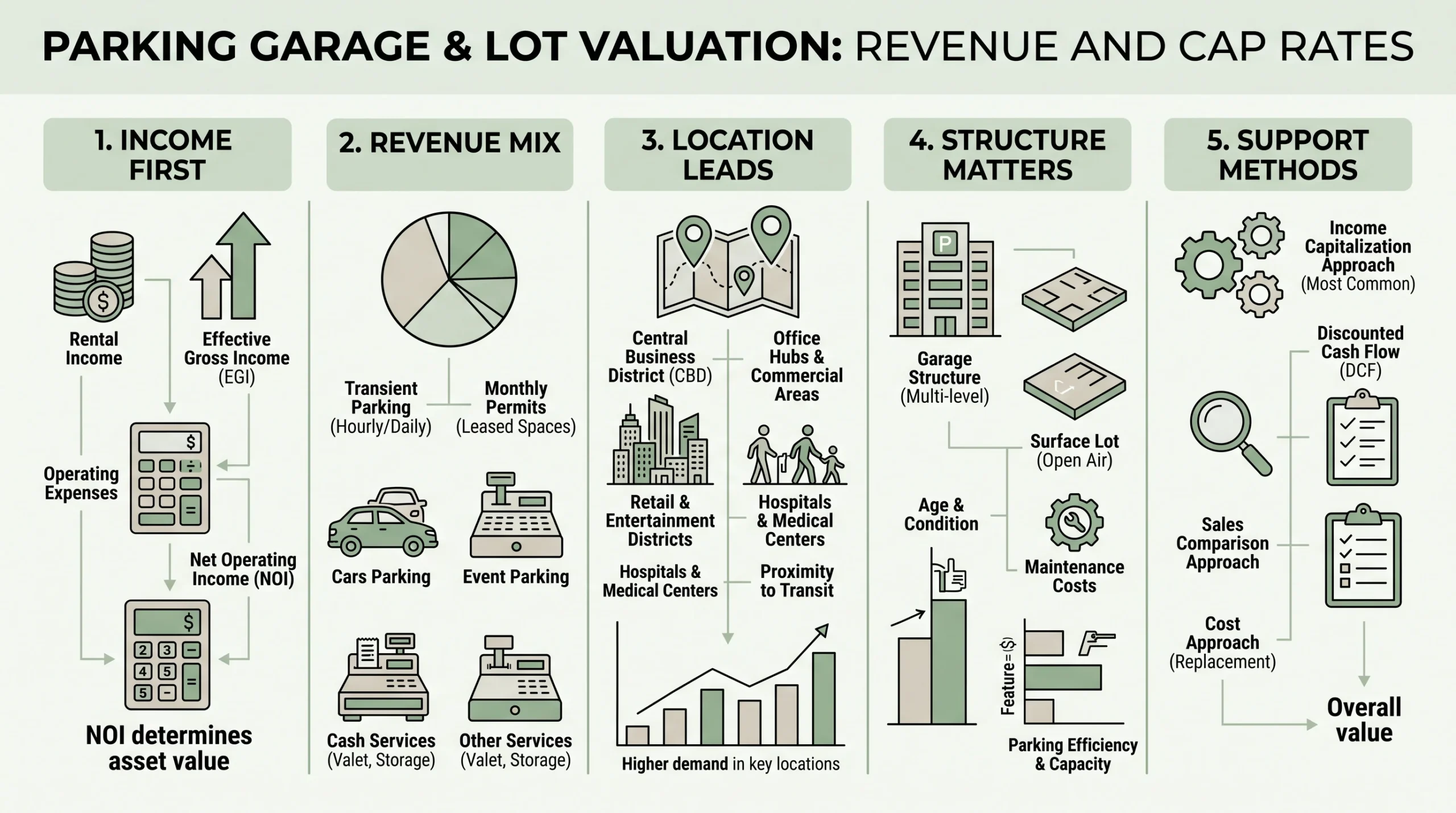
A parking garage or lot is valued mainly on the income it earns. You find the yearly net operating income, then divide it by a market cap rate, and the result is the value of the asset. Income comes from hourly parkers, monthly contracts, event and validation parking, and any on-site retail. Location drives the demand and the pricing power behind those streams.
Sofer Advisors prepares these valuations for owners, lenders, and tax professionals across the country.
This guide explains the revenue streams, the main value drivers, and the methods that support the income approach.
Key Takeaways
- Income first: A parking asset is valued mainly by its net operating income divided by a market cap rate.
- Revenue mix: Income comes from hourly parkers, monthly contracts, event and validation parking, and any retail.
- Location leads: Nearby offices, venues, and transit drive demand and set pricing power.
- Structure matters: A structured garage, a surface lot, and owned versus leased land each change the value.
- Support methods: The sales comparison and cost approaches check the income result, and scarce land can make redevelopment the best use.
Why do owners need a parking valuation?
Owners need a parking valuation for many reasons. A sale or purchase is the most common one. A buyer wants a fair price. A seller wants proof of worth. A clear value helps both sides agree.
Financing is another reason. A lender needs the value before it writes a loan. The appraisal shows how much debt the asset can support. Tax and estate matters also call for a valuation. A gift, an estate, or a property tax appeal each needs a defensible figure.
Disputes and partner buyouts round out the list. When owners split or sell a stake, they need a neutral number. In each case, an independent value gives the parties a solid starting point. It replaces a guess with a supported opinion.
What drives parking revenue?
Parking income comes from a few clear sources. Transient parkers pay by the hour or the day. These drivers want short stays near shops, offices, or events. Their rates are high, but their volume moves with the time of day.
Monthly contract parkers pay a set fee each month. These are often commuters or nearby residents. They give the asset a steady base of income. That base is easy to predict from year to year.
Event and validation parking add more. A garage near a stadium or arena fills fast on game nights. Retail validation lets a shop cover part of a customer’s fee. Some sites also earn rent from ground-floor retail. Each stream carries its own risk and its own margin.
The mix of these streams tells a story. A site that leans on event nights earns in bursts. A site full of monthly parkers earns a steady flow. A buyer studies that mix to judge how stable the income is. Stable income supports a stronger value.
How do you value a parking garage or lot?
The income approach leads for most parking assets. It ties value to the cash the site earns. You start with net operating income. Then you divide it by a market cap rate. Value equals NOI divided by the cap rate.
Two other approaches support the result. The sales comparison approach looks at recent sales of similar lots and garages. It adjusts for size, location, and condition. The cost approach estimates what it would cost to build the same structure today. It fits new or unusual properties best.
A sound valuation checks all three. The income approach usually carries the most weight. The other two confirm that the figure makes sense.
How is net operating income calculated?
Net operating income shows the cash a site earns from its operations. You begin with gross potential revenue. Then you subtract losses from empty spaces and unpaid fees. Last, you subtract the operating expenses.
Operating expenses include property taxes, insurance, and security. They also cover maintenance, utilities, and management fees. The formula leaves out debt payments, depreciation, and major capital projects. Those items affect the owner’s return, but not the daily income of the site.
Analysts also normalize NOI. They adjust one-time or unusual items so the figure reflects a normal year. They review the expense ratio to see if costs look reasonable for the asset type. A clean NOI leads to a more reliable value. A small change in NOI shifts the value as well, so the inputs must be accurate and well supported.
What cap rate applies to parking assets?
The cap rate turns income into value. It reflects the risk a buyer takes and the return a buyer wants. A lower cap rate means lower risk and a higher value. A higher cap rate means more risk and a lower value.
Rates are not fixed. They shift with the property and the market. A prime garage in a busy downtown core tends to trade at a lower rate. An older lot in a weak market tends to trade at a higher one. Appraisers draw the rate from real sales of similar assets, not from a rule of thumb.
Several factors move the rate. Location, condition, and the stability of income all play a part. So does the lease or operating structure behind the site. The right rate for one asset may be wrong for another.
A small change in the rate can swing the value a lot. That is why the rate must rest on real market data. Appraisers look at what buyers actually paid for similar assets. They also weigh the wider market for commercial real estate. A careful rate makes the whole valuation easier to defend.
How does location affect value?
Location is the strongest driver of parking value. It sets the demand for spaces. A site near offices, shops, and homes stays busy through the week. That steady use supports strong and reliable income.
Demand generators matter most. A garage near a stadium, an arena, or a transit hub draws heavy traffic. These anchors create high-rate, short-term parking cycles. A suburban lot that leans on one office tower carries more risk. An urban asset that draws from many sources spreads that risk out.
Supply is the other half. Where land is scarce and parking is limited, each space is worth more. Where empty lots sit nearby, pricing power falls.
How do structure and management affect value?
How the asset is held changes its value. An owner who holds both the land and the structure controls the full income stream. An operator who only leases the land faces the risk that the lease ends or the rent rises. That risk shows up in the value.
The deal with the operator also matters. In an operator agreement, the owner keeps the parking income and pays a fee for management. In a triple-net lease, an operator rents the whole site and pays a fixed rent. Each setup splits risk and reward in a different way.
Physical form plays a role too. A structured garage holds more cars on less land, but it costs more to build and maintain. A surface lot is cheap to run, yet it may not be the best use of the land. Technology, such as automated gates and digital payment, can lift income and trim staffing costs.
Condition is the last piece. An old garage may need repairs to the deck, the ramps, or the lighting. Those costs lower the value until the work is done. A well-kept site earns trust and holds its rates. Appraisers weigh the repair bill against the income the asset can still earn.
When does redevelopment drive value?
Sometimes a lot is worth more as something else. This is the idea of highest and best use. If the land could hold offices, housing, or shops, that use may beat parking. Where land is scarce and demand is high, redevelopment can set the value.
An appraiser weighs the current parking income against the land’s potential. If a new use would earn far more, the land value leads. If parking is the best use for now, the income approach leads. The purpose of the valuation guides which view controls.
How do the three approaches compare?
Each approach answers a different question. The table below shows how they line up for parking assets.
| Approach | What it measures | Best use |
|---|---|---|
| Income approach | NOI divided by a market cap rate | Most working garages and lots |
| Sales comparison | Prices of recent, similar sales | A market check on the income result |
| Cost approach | Cost to build the same site today | New, unusual, or special-use sites |
The income approach usually leads for a working garage or lot. The sales comparison approach confirms the cap rate and the price. The cost approach helps most when the property is new or hard to compare. A strong valuation reconciles all three into one supported figure.
Frequently Asked Questions
How do you value a parking garage?
You value it mainly with the income approach. First, you find the net operating income. Then you divide that income by a market cap rate. The result is the value. Sales comparison and cost methods then check the figure.
What is the best approach to value a parking lot?
The income approach is the standard choice. A lot earns money, so its value tracks its cash flow. Appraisers still compare recent sales and replacement cost to confirm the result.
Why does the income approach lead for parking assets?
Because parking is an income business. Buyers pay for the cash the site produces. The income approach ties value straight to that cash flow. The other approaches mainly support it.
What revenue streams affect a parking valuation?
Four main streams matter. Hourly or transient parking, monthly contract parking, and event or validation parking all count. Any retail rent or other income adds to the total.
How does the land lease affect a parking garage’s value?
It affects risk. An operator who owns the land controls the full income. One who only leases the land may lose it or face higher rent later. That extra risk tends to lower the value.
Is a surface lot or a structured garage worth more?
It depends on the land and the demand. A garage holds more cars but costs more to build and run. A surface lot is cheaper, yet it may waste valuable land. The best use sets the answer.
How do you choose a cap rate for a parking asset?
You draw it from real sales of similar assets. A prime, stable site earns a lower rate. A riskier or older site earns a higher one. Location, condition, and income stability all shape the choice.
Can a parking lot be worth more as redevelopment?
Yes. If the land could hold housing, offices, or shops, that use may beat parking. Where land is scarce, redevelopment can set the value. This is the highest-and-best-use test.
What records do you need to value a parking garage?
You need a few years of income and expense statements. A rent roll or contract list helps, plus occupancy and rate data. Recent repair or capital plans round out the file.
Related Case Studies
- Consumer Brand Valuation: EBITDA vs Revenue Multiples
- Self Storage Facility Valuation: Occupancy and Rates
- Revenue Multiple Valuation: When to Use It Instead of EBITDA
Executive Summary
A parking asset is valued mainly by its net operating income divided by a market cap rate. Income comes from hourly parkers, monthly contracts, event and validation parking, and any retail. Nearby offices, venues, and transit drive demand and set pricing power. A structured garage, a surface lot, and owned versus leased land each change the value. The sales comparison and cost approaches check the income result, and scarce land can make redevelopment the best use.
What Should You Do Next?
Start by gathering your last few years of income and expense records. Separate your monthly contract income from your hourly and event parking. Note any retail rent and your current occupancy and rates. Sofer Advisors provides independent parking and commercial valuations, led by David Hern CPA ABV ASA CVA. Schedule a consultation to discuss your specific asset.
People Also Read
- Revenue Ruling 59-60: The IRS Foundation of Business Valuation
- How to Value an Assisted Living Facility: Census, Cap Rates
About the Author
This guide was prepared by David Hern CPA ABV ASA CVA, founder of Sofer Advisors, a business valuation firm headquartered in Atlanta, GA serving clients across the United States. David holds accreditations as an Accredited Senior Appraiser (ASA) and is Accredited in Business Valuation (ABV), credentials recognized by the IRS, SEC, and FINRA, and is also a Certified Valuation Analyst (CVA). David has served as an expert witness in dozens of cases across multiple jurisdictions, and Sofer Advisors is an Inc. 5000 honoree in 2024 and 2025 with 240+ five-star Google reviews.
For professional business valuation services, visit soferadvisors.com/about-us/ or contact Sofer Advisors at soferadvisors.com/contact-us/.
Disclaimer: This content is for informational purposes only and does not constitute professional valuation advice. Business valuation conclusions depend on specific facts and circumstances. Contact Sofer Advisors for guidance regarding your specific situation.