


Last Updated: November 2026
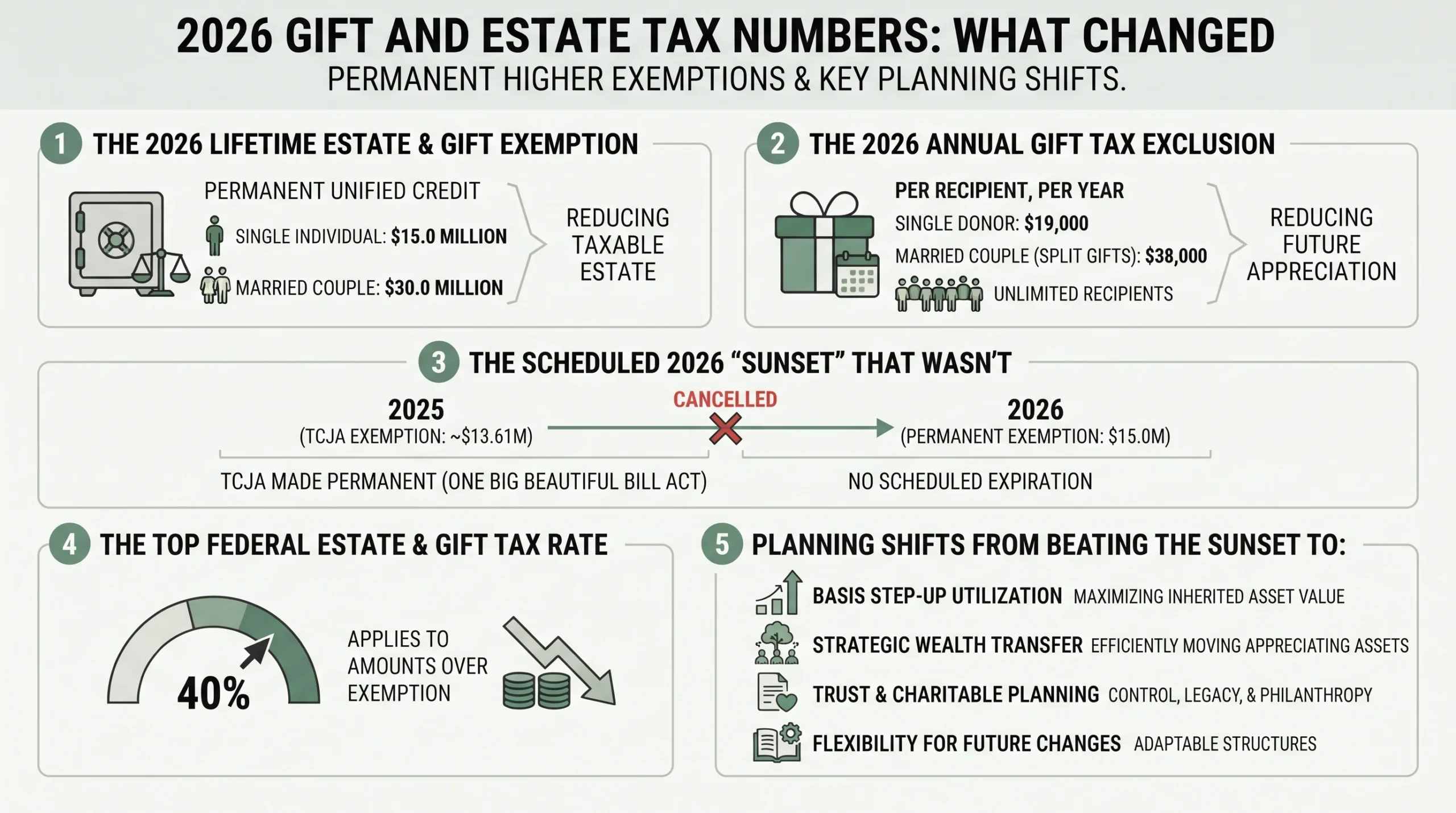
The 2026 lifetime gift and estate tax exemption is $15,000,000 per person, and the annual gift exclusion is $19,000 per recipient. The big change is what did not happen. The scheduled cut that was set to halve the exemption after 2025 was canceled. In 2025, the One Big Beautiful Bill Act kept the higher exemption and made it permanent. The top federal estate and gift tax rate stays at 40 percent.
The team at Sofer Advisors values closely held businesses for owners, investors, CPAs, and the attorneys who guide estate and gift planning.
This guide walks through the 2026 numbers, how the annual exclusion works, and why the permanent exemption shifts planning from beating a deadline to long-term gifting, basis planning, and valuation discounts.
Key Takeaways
- The 2026 lifetime estate and gift exemption is $15,000,000 per person (IRS, Revenue Procedure 2025-32).
- The 2026 annual gift exclusion is $19,000 per recipient.
- The scheduled 2026 “sunset” cut did not happen. The higher exemption is now permanent.
- The top federal estate and gift tax rate stays at 40 percent.
- Planning shifts from beating a deadline to long-term gifting, basis planning, and valuation discounts.
What changed for 2026?
The big change is what did not happen. Under the 2017 Tax Cuts and Jobs Act, the exemption was set to fall after 2025. It would have dropped by roughly half. That looming cut drove a wave of large gifts.
In 2025, Congress passed a new federal tax law. It is known as the One Big Beautiful Bill Act, or OBBBA. The law did two things. It kept the higher exemption, and it made it permanent. It also set the 2026 amount at $15,000,000 per person.
So the feared cut is off the table. The exemption did not shrink. It rose. In 2025 the amount was about $13.99 million per person. For 2026 it is $15,000,000. The top tax rate on amounts above the exemption stays at 40 percent.
This matters for how you plan. The old urgency was simple. Use the exemption before it fell, or lose it. That pressure is gone. You now have time to plan with a longer view.
What are the 2026 gift and estate tax numbers?
The two numbers most people ask about are the lifetime exemption and the annual gift exclusion. The lifetime exemption is the total you can transfer tax-free, during life or at death. The annual exclusion is the amount you can give each person each year without using any of that lifetime amount.
The table below shows both figures for 2025 and 2026. It also shows the top tax rate. The source is the IRS, under Revenue Procedure 2025-32.
| Figure | 2025 | 2026 |
|---|---|---|
| Lifetime exemption (per person) | about $13.99 million | $15,000,000 |
| Annual gift exclusion (per recipient) | $19,000 | $19,000 |
| Top estate and gift tax rate | 40% | 40% |
A few points help explain the table. The lifetime exemption rose from about $13.99 million to $15,000,000. A married couple can combine their amounts. Together they can shield $30,000,000 in 2026. The annual exclusion held steady at $19,000 per recipient. The top rate did not change.
How does the annual gift exclusion work?
The annual exclusion lets you give $19,000 to any person in 2026. You can do this for as many people as you like. A gift at or below this amount does not use your lifetime exemption. It also does not require a gift tax return in most cases.
The math adds up fast. Say you have three children. You can give each of them $19,000 in one year. That moves $57,000 out of your estate with no tax cost. A married couple can double that. Together they can give $38,000 to each child per year.
Gifts above the annual limit are not automatically taxed. They simply use part of your lifetime exemption. You report them on Form 709. Tax is due only after you use up the full $15,000,000.
Why does the permanent exemption change your planning?
The old plan was built around a deadline. Many owners gave away large stakes early to lock in the higher exemption. With the sunset gone, that rush is no longer needed. The focus moves to long-term goals instead of a single date.
Three ideas tend to matter most now. The first is steady, long-term gifting. Annual exclusion gifts still shrink an estate over time. The second is basis planning. Assets held until death often receive a step-up in basis, which can cut future capital gains tax. Gifting during life does not. So the choice between giving now and holding is more balanced than before.
The third idea is valuation discounts on closely held business gifts. When you gift a minority stake in a private company, its fair market value may be lower than a simple pro-rata share. That is because a small stake is harder to control and harder to sell. A defensible appraisal can support these discounts. Each of these moves depends on good numbers and sound advice.
There is also less reason to make rushed gifts you may regret. A large gift is hard to undo. Once you give away control of a business, you give up income and say over it. With the deadline gone, you can match gifts to your own needs. You can also time them around the value of the business. A good plan protects both your heirs and your own security.
How do valuation discounts fit in?
A gift of private business stock needs a fair market value. The IRS expects a defensible figure, not a guess. For a minority interest, two discounts often apply. One is a discount for lack of control. The other is a discount for lack of marketability.
A lack-of-control discount reflects a simple fact. A small owner cannot direct the company or force a sale. A lack-of-marketability discount reflects another. Shares in a private firm cannot be sold as fast as public stock. Both lower the value a buyer would pay. Both can lower the taxable value of the gift.
These discounts must appear in a credible appraisal to hold up. The report should follow fair market value standards under Revenue Ruling 59-60. It should tie the discount to the real facts of the business. A weak estimate invites an IRS challenge. A strong one supports the position you take on the return.
Do you still need to plan if your estate is under $15 million?
Yes, for several reasons. The exemption is permanent under current law, but laws can change again. A future Congress could lower it. Planning early gives you more options if that happens.
State taxes are a second reason. Some states set their own estate or inheritance tax. Many use a much lower threshold than the federal one. Your federal exemption does not protect you from a state tax. Check the rules where you live.
Growth is a third reason. A business that is small today may be large in ten years. Planning while values are lower can move more future growth out of your estate. That is where valuation work and legal structure come together.
Good records are a fourth reason. Keep copies of each gift tax return you file. Keep the appraisals that back up any business gift. These records support the values you reported if the IRS asks later. They also help the next generation understand the plan you built.
How does portability work for married couples?
Portability lets a surviving spouse use a deceased spouse’s unused exemption. It can nearly double the amount a couple shields from tax. Say one spouse dies and uses only part of the $15,000,000 amount. The unused part can pass to the surviving spouse.
There is one catch. Portability is not automatic. The estate of the first spouse to die must file a federal estate tax return. That return is Form 706. It must claim the unused amount, which the rules call the DSUE. Many families miss this step because no tax was due at the first death. Filing anyway can protect a large exemption for later use.
What about the generation-skipping transfer tax?
The generation-skipping transfer tax, or GST, is a separate tax. It applies to gifts that skip a generation, such as transfers to grandchildren. It has its own exemption and its own rules. The GST tax can apply on top of the gift or estate tax.
The permanent change to the lifetime exemption does not erase the GST tax. Families who plan to benefit grandchildren should treat it as a distinct issue. The exact GST exemption figure for 2026 should be confirmed with your tax advisor before you rely on it. Trusts are a common tool for managing this tax, so legal guidance matters here.
Frequently Asked Questions
What is the 2026 lifetime gift and estate tax exemption?
The 2026 lifetime exemption is $15,000,000 per person. This is the total you can transfer tax-free, during life or at death. A married couple can shield $30,000,000 combined. The figure comes from the IRS under Revenue Procedure 2025-32.
What is the 2026 annual gift tax exclusion?
The annual exclusion for 2026 is $19,000 per recipient. You can give this amount to any number of people each year. These gifts do not use your lifetime exemption. In most cases they do not require a gift tax return.
Did the estate tax exemption go down in 2026?
No. It went up. The 2017 tax law had scheduled a cut after 2025. The 2025 federal tax law, known as the OBBBA, canceled that cut. It made the higher exemption permanent and set it at $15,000,000 for 2026.
What is the top federal estate and gift tax rate for 2026?
The top rate is 40 percent. It applies to transfers above the lifetime exemption. This rate did not change for 2026. Amounts within the exemption are not taxed.
Do I still need to rush my gifting before the sunset?
No. The sunset that worried many families is gone. The higher exemption is now permanent under current law. You no longer need to give away wealth just to beat a deadline. You can plan with a longer view.
Why would I need a business valuation to make a gift?
A gift of private company stock needs a fair market value. The IRS expects a defensible appraisal, not an estimate. A valuation also supports discounts for lack of control and lack of marketability. These discounts can lower the taxable value of the gift.
What is the difference between the gift tax and the estate tax?
The gift tax applies to transfers you make while alive. The estate tax applies to transfers at death. Both share one lifetime exemption. A large gift during life reduces the amount left for your estate.
Does my state have its own estate tax?
Some states do. Many use a lower threshold than the federal one. A state tax can apply even when no federal tax is due. Check the rules in the state where you live.
Should I give assets now or hold them until death?
It depends on your goals. Gifting now moves future growth out of your estate. Holding until death may give heirs a step-up in basis that cuts capital gains tax. The right choice weighs both effects, so talk it through with your advisors.
Related Case Studies
- Promissory Note Valuation for Gift and Estate Tax
- How Family Limited Partnerships Are Valued for Gift and Estate Tax
- Valuation Discounts (DLOC and DLOM) on Estate and Gift Tax Returns
Executive Summary
The 2026 lifetime estate and gift exemption is $15,000,000 per person (IRS, Revenue Procedure 2025-32). The 2026 annual gift exclusion is $19,000 per recipient. The scheduled 2026 “sunset” cut did not happen. The higher exemption is now permanent. The top federal estate and gift tax rate stays at 40 percent. Planning shifts from beating a deadline to long-term gifting, basis planning, and valuation discounts.
What Should You Do Next?
Start by reviewing your plan with your estate attorney or tax advisor. Confirm whether the permanent exemption changes your gifting goals. If you hold private business interests, get a defensible valuation before you gift. Sofer Advisors provides independent gift and estate valuations, led by David Hern CPA ABV ASA CVA. Schedule a free consultation to discuss your situation.
People Also Read
- Estate Planning Business Valuation Georgia: Gift & Tax Compliance Guide
- Qualified Appraisal for Estate Tax: The IRS Definition
About the Author
This guide was prepared by David Hern CPA ABV ASA CVA, founder of Sofer Advisors, a business valuation firm headquartered in Atlanta, GA serving clients across the United States. David holds accreditations as an Accredited Senior Appraiser (ASA) and is Accredited in Business Valuation (ABV), credentials recognized by the IRS, SEC, and FINRA, and is also a Certified Valuation Analyst (CVA). David has served as an expert witness in dozens of cases across multiple jurisdictions, and Sofer Advisors is an Inc. 5000 honoree in 2024 and 2025 with 240+ five-star Google reviews.
For professional business valuation services, visit soferadvisors.com/about-us/ or contact Sofer Advisors at soferadvisors.com/contact-us/.
Disclaimer: This content is for informational purposes only and does not constitute professional valuation advice. Business valuation conclusions depend on specific facts and circumstances. Contact Sofer Advisors for guidance regarding your specific situation.