


Last Updated: November 2026
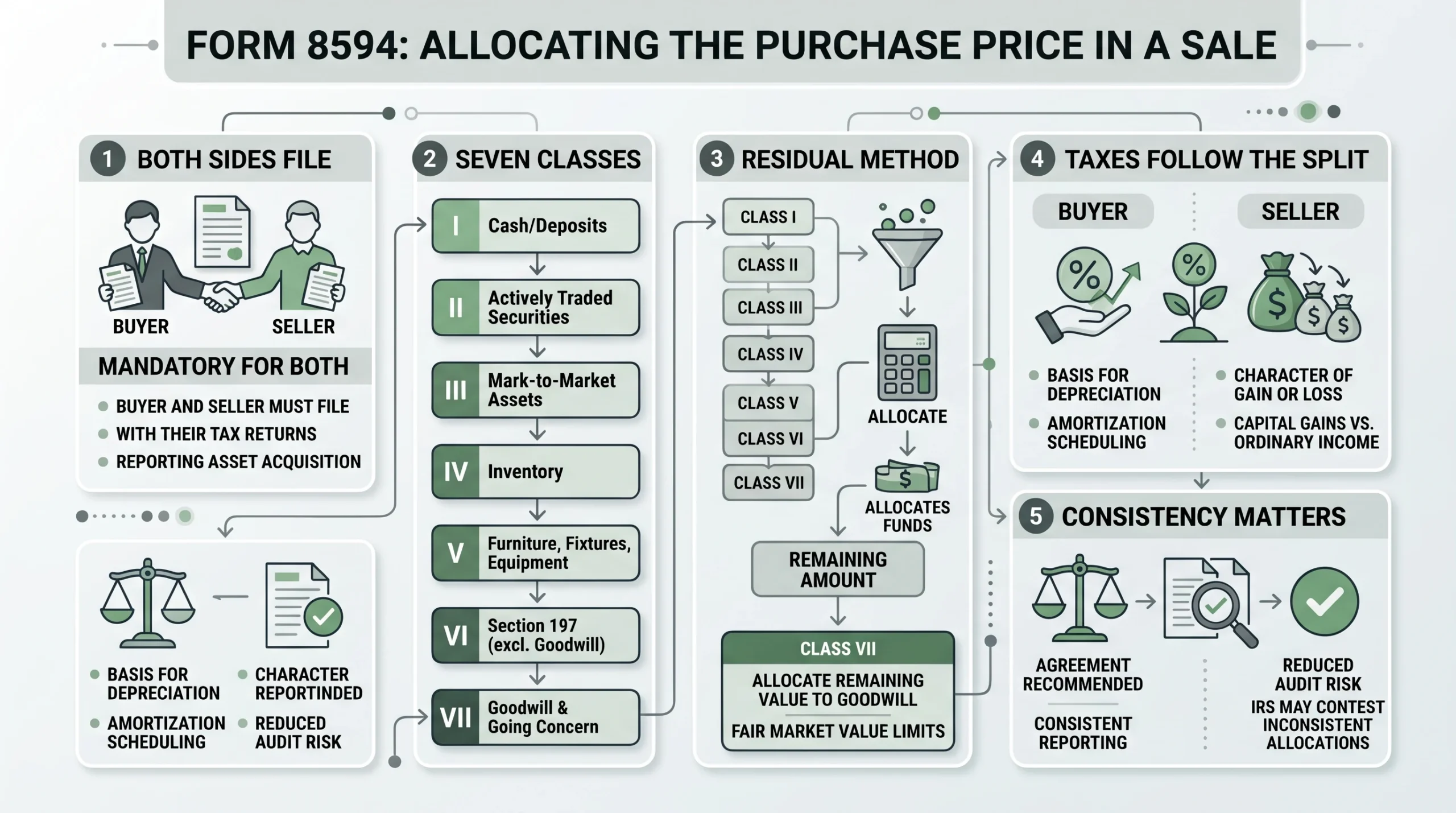
Form 8594 is the IRS form where the buyer and seller report how a sale price is split across the assets of a business. It is called the Asset Acquisition Statement, and both parties file it with their own tax return. The form follows IRC Section 1060, which uses the residual method and seven asset classes. Each class takes value up to its fair market value, and whatever is left becomes goodwill.
The team at Sofer Advisors values the assets behind these allocations for owners, CPAs, and attorneys.
This guide explains who files, how the seven asset classes work, and why the allocation shapes the tax bill on both sides.
Key Takeaways
- Both sides file: The buyer and the seller each file Form 8594 with their own tax return.
- Seven classes: The purchase price is split across seven asset classes under IRC Section 1060.
- Residual method: Each class is filled up to fair market value, and whatever is left becomes goodwill.
- Taxes follow the split: The allocation sets the buyer’s future deductions and the seller’s gain.
- Consistency matters: Both parties should report the same numbers to lower audit risk.
What is Form 8594?
Form 8594 is an IRS form called the Asset Acquisition Statement. It reports how a purchase price is allocated across a group of assets. The form applies to an applicable asset acquisition. That means a sale of assets that make up a trade or business.
Both parties file the form. Each one attaches it to the federal income tax return for the year of the sale. The rules come from IRC Section 1060. That section tells taxpayers to use the residual method and the seven asset classes.
The goal is simple. The buyer and seller should describe the same deal the same way. When both sides report matching numbers, the IRS can trace the deal cleanly. When the numbers differ, questions follow.
Who must file Form 8594?
Both the buyer and the seller must file Form 8594. Each party files its own copy. A sole proprietor attaches it to Form 1040. A corporation attaches it to Form 1120. A partnership attaches it to its own return. The form goes with the return for the tax year when the sale closed.
The filing duty does not depend on the deal size. It applies whenever assets of a trade or business change hands and goodwill could exist. Missing the form can bring penalties. Reporting different numbers from the other party can also draw IRS attention. Accuracy on both sides protects everyone.
Many owners handle the form with help from a CPA or a valuation professional. The hard part is not the form itself. The hard part is valuing each asset so the numbers hold up under review.
What are the seven asset classes?
Form 8594 sorts every asset into one of seven classes. The classes run from the most liquid to the least. Cash sits at the top. Goodwill sits at the bottom. The table below shows what each class holds.
| Asset Class | What It Covers |
|---|---|
| Class I | Cash and general deposit accounts |
| Class II | Actively traded personal property, certificates of deposit, and foreign currency |
| Class III | Accounts receivable, mortgages, and credit-card receivables (debt instruments) |
| Class IV | Inventory and property held for sale to customers |
| Class V | All other assets, such as furniture, fixtures, equipment, land, and buildings |
| Class VI | Section 197 intangibles other than goodwill, such as customer lists and covenants not to compete |
| Class VII | Goodwill and going-concern value |
The order is not random. It drives how the price gets assigned. The next section explains that flow.
How does the residual method work?
The residual method fills the classes in order. You start with Class I and work down to Class VII. Each class takes value up to its fair market value. Then you move to the next class.
Cash in Class I is easy. A dollar of cash is worth a dollar. Classes II through VI take their fair market values next. These cover securities, receivables, inventory, equipment, and most intangibles. Each one gets the value it would fetch on its own.
Once those classes are full, money is often left over. That leftover amount goes to Class VII as goodwill. This is why goodwill is called the residual. It is not measured on its own. It is simply what remains after every other asset gets its fair value. If a buyer pays more than the assets are worth apart, that premium becomes goodwill.
What does an illustrative allocation look like?
Here is an illustrative example. The figures are made up to show the method, not real results.
Say a buyer pays $2,000,000 for a small business. The company holds $50,000 in cash, which fills Class I. It has $150,000 in receivables, which fill Class III. Inventory worth $300,000 fills Class IV. Equipment and furniture worth $600,000 fill Class V. A customer list worth $200,000 fills Class VI. Those classes together absorb $1,300,000. The remaining $700,000 becomes goodwill in Class VII.
The lesson is the pattern, not the numbers. Each class takes its fair value first. Goodwill collects whatever is left. Change any asset value and the goodwill figure shifts to match.
Why does the allocation matter for taxes?
The allocation is not just paperwork. It sets real tax outcomes for both sides.
For the buyer, the split sets the starting basis of each asset. Equipment in Class V can be depreciated over its useful life. Intangibles in Class VI and goodwill in Class VII are Section 197 intangibles. The buyer amortizes them over 15 years. A buyer often wants more value in assets that give faster deductions.
For the seller, the split decides the kind of income. Some assets produce ordinary income. Inventory is one example. Depreciation recapture on equipment is another. Goodwill is usually a capital gain, which is often taxed at a lower rate. A seller often prefers more value in goodwill.
These two goals pull in opposite directions. That tension is why the two sides negotiate the allocation during the deal. A clear agreement up front saves trouble at tax time.
How is Form 8594 structured?
The form has three parts. Each part has a clear job.
Part I collects general information. It names the buyer and the seller. It gives the sale date and the total price. Part II is the core section. Here the taxpayer assigns the price to the seven classes. Both sides should report matching figures in this part.
Part III is the supplemental statement. You use it when the price changes after the first filing. An earn-out or a later adjustment can shift the numbers. Part III updates the allocation so the records stay correct.
What are the penalties for getting it wrong?
The form is short, but mistakes carry a cost. A missing or late Form 8594 can bring a penalty for failure to file. Incomplete or incorrect information can bring a penalty too. The exact amount depends on the facts and the current rules.
The bigger risk is a mismatch. The buyer and seller file separate copies. If those copies report different numbers, the IRS can see the gap. One side might claim a high basis while the other reports a low gain. That kind of conflict invites an audit of both returns.
Good records prevent most of these problems. Keep the signed purchase agreement. Keep the appraisal that supports each asset value. Make sure both copies of the form carry the same figures. A little care at filing time avoids a hard conversation later.
How does Form 8594 differ from Form 8883?
Form 8594 and Form 8883 both allocate a purchase price. The difference is the type of deal.
Form 8594 covers a direct asset sale. The buyer acquires the actual assets of the business. Form 8883 covers a stock purchase with a Section 338 election. In that case, a buyer buys stock but elects to treat the deal as an asset purchase for tax. The election creates a step-up in the basis of the assets inside the company.
Both forms use the residual method and the seven classes. The trigger is what differs. A direct asset deal uses Form 8594. A qualified stock purchase with a Section 338 election uses Form 8883.
Frequently Asked Questions
What is IRC Section 1060?
IRC Section 1060 sets the rules for allocating a purchase price in an applicable asset acquisition. It requires the residual method. It also requires the seven asset classes. The goal is consistent reporting by the buyer and the seller.
Do the buyer and seller have to use the same allocation?
There is no law that forces identical figures. Still, the IRS expects both sides to report consistently. Conflicting numbers raise audit risk for both parties. Most buyers and sellers agree on the allocation during the deal and write it into the purchase agreement.
What is the residual method?
The residual method assigns value to each asset class in order, up to fair market value. Whatever price is left after Classes I through VI goes to Class VII. That final amount is goodwill and going-concern value.
Why does goodwill end up in Class VII?
Goodwill is the residual. It is the part of the price that no specific asset explains. After every other asset gets its fair value, the leftover reflects reputation, customer loyalty, and future earning power. That value lands in Class VII.
How are Section 197 intangibles treated?
Section 197 intangibles include goodwill, going-concern value, customer lists, and covenants not to compete. The buyer amortizes these over 15 years. The period is fixed, no matter the asset’s real useful life. That steady deduction lowers taxable income each year across the 15-year span. It is one reason buyers watch how much value lands in Class VI and Class VII.
What happens if the purchase price changes after filing?
A later change in price requires an update. The taxpayer files a supplemental Form 8594 using Part III. This reallocates the new total across the asset classes. The update keeps the buyer’s basis and the seller’s gain accurate.
Which tax return does Form 8594 attach to?
Form 8594 attaches to the federal income tax return for the year of the sale. A sole proprietor files it with Form 1040. A corporation files it with Form 1120. A partnership files it with its own return.
Does an earn-out change the allocation?
Yes, it can. An earn-out pays the seller more if the business hits later targets. When that extra payment arrives, the total price goes up. The taxpayer then files a supplemental Form 8594 under Part III. The added amount is spread across the classes again. In many deals, it raises the goodwill figure in Class VII.
Is Form 8594 the same as financial reporting purchase price allocation?
No. Tax allocation under Form 8594 follows fixed classes and the residual method. Financial reporting under ASC 805 looks at the fair value of each asset for the balance sheet. The two can reach different values for the same assets because they serve different goals.
Related Case Studies
- Goodwill Calculation Example: Purchase Price to Residual
- Valuing Customer Relationships in a Purchase Price Allocation
- Section 1060 Asset Allocation in a Business Sale
Executive Summary
The buyer and the seller each file Form 8594 with their own tax return. The purchase price is split across seven asset classes under IRC Section 1060. Each class is filled up to fair market value, and whatever is left becomes goodwill. The allocation sets the buyer’s future deductions and the seller’s gain. Both parties should report the same numbers to lower audit risk.
What Should You Do Next?
A clean Form 8594 starts with a solid value for each asset. Gather your purchase agreement and any appraisal. Confirm that the buyer and seller report the same totals. If your deal involves large intangibles or a price that may change later, have a valuation professional review the allocation. Sofer Advisors provides independent purchase price allocation and tax reporting valuations, led by David Hern CPA ABV ASA CVA. Schedule a consultation to discuss your transaction.
People Also Read
- Customer Concentration: Why It Cuts Sale Price 10 to 30 Percent
- Asset Sale vs Stock Sale: Tax and Deal Structure Guide
About the Author
This guide was prepared by David Hern CPA ABV ASA CVA, founder of Sofer Advisors, a business valuation firm headquartered in Atlanta, GA serving clients across the United States. David holds accreditations as an Accredited Senior Appraiser (ASA) and is Accredited in Business Valuation (ABV), credentials recognized by the IRS, SEC, and FINRA, and is also a Certified Valuation Analyst (CVA). David has served as an expert witness in dozens of cases across multiple jurisdictions, and Sofer Advisors is an Inc. 5000 honoree in 2024 and 2025 with 240+ five-star Google reviews.
For professional business valuation services, visit soferadvisors.com/about-us/ or contact Sofer Advisors at soferadvisors.com/contact-us/.
Disclaimer: This content is for informational purposes only and does not constitute professional valuation advice. Business valuation conclusions depend on specific facts and circumstances. Contact Sofer Advisors for guidance regarding your specific situation.