

Last Updated: November 2026
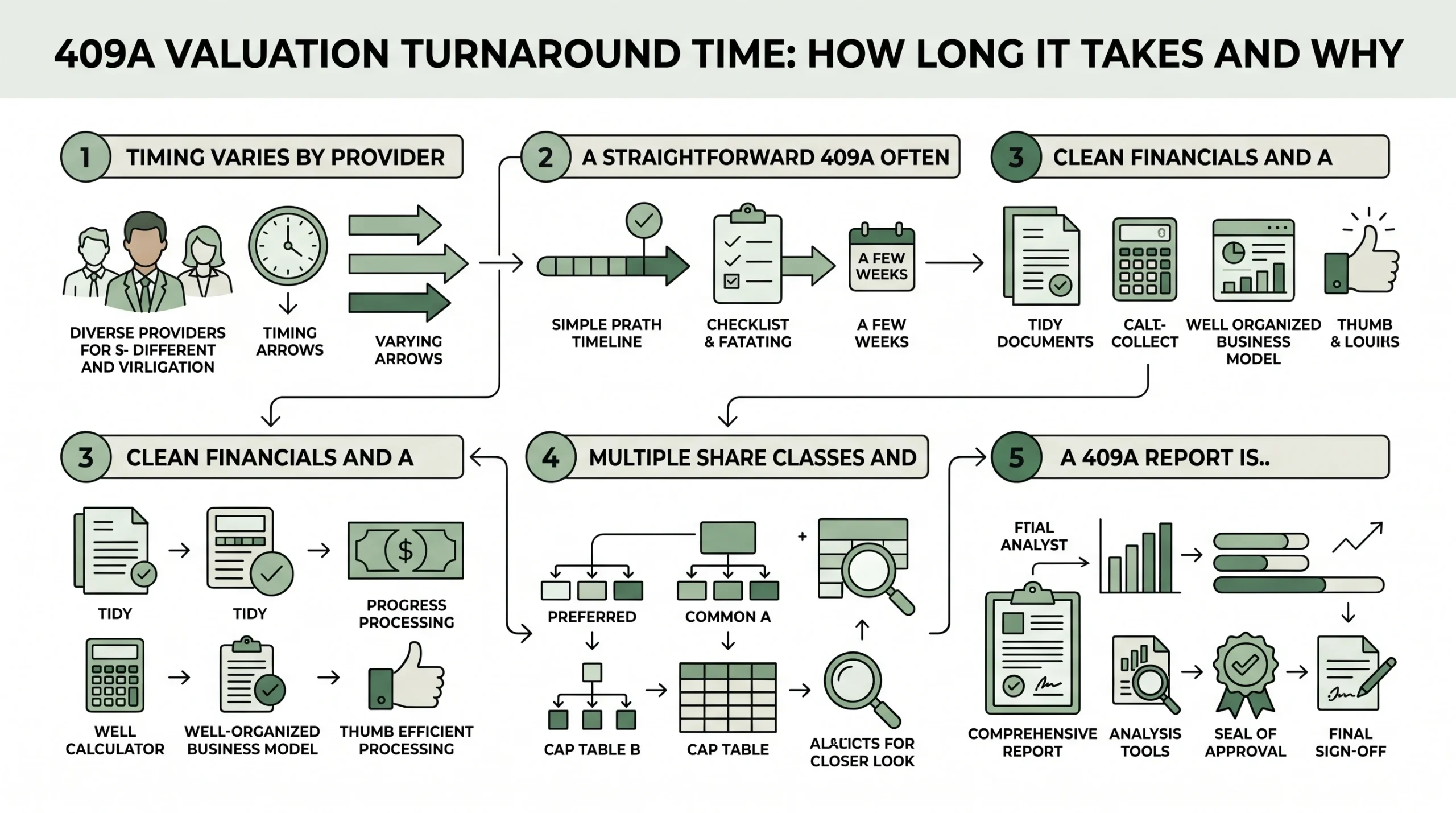
A straightforward 409A valuation often takes about one to two weeks once you hand over complete information. There is no fixed clock. A more complex company, with multiple share classes or recent financing, can take longer. The exact time varies by provider and by how ready your data is. Clean financials and a current cap table are the fastest way to speed things up.
Sofer Advisors prepares these valuations for private companies across the country.
This guide explains what sets the pace, which documents move it faster, and whether you can expedite the work.
Key Takeaways
- Timing varies by provider and by the complexity of your company.
- A straightforward 409A often takes about one to two weeks once complete data is in hand.
- Clean financials and a current cap table are the fastest way to speed things up.
- Multiple share classes and recent financing add time to the work.
- A 409A report is generally valid for up to 12 months, absent a material event.
How long does a 409A valuation take?
Turnaround depends on two things. The first is how complex your company is. The second is how ready your information is.
A simple company moves quickly. Picture an early-stage startup with one share class and clean books. Once the full data is in, a report can come together in about one to two weeks. Some providers offer a rush option that is faster still.
A complex company takes more time. Multiple share classes, recent funding, or a layered cap table all add work. The analyst has to model more moving parts. That careful work protects you if the IRS ever looks closely.
Timing also varies by provider. Each firm runs its own process and carries its own workload. So always ask a provider for its current turnaround before you engage. Frame your planning around a range, not a single fixed date. A rough estimate from the provider is better than a guess.
Keep in mind that the final report is only one part of the work. Much of the time goes into gathering and checking your data. A fast report built on weak inputs helps no one. The goal is a value you can stand behind, delivered in a reasonable window.
What drives the 409A valuation timeline?
A few clear factors set the pace. Knowing them helps you plan your option grants without surprises.
Data readiness is the biggest one. The analyst needs your financials, your cap table, and any recent financing terms. Projections help too. When these arrive clean and complete, the work starts right away. When they are missing or messy, the clock stalls. Chasing records is one of the most common causes of delay.
Company stage and complexity come next. A single share class is simple to model. Several share classes, each with its own rights, are not. Recent or pending financing can also change the picture and add steps. Later-stage companies usually carry more of this complexity.
The valuation method matters as well. For many venture-backed companies, analysts use an option pricing model, often called the OPM. If there was a recent priced round, they may use a backsolve to that price. A more complex structure calls for more careful modeling, and that takes time. The right method depends on your stage and your cap table.
Your own responsiveness plays a role too. Analysts often have follow-up questions during review. Quick answers keep the work moving. Slow replies push the delivery date back. The more engaged you are, the smoother the process runs.
What are the stages of a 409A valuation?
Most 409A engagements follow the same path. The names differ by provider, but the flow is steady. Each stage builds on the one before it.
First comes kickoff. You and the provider agree on scope and purpose. You confirm what the valuation is for and when you need it.
Then comes data collection. You share your financials, cap table, and financing details. This stage sets the pace for everything that follows. Clean, complete records let it move quickly.
Next is analysis. The analyst models your equity and prices the common stock. This is the core of the work. It is also where complex structures demand the most care.
Last comes review and delivery. The provider checks the draft for errors and support. Then it sends the final report. A delay in any early stage ripples through the rest. Missing data at collection, for example, stalls the analysis that follows. That is why readiness at the start matters so much.
Which documents speed up the process?
A few key records do most of the heavy lifting. Having them ready at kickoff is the single best way to move faster.
Your cap table is first. It shows every share, option, and warrant. The analyst needs it to model your equity. Articles of incorporation confirm your authorized share classes. Historical financial statements show how the business has performed over time.
Recent financing terms matter a great deal. A term sheet from a recent round gives a real, arm’s-length price point. That can anchor the whole analysis. Short-term projections round out the forward-looking view.
Gather these before you engage. When they are clean and complete, the analyst can start without a wait. When they are scattered, the review drags on. A short checklist of these items can save you days.
| Document | Why it helps |
|---|---|
| Cap table | Shows all shares, options, and warrants |
| Financial statements | Reflect how the business has performed |
| Recent financing terms | Give a current market price point |
| Short-term projections | Support the forward-looking view |
Can you expedite a 409A valuation?
Yes, in many cases. Some providers offer a rush option for urgent needs. That might suit an imminent financing round or a pending option grant. Ask your provider whether a rush is available, how fast it is, and what it costs.
A rush does not lower the quality of the work. The analysis still has to be thorough and defensible. The report must still support the value it reaches. A rushed, thin report is a real risk.
The best way to go fast is still preparation. Clean data and quick answers do more than any rush fee. If your records are ready, you may not need a rush at all.
Does a rushed 409A valuation create risk?
It can, if speed comes from cutting corners. A 409A has to support its conclusion with sound analysis. When that analysis is thin, the fair market value may be off. An off value puts your stock options at risk.
The main risk is losing safe harbor. Safe harbor is the protection a proper valuation gives you. It shifts the burden of proof to the IRS if your value is ever questioned. A weak report can forfeit that protection.
If options are priced below fair market value, the tax cost can be steep. Employees can face extra tax and penalties under Section 409A. That is why a defensible report matters more than a fast one. Good preparation lets you have both speed and rigor.
So treat timing and quality as partners, not rivals. A clear report records the inputs, the method, and the reasoning behind the value. That record is what holds up if an auditor asks questions later. A rushed report that skips this record can cost you far more than it saves. The time spent on careful work is an investment in defensibility.
How long is a 409A valuation valid?
A 409A report is generally valid for up to 12 months. That holds as long as nothing material changes in the meantime.
A material event can cut that window short. A new funding round is one example. A major change in performance is another. Any of these can shift the fair market value of your common stock.
When a material event happens, you likely need a new valuation. A fresh report keeps your option pricing current. It also keeps your safe harbor protection intact. Plan your option grants around this 12-month cycle, and watch for events that reset it.
How should you plan around 409A timing?
Build the valuation into your calendar early. Do not wait until an option grant is days away. A short buffer gives you room if the review takes longer than hoped.
Work backward from your deadline. If you need signed grants by a certain date, start the valuation well before it. Add time for your own data gathering, not just the provider’s work. That gathering is often the slowest step.
Order a new valuation after any major event. A funding round, a big acquisition, or a sharp change in revenue can all reset the clock. Staying ahead of these events keeps your grants clean. It also spares you a last-minute rush.
Frequently Asked Questions
How long does a 409A valuation take?
It varies by provider and by how complex your company is. A straightforward 409A often takes about one to two weeks once complete data is in hand. A complex cap table can take longer. Ask your provider for its current turnaround before you engage.
What is the fastest way to speed up my 409A?
Have your data ready at kickoff. That means clean financials, a current cap table, and any recent financing terms. Answer the analyst’s questions quickly during review. Preparation does more for speed than anything else. A short checklist before you start can save several days.
Can I rush a 409A valuation?
Often, yes. Many providers offer a rush option for urgent needs. The work still has to be thorough and defensible. Ask about timing and cost before you commit. Clean data can make a rush unnecessary.
What information does a 409A valuation require?
The core items are your cap table, your financial statements, and recent financing terms. Articles of incorporation and short-term projections help too. Clean, complete records let the analyst start right away.
Why do complex cap tables take longer?
More share classes mean more to model. Each class can carry different rights and preferences. Recent or pending financing adds more steps. The analyst has to account for all of it, which takes time. The extra care is what keeps the result defensible.
How long is a 409A valuation valid?
A 409A is generally valid for up to 12 months. A material event, such as a new funding round, can shorten that window. When that happens, you likely need a new valuation to stay current.
What is a 409A valuation for?
It sets the fair market value of a private company’s common stock. Companies use that value to price stock options under IRC Section 409A. A proper valuation helps those options qualify for safe harbor. Without one, option pricing is far harder to defend.
What methods are used to value the stock?
It depends on your situation. For many venture-backed companies, analysts use an option pricing model, or OPM. After a recent priced round, they may backsolve to that price. The method should fit your capital structure.
Does a faster valuation mean a weaker report?
Not if it is done right. Speed often comes from good preparation, not shortcuts. A sound report supports its value with clear analysis. That support is what protects you in an audit.
Related Case Studies
- How Often Do You Need a 409A Valuation Update?
- 409A Valuation for Startups: Complete Compliance Guide 2025-2026
- 409A Valuation Requirements: Complete Compliance Guide 2025
Executive Summary
Timing varies by provider and by the complexity of your company. A straightforward 409A often takes about one to two weeks once complete data is in hand. Clean financials and a current cap table are the fastest way to speed things up. Multiple share classes and recent financing add time to the work. A 409A report is generally valid for up to 12 months, absent a material event.
What Should You Do Next?
Start by gathering your cap table, financials, and recent financing terms. Clean records are the fastest path to a timely report. For help with a defensible 409A valuation, Sofer Advisors offers business valuation services led by David Hern CPA ABV ASA CVA. Reach out today to talk through your specific timeline and your needs.
People Also Read
- What Happens If You Skip a 409A Valuation: Penalties
- 409A vs 8-K Valuation: Key Differences for Startups
About the Author
This guide was prepared by David Hern CPA ABV ASA CVA, founder of Sofer Advisors, a business valuation firm headquartered in Atlanta, GA serving clients across the United States. David holds accreditations as an Accredited Senior Appraiser (ASA) and is Accredited in Business Valuation (ABV), credentials recognized by the IRS, SEC, and FINRA, and is also a Certified Valuation Analyst (CVA). David has served as an expert witness in dozens of cases across multiple jurisdictions, and Sofer Advisors is an Inc. 5000 honoree in 2024 and 2025 with 240+ five-star Google reviews.
For professional business valuation services, visit soferadvisors.com/about-us/ or contact Sofer Advisors at soferadvisors.com/contact-us/.
Disclaimer: This content is for informational purposes only and does not constitute professional valuation advice. Business valuation conclusions depend on specific facts and circumstances. Contact Sofer Advisors for guidance regarding your specific situation.