


Last Updated: October 2026
Tax affecting is the single adjustment that decides whether an S corporation looks cheap or expensive to the IRS. For twenty years the Tax Court refused it. Then Kress and Jones, two 2019 decisions, reopened the question. The court now accepts tax affecting when the model behind it is coherent and the analyst can defend the numbers. That shift matters for every family that transfers S corporation stock by gift or at death.
Sofer Advisors values pass-through entities for business owners, CPAs, and estate attorneys, backed by Inc. 5000 recognition in both 2024 and 2025. The practice has served as an expert witness in 11+ cases and carries 180+ five-star Google reviews. The lesson from Kress and Jones is simple. A tax-affecting adjustment survives review when it is tied to the facts, not when it is bolted on to lower a number.
This guide explains what tax affecting is, how the IRS rejected it in Gross, how Kress and Jones changed the landscape, and which models hold up today. It also covers why the adjustment matters for estate and gift valuations of closely held stock.
Key Takeaways
- What tax affecting is: it applies a hypothetical corporate income tax to a pass-through entity’s earnings so its cash flow can be compared with C corporation market data.
- The IRS fought it for years: Gross v. Commissioner rejected tax affecting in 1999, and the IRS treated a zero tax rate as the default for S corporation earnings.
- Kress and Jones reopened it: two 2019 decisions accepted tax affecting because the analysts tied the rate to how a real buyer would price the stock.
- The model has to be coherent: there is no mandated formula, so the SEAM, Van Vleet, and Treharne models each stand or fall on the logic behind them.
- It moves estate and gift value: a documented adjustment often lowers fair market value, which can reduce the tax on a family transfer.
Each point ties into how a transfer is priced and defended. The sections below take them one at a time.
Why Is Tax Affecting Important to Understand?
Tax affecting decides how much an S corporation interest is worth for tax purposes, and the gap is large. Leave earnings untaxed and the value climbs, which raises gift and estate tax. Apply a corporate rate and the value falls, which the IRS has long viewed as an artificial discount. Kress and Jones changed that calculus. An owner who ignores the adjustment may now overpay tax, while one who applies it without a coherent model hands the IRS an easy challenge. Understanding the line between the two is the whole point.
What Is Tax Affecting in an S Corporation Valuation?
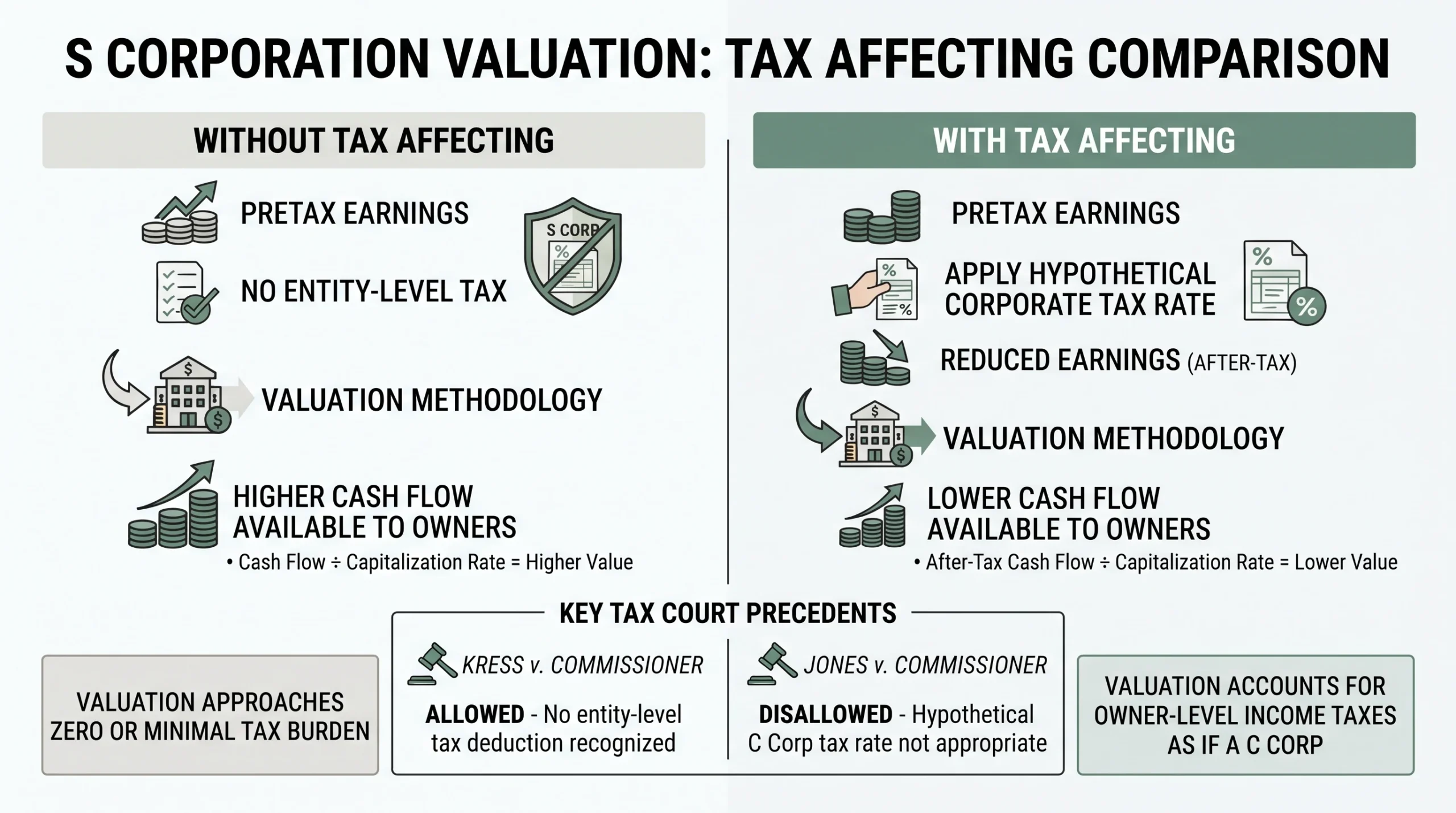
Tax affecting means applying a hypothetical corporate income tax to the earnings of a pass-through entity before you value it. An S corporation pays no tax at the entity level. Instead it passes its income through to the shareholders, who pay tax on their own returns. That makes reported S corporation earnings look higher than a comparable C corporation, which does pay a corporate tax.
The problem shows up in the market approach. Analysts price a private company against data from public companies, and almost every public company is a C corporation. Comparing untaxed S corporation earnings to taxed C corporation earnings is not a fair match. Tax affecting closes that gap by charging the S corporation a hypothetical rate, so both sides of the comparison sit on the same footing. The debate is how much tax to assume, and whether to credit the S corporation for the tax it never pays.
How Did the IRS Reject Tax Affecting in Gross v. Commissioner?
The IRS position for years traced back to Gross v. Commissioner, a 1999 Tax Court decision later upheld on appeal. In Gross, the taxpayer tax affected the earnings using a full corporate rate. The court rejected it. The company paid out nearly all of its earnings and owed no entity-level tax, so the court saw no reason to subtract a tax the business did not pay. The practical result was a zero tax rate and a higher value.
That ruling hardened into a default. The IRS Job Aid for valuing S corporations leaned on Gross and warned analysts away from tax affecting unless they could prove a specific, measurable burden. A string of later cases followed the same path. The message to appraisers was blunt. Tax affect an S corporation and expect the adjustment to be stripped out on audit.
How Did Kress and Jones Change the Landscape?
Two 2019 decisions broke the pattern. In Kress v. United States, a federal district court in Wisconsin accepted a valuation that tax affected S corporation earnings. The court did not bless a formula. It accepted the analysts’ reasoning that a willing buyer would factor shareholder taxes into the price. The same year, in Estate of Jones v. Commissioner, the Tax Court accepted a tax-affected valuation and endorsed a model that adjusted for the tax a buyer would bear.
Estate of Davis sits in the background as the cautionary case, a reminder that the court can still reject an adjustment it finds unsupported. Read together, the cases do not hand owners a free discount. They set a standard. Tax affecting is allowed when the analyst shows how a hypothetical buyer would price the tax, with a rate that matches the facts. A bare corporate rate with no reasoning still fails. An appraiser now has room to tax affect, but only with a record behind the number.
What Models Tax Affect an S Corporation?
There is no mandated formula, which is why the model matters so much. Three named approaches do most of the work. The S Corporation Economic Adjustment Model, or SEAM, built by Daniel Van Vleet and often called the Van Vleet model, prices the net benefit an S corporation holder keeps after shareholder taxes. The Treharne model and the Mercer approach take their own routes to the same question.
The entity context drives the inputs. Subchapter S of the tax code sets who can be an S corporation and how its income is taxed, and those rules shape the premium a buyer would pay. A simpler method applies a straight C corporation rate to equate the two entity types. A fuller model credits the S corporation for avoiding the second layer of tax on dividends. The right choice depends on the distribution history, the buyer profile, and the holding period. What the courts reward is not the label on the model but the fit between its logic and the company’s facts.
How Does Tax Affecting Affect Estate and Gift Valuations?
For an estate or gift, tax affecting usually lowers the value of the stock. A lower estate tax value of the shares can cut the tax on a transfer, which is why owners want the adjustment and the IRS scrutinizes it. The standard is fair market value under Revenue Ruling 59-60, and that standard asks what a hypothetical buyer and seller would agree to. If a real buyer would weigh shareholder taxes, the value should reflect them.
The risk runs the other way too. A thin or unsupported adjustment invites the IRS to restore a zero rate, raise the value, and assess more tax. The protection is a documented rationale that ties the rate to market evidence and the company’s own numbers. See how Sofer Advisors approaches tax and estate reporting valuations for S corporation stock. A clear record is what turns a tax-affecting adjustment from an audit target into a defensible position.
Who Values an S Corporation, and How Do the Options Compare?
Owners pick a valuation partner based on the size of the interest, the audit exposure, and the budget. Large national firms such as Alvarez & Marsal, Stout, and Kroll serve big public companies with broad advisory teams. Sofer Advisors focuses on defensible, partner-led valuations for closely held and middle-market businesses. The table below sets out the common options.
| Provider | Typical role | Best for |
|---|---|---|
| Specialized valuation firm (e.g. Sofer Advisors) | Builds and documents the tax-affecting model for the subject interest | Family and closely held transfers needing audit-ready support |
| Large national firm | Broad advisory plus valuation at enterprise scale | Large public companies with complex, multi-entity plans |
| Estate attorney | Drafts the transfer and reviews the plan; does not value | Families needing the legal structure built and reviewed |
Sofer Advisors runs each engagement through a four-phase process it calls The Sofer Difference, moving from Discovery to Diligence to Analysis to Delivery. That structure keeps every tax rate tied to the record behind it. It reflects the Heart of a Teacher approach, which means explaining the reasoning behind a number rather than just handing over a figure. An independent analyst supplies both the adjustment and the evidence behind it.
Frequently Asked Questions
What is tax affecting in an S corporation valuation?
Tax affecting means applying a hypothetical corporate income tax to the earnings of a pass-through entity before you value it. An S corporation pays no entity-level tax, so its reported earnings look higher than a comparable C corporation. The adjustment makes the two sides comparable when you price the stock against public company data. Sofer Advisors documents the assumed rate so the number reads as a reasoned choice rather than a guess.
How did the IRS historically view tax affecting?
The IRS treated a zero tax rate as the default after Gross v. Commissioner in 1999, where the Tax Court rejected a full corporate rate on earnings the company did not pay tax on. Its S corporation Job Aid warned analysts away from the adjustment without a measurable burden. For years most reports avoided tax affecting rather than fight. Sofer Advisors knows that history and builds each model to answer the exact objections the IRS raised.
How did Kress v. United States change tax affecting?
In Kress v. United States, a 2019 federal district court decision in Wisconsin, the court accepted a valuation that tax affected S corporation earnings. It did not endorse a formula. It accepted the reasoning that a willing buyer would factor shareholder taxes into the price offered for the stock. That broke the long pattern of automatic rejection. Sofer Advisors applies the same standard, tying each assumed rate to how a real buyer would price the interest.
What did Estate of Jones add to tax affecting?
Estate of Jones v. Commissioner, decided by the Tax Court in 2019, accepted a tax-affected valuation and endorsed a model that adjusted earnings for the tax a buyer would bear. It reinforced the shift Kress began in the same year. The case showed the court will credit an academic model when the logic fits the facts. Sofer Advisors uses these models to build a clear, defensible position for owners transferring S corporation stock.
What models are used to tax affect an S corporation?
Analysts use named approaches such as the S Corporation Economic Adjustment Model, known as SEAM or the Van Vleet model, along with the Treharne and Mercer models. Each one quantifies what a buyer gains or loses from pass-through status. The right choice depends on distribution history, the buyer profile, and the holding period. Sofer Advisors selects a model to fit the company’s facts, then documents why that choice reflects how a buyer would actually price the stock.
Why does tax affecting matter for estate and gift valuations?
Tax affecting usually lowers the fair market value of S corporation stock, which can reduce the tax on a gift or estate transfer. Under Revenue Ruling 59-60, the value must reflect what a hypothetical buyer would pay, and a real buyer weighs shareholder taxes. A thin or unsupported adjustment invites the IRS to raise the value. Sofer Advisors supports every adjustment with market evidence so the transfer holds up under review.
Does the IRS now accept tax affecting for every S corporation?
No. There is no blanket acceptance. Kress and Jones opened the door, but both turned on the quality of the reasoning behind the rate. The IRS can still restore a zero rate when an adjustment lacks support, and Estate of Davis shows the court will reject a weak model. Sofer Advisors treats each valuation as if it will be audited, building the record that a coherent, fact-based adjustment requires to survive scrutiny.
How much does an S corporation valuation cost?
Most S corporation valuations run from $7,500 to $25,000 and take about two to six weeks, depending on the complexity of the interest and the depth of tax-affecting analysis required. A flat fee is quoted up front, so the cost is clear before the work starts. Sofer Advisors scopes the engagement first, then sets a fixed price. Request a free estimate for your situation.
Related Case Studies
- Tax-Affecting S-Corp Earnings: Gross, Kessler, and Today’s View
- S Corp vs C Corp: How Entity Choice Affects Business Value
- Valuation Discounts (DLOC and DLOM) on Estate and Gift Tax Returns
Executive Summary
Tax affecting applies a hypothetical corporate tax to an S corporation’s earnings so they can be compared with C corporation market data. The IRS rejected it for years after Gross v. Commissioner, defaulting to a zero rate and a higher value. Two 2019 decisions, Kress v. United States and Estate of Jones, reopened the practice. Neither blessed a formula. Both accepted the adjustment because the analyst showed how a real buyer would price shareholder taxes. The working models, SEAM and the Van Vleet, Treharne, and Mercer approaches, each stand on their logic, not their label. For estate and gift transfers the adjustment usually lowers value and tax, but only a documented, fact-based rate survives review. The first step is a fair market value built on a model that fits the company.
What Should You Do Next?
Gather the S corporation’s distribution history, five years of tax returns, and the terms of the planned transfer, since a clean file supports a defensible rate. Decide early whether tax affecting fits the facts rather than adding it to chase a lower number. This guide was prepared by David Hern CPA ABV ASA, founder of Sofer Advisors, an Inc. 5000 firm specializing in neutral third-party valuations for tax and estate reporting. Schedule a free consultation to discuss your specific situation.
People Also Read
- How S Corp Owner Basis Is Tracked and Why It Matters at Sale
- Built-In Gains Tax: S-Corp Conversions at Sale
About the Author
This guide was prepared by David Hern CPA ABV ASA, founder of Sofer Advisors, a business valuation firm headquartered in Atlanta, GA serving clients across the United States. David holds dual accreditations as an Accredited Senior Appraiser (ASA) and is Accredited in Business Valuation (ABV), credentials recognized by the IRS, SEC, and FINRA. He also holds the Certified Exit Planning Advisor (CEPA) designation. With 15+ years of valuation experience, David has served as an expert witness in 11+ cases across multiple jurisdictions and built Sofer Advisors into an Inc. 5,000-recognized firm with 180+ five-star Google reviews. Its full W2 employee team maintains subscriptions to all major valuation databases and operates under a next business day response policy.
For professional business valuation services, visit soferadvisors.com/about-us/ or contact Sofer Advisors at soferadvisors.com/contact-us/.
This content is for informational purposes only and does not constitute professional valuation advice. Business valuation conclusions depend on specific facts and circumstances. Contact Sofer Advisors for guidance regarding your specific situation.









