


Last Updated: July 2026
The built-in gains tax, or BIG tax, is a corporate-level tax on an S corporation that used to be a C corporation and sells appreciated assets during a set five-year window. Its goal is to stop gains that grew during the C corporation years from escaping tax at the switch to S corporation status. The IRS applies it to the net built-in gain measured at the time of the switch.
Sofer Advisors guides owners and their tax advisors through these complex rules, giving neutral analysis so owners get objective data for smart decisions.
The timing of asset sales and the five-year window both call for careful planning before any deal, because a high tax or a smooth result often rests on one thing: the accurate value of the built-in gain.
Key Takeaways
- Tax Applicability: The BIG tax under IRC Section 1374 applies to an S corporation that is a former C corporation and sells assets within five years.
- Triggering Events: A tax bill arises when an asset sells for more than its adjusted cost basis, which is set at the time of the switch.
- Corporate Tax Rate: The current federal BIG tax rate is 21%, the highest federal corporate income tax rate.
- Valuation Importance: A solid valuation at the switch sets the Net Unrealized Built-in Gain, which caps the total tax you may owe.
- Mitigation Planning: Owners can cut the bill in two ways: holding assets past the five-year window, or using C-corp net operating loss carryforwards.
Built-in gains call for a careful look at your company history and asset basis. The next sections cover the mechanics and the role of valuation.
What triggers the built-in gains tax?
The trigger is simple. A firm sells assets after it switched from a C corporation to an S corporation, and those assets held value above their tax basis measured in the final C corporation year. The sale must fall inside the five-year window.
The IRS bases the tax on the net unrealized built-in gain, or NUBIG, and spells out the mechanics in the Form 1120-S instructions. This is the gap between the fair market value of the assets and their adjusted basis, measured on the date of the S corporation election.
If a firm sells these assets before the window ends, the gain is taxed at the corporate level. Accurate valuation is key here, since it sets the starting basis correctly and keeps the firm in line with federal rules.
How is the BIG tax calculated?
The math starts with the highest corporate tax rate. That rate is now 21% under IRC Section 1374, and you apply it to the recognized built-in gain for the tax year. The calculation tracks a key gap: asset value minus adjusted basis at the switch.
The tax amount has two limits. It cannot exceed the income the firm would have reported as a C corporation, and it cannot pass the NUBIG present at the switch.
These rules keep the tax fair by leaving out any growth after the switch. A firm weighs these limits against realized gains to reach the exact amount owed, which avoids surprises at filing time.
What is the recognition period for built-in gains?
The recognition period is a five-year span. It begins on the first day of the first tax year as an S corporation. During this 60-month window, you must watch each asset sale, since any gain’s built-in part may face corporate-level tax. So the window lets firms plan their tax path after the switch.
The IRS enforces this rule to stop tax avoidance through structure changes. The Tax Cuts and Jobs Act (TCJA) set the five-year rule; before it, the period moved around and in some years reached ten years.
The shorter, clearer window gives owners more freedom to time an exit or growth.
Can you avoid or minimize the BIG tax?
Yes, owners have options. The cleanest path is to wait, holding appreciated assets until the five-year window ends, which removes them from IRC Section 1374 so a later sale avoids this corporate-level tax. But sometimes a sale must happen sooner, and other methods can then reduce the hit.
For example, a firm may offset gains using net operating loss (NOL) carryforwards from its C corporation years — a past loss carried forward to cut future tax. Capital loss carryforwards lower the taxable amount too.
Owners have more tools, such as the installment sale method, which spreads gain over several years and can push income past the window. Each option needs a close look at tax history and current values, so talk over your needs with a specialist who knows the C-corp to S-corp switch well.
How does BIG tax impact a business sale?
The BIG tax can create double taxation in an asset sale, cutting net cash to shareholders because the gain is taxed at the corporate level first, before any money reaches owners. During an asset sale, the firm pays tax on a gap: the sale price minus the tax basis of each item. These layered costs are part of the broader tax implications of selling a business that owners weigh before signing.
Then a second tax hits: owners pay personal tax on the dividends when the firm shares the leftover funds. So tax lands at two levels, hitting both the company and the owner.
For this reason, sellers often prefer a stock sale. This does not trigger the BIG tax because the firm sells as one whole, not as single assets. Buyers often want an asset sale instead, since a stepped-up basis raises the cost basis to the purchase price and means larger depreciation deductions. The asset sale vs stock sale decision often decides where the BIG tax lands.
Why is a valuation needed for IRC 1374?
A valuation is required for IRC 1374 because it sets the fair market value of assets at the switch, which drives the Net Unrealized Built-in Gain, or NUBIG. The NUBIG caps the total BIG tax for the full five-year window. Understanding cost basis vs fair market value is central here, since the gap between the two defines the taxable gain. Without an independent report, the IRS could set an arbitrary value during an audit.
Weak support brings trouble: without a solid analysis, the IRS may claim a higher gain and a larger tax bill. A report built to Appraisal Foundation USPAP standards and the valuation guidance of the AICPA gives a clear baseline for tax filings and lets all parties back their positions with data.
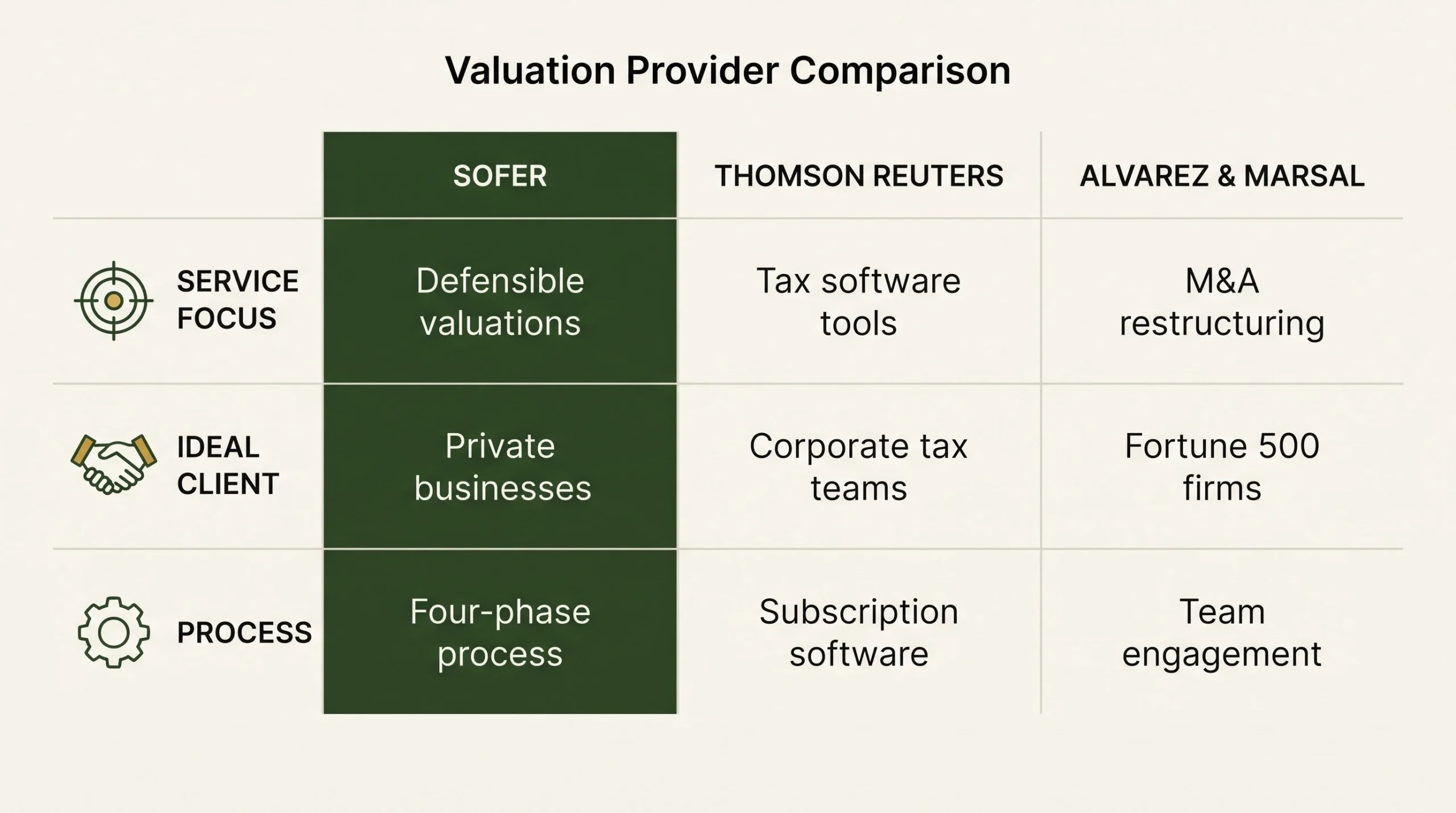
The right advisor depends on your reporting rules, entity complexity, and deal terms. The comparison below shows how firms differ in serving clients during tax or reporting events.
| Feature | Sofer Advisors | Thomson Reuters (Onesource) | Alvarez & Marsal |
|---|---|---|---|
| Service Focus | Independent, defensible valuations for tax compliance (IRC 1374), transactions, and financial reporting. | Provides data, software, and research tools for in-house tax teams and accounting firms. | Large-scale M&A advisory and tax restructuring for complex, often multi-billion dollar enterprises. |
| Ideal Client | Privately-held businesses and their CPAs needing a third-party valuation for a specific transaction or compliance event. | Large corporate tax departments or CPA firms with the internal expertise to use complex software platforms. | Fortune 500 companies, private equity firms, and major law firms requiring integrated transaction services. |
| Process | Collaborative four-phase process (Discovery, Diligence, Analysis, Delivery) with a ‘Heart of a Teacher’ approach. | Subscription-based software access with customer support for technical platform issues. | Team-based engagement model with specialists from tax, valuation, and transaction advisory. |
Picking the right partner means weighing your own skills against the need for a neutral outside report. Software handles routine work but rarely gives the documented opinion you need for high-stakes audits. Sofer Advisors fills that gap with a dedicated, neutral valuation.
What should the valuation review compare?
A strong analysis links each key judgment to the records and to market evidence on the valuation date. The points below sum up the core decision areas.
| Decision area | Evidence and review focus |
|---|---|
| What triggers the built-in gains tax | What triggers the built-in gains tax is the sale of assets by a company that transitioned from a C corporation to an S corporation. |
| How is the BIG tax calculated | The built-in gains tax is calculated by applying the highest corporate tax rate, currently 21% under IRC Section 1374, to the recognized built-in gain for the tax year. |
| What is the recognition period for built-in gains | The recognition period for built-in gains is the 5-year period beginning on the first day of the first taxable year for which a corporation was an S corporation. |
The final report should tie these areas together, not treat any method or input alone.
Frequently Asked Questions
Who pays the built-in gains tax?
The S corporation pays the built-in gains tax. Shareholders do not pay it on their own, since the tax is set at the entity level. It applies to any recognized gain from the sale or distribution of assets that gained value by the time of the switch. Sofer Advisors helps owners see how this corporate-level tax shapes the total result of an asset sale.
Which type of entity is potentially subject to a built-in gains tax?
Any entity that was once a C corporation may face this tax. It must have later switched to S corporation status, and the rule aims at firms trying to shift tax away from the corporate structure.
Are built-in gains taxes deductible?
Built-in gains taxes are generally not deductible as a business expense. They stand for a federal levy on the firm’s income. So firms must pay this bill with after-tax dollars during the window set under IRC Section 1374.
How long do you have to wait to avoid built-in gains tax?
Under current IRS rules, an S corporation must wait five years. That count starts from the S corporation election date, and the firm must hold its assets through this window to avoid the tax. Once the window ends, the assets change status and no longer face corporate-level tax on pre-switch growth. Sofer Advisors reviews corporate records, verifying the exact dates of status changes for accurate timing.
What is the difference between built-in gain and capital gain?
“Built-in gain” has a narrow meaning. It is the growth of an asset during the C corporation years. Meanwhile, a general “capital gain” is broader: the rise in value you realize when you sell an asset. The built-in gain faces special corporate-level tax under IRC Section 1374 if you sell within the window. Sofer Advisors gives clear, data-driven splits between these figures.
What is the current built-in gains tax rate?
The current federal built-in gains tax rate is 21%, which is the highest federal corporate income tax rate under IRC Section 1374. The firm applies this rate to the recognized built-in gain for the tax year. Sofer Advisors helps owners see how this rate shapes the total tax on assets sold inside the five-year window.
What is the net unrealized built-in gain (NUBIG)?
The net unrealized built-in gain, or NUBIG, is the gap between the fair market value of the assets and their adjusted basis, measured on the date of the S corporation election. It acts as the ceiling for the total built-in gains tax across the full five-year window. Sofer Advisors provides independent valuations that set this figure accurately.
Why do sellers often prefer a stock sale?
Sellers often prefer a stock sale because it does not trigger the built-in gains tax. In a stock sale, the firm sells as one whole rather than as single assets, so the corporate-level tax does not apply. Buyers usually want an asset sale instead, since it gives a stepped-up basis and larger depreciation deductions, making this a key point in deal talks.
Can net operating loss carryforwards reduce the BIG tax?
Yes. A firm can offset built-in gains using net operating loss, or NOL, carryforwards from its C corporation years. An NOL is a past loss you carry forward to cut future tax. Capital loss carryforwards can lower the taxable amount too. These tools help when a sale must happen before the five-year window ends.
Related Case Studies
- Asset Sale vs Stock Sale: Tax and Deal Structure Guide
- F Reorganization for S Corp Sales: Why Buyers Often Require It
- How S Corp Owner Basis Is Tracked and Why It Matters at Sale
Executive Summary
The built-in gains tax under IRC Section 1374 applies a 21% corporate-level rate to a former C corporation that converts to S corporation status and sells appreciated assets within a five-year window starting on the first day of the first S corporation tax year. It targets only the gain built up during the C corporation years, measured as the Net Unrealized Built-in Gain at the conversion date, and that NUBIG caps the total tax across the window. Two limits protect the taxpayer: the tax cannot exceed the income a C corporation would have reported, nor the NUBIG. Because the BIG tax can stack with shareholder-level tax in an asset sale, sellers often favor a stock sale while buyers push for an asset sale and its stepped-up basis. Owners can hold assets past the window, apply loss carryforwards, or use an installment sale to soften the hit. An independent, standards-based valuation at the conversion date sets the NUBIG accurately and gives the defensible support the IRS expects on audit.
What Should You Do Next?
Start by gathering your corporate records, including the S corporation election date and financial statements for the final C corporation year. Next, commission an independent valuation of your assets as of the conversion date to fix the NUBIG that caps your exposure. Then model each sale scenario with your CPA to time the deal and apply loss carryforwards before the window closes.
David Hern CPA ABV ASA, founder of Sofer Advisors provides neutral, defensible valuations for S-corp conversions. Schedule a free consultation to discuss your situation.
People Also Read
- How S Corp Owner Basis Is Tracked and Why It Matters at Sale
- Quality of Earnings Report: What Buyers Discover Before a Sale
About the Author
This guide was prepared by David Hern CPA ABV ASAc, founder of Sofer Advisors, a business valuation firm headquartered in Atlanta, GA serving clients across the United States. David holds dual accreditations as an Accredited Senior Appraiser (ASA) and is Accredited in Business Valuation (ABV), credentials recognized by the IRS, SEC, and FINRA. He also holds the Certified Exit Planning Advisor (CEPA) designation. With 15+ years of valuation experience, David has served as an expert witness in 11+ cases across multiple jurisdictions and built Sofer Advisors into an Inc. 5000-recognized firm with 180+ five-star Google reviews. Its full W2 employee team maintains subscriptions to all major valuation databases and operates under a next business day response policy.
For professional business valuation services, visit soferadvisors.com/about-us/ or contact Sofer Advisors at soferadvisors.com/contact-us/.
Disclaimer: This content is for informational purposes only and does not constitute professional valuation advice. Business valuation conclusions depend on specific facts and circumstances. Contact Sofer Advisors for guidance regarding your specific situation.









