


Last Updated: June 2026
S corporation owner basis tracking is the ongoing calculation of a shareholder’s investment in the company for tax purposes, and S corp owners are responsible for doing it themselves. The IRS does not track it for them, and the S corporation does not report it to shareholders. Years of under-tracked basis can produce a surprise taxable gain at the time of sale, even when the sale price seems modest. The mechanics of basis in an S corp differ from a C corp, a partnership, or a sole proprietorship, and the consequences of getting it wrong fall entirely on the shareholder.
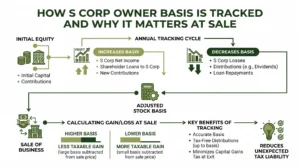
Basis in an S corp determines two things. First, it determines how much gain or loss you recognize when you sell your shares. Second, it determines whether you can currently deduct the losses allocated to you by the S corp on your personal return. Stock basis starts with what you paid or contributed. It increases with your share of income and any more contributions. It decreases with distributions and allocated losses. Debt basis is a separate, parallel calculation that unlocks more loss deductibility under specific circumstances. Both matter. Sofer Advisors helps owners and their advisors work through exactly these questions and turn the analysis into a defensible business valuation they can act on.
The following takeaways summarize the key valuation and transaction factors covered in this guide.
Key Takeaways
- S Corp Shareholders Corporation – S corp shareholders – not the corporation and not the IRS – are responsible for tracking their own basis. IRS Form 7203 is required annually for shareholders who have a basis event.
- Stock Basis Increases Capital – Stock basis increases with capital contributions and income allocations. It decreases with distributions, allocated losses, and certain deductions. The order of adjustments matters.
- Debt Basis Allows Shareholders – Debt basis allows shareholders to deduct losses beyond their stock basis if they have personally loaned money to the S corp – but guarantees alone don’t create debt basis.
- Negative Basis Allowed S – Negative basis is not allowed in S corps. Losses that would create negative basis are suspended and carried forward until basis is restored.
- Stock Sale Seller Pays – In a stock sale, the seller pays capital gains tax on the difference between the sale price and adjusted basis. Low basis means high taxable gain – regardless of whether the price seems low.
- Asset Sale Typically Produces – An asset sale typically produces ordinary income on the sale of receivables, inventory, and depreciation recapture – different tax character than a stock sale, with different basis implications.
Each of these factors is examined in depth in the sections that follow.
What Is S Corp Stock Basis and How Is It Calculated?
Stock basis in an S corporation is the shareholder’s adjusted investment in the company for tax purposes. It is not book value. It is not the market value of the shares. It is not the amount shown on the S corp’s balance sheet. It is the owner’s personal tax account that reflects their economic stake in the corporation, adjusted for all tax events since inception.
Starting basis is established at formation or acquisition. If you contributed $50,000 cash to form the S corp, your initial stock basis is $50,000. If you purchased existing shares for $200,000, your initial stock basis is $200,000.
From there, basis is adjusted each year in a specific order mandated by the IRC:
Increases first:
- Your pro-rata share of the S corp’s ordinary income
- Separately stated income items (capital gains, Section 1231 gains)
- Tax-exempt income
- Any more capital contributions during the year
Decreases second (in this order):
- Non-dividend distributions
- Non-deductible, non-capital expenses
- Your pro-rata share of ordinary loss
- Separately stated loss items (capital losses, Section 1231 losses)
- Deductions (including Section 179)
The ordering matters because it determines whether a distribution causes a taxable event before or after losses are absorbed. A distribution that exceeds stock basis is treated as capital gain, even if you don’t receive net cash above your original investment, because the basis has been consumed by prior loss allocations.
Consider a simple example. You form an S corp with a $100,000 contribution. In year one, the corp allocates $80,000 of losses to you. Your basis drops to $20,000. In year two, you take a $30,000 distribution. The first $20,000 is non-taxable (return of basis). The last $10,000 is taxable as capital gain because it exceeds your remaining basis.
Owners should track this figure carefully, since the IRS sets out how shareholders compute it in its guidance on S corporation stock and debt basis.
What Is Debt Basis and How Is It Different from Stock Basis?
Debt basis is a separate, parallel basis calculation for S corp shareholders who have directly loaned money to the corporation. It exists because S corp shareholders, unlike C corp shareholders, can deduct their share of S corp losses on their personal returns. But loss deductibility is limited to the sum of stock basis plus debt basis. Once both are exhausted, losses are suspended.
The mechanics of debt basis are often misunderstood. A shareholder who guarantees a bank loan made to the S corporation does not create debt basis through that guarantee. This is a common planning error. Debt basis arises only from a direct loan from the shareholder to the corporation, documented by a note, carried on both the shareholder’s personal tax records and the S corp’s books.
If a shareholder has $20,000 in stock basis and has directly loaned the S corp $50,000, their total loss deduction ceiling is $70,000. Allocated losses reduce stock basis first, then debt basis. If debt basis is consumed by losses and later restored through income allocations, the restoration of debt basis comes before the restoration of stock basis.
The IRS scrutinizes shareholder debt basis claims carefully, particularly when the shareholder has no documentation of a formal loan. In audit, a “loan” that looks like a capital contribution will be recharacterized, eliminating the debt basis and disallowing the losses claimed.
Who Is Responsible for Tracking S Corp Basis?
The shareholder is responsible for tracking their own basis. This is explicit in the IRC and in IRS guidance. The S corporation reports the shareholder’s income, loss, and distribution allocations on Schedule K-1. That is the input the shareholder needs to update their basis calculation each year. But the S corp does not track the shareholder’s cumulative basis, that’s the shareholder’s job.
The IRS introduced Form 7203 (S Corporation Shareholder Stock and Debt Basis Limitations) in 2021. It is required for any shareholder who has a basis event in the tax year, meaning any year in which the shareholder claimed a loss, received a distribution, or disposed of stock. The form is attached to the individual’s Form 1040 and requires a year-by-year reconstruction of stock basis and debt basis.
The problem: many S corp shareholders, and even their CPAs, have not tracked basis annually since formation. When a sale occurs, the shareholder must reconstruct basis from inception. For a business formed 15–20 years ago, this can be a significant forensic accounting exercise. The consequences of not tracking basis are always worse than the effort of tracking it.
How Does Basis Affect a Stock Sale vs. an Asset Sale?
The structure of a business sale, stock deal vs. asset deal, has dramatically different tax consequences for the S corp owner. Basis is central to the calculation.
| Sale Structure | Seller Tax Consequence | Buyer Tax Consequence | Basis Impact |
|---|---|---|---|
| Stock sale | Capital gain on (price minus stock basis) | No step-up; inherits seller’s inside basis | Seller’s adjusted stock basis used directly |
| Asset sale (S corp) | Mix of ordinary income + capital gain depending on asset type | Full step-up on acquired assets | Shareholder increases stock basis by S corp income, then reduces by distributions |
| 338(h)(10) election | Stock sale treated as asset sale for tax purposes | Buyer gets step-up; seller has ordinary income exposure | Complex; requires S corp election and coordination |
In a pure stock sale, the seller pays capital gains tax on the difference between the sale price per share and their adjusted stock basis per share. Long-term capital gains rates apply if the shares have been held for more than one year, currently 20% federal plus the 3.8% net investment income tax at high income levels, plus applicable state rates.
In an asset sale of an S corp, the tax is more complex. The sale proceeds are allocated to individual assets, receivables, inventory, equipment, real estate, goodwill, and each asset category has its own tax character. Depreciation recapture is ordinary income under Section 1245 and 1250. Goodwill is capital gain. The S corp pays no corporate-level tax on an asset sale (unlike a C corp). But the gains flow through to shareholders on their K-1s, increasing stock basis before distributions are made. The net effect is similar to a stock sale in terms of overall gain, but the ordinary income character on depreciation recapture creates a tax cost that doesn’t exist in a pure stock sale.
David Hern CPA ABV ASA, founder of Sofer Advisors, brings a Heart of a Teacher to every engagement – translating complex valuation methodology into clear, actionable guidance that clients can act on before and after the report is delivered. With 15+ years of valuation experience, 11+ expert witness cases across multiple jurisdictions, and 180+ five-star Google reviews, David built Sofer Advisors into an Inc. 5000-recognized firm. The Sofer Difference is a four-phase process of Discovery, Diligence, Analysis, and Delivery that ensures every conclusion is defensible, documented, and tied to the specific facts of the business.
While national firms like Stout and Kroll serve large enterprise clients, Sofer Advisors specializes in middle-market businesses that require personalized attention, direct access to credentialed professionals, and a next business day response policy.
What Happens if Basis Becomes Zero or Negative?
Stock basis cannot go below zero. When losses would reduce basis below zero, those losses are suspended, not lost, but deferred, until the shareholder restores basis. Basis can be restored by contributing more capital, receiving income allocations, or making a bona fide loan to the S corp that creates debt basis.
The practical implication: an S corp owner who has been allocated large losses in prior years and has low or zero stock basis when the business is sold will recognize gain on the full proceeds above their near-zero basis. The losses were deducted on prior returns (assuming they had basis at the time), which provided prior-year tax benefits, but those benefits came at the cost of reduced basis. This creates more taxable gain at sale.
Cash basis vs. accrual basis refers to the S corporation’s accounting method, it is distinct from basis tracking. Most small S corps use cash basis. The S corp’s accounting method affects when income and deductions are reported on the K-1, which in turn affects the timing of basis adjustments. But the accounting method does not change the fundamental basis tracking obligation.
How Does S Corp Basis Affect Deductibility of Losses?
Loss deductibility is the second critical function of basis tracking, alongside gain calculation at sale. An S corp shareholder can deduct their allocable share of S corp losses on their personal return only up to the sum of their stock basis and debt basis. Losses above that limit are suspended at the shareholder level.
This differs from a C corp, where losses stay at the corporate level. In an S corp, losses pass through to owners annually, but the deductibility ceiling is the owner’s basis. An owner who invested $50,000 and has no debt basis can deduct a maximum of $50,000 of S corp losses across all years. Losses above that are suspended until basis is restored.
The at-risk rules (IRC Section 465) and passive activity loss rules (IRC Section 469) create more deductibility limits that layer on top of the basis rules.
How Does a Business Valuation Support S Corp Basis Planning?
A certified business valuation serves several functions in S corp basis planning and pre-sale tax strategy.
First, the valuation establishes the expected sale price range. This allows the shareholder and their CPA to calculate the expected taxable gain and plan for the tax liability before the sale closes. Knowing that a sale at $4M will produce $3.2M of taxable gain (because adjusted basis is only $800K) allows time to consider installment sales, opportunity zone deferral, charitable remainder trusts, or other tax-mitigation strategies.
Second, in a stock sale, the business valuation is used to negotiate the price with buyers and to allocate value among different components. A certified valuation provides the analytical foundation for that negotiation.
Third, when an S corp owner gifts shares to family members or transfers interests to trusts as part of an estate plan, the basis in those transferred shares carries over to the recipient. A current valuation supports those transfers and documents the gift tax return in a manner that withstands IRS scrutiny.
The questions below address the most common issues business owners raise before engaging a qualified appraiser for a corp owner basis tracking engagement.
Frequently Asked Questions
How do you track basis in an S corp?
Start with your initial contribution or purchase price, then each year add income allocations and contributions and subtract distributions and losses.
Who is responsible for tracking an S corp shareholder’s basis?
The shareholder is responsible, not the S corporation and not the IRS.
What happens if I don’t track my S corp basis?
At sale, you may pay more tax than necessary, or face an IRS issue if you claimed losses that exceeded your actual basis.
Do S corps have to use accrual basis?
No. S corporations can generally use cash basis accounting.
Can loan guarantees create debt basis in an S corp?
No. Guaranteeing a bank loan does not create debt basis. Debt basis arises only from a direct shareholder-to-corporation loan.
What is Form 7203 and when is it required?
IRS Form 7203 is required since 2021 for shareholders who disposed of S corp stock, received a distribution, claimed a loss, or received a loan repayment during the year.
How does basis work if I sell my S corp shares?
Your taxable gain equals the sale price minus your adjusted stock basis.
What is the difference between stock basis and at-risk basis?
Stock basis limits loss deductibility based on your tax investment in the S corp, while at-risk basis limits deductions to amounts you are personally at risk of losing.
Can a business valuation help with S corp basis planning?
Yes. A certified valuation establishes the expected sale price before a transaction, allowing the owner and CPA to project taxable gain and evaluate tax-deferral strategies.
How do suspended losses work at S corp sale?
Suspended losses are released upon a complete disposition of the S corp interest and can offset the gain recognized on the sale.
Related Case Studies
- Estate Planning Business Valuation Georgia Gift Tax Compliance Guide
- Selling A Business In Georgia Complete Exit Planning Guide 2026
- Personal Goodwill Vs Enterprise Goodwill Tax Divorce Guide
Executive Summary
- S corp shareholders are solely responsible for tracking their own stock basis and debt basis – the IRS does not track it on the shareholder’s behalf.
- Debt basis is created only by direct shareholder-to-corporation loans, not by guarantees of third-party loans. This distinction determines whether loss deductions survive an IRS audit.
- A certified business valuation before a sale creates the analytical foundation for gain projections, tax planning, and purchase price allocation negotiation.
What Should You Do Next?
If you own shares in an S corporation and are approaching a sale, recapitalization, gift, or estate planning transfer, the intersection of basis, tax character, and deal structure can significantly affect your after-tax proceeds. David Hern CPA ABV ASA, founder of Sofer Advisors, holds dual ASA and ABV credentials recognized by the IRS, SEC, and FINRA, with 15+ years of valuation experience and 180+ five-star Google reviews. Schedule a consultation to discuss your business valuation needs.
People Also Read
- Small Business Valuation Georgia What Every Owner Should Know
- Eminent Domain Business Valuation Georgia Property And Business Owner Rights
About the Author
This guide was prepared by David Hern CPA ABV ASA, founder of Sofer Advisors – a business valuation firm headquartered in Atlanta, GA serving clients across the United States. David holds dual accreditations as an Accredited Senior Appraiser (ASA) and is Accredited in Business Valuation (ABV), credentials recognized by the IRS, SEC, and FINRA. He also holds the Certified Exit Planning Advisor (CEPA) designation. With 15+ years of valuation experience, David has served as an expert witness in 11+ cases across multiple jurisdictions and built Sofer Advisors into an Inc. 5000-recognized firm with 180+ five-star Google reviews. The firm’s full W2 employee team maintains subscriptions to all major valuation databases and operates under a next business day response policy.
For professional business valuation services, visit soferadvisors.com/about-us/ or schedule a consultation at soferadvisors.com/contact-us/.
This content is for informational purposes only and does not constitute professional valuation advice. Business valuation conclusions depend on specific facts and circumstances. Contact Sofer Advisors for guidance regarding your specific situation.









