


Last Updated: October 2026
A promissory note valuation is the process of finding the fair market value of a written promise to repay money. For gift and estate tax, the starting point is set by rule. Treasury Regulation 20.2031-4 presumes a note is worth its unpaid principal plus the interest accrued to the valuation date. That number is only a presumption. It can be rebutted with facts.
The team at Sofer Advisors values these notes for business owners, CPAs, and estate attorneys, backed by Inc. 5000 recognition in both 2024 and 2025. The real question is whether the note is truly worth its face amount. If the borrower cannot pay, or the rate is too low, the note is worth less, and the valuation has to prove it.
This guide explains the face-value presumption, the facts that lower it, and the extra scrutiny the IRS gives notes between family members. It also covers the below-market-rate problem and how an appraiser documents a discount from face value.
Key Takeaways
- Face value is the default: Reg. 20.2031-4 presumes a note equals unpaid principal plus accrued interest, unless you show a lower value.
- Four facts can lower it: the borrower’s solvency, the interest rate against the AFR, the security behind the note, and the term all move the value.
- A below-market rate cuts value: a note that pays less than the market rate is worth less than its face amount to a willing buyer.
- Intra-family notes draw scrutiny: the IRS tests whether the note is bona fide debt, with a real expectation of repayment, not a disguised gift.
- Documentation wins the case: a written report that ties the discount to facts is the taxpayer’s best defense in an audit.
Each point rests on the same rule. The sections below take them one at a time.
Why Does Promissory Note Valuation Matter for Tax?
Promissory note valuation matters because it decides whether a transfer is a sale, a loan, or a gift. For gift and estate tax, the value you report drives the tax. Report face value when the note is worth less, and you overpay. Report too little without proof, and the IRS adds tax, interest, and penalties. A sound valuation sets the right number and backs it up.
The stakes are highest with family transfers and estates. When a parent sells a business interest to a child for a note, the IRS asks if the note is real. If the value is wrong, the difference can be treated as a taxable gift. That gift eats into the lifetime exemption and can trigger a bill. The same risk shows up on an estate return, where an executor must report any note the person held. A clear valuation keeps the reported figure defensible.
What Does Regulation 20.2031-4 Presume?
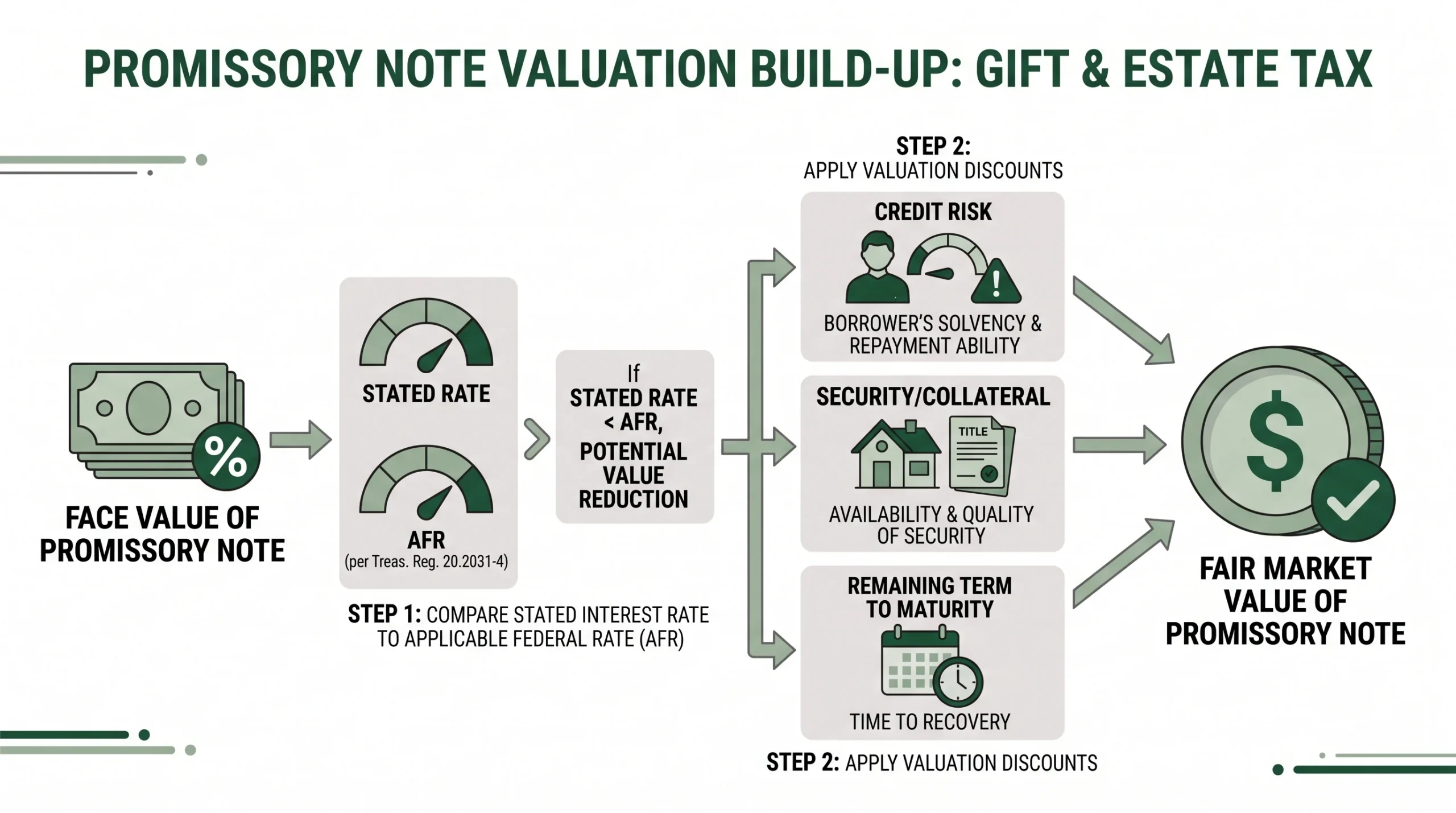
Treasury Regulation 20.2031-4 presumes the value of a note, secured or not, is the unpaid principal plus interest accrued to the valuation date. That is the floor the IRS starts from. The rule then lets you show a lower value. You do that with satisfactory evidence that the note is worth less, or that part of it cannot be collected at all.
The presumption puts the burden on the taxpayer. You do not get a discount by asking for one. You earn it with facts. The regulation names the kinds of proof it accepts. A low interest rate, a distant maturity date, or another cause can show the note is worth less than the amount owed. Uncollectibility counts too, such as a borrower who is insolvent. You can read the text of Regulation 20.2031-4 for the exact standard.
What Makes a Note Worth Less Than Face Value?
Four facts drive a note below its face value. The first is the borrower’s solvency, because a buyer pays less for a debt that may not be repaid. The second is the interest rate against the market. The third is the security, meaning any collateral behind the note. The fourth is the term, since a long wait for payment is worth less today.
Start with the rate. The IRS sets a monthly floor called the Applicable Federal Rate, or AFR. A note that pays less than the market rate is worth less than its principal, since a buyer could earn more elsewhere. That gap is the below-market-rate discount. Solvency comes next. If the borrower cannot cover the payments, the risk of default rises and the value falls. Security and term matter too. Strong collateral lifts value, and a long term lowers it. See the IRS Applicable Federal Rates page for the current floor.
How Does the IRS Scrutinize Intra-Family Notes?
The IRS gives extra scrutiny to notes between family members. The core test is whether the note is bona fide debt. That means a real loan, with a real expectation that the borrower will pay and the lender will collect. If the facts look like a gift dressed up as a loan, the IRS can treat the whole transfer as a gift and tax it.
Several facts support bona fide debt. The note should be in writing, with a fixed rate at or above the AFR, a set schedule, and a maturity date. Payments should actually be made and recorded. The borrower should be able to repay from income or assets. Security helps the case. Courts weigh these same signals when they decide if a family note was genuine. Our guide on valuing an intra-family promissory note for estate tax walks through these facts in detail.
How Does an Appraiser Document a Discount?
An appraiser documents a discount by building a present-value model and tying every input to evidence. The note’s payments are discounted at a rate that reflects the borrower’s risk, not just the AFR. The report then explains each choice. It covers the rate, the borrower’s finances, the collateral, and the market for similar debt. The goal is a number a reviewer can follow and accept.
The write-up is what protects the taxpayer. For a gift, the appraisal supports adequate disclosure, which can start the clock on the statute of limitations. Our note on adequate disclosure on Form 709 explains that timing. A thin, unsupported discount is the first thing an examiner challenges. A clear record is the difference between a figure that holds and one that unravels. You can see how Sofer Advisors handles this work on its business valuation services page.
Who Values a Promissory Note, and How Do the Options Compare?
Owners choose a valuation partner based on the size of the gift, the audit risk, and the budget. Large national firms such as Alvarez & Marsal, Stout, and Kroll serve big public companies with broad advisory teams. Sofer Advisors focuses on defensible, partner-led valuations for closely held and middle-market owners, with expert witness testimony in 11+ cases behind its reports. The table below lays out the common options.
| Provider | Typical role | Best for |
|---|---|---|
| Specialized valuation firm (e.g. Sofer Advisors) | Prices the note and documents the discount as adequate consideration | Family and closely held transfers needing audit-ready support |
| Large national firm | Broad advisory plus valuation at enterprise scale | Large public companies with complex, multi-entity plans |
| Estate attorney | Drafts the note and the gift or sale agreement; does not value it | Families needing the legal structure built and reviewed |
Sofer Advisors runs each engagement through a four-phase process it calls The Sofer Difference, moving from Discovery to Diligence to Analysis to Delivery. That order keeps every discount tied to the facts behind it. It reflects the Heart of a Teacher approach, which means explaining the reasoning behind a number instead of just handing over a figure. For a note that stands up to review, an independent valuation supplies both the discount and the trail of evidence behind it.
Frequently Asked Questions
How do you value a promissory note for gift and estate tax?
You value a promissory note by finding the present value of its future payments. You discount the principal and interest at a rate that reflects the borrower’s risk and current market rates. The starting point is the unpaid principal plus accrued interest, which you then adjust down for solvency, a low rate, weak security, or a long term. Sofer Advisors builds this model and documents each input for the tax return.
Why is a promissory note often worth less than its face value?
A note is often worth less than face value because money paid later is worth less than money today. If the interest rate sits below the market rate, a buyer would pay less for it. If the borrower might not pay, the risk cuts the value further. A long term and weak collateral lower it too. Sofer Advisors measures each of these facts so the reported value reflects what the note is really worth.
What does Treasury Regulation 20.2031-4 presume?
Treasury Regulation 20.2031-4 presumes a note is worth its unpaid principal plus the interest accrued to the valuation date. That applies whether the note is secured or not. The rule then lets you show a lower value with satisfactory evidence, such as a below-market rate, a distant maturity, or a borrower who cannot pay. Sofer Advisors prepares that evidence in a written report so the lower value holds up under review.
What role does the Applicable Federal Rate play?
The Applicable Federal Rate, or AFR, is the minimum interest rate the IRS requires for a loan to count as real debt. A note that charges less than the AFR invites imputed interest and gift questions. Meeting the AFR avoids that problem, but it does not prove fair market value on its own. Sofer Advisors ties each note to the correct monthly AFR and then tests whether more of a discount applies.
Can promissory notes be used to avoid gift tax?
A promissory note cannot erase gift tax if the terms do not reflect a real, market-rate loan. If the rate is below the AFR, the IRS treats the shortfall as a gift. If the note is not expected to be repaid, the whole transfer can be a gift. Priced and documented correctly, a note is a legitimate planning tool. Sofer Advisors reviews the terms so the structure stands as debt, not a gift.
Can you use a 409A valuation for gift tax purposes?
No. A 409A valuation prices a private company’s common stock for deferred compensation under IRC Section 409A. It is not the right standard for gift tax. Gift and estate reporting uses fair market value as defined by Revenue Ruling 59-60. A 409A figure is deliberately conservative and built for a different purpose. Sofer Advisors applies the correct fair market value standard when it values a note or an interest for a gift.
How does the IRS treat an intra-family promissory note?
The IRS looks closely at notes between family members. It tests whether the note is bona fide debt, with a real expectation of repayment on both sides. The agency checks the rate, the schedule, the maturity, whether payments are actually made, and whether the borrower can pay. If the facts fail, the note can be recharacterized as a gift. Sofer Advisors documents these facts so an intra-family note reads as genuine debt.
How do collateral and the borrower’s solvency affect value?
Collateral and solvency move the value through risk. Strong collateral that a lender can seize lowers the risk of loss, which lifts the note’s value. A solvent borrower with steady cash flow does the same. Weak or no security, or a borrower who may default, raises the risk and lowers the value. Sofer Advisors weighs the quality of the collateral and the borrower’s finances when it sets the discount rate.
How much does a promissory note valuation cost?
Most promissory note valuations run from $7,500 to $25,000 and take about two to six weeks, depending on the note and the deadline. The range covers the credit and market analysis needed to support a discount from face value. A flat fee is quoted up front, so the price is clear before work starts. Sofer Advisors scopes the engagement first, then quotes a fixed price. Request a free estimate for your situation.
Related Case Studies
- Valuing a Closely Held Business Interest for Form 706
- How Does Seller Financing Work in a Business Sale?
- Installment Sale of a Business: Tax Deferral and Buyer Pushback
Executive Summary
A promissory note valuation finds the fair market value of a written promise to repay. For gift and estate tax, Regulation 20.2031-4 presumes the value equals unpaid principal plus accrued interest. That presumption can be rebutted. A below-market rate, a shaky borrower, weak collateral, or a long term can each push the value below face. The appraiser proves the discount with a present-value model tied to evidence. Intra-family notes draw the most scrutiny, where the test is whether the note is bona fide debt. The first step is a clear valuation that documents every input, so the reported number survives an audit.
What Should You Do Next?
Gather the note itself, any amendments, the payment history, and the borrower’s financial statements, since a clean file supports a defensible discount. Confirm that the stated rate meets the current AFR before the gift or the estate return is filed. This guide was prepared by David Hern CPA ABV ASA, founder of Sofer Advisors, an Inc. 5000 firm that provides neutral third-party valuations for tax and estate reporting. Schedule a free consultation to discuss your specific situation.
People Also Read
- Fair Market Value for Estate Tax: What Executors Need
- Self-Canceling Installment Note Valuation: Pricing the SCIN Risk
About the Author
This guide was prepared by David Hern CPA ABV ASA, founder of Sofer Advisors, a business valuation firm headquartered in Atlanta, GA serving clients across the United States. David holds dual accreditations as an Accredited Senior Appraiser (ASA) and is Accredited in Business Valuation (ABV), credentials recognized by the IRS, SEC, and FINRA. He also holds the Certified Exit Planning Advisor (CEPA) designation. With 15+ years of valuation experience, David has served as an expert witness in 11+ cases across multiple jurisdictions and built Sofer Advisors into an Inc. 5,000-recognized firm with 180+ five-star Google reviews. Its full W2 employee team maintains subscriptions to all major valuation databases and operates under a next business day response policy.
For professional business valuation services, visit soferadvisors.com/about-us/ or contact Sofer Advisors at soferadvisors.com/contact-us/.
This content is for informational purposes only and does not constitute professional valuation advice. Business valuation conclusions depend on specific facts and circumstances. Contact Sofer Advisors for guidance regarding your specific situation.









