


Last Updated: June 2026
An installment sale allows a business seller to report gain proportionally as payments are received rather than recognizing the entire taxable gain at closing. This defers federal income tax into future years and potentially into lower tax brackets. For a seller facing a large capital gain, the tax deferral can be worth hundreds of thousands of dollars in net present value, depending on the deal structure and the seller’s other income.
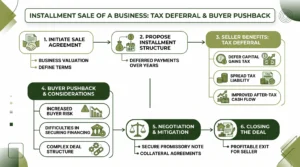
The mechanics are governed by IRC Section 453. The statute is well-established, but its application to business sales involves asset-by-asset analysis. Some assets can be sold on installment; others cannot. And while the tax benefits to sellers are real, buyers frequently push back on installment terms. Installment notes create credit exposure for the buyer, subordination conflicts with acquisition financing, and interest rate obligations. Sofer Advisors helps owners and their advisors work through exactly these questions and turn the analysis into a defensible business valuation they can act on.
The following takeaways summarize the key valuation and transaction factors covered in this guide.
Key Takeaways
- Installment Sales Defer Eliminate – Installment sales defer – but do not eliminate – capital gains tax; the seller reports gain in proportion to the principal received in each tax year.
- Inventory Depreciation Recapture Section – Inventory and depreciation recapture (Section 1245 and 1250 property) are ineligible for installment treatment and are fully taxable in the year of sale.
- Gross Profit Percentage Key – The gross profit percentage is the key calculation: it determines how much of each payment received is taxable gain vs. return of basis.
- Buyers Resist Installment Notes – Buyers resist installment notes because of credit risk, subordination to senior debt, and opportunity cost – sellers need to offer something in return.
- Applicable Federal Rate AFR – The Applicable Federal Rate (AFR) sets a minimum interest rate for installment notes; notes below AFR create imputed interest income.
- Installment Sales Work Best – Installment sales work best for goodwill-heavy businesses, motivated sellers with low basis, and buyers who cannot secure full financing at closing.
Each of these factors is examined in depth in the sections that follow.
How Does an Installment Sale of a Business Work?
Under IRC Section 453, when a seller receives at least one payment after the year of sale, they may elect installment sale reporting. Instead of paying all the tax on the gain in the year of sale, the seller recognizes gain proportionally as payments are received. This is not a tax elimination, it is a time-value-of-money benefit.
The mechanics start with the gross profit percentage (GPP):
GPP = (Gross Profit) / (Contract Price)
Where:
- Gross Profit = Selling Price minus Adjusted Basis minus Selling Expenses
- Contract Price = Total consideration received, including principal payments and any liabilities assumed by the buyer
Each payment received, principal only, not interest, is multiplied by the GPP to determine the taxable gain portion. The remainder is a tax-free return of basis. Interest payments are taxable as ordinary income in the year received.
Example: A seller’s business has an adjusted basis of $500,000 and a selling price of $2,000,000. The deal includes $800,000 at closing and $1,200,000 payable over 5 years. Selling expenses are $100,000. Gross profit is $1,400,000. Contract price is $2,000,000. GPP is 70%. Each $240,000 annual principal payment produces $168,000 of taxable capital gain and $72,000 return of basis.
The deferral benefit is real but finite. If capital gains rates increase in future years, the deferred gain may be taxed at higher rates than in the year of sale.
When payments are received across more than one tax year, the installment method may apply, as detailed in IRS Publication 537, Installment Sales.
What Assets Are Not Eligible for Installment Sale Treatment?
This is the most important planning point. The installment sale election does not apply uniformly to all assets in a business sale. The ineligible categories are often the assets with the largest embedded gains.
Inventory. IRC Section 453(b)(2) explicitly excludes inventory from installment sale treatment. In an asset sale, all consideration allocated to inventory is taxable as ordinary income in the year of sale. For businesses with large inventory positions, retailers, distributors, manufacturers, this can be a significant immediate tax hit regardless of the installment structure on other assets.
Section 1245 depreciation recapture. When depreciable personal property (equipment, machinery, vehicles) is sold above its depreciated basis, the gain from prior depreciation is recaptured as ordinary income under IRC Section 1245. This recapture is not eligible for installment treatment, it is taxed in full in the year of sale. Only the gain above the original cost basis (true capital gain) is eligible for installment deferral.
Section 1250 depreciation recapture. Real property sold above its depreciated basis has a recapture component under IRC Section 1250, taxed at the 25% “unrecaptured Section 1250 gain” rate. This recapture is also not eligible for installment deferral and is recognized in the year of sale.
Publicly traded property. Marketable securities cannot be reported on the installment method.
What this means in practice: a business with $300,000 in equipment (fully depreciated, sold for $300,000) and $200,000 in inventory has $500,000 of assets that generate immediate taxable income. The installment benefit applies primarily to goodwill and going-concern value.
| Asset Type | Installment Treatment | Tax Character |
|---|---|---|
| Goodwill | Eligible | Capital gain (long-term if held >1 year) |
| Customer lists / intangibles | Eligible | Capital gain (Sec. 1231) |
| Covenant not to compete | Eligible | Ordinary income (allocated per IRC Sec. 197) |
| Equipment (above original cost) | Eligible for excess gain only | Capital gain on excess |
| Equipment (depreciation recapture) | Not eligible | Ordinary income (Sec. 1245) |
| Real property (depreciation recapture) | Not eligible | Ordinary income (25% rate, Sec. 1250) |
| Inventory | Not eligible | Ordinary income |
| Accounts receivable | Not eligible (cash basis) | Ordinary income |
| Marketable securities | Not eligible | Capital gain |
Why Do Buyers Push Back on Installment Sales?
Sellers often initiate installment sale discussions without fully anticipating buyer resistance. Understanding why buyers push back helps sellers structure the note in a way that addresses those objections.
Credit risk. An installment note is an unsecured or subordinated obligation of the buyer. If the business deteriorates after closing, or the buyer overleverages the acquisition, the seller note may not be repaid. Sellers who accept a $1,000,000 installment note are effectively extending credit to an entity they no longer control. Defaults on seller notes do occur, especially when acquisitions are overleveraged or the business underperforms post-close.
Subordination. Institutional acquisition financing (bank loans, SBA loans, PE debt) is almost always senior to seller notes. In a default or liquidation, the senior lender is paid first. The seller note may recover 40 cents on the dollar or less. Buyers who are financing with SBA 7(a) loans face specific rules: the SBA requires seller notes to be fully subordinated, cannot be repaid during the first two years, and are typically capped at 10% of the purchase price.
Interest obligation. An installment note carrying 5%–6% interest is a real cost of capital for the buyer. If the buyer has alternative financing at lower rates, the seller note is more expensive. In rising rate environments, a fixed-rate seller note may be cheaper than bank financing.
The seller’s best tools for overcoming buyer resistance: offer a purchase price premium for the installment structure, secure the note with real property or business assets, and negotiate for regular financial reporting requirements that give early warning of deterioration.
When Does an Installment Sale Make Financial Sense?
Installment sales are not the right structure for every transaction. They make the most economic sense when several conditions are met at the same time.
- High-basis goodwill businesses. Professional services firms, technology companies, and other asset-light businesses where goodwill constitutes 80%+ of enterprise value benefit most from installment treatment. The eligible goodwill gain can be spread over years.
- Seller with high current-year income. A seller who has other significant income in the year of sale, from a separate investment, a large bonus, or another transaction, may be in the highest federal bracket. Deferring some gain to a later year when total income is lower reduces the effective tax rate on the deferred portion.
- Motivated buyer without full financing. If the buyer cannot finance 100% of the purchase price at closing, common with individual buyers, management buyouts, and SBA-adjacent deals, a seller note fills the financing gap. Without the installment structure, the deal may not close at all.
- Deal structure where earnout risk is already present. In some transactions, an installment note is cleaner than an earnout because it is a fixed obligation, not contingent on post-close performance. A seller who would otherwise accept an earnout for 20% of the deal is often better served by a fixed installment note.
- Lower interest rate environment relative to capital gains deferral value. The NPV calculation turns on: (1) the pre-tax rate of return the seller can earn on the deferred tax dollars, and (2) the expected future tax rate on the deferred gain. When capital gains rates are stable and the seller has attractive reinvestment opportunities, the deferral benefit compounds.
David Hern CPA ABV ASA, founder of Sofer Advisors, brings a Heart of a Teacher to every engagement – translating complex valuation methodology into clear, actionable guidance that clients can act on before and after the report is delivered. With 15+ years of valuation experience, 11+ expert witness cases across multiple jurisdictions, and 180+ five-star Google reviews, David built Sofer Advisors into an Inc. 5000-recognized firm. The Sofer Difference is a four-phase process of Discovery, Diligence, Analysis, and Delivery that ensures every conclusion is defensible, documented, and tied to the specific facts of the business.
While national firms like Stout and Kroll serve large enterprise clients, Sofer Advisors specializes in middle-market businesses that require personalized attention, direct access to credentialed professionals, and a next business day response policy.
What Are the Interest Rate Requirements for Installment Notes?
The IRS requires installment sale notes to carry at least the Applicable Federal Rate (AFR) in interest. AFR is published monthly by the IRS and varies by note term. As of mid-2026, AFR rates are about:
- Short-term (3 years or less): 4.5%–5.0%
- Mid-term (3–9 years): 4.2%–4.7%
- Long-term (over 9 years): 4.0%–4.5%
(Check current IRS Rev. Rul. for exact monthly rates, these fluctuate.)
If the note interest rate is below AFR, the IRS will impute interest. It will treat part of each principal payment as unstated interest income, taxed as ordinary income rather than capital gain. This increases the seller’s tax burden without any corresponding cash receipt. All installment notes should be structured at or above AFR to avoid imputation.
Interest income from installment notes is taxed as ordinary income, not capital gain, regardless of the underlying asset type.
How Do Installment Sales Interact With Estate Planning?
Installment obligations have specific estate planning implications. If the seller dies with an outstanding installment note, the note is included in the taxable estate at its fair market value. But the seller’s estate does not recognize the deferred gain at death, that gain is recognized as payments continue to be received by the estate or heirs.
This is distinct from the “step-up in basis” that applies to most capital assets at death. Installment obligations do not receive a step-up.
How Does an Installment Sale Compare to Alternative Tax Deferral Strategies?
Sellers focused on tax deferral should evaluate installment sales against three main alternatives.
- Opportunity Zone reinvestment (IRC Section 1400Z-2). A seller who reinvests capital gain proceeds into a Qualified Opportunity Fund within 180 days of sale can defer and partially reduce the capital gains tax. For Georgia-based sellers, there are designated OZ census tracts in Atlanta and other markets. OZ deferral requires a 10-year hold for maximum exclusion of appreciation.
- Employee Stock Ownership Plan (ESOP). A sale to an ESOP allows qualifying C corporation shareholders to defer capital gains indefinitely under IRC Section 1042 if proceeds are reinvested in qualified replacement property. ESOP structures are complex and require minimum ownership thresholds. But for the right business, the tax deferral can be permanent.
- Charitable remainder trust (CRT). A seller can contribute appreciated business interests to a CRT before sale. The seller receives an income stream for life or a term of years, a charitable deduction, and deferral of the capital gain. Not suitable for all sellers, requires genuine charitable intent and irrevocable transfer.
Installment sales are the simplest of these alternatives and the most immediately applicable to a standard business sale.
The questions below address the most common issues business owners raise before engaging a qualified appraiser for a installment sale business engagement.
Frequently Asked Questions
How is an installment sale of a business taxed?
The seller reports capital gain proportionally as principal payments are received, using the gross profit percentage. Interest payments are taxed as ordinary income in the year received.
How can I avoid paying capital gains when selling a business?
There is no strategy that eliminates capital gains tax on a business sale, only deferral or rate reduction strategies. Installment sales, Opportunity Zone reinvestment, ESOP elections under Section 1042, and charitable remainder trusts are the main options.
What assets are not eligible for installment sale treatment?
Inventory, depreciation recapture on Section 1245 property (equipment, fixtures), unrecaptured Section 1250 gain (real estate depreciation), accounts receivable for cash-basis taxpayers, and marketable securities are all ineligible.
What happens if the buyer defaults on an installment note?
If the buyer defaults and the seller repossesses the business or assets, the seller recognizes gain on the repossession under IRC Section 1038 or general repossession rules for personal property.
Can a seller in an S corporation sale use installment reporting?
Yes, with complexity. An S corporation asset sale with installment treatment passes through gain annually to shareholders proportionally.
What is the Applicable Federal Rate and why does it matter?
The AFR is the minimum interest rate the IRS requires on installment notes to avoid imputed interest treatment. Notes below AFR have interest imputed, the IRS treats part of each principal payment as interest, converting capital gain to ordinary income.
How does an installment sale affect the purchase price negotiation?
Sellers who offer installment terms typically accept a modest price premium from buyers, recognizing that the note carries risk and illiquidity not present in an all-cash close.
What is a self-canceling installment note (SCIN)?
A SCIN is an installment note that automatically cancels upon the seller’s death without triggering gain recognition to the estate. The trade-off: the note must carry a premium (higher purchase price or interest rate) to compensate for the mortality risk.
Are installment sales more common in stock sales or asset sales?
Installment reporting is available in both structures. The asset-by-asset ineligibility rules are more explicit in asset sales.
What is the role of a business valuation in an installment sale?
A certified valuation establishes the fair market value of the business and the allocation among assets. This drives both the purchase price and the tax consequences.
Related Case Studies
- Selling A Business In Georgia Complete Exit Planning Guide 2026
- Estate Planning Business Valuation Georgia Gift Tax Compliance Guide
- Business Exit Planning Strategies Guide For Owners In 2025
Executive Summary
- IRC Section 453 installment sales defer capital gains recognition proportionally as payments are received; tax is not eliminated.
- Inventory, depreciation recapture, and marketable securities are ineligible for installment treatment and are taxed in the year of sale.
- Buyers resist installment notes due to credit risk, SBA subordination requirements, and interest obligation – sellers need to address these with premium pricing, collateral, or security provisions.
What Should You Do Next?
Tax structure decisions made before a transaction cannot be undone after signing. If you are planning a business sale in the next 12–24 months, a certified business valuation from David Hern CPA ABV ASA, founder of Sofer Advisors, holds dual ASA and ABV credentials recognized by the IRS, SEC, and FINRA, with 15+ years of valuation experience and 180+ five-star Google reviews. Schedule a consultation to discuss your business valuation needs.
People Also Read
- Why You Must Start Planning Your Business Exit Now With The Right Valuation Expert
- What To Expect During A Business Valuation Step By Step Process
About the Author
This guide was prepared by David Hern CPA ABV ASA, founder of Sofer Advisors – a business valuation firm headquartered in Atlanta, GA serving clients across the United States. David holds dual accreditations as an Accredited Senior Appraiser (ASA) and is Accredited in Business Valuation (ABV), credentials recognized by the IRS, SEC, and FINRA. He also holds the Certified Exit Planning Advisor (CEPA) designation. With 15+ years of valuation experience, David has served as an expert witness in 11+ cases across multiple jurisdictions and built Sofer Advisors into an Inc. 5000-recognized firm with 180+ five-star Google reviews. The firm’s full W2 employee team maintains subscriptions to all major valuation databases and operates under a next business day response policy.
For professional business valuation services, visit soferadvisors.com/about-us/ or schedule a consultation at soferadvisors.com/contact-us/.
This content is for informational purposes only and does not constitute professional valuation advice. Business valuation conclusions depend on specific facts and circumstances. Contact Sofer Advisors for guidance regarding your specific situation.









