


Last Updated: September 2026
A Form 706 business valuation sets the fair market value of a closely held business interest as of the owner’s date of death. The executor reports that value on the federal estate tax return, usually on Schedule F. Fair market value is the price a willing buyer and seller would accept, with neither forced to act and both fully informed. The figure must follow IRS Revenue Ruling 59-60, and it must hold up if the return is audited.
This matters because the estate tax return is due nine months after death. Form 706 is required when the gross estate tops the federal exemption, now a permanent $15 million per person under the 2025 tax law. A weak appraisal invites IRS review, penalties, and interest. A strong one gives the estate a defensible basis for every number it reports.
Sofer Advisors prepares these appraisals for executors and their attorneys. It is a business valuation firm based in Atlanta, GA, that serves estates across the United States. With 180+ five-star Google reviews and testimony in 11+ expert witness cases, its work is built to hold up under review. A Heart of a Teacher approach means each report explains the reasoning, not just the final figure.
Key Takeaways
- Form 706 requires fair market value: report the interest at its date-of-death value, most often on Schedule F.
- Revenue Ruling 59-60 sets the standard: the IRS weighs earnings, assets, and comparable sales, not a single formula.
- Discounts need proof: the discounts for lack of control and marketability must rest on data, not round numbers.
- The alternate date can help: IRC Section 2032 lets you value six months later if it lowers both the estate and the tax.
- A buy-sell price is not automatic: it binds the IRS only when it meets the tests in IRC Section 2703.
These rules work together to set the estate’s tax bill. The sections below explain each one, starting with why the valuation is needed at all.
Why is a business valuation required for Form 706?
A valuation is required because the executor must report every asset at fair market value, including any closely held business interest. A closely held business has no public market price, so an appraisal supplies one. Without a defensible report, the estate risks an understatement penalty if the IRS challenges the figure. The IRS instructions for Form 706 call for a full statement of how each value was reached.
The value must follow Revenue Ruling 59-60. This ruling lists the factors that matter when no market quote exists. They include the nature and history of the business, the economic outlook, book value, earning capacity, dividend capacity, and goodwill. A report that walks through these factors gives the IRS a clear basis to accept the number. A bare estimate does not, and that gap is where audits begin.
What valuation methods does the IRS accept for an estate?
The IRS accepts three methods: the income approach, the market approach, and the asset approach. Each looks at value from a different angle. The income approach turns expected earnings into a present value. The market approach compares the business to similar companies that have sold. The asset approach nets the fair value of assets against liabilities. No single method is required.
A credentialed appraiser picks the method that fits the company and explains why. A profitable operating company often points to the income or market approach. A holding company often points to the asset approach. The report must show the reasoning, because that reasoning is the defense if the value is questioned. Sofer Advisors handles this work through its tax and estate valuation services.
How are valuation discounts applied on Form 706?
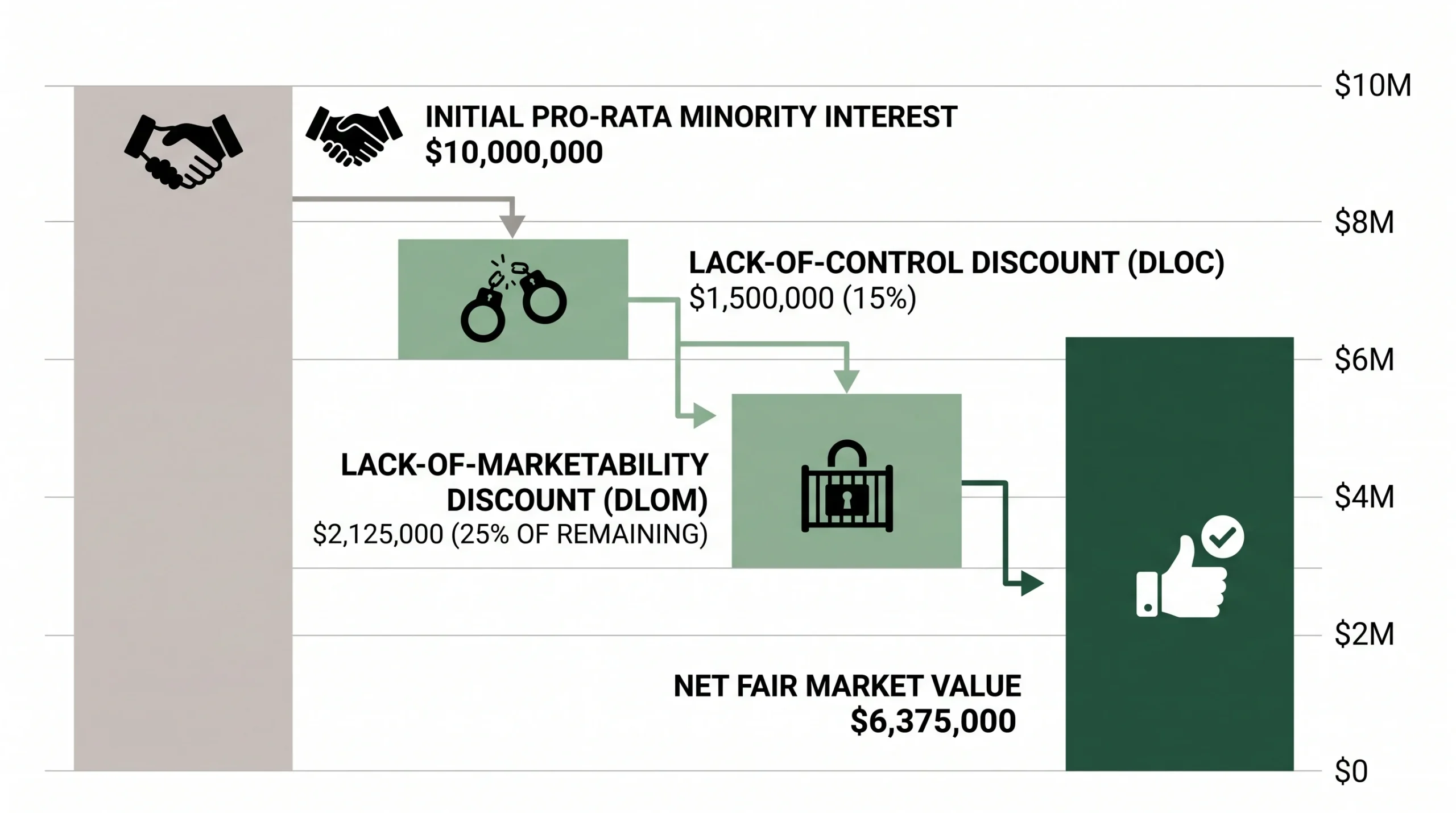
Discounts lower the reported value to reflect the real limits of a partial interest. Two show up most often. The discount for lack of control (DLOC) applies when the interest cannot direct the business. The discount for lack of marketability (DLOM) applies when the interest is hard to sell. Together, they can cut the taxable value of a minority interest by a meaningful margin.
The IRS does not accept round numbers. Each discount needs support from data, such as studies of restricted stock sales or closed-end fund trading. The appraiser measures the controlling value first, then applies the discounts in order. Our guide to valuation discounts on estate and gift tax returns shows how this support is built and documented.
What is the alternate valuation date under IRC 2032?
The alternate valuation date lets the executor value the estate six months after death instead of on the date of death. IRC Section 2032 allows this only when it lowers both the gross estate and the estate tax. The election covers every asset, not just the ones that fell in value. Assets sold within the six months are valued on their sale date.
This choice can help an estate that holds assets during a market decline. It can also hurt if values recover, so the math must be checked before the election is made. The decision is fixed once the return is filed. An appraiser can model both dates so the executor sees the tax effect of each. Careful timing is a core part of sound estate administration.
What makes an appraisal qualified for the IRS?
A qualified appraisal is prepared by a qualified appraiser and meets the content rules in the Treasury regulations. The appraiser must hold a recognized credential and value that type of property for a living. The report must describe the interest, the valuation date, the methods used, and the appraiser’s qualifications. It must also follow the Uniform Standards of Professional Appraisal Practice (USPAP), which require impartial and objective work.
Credentials signal training. The Accredited Senior Appraiser (ASA) and the Accredited in Business Valuation (ABV) designations are two the IRS recognizes. Both come from bodies like the American Society of Appraisers and the AICPA. Large national firms such as Alvarez & Marsal serve the biggest estates, and solo practitioners take the smallest. A middle-market appraisal firm sits between them, with a credentialed appraiser on every engagement.
Does a buy-sell agreement fix the Form 706 value?
A buy-sell agreement price does not automatically set the estate tax value. The IRS tests the agreement under IRC Section 2703 before it accepts the price. The price binds only if the agreement is a real business arrangement, not a way to pass wealth to heirs cheaply. Its terms must also match what unrelated parties would agree to at arm’s length.
| Approach to value | IRS compliance | Typical cost | Audit defensibility |
| Credentialed appraisal (ASA / ABV) | Meets qualified appraisal rules | $7,500 to $25,000 | High; follows USPAP and Rev. Rul. 59-60 |
| Generalist CPA estimate | Often lacks valuation credentials | Bundled in general fees | Low; often challenged as not independent |
| Buy-sell price alone | Only if it meets IRC 2703 | Set in the contract | Low unless the 2703 tests are met |
The gap between these paths grows wide during an audit. A price set inside a family agreement often fails the arm’s length test, so the IRS ignores it. A credentialed report priced from $7,500 to $25,000 usually costs far less than the penalties an understated estate can trigger. This is where The Sofer Difference matters: a four-phase process of Discovery, Diligence, Analysis, and Delivery that documents each judgment. Executors should confirm any advisor holds an active ASA or ABV credential before they engage.
Frequently Asked Questions
Are appraisals required for Form 706?
Yes. The IRS expects a qualified appraisal for any closely held business interest reported on Form 706. The tax code does not demand a formal report for every minor asset, but an informal estimate for a business interest often triggers an audit. A credentialed report gives the executor the proof needed to support the reported value and to answer questions if the return is reviewed.
Which schedule reports a business interest on Form 706?
A closely held business interest is usually reported on Schedule F of Form 706, which covers other miscellaneous property. Stock in a closely held corporation can also appear on Schedule B. The right schedule depends on the entity type and how the interest is held. The appraisal supports the fair market value entered on that schedule and explains how it was reached.
What documents does an estate business valuation need?
An appraiser usually needs five years of financial statements and tax returns, plus current balance sheets. The review also covers organizational documents, shareholder agreements, and any buy-sell contract that limits transfers. A qualified appraiser requests these items early in the process. Gathering them promptly helps confirm the financial health and the operating context of the business before the analysis begins.
What are common mistakes when filing Form 706?
A frequent error is claiming a discount without enough data to support it. Another is relying on an old or unsupported buy-sell price. Executors also miss the alternate valuation date when it could have lowered the tax. Recognized appraisal standards guard against these errors, keeping each position on the return consistent with the real economics of the assets.
How do you calculate the value of an estate?
You add the fair market value of every asset as of the date of death. That includes real property, cash, investments, and any closely held business interest. For a business, a qualified appraiser applies the income, market, or asset approach. The total is then reduced by allowed deductions to reach the taxable estate that Form 706 reports to the IRS.
How much does a Form 706 business valuation cost?
A Form 706 business valuation generally runs $7,500 to $25,000, based on typical engagement pricing. The range depends on the entity’s complexity, the number of operating units, and the deadline. Rush work adds a premium. A flat fee is quoted up front, so the estate knows the cost before the engagement starts. A quote can be tailored to your filing.
What is the difference between fair market value and fair value?
Fair market value is the price at which property would change hands between a willing buyer and seller, with neither under pressure to act. Fair value is a legal or accounting term that can shift with the statute or the purpose, such as a shareholder dispute. Estate tax reporting uses the fair market value standard, which keeps the Form 706 value consistent with IRS rules.
How long does an estate business valuation take?
Most estate business valuations take four to eight weeks, based on typical engagement data. The timeline depends on the size of the company and how fast documents arrive. Rush work can shorten it for a premium. Because Form 706 is due nine months after death, starting early leaves room for review by the estate’s attorney before the return is filed.
What is Revenue Ruling 59-60?
Revenue Ruling 59-60 is the core IRS guidance for valuing closely held business interests for tax purposes. It lists the factors to weigh, including the nature and history of the business, its economic outlook, earning capacity, and goodwill. It confirms that no single formula controls. A report built around these factors carries far more weight with the IRS than a simple estimate.
Related Case Studies
- How Family Limited Partnerships Are Valued for Gift and Estate Tax
- Valuation Discounts (DLOC and DLOM) on Estate and Gift Tax Returns
- Estate Freeze Strategies: How Valuations Lock In Today’s Value
Executive Summary
A Form 706 business valuation reports a closely held interest at fair market value as of the date of death, usually on Schedule F. The value must follow Revenue Ruling 59-60 and rest on the income, market, or asset approach. Discounts for lack of control and marketability can lower the taxable value, but each needs data to survive an audit. IRC Section 2032 allows an alternate date six months later when it cuts both the estate and the tax. A qualified, credentialed appraisal, priced from $7,500 to $25,000, gives the estate a defensible number and helps guard against penalties.
What Should You Do Next?
Gather the last five years of financial statements, tax returns, and any shareholder or buy-sell agreements. Confirm the valuation date with your attorney, and decide whether the alternate date under IRC Section 2032 is worth modeling. Then engage a credentialed appraiser early, because the return is due nine months after death and rushed work costs more.
David Hern CPA ABV ASA, founder of Sofer Advisors, prepares defensible valuations for estate tax reporting. Schedule a consultation to discuss your filing.
People Also Read
- Fair Market Value for Estate Tax: What Executors Need
- Applying IRS Revenue Ruling 59-60: 8 Factors in Every Valuation
About the Author
This guide was prepared by David Hern CPA ABV ASA, founder of Sofer Advisors, a business valuation firm headquartered in Atlanta, GA serving clients across the United States. David holds dual accreditations as an Accredited Senior Appraiser (ASA) and is Accredited in Business Valuation (ABV), credentials recognized by the IRS, SEC, and FINRA. He also holds the Certified Exit Planning Advisor (CEPA) designation. With 15+ years of valuation experience, David has served as an expert witness in 11+ cases across multiple jurisdictions and built Sofer Advisors into an Inc. 5000-recognized firm with 180+ five-star Google reviews. Its full W2 employee team maintains subscriptions to all major valuation databases and operates under a next-business-day response policy.
For professional business valuation services, visit or contact Sofer Advisors.
Disclaimer: This content is for informational purposes only and does not constitute professional valuation advice. Business valuation conclusions depend on specific facts and circumstances. Contact Sofer Advisors for guidance regarding your specific situation.









