


Last Updated: October 2026
A self-canceling installment note, or SCIN, prices mortality, and the premium it charges is the part the IRS attacks. A SCIN is an installment sale with one twist. If the seller dies before the note is paid off, the unpaid balance is wiped out. That canceled balance also leaves the seller’s estate. In exchange for that benefit, the note carries a risk premium above a normal sale price.
The team at Sofer Advisors values these notes for business owners, CPAs, and estate attorneys, backed by Inc. 5000 recognition in both 2024 and 2025. The whole plan rises or falls on one number. If the premium is too small, the IRS calls the shortfall a gift and taxes it.
This guide explains what self-canceling means, how the premium is priced, and how a SCIN differs from a private annuity. It also covers the court cases, the IRS forms, and the tax traps that decide whether the structure holds up.
Key Takeaways
- What a SCIN does: it sells an asset on an installment note that cancels at the seller’s death, so the unpaid balance drops out of the estate.
- The premium is the price of that feature: the buyer pays extra, as a higher rate or a higher principal, to compensate the seller for the cancellation risk.
- Mortality tables set the number: the premium is priced off IRS actuarial tables and the Section 7520 rate, with the monthly AFR as the floor for interest.
- Adequate premium stops a gift: a thin premium lets the IRS treat part of the deal as a taxable gift to the buyer.
- Cash flow matters: a SCIN works best with income-producing assets, such as a closely held business, that can fund the payments.
Each of these pieces ties into the wider estate plan. The sections below take them one at a time.
Why Is a SCIN Valuation Important to Understand?
A SCIN valuation decides whether a wealth transfer is a sale or a gift. The owner wants the asset, and its future growth, out of the estate at the lowest tax cost. The self-canceling feature makes that possible, but only if the note is priced like a real debt. The premium is the proof. Price it well and the transfer stands. Price it short and the IRS recharacterizes the gap as a gift, adds gift tax, and can unwind the plan during an audit or estate review.
What Does Self-Canceling Mean in a SCIN?
Self-canceling means the note ends automatically at the seller’s death. Any balance still owed is extinguished. The buyer owes nothing more, and the canceled amount is not pulled back into the seller’s gross estate. A normal installment note does the opposite. Its unpaid balance stays in the estate as an asset and gets taxed there.
The IRS looks for a few elements before it treats the deal as a bona fide SCIN. There must be a real debt with a fixed term and a set payment schedule. The cancellation must be built into the note from day one, not added later. The seller must expect to be repaid, and the buyer must expect to pay. The seller’s life expectancy at the sale date must also be longer than the note term, so the note can plausibly be paid in full. If the seller is terminally ill, with death likely within a year, the standard tables may not apply at all.
How Is the SCIN Risk Premium Priced?
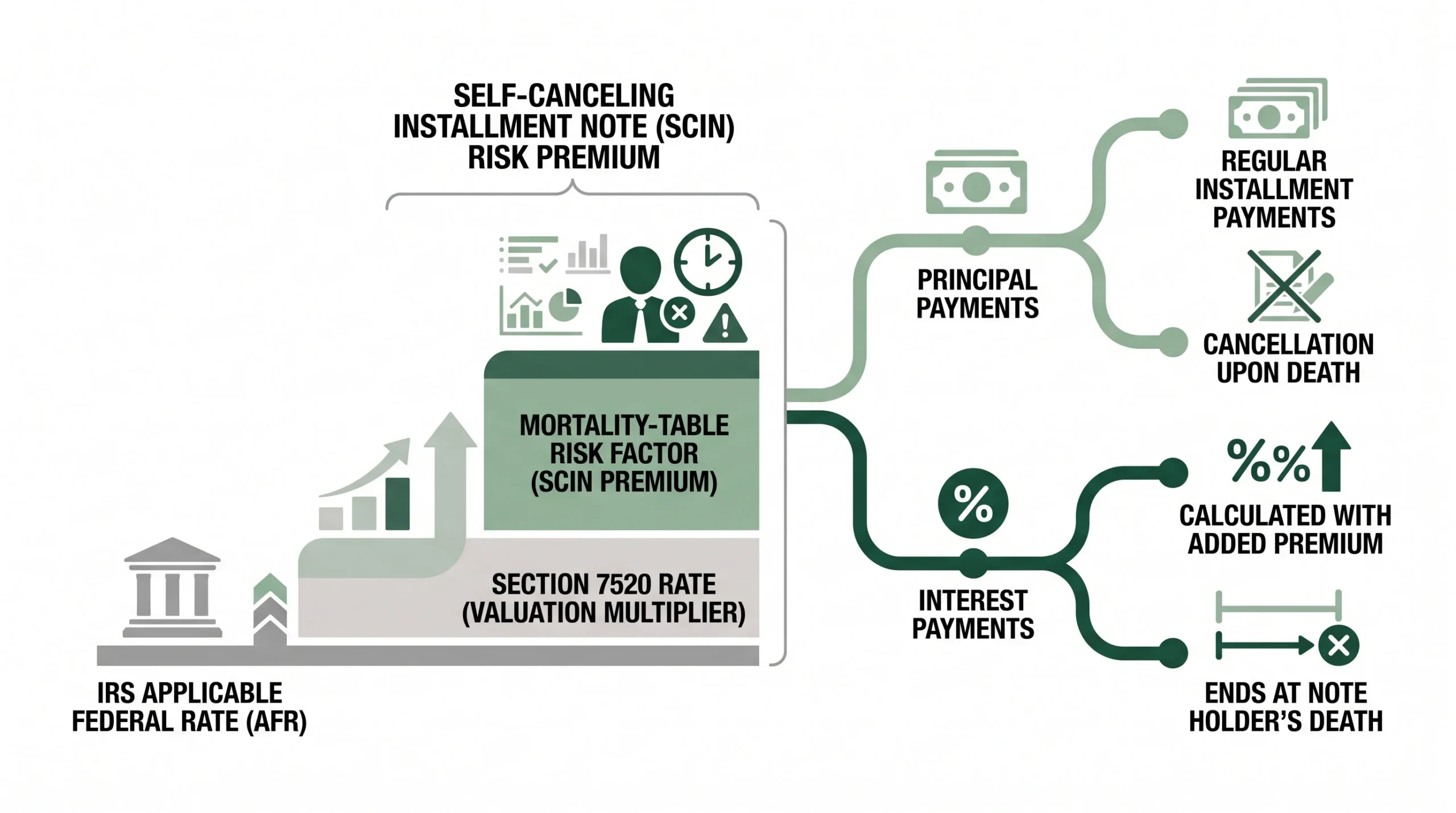
The risk premium is the extra value the buyer gives up for the chance that the note cancels early. It can take two forms. A principal premium raises the sale price above fair market value. An interest premium raises the note’s rate above the market rate. Either way, the goal is the same. The seller must receive full and adequate consideration for the cancellation feature, measured as of the sale date.
The math leans on IRS actuarial tables and the Section 7520 rate. Those tables give the seller’s life expectancy and the present value factors. The premium rises with the seller’s age and the length of the note, because both raise the odds that cancellation actually happens. The baseline interest rate comes from the IRS monthly Applicable Federal Rates, or AFR. A note that charges less than the AFR invites imputed interest and gift questions.
This is where valuation does the heavy lifting. The appraiser documents the premium and ties the number to the facts. A thin premium is the first thing an examiner challenges. A clear record keeps the transfer a sale rather than a gift.
How Does a SCIN Compare to a Private Annuity and Other Installment Notes?
A SCIN and a private annuity both bet on the seller’s life, but they pay out in different ways. A SCIN has a fixed term. If the seller lives through it, the buyer finishes every payment, premium included. A private annuity has no fixed term. The buyer pays for as long as the seller lives, and the payments stop at death no matter how long or short that is. A SCIN is secured debt that the heirs can enforce. A private annuity is usually an unsecured promise.
Against a plain installment note, the SCIN still lives under IRC Section 453, which governs how installment gains are reported. The difference is the cancellation feature and the premium that pays for it. A plain note has neither. Its balance survives the seller and sits in the estate. Because a SCIN often involves a family business, the valuation has to hold up for both income tax and estate tax. You can see how Sofer Advisors approaches tax and estate reporting valuations for these transfers.
What Court Cases, Forms, and Tax Traps Shape SCIN Valuation?
Two cases frame the ground rules. In Estate of Costanza v. Commissioner, the appeals court accepted a SCIN as real debt because the facts showed a genuine intent to repay and collect. In Estate of Davidson, the IRS challenged a SCIN written for a seller in poor health and argued the standard tables understated the premium. Davidson settled, but it put a marker down. When death looks near, the actuarial tables alone may not carry the valuation. The Frane case adds a third point on timing. It held that canceled gain is recognized when the seller dies, not spread out afterward.
The forms follow the structure. The seller reports gain on Form 6252, the installment sale form, as payments arrive. If the premium is thin and the IRS finds a gift, that gift shows up on Form 709. At death, the estate uses Form 706, and the canceled note is excluded from it. Two related questions come up often. The alternate valuation date, under Section 2032, lets an estate value its assets six months after death instead of on the date of death, which can lower a falling estate. And you cannot report a loss on the installment method, because Section 453 applies only to gains. A sale at a loss is recognized in full in the year of sale.
Who Values a SCIN, and How Do the Options Compare?
Owners pick a valuation partner based on the size of the asset, the audit exposure, and the budget. Large national firms such as Alvarez & Marsal, Stout, and Kroll serve big public companies with broad advisory teams. Sofer Advisors focuses on defensible, partner-led valuations for closely held and middle-market businesses, with expert witness testimony in 11+ cases behind its reports and 180+ five-star Google reviews. The table below sets out the common options.
| Provider | Typical role | Best for |
|---|---|---|
| Specialized valuation firm (e.g. Sofer Advisors) | Prices the risk premium and documents the note as adequate consideration | Family and closely held transfers needing audit-ready support |
| Large national firm | Broad advisory plus valuation at enterprise scale | Large public companies with complex, multi-entity plans |
| Estate attorney | Drafts the note and the sale agreement; does not value | Families needing the legal structure built and reviewed |
Sofer Advisors runs each engagement through a four-phase process it calls The Sofer Difference, moving from Discovery to Diligence to Analysis to Delivery. That structure keeps every premium tied to the tables and the facts behind it. It reflects the Heart of a Teacher approach, which means explaining the reasoning behind a number rather than just handing over a figure. For a note that stands up to review, an independent valuation supplies both the premium and the trail of evidence behind it.
Frequently Asked Questions
What does self-canceling mean in a SCIN?
Self-canceling means the note ends on its own when the seller dies. Any balance the buyer still owes is wiped out, and the buyer owes nothing further. That canceled balance also stays out of the seller’s gross estate, which is the whole point of the structure. A normal note leaves its balance in the estate instead. Sofer Advisors documents the cancellation feature so the note reads as genuine debt under IRS review.
What is the difference between a SCIN and a private annuity?
A SCIN has a fixed term and cancels only if the seller dies before it ends. A private annuity has no term and pays the seller for life, stopping at death whenever it comes. A SCIN is secured debt the heirs can enforce, while a private annuity is usually an unsecured promise to pay. Sofer Advisors values both structures so the pricing meets the fair market value standard the IRS expects.
How is the SCIN risk premium priced?
The premium is priced off IRS actuarial tables and the Section 7520 rate, which supply the seller’s life expectancy and the present value factors. It can be added as a higher sale price or a higher interest rate. The premium grows with the seller’s age and the note term, since both raise the chance of cancellation. Sofer Advisors builds and documents that number so it reads as adequate consideration, not a gift.
Does the AFR set the interest rate on a SCIN?
The IRS Applicable Federal Rate, published monthly, sets the minimum interest a SCIN can charge. A note priced below the AFR triggers imputed interest and can create a gift from the seller to the buyer. The AFR is the baseline, and the mortality premium sits on top of it. Sofer Advisors ties each note to the correct monthly AFR so the interest terms survive an examiner’s first question.
Can you have a loss on an installment sale?
No. The installment method under Section 453 applies only to gains, so a loss cannot be spread across future years. A sale at a loss is recognized in full in the year it happens, whatever the payment schedule says. This matters when an asset has fallen below its basis. Sofer Advisors measures the asset’s fair market value first, so owners know whether a gain or a loss is actually in play.
What IRS forms report a SCIN transaction?
The seller reports installment gain on Form 6252 as payments come in. If the premium is too thin and the IRS finds a gift, that gift is reported on Form 709. At the seller’s death, the estate files Form 706, and the canceled note is excluded from it. Each form has to agree with the valuation behind the note. Sofer Advisors prepares reports that support every figure these forms carry.
What is the IRS alternate valuation date?
The alternate valuation date, under Section 2032, lets an estate value its assets six months after the date of death rather than on the death date. An executor may elect it when values have fallen, since it can lower the estate tax. It applies to the estate as a whole, not to single assets. Sofer Advisors prepares date-of-death and alternate-date valuations so executors can compare the two and choose well.
What court cases shaped SCIN valuation?
Estate of Costanza v. Commissioner upheld a SCIN as real debt because the facts showed genuine intent to repay. Estate of Davidson, which settled, warned that standard tables may understate the premium when the seller is in poor health. The Frane case set the timing rule that canceled gain is recognized at death. Sofer Advisors applies these precedents when pricing a note so the premium and the record hold up.
How much does a self-canceling installment note valuation cost?
Most SCIN valuations run from $7,500 to $25,000 and take about two to six weeks, depending on the business interest and the deadline. The range covers the actuarial work needed to support the premium and document adequate consideration. A flat fee is quoted up front, so the cost is clear before the work starts. Sofer Advisors scopes the engagement first, then quotes a fixed price. Request a free estimate for your situation.
Related Case Studies
- Installment Sale of a Business: Tax Deferral and Buyer Pushback
- Valuing an Intra-Family Promissory Note for Estate Tax
- The Alternate Valuation Date (Section 2032) for Estates
Executive Summary
A SCIN sells an asset on a note that cancels at the seller’s death, so the unpaid balance leaves the estate. The price of that benefit is the risk premium, set as a higher principal or a higher rate. Price it off IRS actuarial tables and the Section 7520 rate, with the monthly AFR as the interest floor. An adequate, documented premium is what keeps the deal a sale instead of a gift. The structure fits income-producing assets, such as a closely held business, that can fund the payments. Watch the tax traps: canceled gain is taxed at death, a loss cannot use the installment method, and a seller in poor health may fall outside the standard tables. The first step is a fair market value of the asset and a premium backed by the tables.
What Should You Do Next?
Gather the asset’s financials, the seller’s age and health facts, and the draft note terms, since a clean file supports a defensible premium. Confirm the current month’s AFR and the Section 7520 rate before the note is signed. This guide was prepared by David Hern CPA ABV ASA, founder of Sofer Advisors, an Inc. 5000 firm specializing in neutral third-party valuations for tax and estate reporting. Schedule a free consultation to discuss your specific situation.
People Also Read
- SCIN Business Sale Valuation: A Guide to Self-Canceling Notes
- What Is a GRAT and How Does It Transfer Business Value to Heirs?
About the Author
This guide was prepared by David Hern CPA ABV ASA, founder of Sofer Advisors, a business valuation firm headquartered in Atlanta, GA serving clients across the United States. David holds dual accreditations as an Accredited Senior Appraiser (ASA) and is Accredited in Business Valuation (ABV), credentials recognized by the IRS, SEC, and FINRA. He also holds the Certified Exit Planning Advisor (CEPA) designation. With 15+ years of valuation experience, David has served as an expert witness in 11+ cases across multiple jurisdictions and built Sofer Advisors into an Inc. 5,000-recognized firm with 180+ five-star Google reviews. Its full W2 employee team maintains subscriptions to all major valuation databases and operates under a next business day response policy.
For professional business valuation services, visit soferadvisors.com/about-us/ or contact Sofer Advisors at soferadvisors.com/contact-us/.
This content is for informational purposes only and does not constitute professional valuation advice. Business valuation conclusions depend on specific facts and circumstances. Contact Sofer Advisors for guidance regarding your specific situation.









