


Last Updated: October 2026
A blockage discount reduces the per-share value of a large block of publicly traded stock. A block too big to sell quickly would push the market price down if sold all at once, so its value per share is less than the quoted price. The reduction can run from a few percent to well over 10 percent of quoted value, depending on how the block compares to normal trading volume. The IRS recognizes this concept for estate and gift tax valuation.
The team at Sofer Advisors prepares these studies for estates, trustees, and their counsel, backed by Inc. 5000 recognition in both 2024 and 2025. The discount reflects market reality, not a private company problem; it applies to public stock where the block dwarfs normal trading volume. A defensible, data-driven report is what lets the discount survive IRS review.
If you are valuing a large public holding for an estate, a lifetime gift, or a divorce, the blockage discount can change the taxable value by a meaningful sum. This guide explains what triggers a blockage discount, how it is calculated, what the IRS scrutinizes, and how it differs from a discount for lack of marketability. It also covers when the discount does not apply.
Key Takeaways
- What it is: a reduction applied to a large block of public stock that would depress the price if sold at once.
- Main use: federal estate and gift tax, to set a fair market value that reflects real market limits.
- Not fixed: the discount depends on block size versus trading volume, volatility, and liquidation cost.
- Documentation: the IRS requires a defensible analysis from a qualified appraiser to support the discount.
- Different from DLOM: a discount for lack of marketability applies to illiquid private stock, not large public blocks.
Each of these points rests on the same question of how much stock the market can absorb, and the sections below work through them in turn.
Why Is a Blockage Discount Important to Understand?
The discount can lower the taxable value of a large holding, so the rules behind it carry real weight. Treasury Regulation Section 20.2031-2(e) expressly recognizes the blockage adjustment for estate tax, allowing a price below the quoted figure when a block cannot be sold at once without depressing the market. Revenue Ruling 59-60 sets the broader fair market value standard that every estate and gift appraisal must follow, including the hypothetical willing-buyer and willing-seller test. Where resale limits apply, SEC Rule 144 shapes how quickly restricted shares can enter the market. A conclusion tied to these authorities and supported by trading data is far harder for the IRS to reduce.
What Triggers a Blockage Discount?
A blockage discount is triggered when someone holds a block so large that selling it at once would move the price. The holder cannot liquidate the full position in a normal time frame at the quoted price. That gap between the quote and the achievable price is the discount. It reflects the limited ability of the market to absorb the shares quickly.
The situation usually appears in estate tax filings, large lifetime gifts, or divorce settlements. In each, a big holding in one public company must be valued as of a specific date. If the block is large relative to the stock’s average daily volume, the market cannot absorb it quickly. The analyst then uses trading data and volatility to quantify the likely price impact. Treasury Regulation Section 20.2031-2(e) recognizes the adjustment for estate tax.
How Is a Blockage Discount Calculated?
There is no single formula. The analyst estimates the price impact of selling a block that the market cannot absorb at the quoted price. The key inputs are block size, average trading volume, price volatility, and current market conditions. Together these set the expected absorption capacity over a reasonable period.
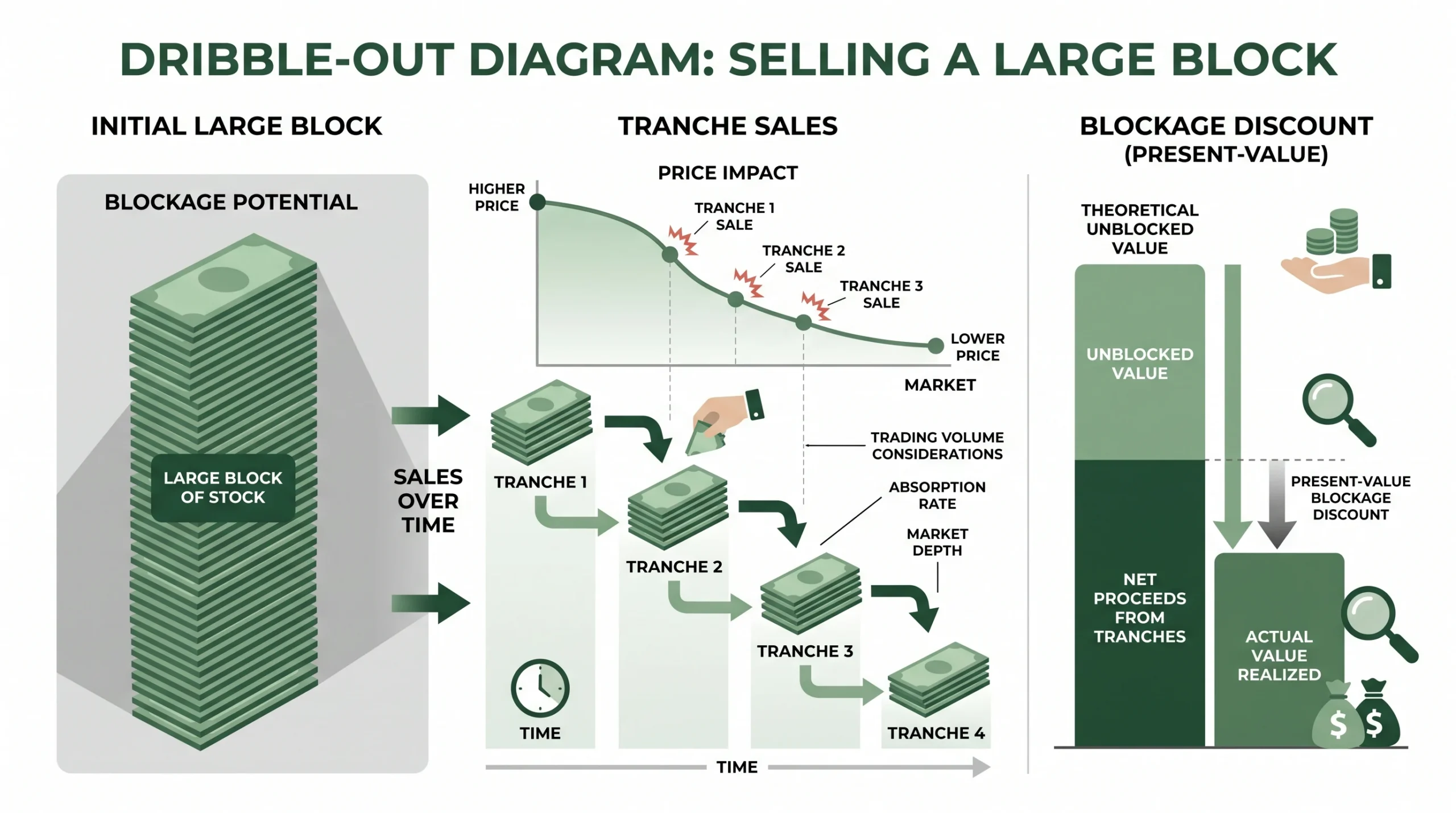
Two methods are common. The first is a dribble-out model, which spreads the sale over time and estimates the price impact of each tranche. The second estimates the cost of a secondary offering or private placement through an investment bank. Restricted stock studies can provide benchmarks. But the block size relative to trading depth remains the main driver of the final number.
How Does the Dribble-Out Method Work?
The dribble-out method is the most common way to model a blockage discount. It assumes the block is sold in pieces over time, not all at once. Each tranche is small enough that the market can absorb it without a big price drop. The analyst estimates how long the full sale would take at a reasonable daily volume.
The discount comes from two costs of that delay. The first is the time value of waiting to receive the full proceeds. The second is the price risk during the sale period, since the stock can move before the block clears. A longer sell-down period means more risk and a larger discount. The analyst discounts the projected proceeds back to the valuation date. The gap between that figure and the quoted value is the blockage discount.
What Does the IRS Scrutinize?
The IRS focuses on whether the discount is supported by market evidence as of the valuation date. It compares the block to the company’s total public float and average trading volume. If the block is large relative to normal activity, the agency asks whether the owner could really sell without moving the price. The answer must rest on data, not assertion.
The appraiser documents the stock’s price history and the company’s financial health. The analysis also weighs market trends and any resale restrictions. A thorough, evidence-based report is what survives an IRS challenge. Without it, the burden of proof stays on the taxpayer, and the discount is easy to reduce or deny. If you are preparing a filing that claims a blockage discount, talk to a Sofer Advisors valuation specialist before the return is due.
How Do the Professional Roles Work Together?
A blockage discount usually needs more than one professional. A valuation expert quantifies the discount. An estate attorney integrates it into the filing or estate plan. A tax advisor analyzes how it affects the overall tax burden. Each role is distinct, and together they build a defensible position. The table below shows the division of labor.
| Professional | Primary responsibility | Focus area |
|---|---|---|
| Valuation expert | Quantifies the discount | Fair market value analysis |
| Estate attorney | Legal integration | Estate plan compliance |
| Tax advisor | Reporting strategy | Tax impact and filing |
| Trustee or executor | Carries out the plan | Fiduciary duty and records |
Coordination matters because the IRS reviews the whole strategy, not just the isolated number. A consistent record across every role is what holds up in an audit. When the valuation, the legal filing, and the tax return all tell the same story, the discount is far harder to challenge. Gaps between them are exactly what an examiner looks for first.
Why Is a Qualified Appraisal Essential?
The IRS requires a thorough, independent report to support a blockage discount. A qualified appraisal provides that. It applies accepted methods and cites relevant market data. That is what withstands scrutiny and helps avoid valuation-related penalties. Without it, the taxpayer carries the burden of proof alone.
The report also explains how the appraiser reached the conclusion. That transparency reflects the Heart of a Teacher approach, which walks the reader through the data behind a number rather than simply stating it. It documents the method, the data, and the assumptions. Because the dollar amounts in a large block can be substantial, even a modest change in the discount can shift the tax by a large sum. That is why the analysis deserves real rigor rather than a rule of thumb.
How Do You Choose a Blockage Discount Provider?
Estates choose a provider based on the size of the holding, the audit exposure, and the need for a defensible, independent report. Larger national firms such as Alvarez & Marsal, Stout, and Kroll serve big corporate and institutional engagements with broad teams. Sofer Advisors focuses on partner-led estate and gift valuations for families and closely held owners, backed by expert witness testimony in 11+ cases and 180+ five-star Google reviews. For an estate filing, the provider must be able to defend the discount line by line if the IRS asks.
Sofer Advisors works through a four-phase process it calls The Sofer Difference, moving from Discovery to Diligence to Analysis to Delivery. That structure keeps each study grounded in trading data and backed by a clear documentation trail. For a blockage conclusion that stands up to review, an independent valuation firm supplies both the model and the evidence behind it.
Frequently Asked Questions
What is a blockage discount?
It is a reduction in the per-share value of a large block of public stock. The block is too big to sell at once without pushing the price down, so its value per share is below the quoted market price. The adjustment is recognized under Treasury Regulation Section 20.2031-2(e) and is common in estate and gift tax valuation. Sofer Advisors prepares the study that measures how much below the quote the block is worth.
What triggers a blockage discount?
A holding large enough that selling it at once would move the market price. The holder cannot liquidate the full position quickly at the quoted price without pushing it down. It usually comes up in estate filings, large gifts, or divorce settlements involving a concentrated position in one public company. The larger the block versus daily volume, the stronger the case. Sofer Advisors measures the block against the float and trading history to confirm whether a discount is warranted.
How is a blockage discount calculated?
There is no fixed formula. The analyst weighs block size against trading volume, volatility, and current market conditions. Common methods include a dribble-out model, which spreads the sale over time, and the estimated cost of a secondary offering or private placement. Block size relative to trading depth is the main driver of the result. Sofer Advisors builds the model, documents each input, and ties the conclusion to the valuation date so the figure holds up under IRS review.
How is it different from a DLOM?
A blockage discount applies to large blocks of public stock that are liquid in small amounts but not in a single large trade. A discount for lack of marketability applies to private stock with no public market at all. One addresses the price impact of a big public sale; the other addresses the absence of any public exit. Sofer Advisors applies the correct adjustment to each situation and explains why the other does not fit.
Does a blockage discount apply to a controlling interest?
Usually not. A control position carries benefits a minority holder lacks, so it may warrant a premium instead of a discount. The blockage discount applies to a block whose size, not its control, limits how it can be sold without moving the price. When control and block size both come into play, the analysis gets more complex. Sofer Advisors documents which effects apply and why, so the conclusion reflects the real economics of the holding.
What size discount is typical?
There is no standard figure. The discount depends entirely on the block size relative to trading volume and the stock’s volatility. A thinly traded stock with a very large block supports a larger discount, while a liquid stock with a modest block may support little or none. Each case must be supported by its own data, not a rule of thumb. Sofer Advisors sizes the discount from the specific trading record rather than a generic percentage.
What does the IRS require to allow the discount?
A defensible, independent appraisal that documents the price impact as of the valuation date. It must compare the block to the public float and average trading volume and support the size with market evidence, consistent with Treasury Regulation Section 20.2031-2(e). A weak or undocumented discount is easy for the IRS to deny, leaving the full quoted value taxable. Sofer Advisors prepares the qualified appraisal that meets this standard and stands behind it if the filing is examined.
How much does a blockage discount study cost?
A blockage discount study usually falls within the range of a standard business valuation, roughly $7,500 to $25,000. The fee depends on the complexity of the analysis, the volatility of the stock, and the data required. A flat scope is quoted up front, so the cost is clear before the work begins. Sofer Advisors sets the scope first, then quotes a fixed price. Request a free estimate for a range specific to your holding.
Related Case Studies
- Blockage Discounts: Valuing Large Stock Positions
- Secondary Sales of Private Stock: Valuation and 409A Implications
- DLOM and Restricted Stock Studies: Sizing the Discount
Executive Summary
A blockage discount lowers the per-share value of a large public stock block because selling it at once would depress the price. It is used mainly for federal estate and gift tax, recognized under Treasury Regulation Section 20.2031-2(e) and measured against the fair market value standard of Revenue Ruling 59-60. The size depends on the block relative to average daily volume, the stock’s volatility, and the cost of a sell-down, often modeled with a dribble-out method or a secondary-offering estimate. Discounts can range from low single digits to well over 10 percent. Most studies run $7,500 to $25,000. The first action is to gather the block size, the public float, and the stock’s trading history.
What Should You Do Next?
Pull the exact block size, the valuation date, and the stock’s trading volume and price history so the analysis has a factual base. Note any resale restrictions, such as a lock-up or Rule 144 limit, since they lengthen the sell-down and affect the discount. This guide was prepared by David Hern CPA ABV ASA, founder of Sofer Advisors, an Inc. 5000 firm specializing in estate and gift tax valuations. Schedule a free consultation to discuss your specific situation.
People Also Read
About the Author
This guide was prepared by David Hern CPA ABV ASA, founder of Sofer Advisors, a business valuation firm headquartered in Atlanta, GA serving clients across the United States. David holds dual accreditations as an Accredited Senior Appraiser (ASA) and is Accredited in Business Valuation (ABV), credentials recognized by the IRS, SEC, and FINRA. He also holds the Certified Exit Planning Advisor (CEPA) designation. With 15+ years of valuation experience, David has served as an expert witness in 11+ cases across multiple jurisdictions and built Sofer Advisors into an Inc. 5,000-recognized firm with 180+ five-star Google reviews. Its full W2 employee team maintains subscriptions to all major valuation databases and operates under a next business day response policy.
For professional business valuation services, visit soferadvisors.com/about-us/ or contact Sofer Advisors at soferadvisors.com/contact-us/.
This content is for informational purposes only and does not constitute professional valuation advice. Business valuation conclusions depend on specific facts and circumstances. Contact Sofer Advisors for guidance regarding your specific situation.









