


Last Updated: September 2026
A collateral liquidation valuation tells a lender what it could recover if it had to sell the assets a borrower pledged. It does not measure what the business is worth as a going concern. Instead, it assumes a sale, so the figure is far lower. Lenders often advance only 50% to 80% of that value, depending on the asset. Knowing this gap early helps a borrower set the right expectations before applying for a loan.
This gap surprises many owners. A company can be worth several million dollars as a going concern, yet its pledged equipment and inventory may bring far less at a quick sale. Lenders lend against the lower number to protect themselves if a loan goes bad. The premise of value the appraiser picks drives the whole result, so it pays to understand each one.
Sofer Advisors is a business valuation firm based in Atlanta, GA that serves clients across the United States. It gives neutral, third-party opinions of value for owners, lenders, and their advisors. Its team has testified as an expert witness in 11+ cases across Georgia, Florida, California, and New Mexico, and it holds 180+ five-star Google reviews. That independent view helps both sides price collateral fairly.
Key Takeaways
- Collateral is valued under a sale premise: lenders assume the assets must be sold, not kept running, so the value falls below fair market value.
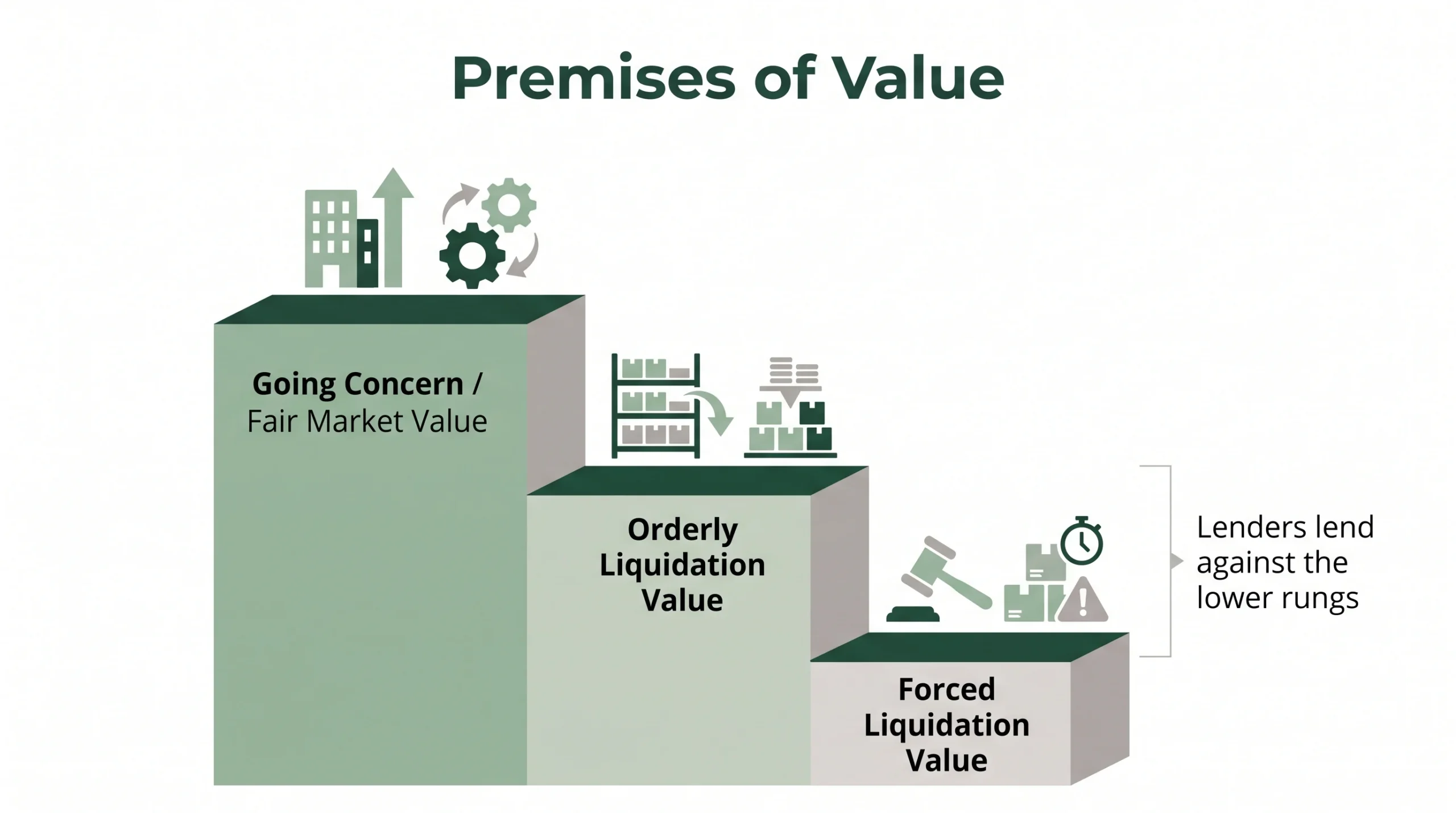
- Three premises, ranked: going-concern value sits highest, orderly liquidation value in the middle, and forced liquidation value lowest.
- Orderly versus forced: orderly liquidation value assumes several months to find buyers, while forced liquidation value assumes a fast, compelled sale like an auction.
- Advance rates cut it further: lenders apply a haircut to the liquidation figure, so a borrowing base rarely equals full asset value.
- Specialized assets widen the gap: niche or hard-to-move equipment sells for less, and removal and transport costs shrink net proceeds.
Each premise answers a different question about the same assets. The sections below define them and show why the lender’s number lands where it does.
What is a collateral liquidation valuation?
A collateral liquidation valuation estimates what a lender could recover by selling the assets a borrower pledges for a loan. It answers one question: if the loan defaults, what will the collateral bring? Because it assumes a sale, the appraiser values the assets under a liquidation premise, not their worth in daily use. Lenders use the result to set the loan amount, the advance rate, and the borrowing base. The pledged assets often include equipment, inventory, and accounts receivable.
The purpose shapes the method. A lender is not buying the business, so it does not care what the company earns in a strong year. It cares what it can sell the pledged assets for if the borrower stops paying. That is why a going-concern valuation and a collateral valuation can produce very different numbers for the same company. One assumes the business keeps running. The other assumes it stops.
What premise of value do lenders use for collateral?
Lenders use a premise of value that assumes a sale, not continued use. The premise of value is the assumption about how and under what conditions the assets change hands. It sits at the core of every appraisal, because the same asset is worth more in place and running than it is stripped out and sold. The appraiser must state the premise and the exact value definition used, so the reader knows what the number means. That rule comes from USPAP, the standards that govern the appraisal profession.
Three premises come up most in lending. The highest is going-concern value, also called fair market value in continued use, where the assets keep operating as one unit. Next is orderly liquidation value, a piecemeal sale with reasonable time to find buyers. Lowest is forced liquidation value, an immediate sale under pressure. Our guide on USPAP compliance shows why stating the premise keeps a valuation defensible.
What is orderly versus forced liquidation value?
Orderly liquidation value (OLV) is the gross amount a piecemeal sale should bring when the seller has a reasonable time to find buyers, net of the costs of the sale. Forced liquidation value (FLV) is what the same assets bring in an immediate, compelled sale, such as an auction with little time. The difference is time. More time usually means more money, because a rushed sale draws fewer and lower bids.
Appraisers who value machinery and equipment define these terms with care, and the American Society of Appraisers sets standards for that work. Orderly value often assumes a sale window of several months. Forced value assumes days, or a single auction date. The table below compares the three premises and where each one lands.
| Premise of value | What it assumes | Relative value |
| Going-concern (fair market value in use) | Assets keep operating as one working unit | Highest |
| Orderly liquidation value (OLV) | Piecemeal sale with several months to find buyers | Middle |
| Forced liquidation value (FLV) | Immediate, compelled sale such as an auction | Lowest |
Why is collateral value below fair market value?
Collateral value sits below fair market value because a sale premise strips out the value of the business as a working whole. Fair market value often reflects a going concern, with customers, cash flow, and a trained team in place. A liquidation breaks that apart and sells the pieces. Buyers of used equipment or bulk inventory expect a discount. So the recovery number lands well under what the business is worth while it operates.
Several forces widen the gap. Specialized or custom assets have a thin resale market, so they sell for less. Removal, transport, and storage costs come out of the proceeds. A weak market for a given asset class drags prices down further. Our guide on the fair market value of a company shows how a going-concern figure is built, which makes the contrast clear. The cost approach and the income approach can also point to different numbers for the same assets.
How do advance rates and loan-to-value use liquidation value?
Lenders rarely lend the full liquidation value. They apply an advance rate, a percentage haircut, to protect against a shortfall. An advance rate on accounts receivable might run 70% to 85%, while used equipment might see 50% or less of orderly liquidation value. The loan-to-value ratio and the borrowing base both flow from these haircuts. In asset-based lending, the borrowing base is recalculated as collateral values change over the life of the loan.
These numbers matter most when a loan is stressed. In a workout or a default, the lender tests whether the collateral still covers the balance. Bank guidance, including the OCC handbook on commercial lending, expects sound appraisals behind these credit decisions. Sofer Advisors prepares independent collateral opinions for bank and venture financing, so a lender and a borrower can work from the same defensible number.
Which firm should value collateral for a loan?
Owners and lenders choose among an independent valuation firm, an equipment auctioneer, and a large advisory firm, and their incentives differ. An independent firm follows standards and gives a neutral number, with a flat fee not tied to the loan. An auctioneer may quote a low figure it can beat at sale. Large firms like Alvarez & Marsal, Stout, and Kroll serve the biggest deals, but can be a heavy fit for a small loan. The right partner states the premise clearly and defends it.
An independent, credentialed appraiser reads the assignment the way a lender’s examiner would. It names the premise, states the value definition, and documents the market data behind each figure. A credible collateral opinion protects both sides if the loan is ever tested. An independent firm keeps the appraisal separate from any sale, so the number reflects the real recovery, not a party’s hope for the deal.
Sound appraisal work settles the number before anyone needs it. The questions below cover what owners and lenders ask most about collateral value.
Frequently Asked Questions
What is collateral valuation?
Collateral valuation estimates what a lender could recover by selling the assets a borrower pledges to secure a loan. It assumes a sale, not continued use, so the figure sits below fair market value. The pledged assets often include equipment, inventory, and accounts receivable. Lenders use the result to set the loan amount and the advance rate.
What is orderly liquidation value versus forced liquidation value?
Orderly liquidation value is the amount a piecemeal sale should bring when the seller has a reasonable time, often several months, to find buyers, net of sale costs. Forced liquidation value is what the same assets bring in an immediate, compelled sale, such as an auction. The difference is time, and more time usually means more money.
Why is liquidation value lower than fair market value?
Liquidation value is lower because a sale premise breaks apart the business and sells the pieces. Fair market value often reflects a going concern, with customers, cash flow, and staff in place. A rushed or piecemeal sale draws discounted bids. Removal, transport, and a thin resale market for specialized assets widen the gap further.
When do lenders use a going-concern premise instead of a liquidation premise?
A lender may consider going-concern value when the loan depends on the business staying open and producing cash flow. Even then, the lender usually checks the liquidation value as a downside test. Cash-flow loans lean on going-concern value, while asset-based loans lean on orderly or forced liquidation value. Most credit files look at both.
What are the four types of collateral?
Common collateral falls into four broad groups: real estate, equipment and machinery, inventory, and accounts receivable. Some lenders also take cash, investments, or intellectual property. Each type carries its own advance rate, because each sells with a different speed and certainty. Receivables convert to cash faster than niche equipment, so they usually earn a higher rate.
How do you pay back a collateral loan?
A borrower repays a collateral loan through scheduled payments from the cash flow of the business, the same as most loans. The collateral is the backstop, not the plan. If the borrower defaults, the lender can seize and sell the pledged assets to recover the balance. Any shortfall after the sale may still be owed.
What is an advance rate or haircut on collateral?
An advance rate is the share of a collateral value that a lender will actually lend. The gap between that share and the full value is the haircut. It cushions the lender against sale costs, price swings, and a slow market. Receivables might carry a 70% to 85% rate, while used equipment often sees 50% or less.
Does USPAP require the appraiser to state the premise of value?
Yes. USPAP requires the appraiser to state the premise of value and the exact value definition used in the report. That tells the reader whether the number reflects continued use, orderly liquidation, or forced liquidation. Stating the premise keeps the valuation clear and defensible, which matters when a lender or a court reviews the work later.
How much does a collateral valuation from Sofer Advisors cost?
A collateral valuation from Sofer Advisors typically runs $7,500 to $25,000, in line with a standard business valuation engagement, with a timeline of about four to eight weeks. Cost depends on the number and type of assets, the premise required, and the depth of market research. For a quote tied to your loan, contact us with your asset list and financials.
Related Case Studies
- SBA Loan Business Valuation: What Lenders Require
- How to Value a Manufacturing Company: Complete Guide 2026
- How to Value a Trucking Company: Fleet, Lanes, and 2026 Multiples
Executive Summary
Lenders value collateral to answer one question: if a loan defaults, what can the pledged assets be sold for? Because the answer assumes a sale, the appraiser uses a liquidation premise, and the number falls below fair market value. Three premises rank the result. Going-concern value is highest, orderly liquidation value sits in the middle with several months to find buyers, and forced liquidation value is lowest under a fast, compelled sale. Lenders then apply an advance rate, so the borrowing base is lower still. Specialized assets, a thin resale market, and removal costs widen the gap. Stating the premise clearly keeps the opinion defensible.
What Should You Do Next?
Start by listing the assets you plan to pledge, grouped by type: real estate, equipment, inventory, and receivables. Next, ask your lender which premise it will use and what advance rate applies to each group, since that sets your real borrowing base. Then get an independent collateral opinion that states the premise and the value definition, so both sides work from the same number instead of a guess. Sofer Advisors runs this review through The Sofer Difference, its four-phase process of Discovery, Diligence, Analysis, and Delivery, and works with a Heart of a Teacher so owners understand each choice.
David Hern CPA ABV ASA, founder of Sofer Advisors, gives neutral, defensible collateral and liquidation opinions for lenders and borrowers. Schedule a consultation to discuss your assets and loan.
People Also Read
- What Is a Solvency Opinion? Complete Guide for Business Owners
- Difference Between Book Value and Fair Value Explained
About the Author
This guide was prepared by David Hern CPA ABV ASA, founder of Sofer Advisors, a business valuation firm headquartered in Atlanta, GA serving clients across the United States. David holds dual accreditations as an Accredited Senior Appraiser (ASA) and is Accredited in Business Valuation (ABV), credentials recognized by the IRS, SEC, and FINRA. He also holds the Certified Exit Planning Advisor (CEPA) designation. With 15+ years of valuation experience, David has served as an expert witness in 11+ cases across multiple jurisdictions and built Sofer Advisors into an Inc. 5000-recognized firm with 180+ five-star Google reviews. Its full W2 employee team maintains subscriptions to all major valuation databases and operates under a next business day response policy.
For professional business valuation services, visit soferadvisors.com/about-us/ or contact Sofer Advisors at soferadvisors.com/contact-us/.
Disclaimer: This content is for informational purposes only and does not constitute professional valuation advice. Business valuation conclusions depend on specific facts and circumstances. Contact Sofer Advisors for guidance regarding your specific situation.









