


Last Updated: November 2026
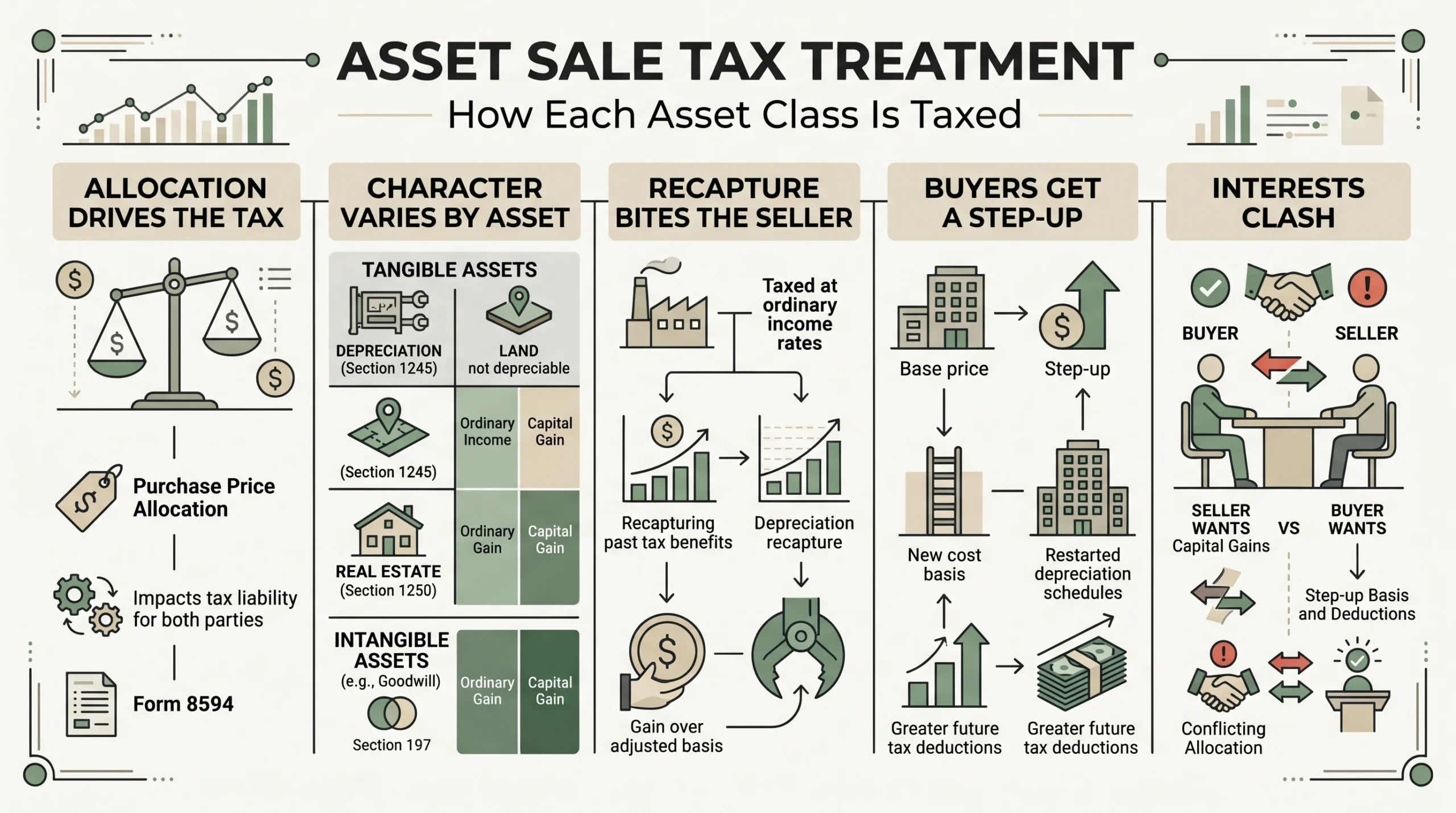
In an asset sale, each asset is taxed on its own, and the character of that asset decides the rate. Inventory and depreciation recapture produce ordinary income, while goodwill is usually capital gain. The total price is split across seven asset classes under Section 1060 and reported on Form 8594. That allocation fixes the seller’s gain on each asset and the buyer’s basis for future deductions.
The team at Sofer Advisors builds these allocations for business owners, CPAs, and attorneys.
This guide walks through how each asset class is taxed for both the seller and the buyer.
Key Takeaways
- Allocation drives the tax: the price is split across asset classes under Section 1060 and reported on Form 8594.
- Character varies by asset: inventory and recapture are ordinary income, while goodwill is usually capital gain.
- Recapture bites the seller: gain on equipment is taxed as ordinary income up to past depreciation.
- Buyers get a step-up: they depreciate tangible assets and amortize Section 197 intangibles over 15 years.
- Interests clash: buyers often prefer asset sales, and sellers often prefer stock sales.
What is an asset sale, and how does it differ from a stock sale?
An asset sale transfers specific assets and liabilities. A stock sale transfers ownership shares in the company. The choice changes the tax bill for both parties.
Buyers tend to prefer asset sales. They get a stepped-up basis in the assets. That basis lets them take larger deductions later. They can also leave behind liabilities they do not want.
Sellers often prefer stock sales. A stock sale usually produces capital gain on the whole deal. An asset sale can force some gain to be taxed as ordinary income. That difference can cost the seller real money.
This tension sits at the center of most deal talks. The structure the parties pick decides how much is taxed at higher ordinary rates. It also decides how much qualifies for lower capital gain rates. Each side pushes for the outcome that helps it most.
How does the IRS classify assets in an asset sale?
The sale of a trade or business is an applicable asset acquisition. The rules for it live in Section 1060. The total price must be split across the assets. This split is called purchase price allocation.
Both the buyer and the seller report the allocation. They use Form 8594, the Asset Acquisition Statement. Both sides are supposed to report the same numbers. The IRS can compare the two filings for a mismatch.
Section 1060 uses the residual method. The price is assigned class by class. Cash comes first. The price then flows through the more liquid assets. Goodwill and going concern value come last. Whatever price is left over lands in that final class. So goodwill often absorbs the part of the deal that the other assets do not explain.
The assets fall into seven classes. Class I is cash and deposits. Class II is actively traded items, like securities. Class III is accounts receivable. Class IV is inventory. Class V is other tangible property, such as equipment. Class VI is Section 197 intangibles other than goodwill. Class VII is goodwill and going concern value.
This allocation sets the stakes for taxes. For the seller, it fixes the gain on each asset. For the buyer, it fixes the basis for future deductions.
How is each asset class taxed to the seller?
The seller’s tax depends on the character of each asset. Some assets create ordinary income. Others create capital gain. The table below shows the common classes.
| Asset Class | Example | Tax Character to the Seller |
|---|---|---|
| Inventory | Goods held for sale | Ordinary income |
| Accounts receivable | Money owed by customers | Generally ordinary income |
| Equipment (Section 1245) | Machinery and fixtures | Recapture as ordinary income, then Section 1231 gain |
| Real property (Section 1250) | Buildings and improvements | Capital gain, with unrecaptured Section 1250 gain rules |
| Section 197 intangibles | Goodwill and going concern | Generally capital gain |
| Covenant not to compete | The seller’s promise | Ordinary income |
| Personal goodwill | The owner’s reputation | Capital gain to the individual |
Inventory is ordinary income. So is the gain on accounts receivable, in most cases. These are not capital assets. No capital gain rate applies to them.
Equipment is Section 1245 property. Here the rule is depreciation recapture. Gain is taxed as ordinary income up to the depreciation already claimed. Any gain above that amount is Section 1231 gain. That excess can be treated as capital gain.
Real property is Section 1250 property. The gain is generally capital gain. Special unrecaptured Section 1250 gain rules can apply to past depreciation. Those rules can tax part of the gain at a different rate. The rest of the gain keeps its capital character.
Section 197 intangibles and goodwill are usually capital gain to the seller. A covenant not to compete is the exception. It produces ordinary income to the seller. Personal goodwill is different again. When it is truly tied to the owner, it can be capital gain to that individual.
The mix of these characters sets the seller’s real tax cost. A deal heavy in inventory and equipment leans toward ordinary income. A deal heavy in goodwill leans toward capital gain. Two sales at the same price can land very differently. This is why the seller cares about every line of the allocation.
What does the buyer gain from an asset sale?
The buyer’s main prize is the step-up in basis. The buyer records each asset at its allocated price. That fresh basis drives future tax deductions.
Tangible assets can be depreciated. Equipment and similar property are written off over time. The larger the allocated price, the larger the future deductions. This is why buyers want more value placed on these assets.
Section 197 intangibles work differently. Goodwill and most other intangibles are amortized. The buyer deducts them over 15 years. A covenant not to compete is also a Section 197 asset. It follows the same 15-year rule.
This is why allocation becomes a negotiation. The buyer wants more value in assets with fast write-offs. The seller wants more value in assets taxed as capital gain. The same dollar is taxed one way for one side and another way for the other.
The buyer also weighs timing. Equipment can be written off faster than goodwill. Goodwill is spread evenly over 15 years. So a buyer may push value toward short-lived assets. The seller may resist, since those same assets often trigger ordinary income. A fair allocation has to respect the real value of each asset, not just the tax wish of one side.
How does double taxation affect a C-corporation sale?
A C-corporation asset sale can be taxed twice. First, the corporation pays tax on its gain from the sale. Then the shareholders pay tax when the money is paid out. This is the double taxation problem.
A pass-through entity usually avoids this. An S-corporation or an LLC generally has one layer of tax. The gain flows straight through to the owners. It is taxed only once at their level.
This is one key reason entity type matters so much. The same exact asset sale can cost far more inside a C-corporation. Owners often model the tax before they settle on a structure. In some deals, a Section 338(h)(10) election lets the parties treat a stock sale as an asset sale for tax purposes.
How do valuation advisors support the allocation?
The numbers on Form 8594 need support. The IRS can challenge an allocation that looks off. A defensible allocation rests on real fair market values. Guesswork does not hold up well under review.
A valuation advisor studies each asset. Tangible assets get valued on their own. Intangibles, like customer lists and goodwill, get valued with accepted methods. The result is an allocation both sides can stand behind.
Sofer Advisors prepares these purchase price allocation studies. The work gives the buyer a basis they can defend. It gives the seller protection against claims of a skewed price. Clear support also helps if the filing is ever audited. A well-documented study spells out each value and the reason behind it. That record is far easier to stand behind than a bare number.
Frequently Asked Questions
What is Form 8594?
Form 8594 is the Asset Acquisition Statement. The buyer and the seller both file it with the IRS. It reports how the purchase price was split across the asset classes. It is required when a group of assets that makes up a trade or business changes hands and the buyer’s basis depends on the price.
Why does inventory create ordinary income?
Inventory is not a capital asset. It is stock a business sells in its normal operations. Gain on it is taxed as ordinary income. That rate is usually higher than the capital gain rate.
What is depreciation recapture?
Recapture happens when you sell equipment for more than its depreciated basis. The gain is taxed as ordinary income up to the depreciation you already deducted. In effect, the IRS claws back part of the earlier tax benefit. Any gain above that amount can be capital gain.
How is goodwill taxed to the seller?
Goodwill is a Section 197 intangible. For the seller, the gain on goodwill is generally capital gain. That usually means a lower rate than ordinary income. This is one reason sellers like to place value on goodwill.
How does the buyer treat goodwill?
The buyer amortizes goodwill over 15 years under Section 197. Each year, the buyer deducts part of the cost. Most other acquired intangibles follow the same 15-year rule. These deductions are a real benefit of an asset sale.
Why is a covenant not to compete taxed differently?
A covenant not to compete is a Section 197 intangible. But the seller’s payment for it is ordinary income, not capital gain. The buyer still amortizes it over 15 years. So the two sides treat the same item in different ways.
What is personal goodwill?
Personal goodwill is tied to the owner, not the company. It can come from the owner’s skills, reputation, or client relationships. When it is truly personal, the owner can sometimes sell it on their own. That can produce capital gain to the individual and avoid a layer of corporate tax.
Why do buyers prefer asset sales?
A buyer gets a stepped-up basis in an asset sale. That basis means larger deductions in future years. The buyer can also leave behind liabilities they do not want. Sellers often prefer stock sales for the opposite reasons.
Can the buyer and seller report different allocations?
They are expected to report the same split. Both file Form 8594 with matching numbers. A mismatch can draw IRS attention and raise audit risk. A shared, supported allocation protects both sides. This is why many deals fix the allocation in the purchase agreement itself.
Related Case Studies
- Section 1060 Asset Allocation in a Business Sale
- Asset Sale vs Stock Sale: Tax and Deal Structure Guide
- Installment Sale of a Business: Tax Deferral and Buyer Pushback
Executive Summary
The price is split across asset classes under Section 1060 and reported on Form 8594. Inventory and recapture are ordinary income, while goodwill is usually capital gain. Gain on equipment is taxed as ordinary income up to past depreciation. They depreciate tangible assets and amortize Section 197 intangibles over 15 years. Buyers often prefer asset sales, and sellers often prefer stock sales.
What Should You Do Next?
A clean allocation starts with real values for each asset. Pull together your asset list, your depreciation schedules, and your draft purchase agreement. Map each asset to its class before you sign the deal. Settle the allocation early, while both sides can still negotiate it. That work decides how much of the deal is taxed as ordinary income. Sofer Advisors prepares independent purchase price allocation studies, led by David Hern CPA ABV ASA CVA.
People Also Read
About the Author
This guide was prepared by David Hern CPA ABV ASA CVA, founder of Sofer Advisors, a business valuation firm headquartered in Atlanta, GA serving clients across the United States. David holds accreditations as an Accredited Senior Appraiser (ASA) and is Accredited in Business Valuation (ABV), credentials recognized by the IRS, SEC, and FINRA, and is also a Certified Valuation Analyst (CVA). David has served as an expert witness in dozens of cases across multiple jurisdictions, and Sofer Advisors is an Inc. 5000 honoree in 2024 and 2025 with 240+ five-star Google reviews.
For professional business valuation services, visit soferadvisors.com/about-us/ or contact Sofer Advisors at soferadvisors.com/contact-us/.
Disclaimer: This content is for informational purposes only and does not constitute professional valuation advice. Business valuation conclusions depend on specific facts and circumstances. Contact Sofer Advisors for guidance regarding your specific situation.









