


Last Updated: October 2026
A qualified appraisal for estate tax is a formal valuation that sets the fair market value of property in a decedent’s estate. The executor uses it to report assets on Form 706, the federal estate tax return. The value is measured as of the date of death, reflecting what a willing buyer would pay a willing seller, with neither under pressure to act. With the 2026 federal estate tax exemption at $15 million per person, larger estates face close IRS review.
The appraisal matters most for assets with no public price, such as a closely held business. Sofer Advisors prepares these reports for executors, estate attorneys, and CPAs, backed by Inc. 5000 recognition in both 2024 and 2025. A credible report documents a good faith effort to value the estate correctly and protects the executor if the IRS reviews the return.
This guide explains who counts as a qualified appraiser, what the report must contain, how estate value standards differ, and the common errors that draw an audit.
Key Takeaways
- Date of death value: estate assets are valued at fair market value as of the date of death, unless the executor elects the alternate date.
- Qualified appraiser: the IRS expects a credentialed, independent professional who follows USPAP and regularly performs valuations.
- Report content: a valid report states the method, the effective date, a clear rationale, and the appraiser’s credentials and signature.
- Exemption level: the 2026 federal estate tax exemption is $15 million per person, so larger estates face the most scrutiny.
- Penalty exposure: a weak or biased appraisal can trigger valuation penalties under the tax code for both the estate and the appraiser.
Each of these points ties back to one goal: a defensible value. The sections below examine each one in detail.
Why Is a Qualified Appraisal Important to Understand?
The IRS requires a qualified appraisal to confirm the fair market value of assets that have no ready market price, so an estate cannot understate value and underpay tax. IRC Section 2031 defines the gross estate at fair market value, Revenue Ruling 59-60 sets the factors an appraiser must weigh for a closely held business, and IRC Section 6695A exposes the appraiser to a penalty for a flawed report. A credentialed, independent appraisal that follows USPAP becomes the estate’s first line of defense if the return is questioned.
What Makes an Appraiser “Qualified”?
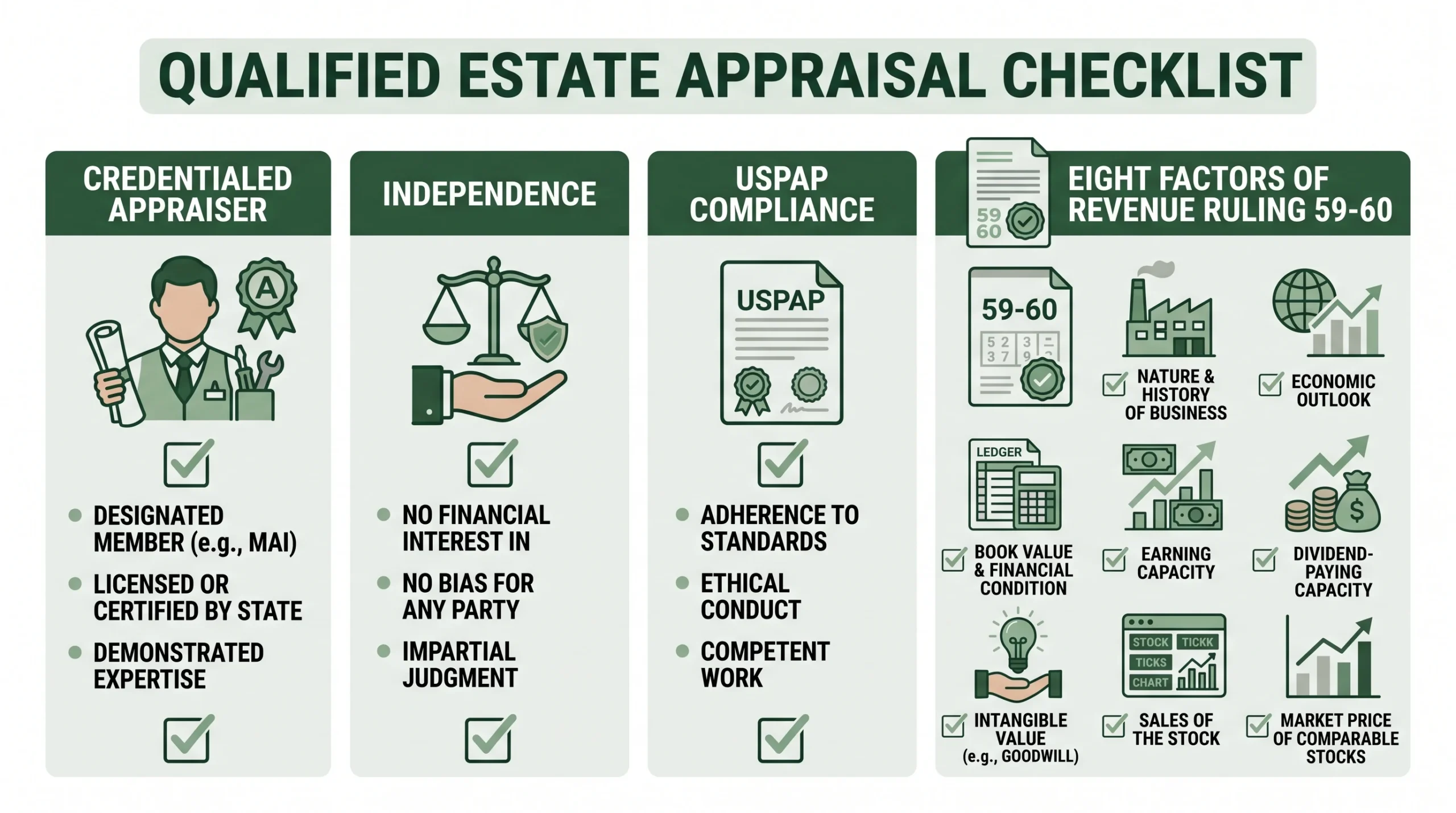
A qualified appraiser has real education and experience in valuing the type of property at issue. For a business interest, that means a recognized credential, such as the Accredited Senior Appraiser (ASA) or the Accredited in Business Valuation (ABV), and a record of performing valuations regularly for pay.
Independence is the other key test. The appraiser cannot be the executor, an heir, or anyone with a stake in the result, and must follow the Uniform Standards of Professional Appraisal Practice, known as USPAP. The formal qualified appraisal definition in the tax code was written for charitable gifts, but the IRS expects the same rigor for an estate. Large national firms such as Alvarez & Marsal, Stout, and Kroll serve big corporate estates with broad teams. Sofer Advisors focuses on partner-led estate and gift valuations for closely held owners, backed by expert witness testimony in 11+ cases, and works through a four-phase process it calls The Sofer Difference, moving from Discovery to Diligence to Analysis to Delivery.
Matching the right credentialed appraiser to an estate is easier with a direct conversation about the assets involved. Talk to a Sofer Advisors valuation specialist about the interests in the estate.
What Must the Appraisal Report Contain?
The report must describe the property, state the valuation method, and give the effective date. For estate tax, that date is the date of death. The executor may instead elect an alternate date, which is six months later, under IRC Section 2032. The report must also carry the appraiser’s signature and credentials.
The analysis must show its work. For a closely held business, the IRS expects the eight factors from Revenue Ruling 59-60. These cover the company’s history, earnings, dividends, net asset value, and the outlook for its industry. The report must explain the rationale for every discount or premium. A naked conclusion, with no supporting data, invites a challenge. A clear chain of reasoning is what makes the value defensible.
Which Assets Do Not Need a Qualified Appraisal?
Some assets have an obvious value, so no appraisal is needed. Cash and bank accounts are the simplest case. Publicly traded securities also qualify, because the market sets a price each day. For those holdings, the executor can report the value straight from statements.
The need for an appraisal rises with how hard the asset is to value. A private business, a partnership interest, or a unique property all call for expert analysis. Even when an appraisal is optional, the executor should keep records that support the reported figure. If the IRS asks, the estate must be able to show how it reached the number.
How Do Value Standards Compare by Purpose?
The purpose of a valuation sets the standard of value and the discounts that apply. Estate tax uses fair market value, which assumes a hypothetical willing buyer and seller and ignores what one strategic buyer might pay. Using the wrong standard for the event can lead to a rejected filing. The table below shows how the common purposes differ.
| Valuation purpose | Standard of value | Typical discounts |
|---|---|---|
| Estate tax (Form 706) | Fair market value | DLOM and lack of control common |
| Gift tax (Form 709) | Fair market value | DLOM and lack of control common |
| Shareholder dispute | Fair value | Discounts often disallowed |
| M&A transaction | Investment value | Varies by deal terms |
Each purpose needs its own analysis. A number built for a sale will not hold up on an estate return. Matching the standard to the regulatory context is the heart of a defensible report, and it is also the first thing a reviewer checks.
How Do Valuation Discounts Work for Estate Tax?
Discounts are a major part of valuing a private business for an estate. The two most common are the discount for lack of control and the discount for lack of marketability. A minority owner cannot direct the company, so that interest is worth less per share. That gap is the discount for lack of control.
The discount for lack of marketability, or DLOM, reflects how hard it is to sell a private interest. There is no public exchange for the shares, and a buyer may wait months or years to exit. The appraiser supports the DLOM with studies of restricted stock and pre-IPO sales. The IRS accepts a discount only when the data backs it up, so an unsupported discount is one of the fastest ways to draw a challenge.
Applied well, discounts can lower the taxable value of a business interest in a defensible way. Sofer Advisors applies a Heart of a Teacher approach to discounts, showing the restricted-stock and pre-IPO studies behind each figure rather than asserting a percentage, an approach reflected in its 180+ five-star Google reviews.
What Are Common Errors in Estate Tax Appraisals?
The most common error is a loss of independence. An appraiser with a stake in the outcome can sink the whole report, and the IRS may disregard it entirely. Another frequent problem is an unsupported discount for lack of marketability. The discount may be valid, but it must be backed by data.
Other errors are easy to avoid with care. Using the wrong valuation date changes the result. Skipping USPAP weakens the report. Stating a value with no method behind it forces the IRS to challenge it. Each of these gaps gives an auditor a reason to push back, so a transparent, well-documented report is the best defense.
Frequently Asked Questions
What is a qualified appraisal for estate tax purposes?
A qualified appraisal for estate tax is a formal valuation by a credentialed, independent appraiser who follows USPAP. It sets the fair market value of estate property as of the date of death, states the method and the rationale, and carries the appraiser’s signature and credentials. That record is what holds up if the IRS reviews Form 706. Sofer Advisors prepares these reports with accredited appraisers so the value is defensible from the day it is filed.
At what value does the estate tax apply?
For 2026, the federal estate tax exemption is $15 million per person, set by the 2025 tax law and indexed for inflation. It was $13.99 million in 2025. Estates above the exemption must file Form 706 and may owe tax on the excess, which is why larger estates draw the closest IRS review. Sofer Advisors values the closely held assets in those estates so the reported figures can withstand an examination.
What is the three-year rule for an estate?
The three-year rule pulls certain gifts and transfers back into the gross estate if they were made within three years of death. It is set by IRC Section 2035 and most often applies to life insurance and gift tax paid near death. The rule stops a person from moving assets out of the estate right before death to avoid tax. Sofer Advisors coordinates with the estate’s attorney so the valuation reflects what the rule brings back in.
How does an estate appraisal work?
The appraiser gathers financial data, studies the industry, and applies the income or market approach to reach a value. For a closely held business, the analysis follows the eight factors in Revenue Ruling 59-60, covering history, earnings, dividends, and the industry outlook. The result is a fair market value as of the date of death. Sofer Advisors documents each factor and every discount, so the conclusion traces cleanly from the data to the number.
How much does a qualified appraisal for estate tax cost?
Most estate tax valuations range from about $7,500 to $25,000. The fee depends on the entity’s complexity, the number of asset classes, and the timeline, since weak records and a tight deadline both raise the work. A flat fee is quoted up front, so the executor knows the cost before the work starts. Sofer Advisors scopes the engagement first, then holds that price. Request a free estimate for your estate.
Who can perform a qualified appraisal for the IRS?
The IRS expects a credentialed appraiser who regularly performs valuations for pay and stays independent of the estate. A designation such as the Accredited Senior Appraiser or Accredited in Business Valuation signals that training, and independence means the appraiser is not the executor, an heir, or anyone with a stake in the result. Sofer Advisors staffs each estate engagement with accredited, independent appraisers for exactly this reason.
Can I use an old appraisal for estate tax?
An old appraisal rarely works, because the value must reflect the date of death. Markets and company performance shift over time, so a report prepared for another date or purpose will not match the economic reality the IRS expects. A current, date-specific analysis is what the return needs. Sofer Advisors prepares a valuation tied to the exact date of death, or the alternate date, so the figure on Form 706 is properly supported.
What is the alternate valuation date?
The alternate valuation date lets the executor value estate assets six months after death, under IRC Section 2032. It is available only if the election lowers both the gross estate and the combined estate and generation-skipping transfer tax. Choosing it can help when asset values have fallen after death. Sofer Advisors can value both the date of death and the alternate date, so the executor sees which election produces the better result.
Related Case Studies
- Valuation of Closely Held Business for Estate Tax Purposes
- Closely Held Business Valuation for Estate Tax: Atlanta Guide
- Estate Planning Business Valuation Georgia: Gift & Tax Compliance Guide
Executive Summary
A qualified estate tax appraisal sets the fair market value of a decedent’s property as of the date of death, or the alternate date six months later under IRC Section 2032, for reporting on Form 706. The appraiser must be credentialed, independent, and follow USPAP, and for a closely held business the report must apply the eight factors of Revenue Ruling 59-60 and support every discount for lack of control or marketability. With the 2026 exemption at $15 million per person, estates above that line face the closest review. These valuations generally run $7,500 to $25,000. The first step is to assemble the financial statements and ownership records as of the date of death.
What Should You Do Next?
Confirm the appraiser is credentialed, independent, and signs the report, and make sure the valuation date matches the date of death or a valid alternate date election. Gather the financial statements, ownership records, and industry data that support the value, since those are what shift the burden to the IRS to disprove a well-supported number. This guide was prepared by David Hern CPA ABV ASA, founder of Sofer Advisors, an Inc. 5000 firm specializing in estate and gift tax valuations. Schedule a free consultation to discuss your specific situation.
People Also Read
About the Author
This guide was prepared by David Hern CPA ABV ASA, founder of Sofer Advisors, a business valuation firm headquartered in Atlanta, GA serving clients across the United States. David holds dual accreditations as an Accredited Senior Appraiser (ASA) and is Accredited in Business Valuation (ABV), credentials recognized by the IRS, SEC, and FINRA. He also holds the Certified Exit Planning Advisor (CEPA) designation. With 15+ years of valuation experience, David has served as an expert witness in 11+ cases across multiple jurisdictions and built Sofer Advisors into an Inc. 5,000-recognized firm with 180+ five-star Google reviews. Its full W2 employee team maintains subscriptions to all major valuation databases and operates under a next business day response policy.
For professional business valuation services, visit soferadvisors.com/about-us/ or contact Sofer Advisors at soferadvisors.com/contact-us/.
This content is for informational purposes only and does not constitute professional valuation advice. Business valuation conclusions depend on specific facts and circumstances. Contact Sofer Advisors for guidance regarding your specific situation.









