


Last Updated: October 2026
A life insurance policy valuation for estate tax sets the dollar value the IRS taxes when the policy owner dies. That value is usually not the death benefit. It is what the policy is worth, and for a whole life or universal policy that figure comes off the insurer’s own records. Get it wrong and the estate either overpays or draws an audit.
Sofer Advisors values policies and the business interests that sit beside them for executors, estate attorneys, and CPAs. Sofer Advisors earned Inc. 5000 recognition in both 2024 and 2025. The rules here are narrow and easy to trip over. One retained power can pull a full death benefit back into a taxable estate.
This guide explains why a policy lands in the estate, how the IRS values it, how a gift differs from a transfer at death, the three-year rule, and how an irrevocable trust keeps proceeds out. It points to the statutes and the IRS form behind each step.
Key Takeaways
- Incidents of ownership control inclusion: under IRC Section 2042, a death benefit joins the gross estate if the insured kept any ownership power, such as the right to change the beneficiary or borrow against cash value.
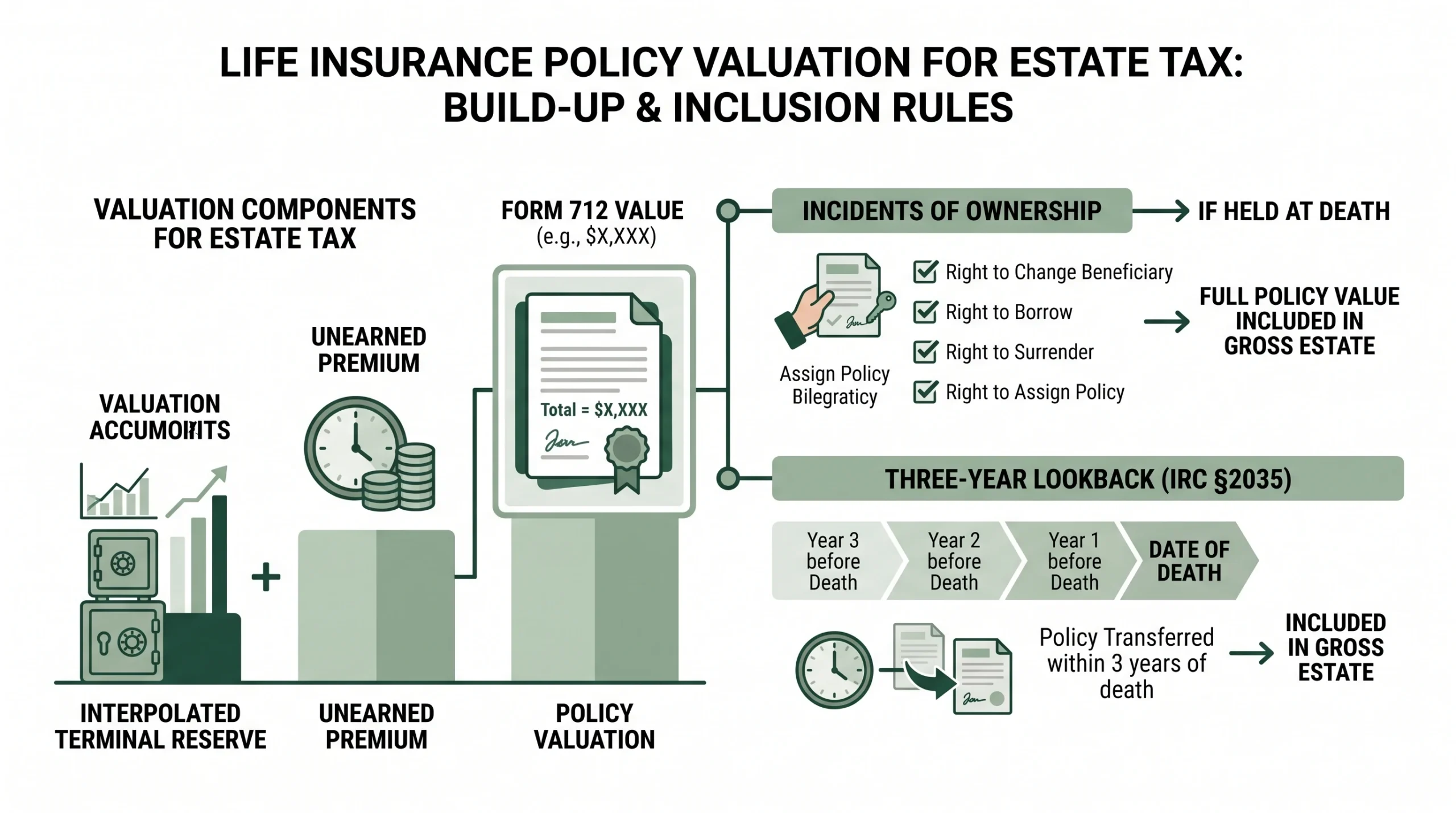
- The value is replacement cost, not the payout: for most policies the IRS uses the interpolated terminal reserve plus unearned premium, which the carrier reports on IRS Form 712.
- Term policies often value near zero: a term policy with no cash value is usually worth little during life, while whole life and universal policies carry a reserve.
- The three-year rule reaches back: under IRC Section 2035, a policy given away within three years of death is pulled back into the estate.
- An ILIT can keep proceeds out: when an irrevocable trust owns the policy from the start, the insured never holds incidents of ownership, so the benefit stays outside the estate.
Each rule ties to a specific statute or form. The sections below take them one at a time.
Why Is Life Insurance Included in a Taxable Estate?
Life insurance proceeds join the gross estate when the insured held incidents of ownership in the policy at death, or when the money is payable to the estate. Under IRC Section 2042, the death benefit is taxed even if someone else receives the payout. The test is control, not who collects the check. One retained power is enough to bring the full benefit in.
Incidents of ownership are the economic powers over the contract. They include the right to change the beneficiary, to surrender or cancel the policy, to assign it, to pledge it, or to borrow against its cash value. Keep even one and the IRS treats the policy as yours. The rule reaches policies held in trust too, if the insured can still shift who benefits. The statute sits at 26 U.S. Code 2042.
How Does the IRS Value a Life Insurance Policy?
The IRS values a policy at its replacement cost, not the death benefit. For most whole life and universal policies, that is the interpolated terminal reserve plus any premium paid for coverage beyond the valuation date. The insurer reports these figures on IRS Form 712. The terminal reserve is close to, but not the same as, the cash surrender value quoted on a routine statement.
A term policy usually has no cash value, so during life it is often worth close to nothing. A whole life or universal policy builds a reserve, which is the insurer’s measure of its liability on the contract. The executor requests IRS Form 712 from the carrier and attaches it to the return. The form supplies the exact reserve and premium numbers the IRS expects to see.
How Is a Policy Valued for a Gift Versus an Estate?
Gift and estate valuation use the same core method with different dates. For a gift of a policy, Treasury Regulation 25.2512-6 sets the value as what the insurer would charge for a comparable contract. When no such sale price exists, the value is the interpolated terminal reserve plus the unearned part of the last premium. The estate uses the parallel rule, fixed on the date of death.
A paid-up or single-premium policy is valued at the single-premium price the insurer would charge for the same coverage on someone the insured’s age. The arithmetic matters. One regulation example adds an interpolated reserve of about $13,500 to two-thirds of the annual premium to reach the gift value. Sofer Advisors ties each figure to the carrier’s data. See our guide to fair market value for estate tax.
How Does the Three-Year Rule Affect Transferred Policies?
The three-year rule, in IRC Section 2035, pulls a transferred policy back into the estate if the insured dies within three years of giving it away. Congress wrote it to stop deathbed transfers that strip a large benefit out of the estate at the last minute. The usual annual-gift exception does not apply to life insurance, so even a small transfer of a policy still counts.
Say an owner gives a policy to an irrevocable trust and dies two years later. The IRS ignores the transfer and taxes the full death benefit. If the owner lives past the three-year mark, the policy stays out. This is why timing drives the planning. A trust that buys a new policy directly avoids the trap, since there is no earlier transfer to count. Read 26 U.S. Code 2035.
How Does an ILIT Keep Proceeds Out of the Estate?
An irrevocable life insurance trust, or ILIT, owns the policy so the insured never holds incidents of ownership. Because the insured does not control the contract, Section 2042 does not reach the proceeds, and the death benefit passes to heirs outside the taxable estate. The trustee, not the insured, manages the policy and pays the premiums from funds the grantor contributes.
The trade-off is control. The grantor gives up the right to change beneficiaries or touch the cash value, and that surrender is what earns the tax result. Premiums are usually funded with annual gifts to the trust. For the benefit to hold, the trust should own the policy from the start, or the owner must outlive the three-year window after moving an existing one. Sofer Advisors often values the business interests gifted to fund these trusts. See ILIT-owned policies and estate inclusion.
For a closer look at how Sofer Advisors prepares estate and gift tax valuations, see its business valuation services.
Who Values a Life Insurance Policy, and How Do the Options Compare?
Most policy values come straight from the insurer on Form 712, so the executor rarely needs an appraiser for the policy itself. The harder job is the closely held business interest that often sits in the same estate. That work needs an independent valuation firm. Owners choose a provider based on the size of the estate, the audit risk, and the budget.
Large national firms such as Alvarez & Marsal, Stout, and Kroll serve big public companies with broad advisory teams. Sofer Advisors focuses on defensible, partner-led valuations for closely held and middle-market estates, with expert witness testimony in 11+ cases and 180+ five-star Google reviews behind its reports. The table below lays out the common options.
| Provider | Typical role | Best for |
|---|---|---|
| Specialized valuation firm (e.g. Sofer Advisors) | Values the business interests in the estate and supports the policy figures from Form 712 | Families and closely held owners needing audit-ready estate support |
| Large national firm | Broad advisory plus valuation at enterprise scale | Large public companies with complex, multi-entity estates |
| Insurance carrier | Issues Form 712 with the policy’s reserve and premium values | Supplying the raw policy numbers the return requires |
Sofer Advisors runs each engagement through a four-phase process it calls The Sofer Difference, moving from Discovery to Diligence to Analysis to Delivery. That order keeps every number tied to the carrier’s data and the statute behind it. It reflects a Heart of a Teacher approach, which means explaining why a figure lands where it does rather than just handing over a result. For an estate that may face review, that record is what holds up.
Frequently Asked Questions
How does the IRS value a life insurance policy for estate tax?
For a whole life or universal policy, the IRS uses replacement cost, which is the interpolated terminal reserve plus any premium paid for coverage past the date of death. The insurer reports these figures on Form 712. A term policy with no cash value is usually worth little, and the death benefit itself is not the value during life. Sofer Advisors ties each reported number to the carrier’s statement and the governing regulation.
What is an incident of ownership in a life insurance policy?
An incident of ownership is any economic power the insured keeps over the policy. It includes the right to change the beneficiary, to surrender or cancel the contract, to assign it, to pledge it, or to borrow against its cash value. Keeping even one power brings the death benefit into the gross estate under IRC Section 2042. Sofer Advisors reviews policy and trust documents to flag any power that triggers inclusion.
Does the three-year rule apply to life insurance?
Yes. Under IRC Section 2035, a policy transferred within three years of the insured’s death is pulled back into the gross estate, and the full death benefit is taxed. The annual-gift exclusion does not shield a life insurance transfer, so even a modest gift of a policy counts. Surviving the three-year window is what makes the transfer stick. Sofer Advisors helps families and counsel review transfer dates against this rule.
What is IRS Form 712 used for?
Form 712 is a statement the insurance company completes to report a policy’s value. The executor requests it from the carrier and attaches it to the estate return, Form 706, or to the gift return, Form 709. It supplies the interpolated terminal reserve, the unearned premium, and the death benefit the IRS needs. Sofer Advisors uses the Form 712 figures as the anchor when a policy sits inside a larger taxable estate.
How is a term life policy valued compared to whole life?
A term policy has no cash value and only pays if the insured dies during the term, so during life it is usually valued at or near zero. A whole life or universal policy builds a terminal reserve, which gives it a real transfer value well before death. That reserve, not the cash surrender figure, drives the number. Sofer Advisors checks the policy type first, since it changes the valuation method entirely.
How is a life insurance policy valued for a gift?
For a gift, Treasury Regulation 25.2512-6 sets the value as what the insurer would charge for a comparable contract. When no such sale price exists, the value is the interpolated terminal reserve plus the unearned portion of the last premium. A paid-up policy is valued at the single-premium cost for the same coverage. Sofer Advisors documents the gift-date figures so the amount reported on Form 709 holds up under review.
Can an ILIT keep a life insurance policy out of the estate?
Yes, if the irrevocable trust owns the policy and the insured holds no incidents of ownership. Because the insured cannot change the beneficiary or reach the cash value, Section 2042 does not reach the proceeds. The trustee manages the policy and pays premiums, often with annual gifts to the trust. Sofer Advisors values the business interests used to fund these trusts and coordinates with the estate attorney who drafts them.
Can you use the alternate valuation date for a life insurance death benefit?
No. The alternate valuation date under IRC Section 2032 lets an executor value most assets six months after death, but a death benefit is fixed the moment the insured dies. Because the payout does not rise or fall over the next six months, there is no alternate figure to elect. The election can still help with business interests in the same estate. Sofer Advisors prepares both date-of-death and alternate-date valuations for those assets.
How much does a life insurance policy valuation for estate tax cost?
The policy value itself usually comes free from the carrier on Form 712. The real cost is valuing any closely held business interest in the same estate, which runs from $7,500 to $25,000 and takes about four to eight weeks, depending on the interest and the deadline. Sofer Advisors scopes the work first, then quotes a flat fee. Request a free estimate at the Sofer Advisors contact page.
Related Case Studies
- Form 706 Business Valuation: What the IRS Requires
- How Is a Buy-Sell Agreement Funded With Life Insurance?
- The Alternate Valuation Date (Section 2032) for Estates
Executive Summary
A life insurance policy enters the taxable estate when the insured keeps incidents of ownership, under IRC Section 2042, or when proceeds go to the estate. The taxed value is replacement cost, not the death benefit. For whole life and universal policies that is the interpolated terminal reserve plus unearned premium, reported by the carrier on Form 712. Term policies usually value near zero. A gift of a policy follows Regulation 25.2512-6, and the three-year rule in Section 2035 pulls recent transfers back in. An ILIT keeps proceeds out when it owns the policy and the insured holds no control.
What Should You Do Next?
Start by listing every policy in the estate and requesting a Form 712 from each carrier. Confirm who owns each policy and whether any transfer happened inside the last three years, since that decides inclusion. For the business interests beside the policies, gather financials and entity agreements. This guide was prepared by David Hern CPA ABV ASA, founder of Sofer Advisors, an Inc. 5000 firm offering independent business valuation services. Schedule a free consultation through our contact page to discuss your situation.
People Also Read
- Valuing a Closely Held Business Interest for Form 706
- FMV of Closely Held Business Stock: IRS Methods
About the Author
This guide was prepared by David Hern CPA ABV ASA, founder of Sofer Advisors, a business valuation firm headquartered in Atlanta, GA serving clients across the United States. David holds dual accreditations as an Accredited Senior Appraiser (ASA) and is Accredited in Business Valuation (ABV), credentials recognized by the IRS, SEC, and FINRA. He also holds the Certified Exit Planning Advisor (CEPA) designation. With 15+ years of valuation experience, David has served as an expert witness in 11+ cases across multiple jurisdictions and built Sofer Advisors into an Inc. 5,000-recognized firm with 180+ five-star Google reviews. Its full W2 employee team maintains subscriptions to all major valuation databases and operates under a next business day response policy.
For professional business valuation services, visit soferadvisors.com/about-us/ or contact Sofer Advisors at soferadvisors.com/contact-us/.
This content is for informational purposes only and does not constitute professional valuation advice. Business valuation conclusions depend on specific facts and circumstances. Contact Sofer Advisors for guidance regarding your specific situation.









