


Last Updated: June 2026
An irrevocable life insurance trust (ILIT) in a cross-purchase buy-sell agreement does one thing no other structure does cleanly. It keeps life insurance proceeds out of the deceased owner’s taxable estate while still funding the buyout of the owner’s business interest. Without an ILIT, a cross-purchase arrangement funded by individually owned policies creates a trap. The deceased owner’s policy is included in their taxable estate under IRC Section 2042. This can trigger estate tax on the very proceeds meant to pay for the buyout.
The fix is straightforward. The ILIT owns the policy on the insured owner’s life, not the insured owner. The trust is the beneficiary. When the owner dies, the trust collects the proceeds. Those proceeds are then used by surviving owners to purchase the deceased’s business interest. The estate receives cash. The surviving owners receive the deceased’s equity. No estate inclusion of the policy; no cash shortfall; no forced liquidation. Sofer Advisors helps owners and their advisors work through exactly these questions and turn the analysis into a defensible business valuation they can act on.
The following takeaways summarize the key valuation and transaction factors covered in this guide.
Key Takeaways
- ILIT Prevents Life Insurance – An ILIT prevents life insurance proceeds from being included in the insured owner’s taxable estate by transferring policy ownership to an irrevocable trust.
- Crosspurchase Buysells Taxefficient Surviving – Cross-purchase buy-sells are more tax-efficient for surviving owners than entity-purchase plans because surviving owners receive a stepped-up cost basis on acquired shares.
- Threeyear Rule IRC Section – The three-year rule under IRC Section 2042 requires the insured owner to have no incidents of ownership in the policy for three years before death to avoid estate inclusion.
- Crummey Powers Allow Trust – Crummey powers allow trust beneficiaries to withdraw contributions, which is required to make premium payments qualify as annual-exclusion gifts.
- Life Insurance Policy Amount – The life insurance policy amount must be supported by a defensible business valuation. An underfunded policy leaves a buy-sell gap. An overfunded policy creates estate planning problems.
- Business Growth Outpaces Policy – Business growth that outpaces the policy face value creates coverage gaps. Address these proactively by updating the valuation and adjusting the policy.
Each of these factors is examined in depth in the sections that follow.
What Is an ILIT and Why Is It Used in Buy-Sell Planning?
An irrevocable life insurance trust is a trust created to own life insurance policies outside the insured’s taxable estate. “Irrevocable” means the grantor cannot revoke it, reclaim the policy, or change the trust terms after creation. This irrevocability gives the ILIT its estate planning power. The IRS treats assets held by a properly structured ILIT as outside the insured’s gross estate.
In the buy-sell planning context, the ILIT solves a problem that arises when business co-owners want to fund a cross-purchase agreement with life insurance. In a simple cross-purchase without an ILIT, each owner buys a policy on each co-owner’s life. When Owner A dies, Owner B collects the policy proceeds on A’s life and uses them to buy A’s business interest. The problem: if A owned the policy on A’s own life (or had incidents of ownership over it), the proceeds are included in A’s estate under IRC 2042. This can sharply increase the estate tax liability.
The ILIT avoids this by removing the insured owner from any ownership relationship with the policy. The trust owns the policy. The trust is named beneficiary. The insured has no incidents of ownership. Upon death, the proceeds flow to the trust. They are then distributed to fund the purchase per the terms of the buy-sell agreement.
For business owners in the $5M–$50M enterprise value range, the business often makes up most of the estate. Estate inclusion of even one life insurance policy can create a seven-figure tax exposure. The ILIT structure is standard practice for any well-advised buy-sell at this scale.
These structures interact with federal transfer-tax rules, which the IRS summarizes in its estate tax guidance.
What Is the Difference Between Cross-Purchase and Entity-Purchase Buy-Sells?
The choice between cross-purchase and entity-purchase (redemption) structures affects both insurance funding and tax basis.
| Feature | Cross-Purchase | Entity Purchase (Redemption) |
|---|---|---|
| Who buys the deceased’s interest? | Surviving owners personally | The business entity |
| Who owns the insurance policy? | Each surviving owner on each co-owner | The entity on each owner |
| Surviving owner tax basis | Stepped-up (purchase price) | No step-up – basis stays at original |
| Number of policies required (3 owners) | 6 (each of 3 owners insures the other 2) | 3 (entity insures each owner) |
| Estate inclusion risk | High if owners hold each other’s policies | Lower, but entity-owned policies not in individual estate |
| Policy proceeds: income tax | Generally tax-free to individual recipients | Corporate AMT may apply; IRC 101(j) COLI rules |
| Best for | Businesses with 2-4 owners | Businesses with many owners or where basis isn’t a priority |
The basis advantage of cross-purchase is significant and often underappreciated. Under a cross-purchase, the surviving owners buy the deceased’s interest at the buy-sell price. That price becomes their new basis in those shares. When the surviving owners eventually sell the business, they have a higher basis. This means lower taxable gain. Under an entity-purchase redemption, no step-up occurs. The surviving owners’ basis in their original shares is unchanged, even though they now own a larger percentage of the business.
For a business worth $10M with three equal owners, the difference in long-term capital gains exposure between cross-purchase and redemption can be hundreds of thousands of dollars per owner. The cross-purchase structure, especially ILIT-funded, is often the more tax-efficient option for small business exit planning.
How Does the Three-Year Rule Apply to ILIT-Funded Buy-Sells?
IRC Section 2042 says life insurance proceeds are included in the insured’s gross estate if the insured possesses any incident of ownership in the policy at death. “Incidents of ownership” include the right to change the beneficiary, borrow against the policy, surrender it for cash value, or assign it. If the insured held these rights, even indirectly, the policy is in the estate.
But there is a second trap: IRC Section 2035. Under the three-year rule, if the insured transfers a life insurance policy to an ILIT within three years of death, the transfer is ignored. The policy proceeds are pulled back into the gross estate. The IRS treats this as a deathbed transfer designed to avoid estate inclusion.
The practical implications are significant.
First, ILITs must be established with adequate lead time. If a business owner is in declining health, creating an ILIT at that point creates three-year rule exposure. The better practice is to establish the ILIT while the owner is healthy.
Second, if an existing policy is transferred to a new ILIT, perhaps because the original structure was poorly designed, the three-year clock restarts. The safer approach is for the ILIT to apply for and own a new policy from inception. It should not receive a transfer of an existing policy.
Third, if the owner created the ILIT but retained any indirect control, for example, serving as trustee, the IRS may argue that incidents of ownership still exist. The owner should not serve as trustee of their own ILIT.
How Do Crummey Powers and Trustee Selection Work?
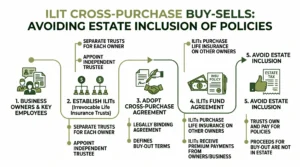
An ILIT has no assets of its own. It needs cash to pay annual insurance premiums. The grantor (the business owner) typically funds the trust each year by making a gift equal to the premium amount. For that gift to qualify for the annual exclusion from gift tax (currently $18,000 per beneficiary in 2026), the beneficiaries must have a present interest in the gift. This means they must have the immediate right to demand the contribution.
Crummey powers solve this. Named after the tax case Crummey v. Commissioner, these are provisions in the trust document that give each beneficiary a limited window, typically 30–60 days after each contribution, to withdraw their share of the contribution. In practice, beneficiaries rarely exercise this right. But their legal right to do so is what qualifies the contribution as a present-interest gift eligible for the annual exclusion.
For a trust with four beneficiaries and an annual premium of $40,000, $10,000 per beneficiary falls within the annual exclusion with Crummey powers. Without Crummey powers, the entire premium would be a taxable gift requiring a Form 709 filing.
Trustee selection is equally critical. The trustee administers the trust, pays premiums, and distributes proceeds upon the insured’s death. The insured should not serve as their own trustee, doing so risks creating incidents of ownership arguments. An independent trustee (a corporate trust company, a trusted advisor, or an adult child not named as a beneficiary) is the standard choice. The trustee must send annual Crummey notices and keep records showing that beneficiaries received notice of their withdrawal rights.
David Hern CPA ABV ASA, founder of Sofer Advisors, brings a Heart of a Teacher to every engagement – translating complex valuation methodology into clear, actionable guidance that clients can act on before and after the report is delivered. With 15+ years of valuation experience, 11+ expert witness cases across multiple jurisdictions, and 180+ five-star Google reviews, David built Sofer Advisors into an Inc. 5000-recognized firm. The Sofer Difference is a four-phase process of Discovery, Diligence, Analysis, and Delivery that ensures every conclusion is defensible, documented, and tied to the specific facts of the business.
While national firms like Stout and Kroll serve large enterprise clients, Sofer Advisors specializes in middle-market businesses that require personalized attention, direct access to credentialed professionals, and a next business day response policy.
When Must the ILIT and Policy Be Updated?
The ILIT is not a set-and-forget structure. Three events trigger mandatory review.
- Business value growth. If the business doubles in value after the ILIT is created, the buy-sell agreement and the policy face value may be inadequate to fund the full buyout. The surviving owners may not have enough proceeds to purchase the deceased’s interest at its actual value. This creates a funding gap and potential disputes. The buy-sell agreement should require that the business be revalued every two to three years. The policy face value should be adjusted accordingly.
- Change in ownership structure. If a third owner joins or an existing owner sells some of their interest, the cross-purchase arrangement and the ILIT structure need review. Cross-purchase plans with many owners (5+) become hard to manage because the number of required policies grows as n(n-1). At some point, the entity-purchase structure becomes more practical.
- Policy performance issues. Universal life policies can develop funding shortfalls if the underlying investment account underperforms projections. Review policy illustrations at least every three years to confirm the policy remains on track.
The business valuation component deserves particular attention. The IRS has challenged buy-sell agreements where the price was not set by an independent appraiser and was not the result of arm’s-length negotiation. Under IRC Section 2703, a buy-sell price is disregarded for estate tax purposes unless the price is comparable to arm’s-length terms. An outdated buy-sell price, not supported by a current certified valuation, creates estate tax exposure that defeats the purpose of the ILIT structure.
What Are the Tax Basis Implications of ILIT Cross-Purchase Structures?
In a cross-purchase arrangement funded through an ILIT, the surviving owners acquire the deceased’s shares at the buy-sell price. That price becomes their basis in the acquired shares. This stepped-up basis reduces future taxable gain on an eventual sale of the business.
This is the primary tax efficiency advantage over entity-purchase redemption. In a redemption, the entity uses its own funds (or entity-owned policy proceeds) to redeem the deceased’s shares. The surviving owners’ ownership percentage increases, but their basis in their original shares stays unchanged. They now own a larger percentage of the business without the benefit of a basis step-up.
For a business that will eventually sell for $15M, the difference between carrying $500,000 in original basis versus $5M in stepped-up basis is about $4.5M in more gain, taxed at capital gains rates. At a 23.8% federal long-term capital gains rate (including net investment income tax), that’s over $1M in more federal tax, before state income tax.
The ILIT cross-purchase structure does require more administrative work. The trust must be properly drafted. Crummey notices must be sent annually. Trustee duties must be fulfilled. The buy-sell agreement must reference the ILIT mechanics. But for business owners in the $5M–$50M value range, the tax efficiency justifies the administrative cost.
The questions below address the most common issues business owners raise before engaging a qualified appraiser for a ilit cross purchase buy engagement.
Frequently Asked Questions
What is an ILIT in a buy-sell agreement?
An ILIT owns the life insurance policies used to fund a cross-purchase buy-sell, so the death benefit is excluded from the insured’s taxable estate.
What is the three-year rule for life insurance and estates?
Under IRC Section 2035, if the insured transfers a policy to an ILIT within three years of death, the proceeds are pulled back into the gross estate.
Why is cross-purchase better than entity purchase for tax purposes?
In a cross-purchase, surviving owners buy shares at the buy-sell price, which becomes their new tax basis, reducing capital gains tax on a future business sale. In a redemption, no step-up occurs.
What are Crummey powers in an ILIT?
Crummey powers give trust beneficiaries the right to withdraw their share of contributions for a limited window each year, qualifying premium contributions as annual-exclusion gifts.
Who should serve as trustee of an ILIT?
The insured owner should not serve as trustee, doing so risks creating incidents of ownership.
How often should the business value be updated in an ILIT buy-sell?
At minimum every two to three years, and right away after any major business event.
What happens if the insurance policy is underfunded?
If the policy face value is lower than the buy-sell price at death, surviving owners must fund the shortfall from personal assets, seller financing, or an earnout.
Can an ILIT be used in a redemption (entity-purchase) buy-sell?
ILITs are most commonly used in cross-purchase structures. Entity-owned policies in redemption arrangements typically don’t raise the same estate inclusion concern.
What documents are required to establish an ILIT for a buy-sell?
Key documents include the ILIT trust agreement, the life insurance policy application listing the trust as owner and beneficiary, the buy-sell agreement referencing the ILIT structure, and an annual Crummey notice process.
How does an ILIT interact with S corporation shareholder restrictions?
S corporations have restrictions on eligible shareholders, trusts must meet specific requirements (ESBT or QSST elections) to hold S corporation stock. If the ILIT is designed to receive S corporation shares as part of a buy-sell, the trust must be structured to qualify as an eligible S corporation shareholder. Otherwise, the structure may inadvertently terminate the S election.
Related Case Studies
- Buy Sell Agreement Valuation Atlanta Complete Guide For Georgia Business Partners
- Estate Planning Business Valuation Georgia Gift Tax Compliance Guide
- Buy Sell Agreement Vs Shareholder Agreement Key Differences
Executive Summary
- An ILIT removes life insurance proceeds from the insured’s taxable estate by having the trust own the policy rather than the individual.
- Cross-purchase arrangements funded through ILITs give surviving owners a stepped-up basis on acquired shares – a significant long-term capital gains advantage over entity-purchase redemptions.
- The buy-sell price must be supported by a current, credentialed business valuation to satisfy IRC Section 2703 and avoid IRS challenge.
What Should You Do Next?
If your buy-sell agreement is funded by life insurance and you haven’t had a certified business valuation in the past two to three years, the gap between your policy face value and actual business value may be significant. The IRS may challenge the price if the buy-sell is triggered. David Hern CPA ABV ASA, founder of Sofer Advisors, holds dual ASA and ABV credentials recognized by the IRS, SEC, and FINRA, with 15+ years of valuation experience and 180+ five-star Google reviews. Schedule a consultation to discuss your business valuation needs.
People Also Read
- Buy Sell Agreement Vs Shareholder Agreement Key Differences
- Buy Sell Agreement Vs Shareholder Agreement Atlanta Guide
About the Author
This guide was prepared by David Hern CPA ABV ASA, founder of Sofer Advisors – a business valuation firm headquartered in Atlanta, GA serving clients across the United States. David holds dual accreditations as an Accredited Senior Appraiser (ASA) and is Accredited in Business Valuation (ABV), credentials recognized by the IRS, SEC, and FINRA. He also holds the Certified Exit Planning Advisor (CEPA) designation. With 15+ years of valuation experience, David has served as an expert witness in 11+ cases across multiple jurisdictions and built Sofer Advisors into an Inc. 5000-recognized firm with 180+ five-star Google reviews. The firm’s full W2 employee team maintains subscriptions to all major valuation databases and operates under a next business day response policy.
For professional business valuation services, visit soferadvisors.com/about-us/ or schedule a consultation at soferadvisors.com/contact-us/.
This content is for informational purposes only and does not constitute professional valuation advice. Business valuation conclusions depend on specific facts and circumstances. Contact Sofer Advisors for guidance regarding your specific situation.









