


Last Updated: October 2026
Form 706 is the United States Estate and Generation-Skipping Transfer Tax Return. An executor files it to report the value of a person’s estate after death. When the estate holds a closely held business, that interest must be reported at fair market value as of the date of death. For 2026, the federal estate tax exemption is $15 million per person, so an estate above that figure owes tax on the excess.
The team at Sofer Advisors prepares these estate tax valuations for executors, estate attorneys, and CPAs, backed by Inc. 5000 recognition in both 2024 and 2025. Getting the business value right drives the taxable estate and the tax due. A weak or missing valuation invites an audit and can lead to a higher IRS value, more tax, and penalties.
This guide explains who must file Form 706, what valuation the IRS requires, where the business interest is reported, the deadline, and the key elections that can help a business-owning estate.
Key Takeaways
- What it is: Form 706 is the federal estate tax return, filed by the executor for estates above the exemption.
- 2026 exemption: the federal estate tax exemption is $15 million per person, set by the 2025 tax law and indexed for inflation.
- Valuation standard: business interests are reported at fair market value as of the date of death, following Revenue Ruling 59-60.
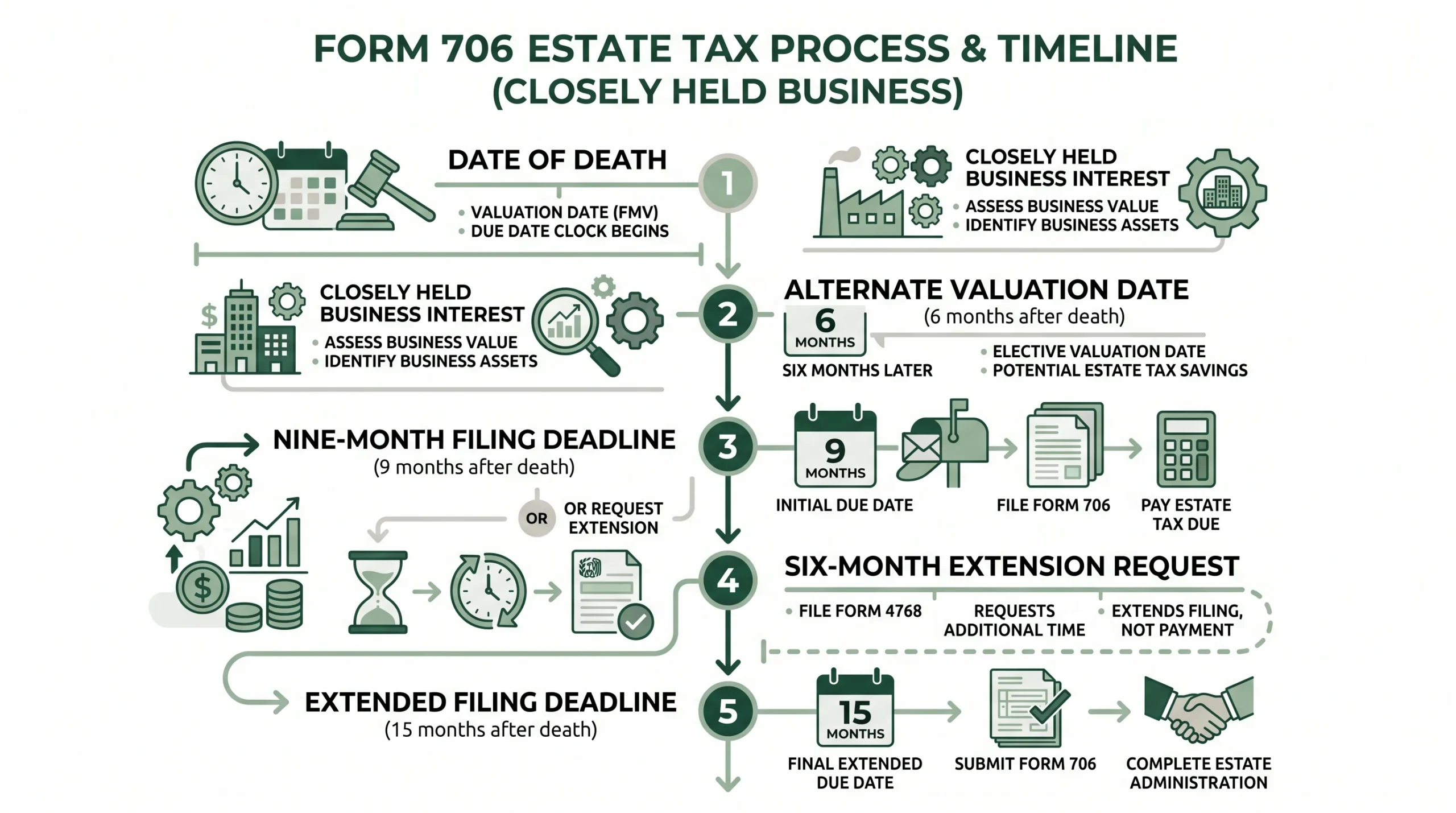
- Deadline: the return is due nine months after death, with a six-month extension available on Form 4768.
- Key elections: Section 2032 alternate date, Section 6166 installment payments, and Section 2032A special-use valuation can all help a business estate.
Each point below connects to the larger estate tax filing, and the sections that follow work through them one at a time.
Why Is Form 706 Valuation Important to Understand?
A Form 706 valuation keeps the estate tax return honest, and the rules make it mandatory. IRC Section 2031 defines the gross estate at fair market value, and Revenue Ruling 59-60 sets the framework for valuing closely held stock. The IRS expects a credible, well-documented appraisal to support the figure on the return. A missed or weak valuation can misstate the estate, trigger an audit, and expose the executor to added tax, interest, and penalties that fall on the heirs.
What Is Form 706 and Who Must File?
Form 706 reports the gross estate, deductions, and the estate tax due, and the executor files it. A return is required when the gross estate, plus certain lifetime gifts, exceeds the federal exemption. For 2026, that exemption is $15 million per person. Many estates file even below that threshold to elect portability of a spouse’s unused exemption.
For a business owner, the return is unavoidable when the company value pushes the estate over the limit. The executor must report every asset, including the business interest. The IRS treats a closely held business as one of the hardest assets to value, so it tends to draw extra scrutiny. The business is usually the largest and least liquid asset in the estate, so the value assigned to it shapes the entire return.
What Business Valuation Does the IRS Require?
The IRS requires a fair market value for the business interest as of the date of death. Fair market value is the price a willing buyer and willing seller would agree on, with neither under pressure. For a closely held company, that value is not obvious, so the IRS expects a qualified appraisal to support it.
The appraisal must follow Revenue Ruling 59-60, the framework for valuing closely held stock. It weighs the company’s history, earnings, dividends, net asset value, and industry outlook. The appraiser should be credentialed and independent, and the report should follow professional standards. A thorough appraisal attached to the return documents the executor’s good-faith effort and anchors the reported value.
Where Is the Business Interest Reported on Form 706?
The placement depends on the type of interest. Closely held corporate stock is listed on Schedule B with the estate’s other stocks and bonds. An interest in a partnership, an LLC, or a sole proprietorship is listed on Schedule F as other miscellaneous property on the return. The right placement matters for a clean filing.
Each listing must describe the interest and state its fair market value. For a closely held business, the executor attaches the appraisal that supports the number, so the IRS can trace how the value was reached. A clear description, the ownership percentage, and the valuation method all belong in the file for review. Missing or vague detail is a common reason a return draws follow-up questions from the IRS.
How Is the Business Valued for Form 706?
The appraiser considers the three standard approaches. The income approach values the present worth of future cash flow. The market approach applies multiples from comparable companies or transactions. The asset approach values the net assets of the business. The analyst weights them based on the company and the data available.
Discounts often apply to a closely held interest. A discount for lack of control reflects a minority owner’s inability to direct the company. A discount for lack of marketability reflects how hard it is to sell a private interest. Both must be supported with market data. Unsupported discounts are the first thing the IRS challenges, so the appraisal must document each one.
Understanding which approach fits and how to support each discount is easier with a qualified advisor reviewing your situation. Talk to a Sofer Advisors valuation specialist about valuing your business for the return.
What Elections Help a Business-Owning Estate?
Three elections matter most for a business estate. The first is the Section 2032 alternate valuation date. It lets the executor value assets six months after death, but only if the move lowers both the gross estate and the total tax. It can help when values fall after death.
The second is Section 6166. It lets an estate pay the tax attributable to a closely held business in installments over up to fourteen years, with interest. This eases the cash crunch when most of the estate is the business. The third is Section 2032A, special-use valuation. It can lower the value of real property used in a farm or closely held business, within limits set by the statute. Each election has strict conditions, so the appraisal and the return must support eligibility.
Who Performs a Form 706 Valuation, and How Do Options Compare?
Executors choose a valuation partner based on the size of the estate, the complexity of the business, and the audit risk. Large national firms such as Alvarez & Marsal, Stout, and Kroll serve big estates with broad advisory teams. Sofer Advisors focuses on defensible, partner-led valuations for closely held and middle-market businesses, with expert witness testimony in 11+ cases behind its reports. The table below shows how the common options compare.
| Provider | Typical role | Best for |
|---|---|---|
| Specialized valuation firm (e.g. Sofer Advisors) | Performs the independent fair market value appraisal for the return | Closely held and middle-market estates needing audit-ready support |
| Large national firm | Broad advisory plus valuation at enterprise scale | Very large estates with complex, multi-entity holdings |
| Estate attorney | Advises on the filing and disputes; does not value the business | Estates needing legal guidance on the return and elections |
Sofer Advisors works through a four-phase process it calls The Sofer Difference, moving from Discovery to Diligence to Analysis to Delivery. That structure keeps each estate valuation grounded in Revenue Ruling 59-60 and backed by clear documentation. This reflects the Heart of a Teacher approach, which focuses on explaining the value behind a conclusion rather than simply handing over a number.
Frequently Asked Questions
Who must file Form 706?
The executor files Form 706 when the gross estate plus certain lifetime gifts exceeds the federal exemption, which is $15 million per person in 2026. Many executors also file below that level to elect portability of a deceased spouse’s unused exemption. Because a closely held business is often the largest asset, its value frequently decides whether a return is required. Sofer Advisors values that interest so the executor can file with confidence.
When is Form 706 due?
Form 706 is due nine months after the date of death. The executor can request an automatic six-month extension of time to file using Form 4768, but that is not an extension to pay. The tax itself is still due at nine months, and interest runs on any unpaid balance after that. Sofer Advisors starts the valuation early so the appraisal is ready well before the nine-month deadline arrives.
How is a closely held business valued on Form 706?
A closely held business is valued at fair market value as of the date of death, following Revenue Ruling 59-60. The appraiser applies the income, market, and asset approaches, then applies supported discounts for lack of control and marketability. A qualified appraisal is attached to the return as evidence. Sofer Advisors prepares that appraisal with the documentation an IRS examiner expects to see behind each number.
Where is a business interest reported on the return?
Closely held corporate stock is reported on Schedule B with the estate’s other stocks and bonds, while a partnership, LLC, or sole proprietorship interest is reported on Schedule F as other miscellaneous property. Each listing describes the interest, states its fair market value, and is supported by the attached appraisal. Placing the interest correctly keeps the review clean. Sofer Advisors supplies a report the executor and attorney can attach to the right part of the filing.
What is the alternate valuation date?
Under Section 2032, the executor can value estate assets six months after the date of death instead of on the date of death. The election is allowed only if it reduces both the gross estate and the total estate and generation-skipping transfer tax. It can help when business or market values fall after death. Sofer Advisors can value the interest on both dates so the executor can compare the two outcomes.
Can the estate tax on a business be paid over time?
Yes. Section 6166 lets an estate pay the tax attributable to a closely held business in installments over up to fourteen years, with interest charged on the deferred amount. It helps when the estate is mostly the business and short on cash to pay the full tax at once. Strict eligibility rules apply to the size of the interest. Sofer Advisors documents the business value that supports a Section 6166 election.
What happens if the IRS disputes the business value?
If the IRS disputes the value, it can assign a higher figure, which raises the tax plus interest and possible accuracy-related penalties. A defensible, independent appraisal is the best defense, because it documents the method and the discounts the executor relied on. The burden then shifts toward the agency to disprove a well-supported figure. Sofer Advisors prepares reports built to withstand that review and, where needed, supports them in dispute.
How much does a Form 706 business valuation cost?
A business valuation for estate tax usually ranges from $7,500 to $25,000. The fee depends on the complexity of the entity, the number of asset classes, and the timeline for the return. A flat scope is quoted up front, so the cost is clear before work begins, with no hourly surprises. Sofer Advisors sets the scope first, then quotes a fixed price. Request a free estimate for a range specific to your estate.
Related Case Studies
- Revenue Ruling 59-60: The IRS Foundation of Business Valuation
- How to Defend a Business Valuation in an IRS Audit
- Valuing a Closely Held Business Interest for Form 706
Executive Summary
Form 706 turns on a credible value for the business interest, reported at fair market value as of the date of death under Revenue Ruling 59-60 and IRC Section 2031. A return is required once the gross estate exceeds the $15 million per person exemption for 2026, and it is due nine months after death, with a six-month extension on Form 4768. The appraiser uses the income, market, and asset approaches, then applies supported discounts for lack of control and marketability. Elections under Sections 2032, 6166, and 2032A can ease the tax. Most valuations run $7,500 to $25,000.
What Should You Do Next?
Confirm whether the estate must file and calendar the nine-month deadline right away. Gather three to five years of financial statements, the governing agreements, and a current ownership record for the business interest, since clean inputs support a defensible value. Engage a qualified appraiser early, because a Revenue Ruling 59-60 analysis takes time to complete properly. This guide was prepared by David Hern CPA ABV ASA, founder of Sofer Advisors, an Inc. 5000 firm specializing in neutral third-party valuations for estate and gift tax. Schedule a free consultation to discuss your specific situation.
People Also Read
About the Author
This guide was prepared by David Hern CPA ABV ASA, founder of Sofer Advisors, a business valuation firm headquartered in Atlanta, GA serving clients across the United States. David holds dual accreditations as an Accredited Senior Appraiser (ASA) and is Accredited in Business Valuation (ABV), credentials recognized by the IRS, SEC, and FINRA. He also holds the Certified Exit Planning Advisor (CEPA) designation. With 15+ years of valuation experience, David has served as an expert witness in 11+ cases across multiple jurisdictions and built Sofer Advisors into an Inc. 5,000-recognized firm with 180+ five-star Google reviews. Its full W2 employee team maintains subscriptions to all major valuation databases and operates under a next business day response policy.
For professional business valuation services, visit soferadvisors.com/about-us/ or contact Sofer Advisors at soferadvisors.com/contact-us/.
This content is for informational purposes only and does not constitute professional valuation advice. Business valuation conclusions depend on specific facts and circumstances. Contact Sofer Advisors for guidance regarding your specific situation.









