


Last Updated: October 2026
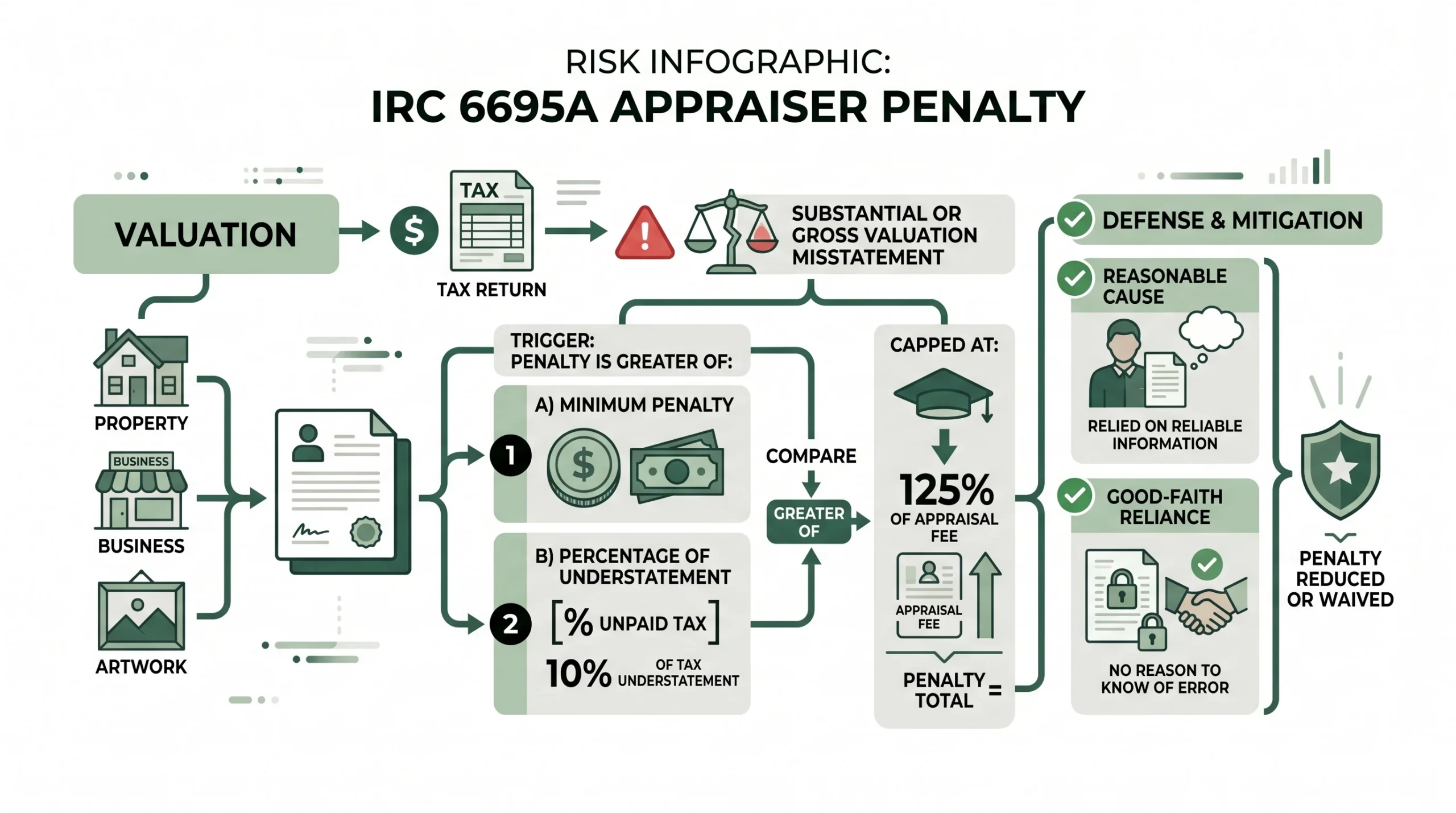
The IRC 6695A appraiser penalty is a civil charge the IRS can assess against the person who prepared a valuation when that appraisal leads to a substantial or gross valuation misstatement on a tax return. It lands on the appraiser, not only the taxpayer. The penalty runs to the greater of $1,000 or 10 percent of the tax the misstatement caused, capped at 125 percent of the fee the appraiser charged.
Appraisals for estate, gift, and income tax filings carry real exposure, so the appraiser’s independence and method matter as much as the final number. The valuation experts at Sofer Advisors prepare tax appraisals for business owners, CPAs, and attorneys, backed by Inc. 5000 recognition in both 2024 and 2025 and 180+ five-star Google reviews. A defensible file is what keeps a value from becoming a penalty.
This guide explains what triggers the penalty, how the IRS calculates it, the defense an appraiser can raise, who is exposed, and how a qualified appraisal lowers the risk.
Key Takeaways
- The appraiser pays: IRC 6695A charges the person who prepared the valuation, so a bad number can cost the appraiser a separate penalty on top of the taxpayer’s.
- A set line triggers it: the penalty applies when the value is a substantial misstatement, 150 percent or more of the correct figure on an income return, or a gross one at 200 percent or more.
- The amount has a fee cap: it is the greater of $1,000 or 10 percent of the underpayment, but never more than 125 percent of the fee the appraiser earned.
- One defense exists: the appraiser must show the value was more likely than not correct, which takes a sound method and a documented file.
- A qualified appraisal lowers risk: a credentialed, independent appraiser who ties each number to market data protects both the taxpayer and the preparer.
The sections below take these one at a time.
Why Does IRC 6695A Put Appraisers at Risk?
IRC 6695A puts appraisers at risk because it makes the valuation professional directly liable for a bad number. Before 2006, the taxpayer absorbed most valuation penalties. Now the person who prepared the appraisal pays a separate penalty when the value is overstated or understated past a set line. The rule reaches anyone paid to value property for a return, so a single report can trigger two penalties at once.
Congress added the rule in the Pension Protection Act of 2006 to curb inflated charitable and estate values. The message to appraisers is plain. A tax appraisal is not a sales pitch, and the preparer cannot hide behind the client who signed the return. The IRS can assess the penalty with no deadline, since the statute carries no limitation period. That is why a careful appraiser documents every assumption and ties each figure to market evidence before the report goes out.
What Triggers the IRC 6695A Penalty?
The penalty triggers when an appraiser prepares a value the person knew, or reasonably should have known, would be used on a return, and that value produces a substantial or gross valuation misstatement. For income tax, a misstatement is substantial when the claimed value is 150 percent or more of the correct value. It turns gross at 200 percent or more. Estate and gift returns use a mirror test on understated values.
The thresholds come from IRC Section 6662, which defines the misstatement levels the penalty borrows. On an estate or gift return, a value is a substantial understatement when it falls to 65 percent or less of the correct figure, and gross at 40 percent or less. The direction flips because estate and gift planning rewards a low value, while an income tax deduction rewards a high one.
How Is the 6695A Penalty Amount Calculated?
The penalty equals the lesser of two amounts. The first is the greater of $1,000 or 10 percent of the tax underpayment the misstatement caused. The second is 125 percent of the gross income the appraiser received for the engagement. The fee cap matters, because it keeps the penalty tied to what the appraiser earned rather than the taxpayer’s whole bill.
Work a quick example under IRC Section 6695A. Say an appraiser charges $5,000 and the misstatement drives a $15,000 underpayment. Ten percent of the underpayment is $1,500, which beats the $1,000 floor. The fee cap is 125 percent of $5,000, or $6,250. The appraiser owes the lesser of the two, so the penalty is $1,500.
What Defense Can an Appraiser Raise?
The statute gives one defense. An appraiser escapes the penalty by showing the value in the report was more likely than not the correct value. That means proving a greater than even chance the figure would hold up, not merely that the work was honest. The defense rests on method and evidence, so a sound process documented at the time of the appraisal is what carries it.
To meet that bar, the appraiser follows recognized standards such as USPAP and the AICPA valuation rules, and keeps a file that links every assumption to market data. Independent judgment is the core of it, which is why independence matters in a valuation. A number shaped by client pressure rather than evidence is the first thing an examiner attacks. A contemporaneous record of the reasoning is the strongest proof the value was reached in good faith.
How Does a Qualified Appraisal Lower the Risk?
A qualified appraisal prepared by a qualified appraiser lowers the risk on both sides of the return. For the taxpayer, it supports the filing position and shows reasonable reliance on a professional. For the appraiser, it supplies the documented method that backs the more likely than not defense. The IRS expects defined education, experience, and credentials behind the signature, not a casual estimate.
A qualified appraiser holds a recognized designation, values the type of property in question regularly, and meets the education and experience tests the IRS sets. Business interests reported on estate, gift, and income returns usually need this level of work, and you can see when a qualified business appraisal is required. Sofer Advisors prepares these reports through its tax and estate reporting valuations so the file reads as credible on the day it is filed and on the day it is examined.
Who Values These Appraisals, and How Do the Options Compare?
Owners and their advisors choose a valuation provider based on the size of the interest, the audit exposure, and the standards the report must meet. Specialized valuation firms focus on defensible, standards-based work for closely held businesses. Large national firms serve big public companies. An estate or tax attorney drafts the return and the plan but does not value the property. The table below sets out the common options.
| Provider | Typical role | Best for |
|---|---|---|
| Specialized valuation firm (e.g. Sofer Advisors) | Prepares a qualified appraisal and documents the value as more likely than not correct | Closely held and middle-market interests reported on tax returns |
| Large national firm | Broad advisory plus valuation at enterprise scale | Large public companies with complex, multi-entity filings |
| Estate or tax attorney | Drafts the return and the structure; does not value the property | Families needing the legal plan built and reviewed |
Large national firms such as Alvarez & Marsal, Stout, and Kroll serve enterprise clients with wide advisory teams. Sofer Advisors focuses on partner-led tax appraisals, with expert witness testimony in 11+ cases behind its reports. Each engagement runs through a four-phase process it calls The Sofer Difference, moving from Discovery to Diligence to Analysis to Delivery. That structure reflects a Heart of a Teacher approach, which means explaining the reasoning behind a number so the owner and the IRS can both follow it.
Frequently Asked Questions
What triggers the IRC 6695A appraiser penalty?
The penalty triggers when an appraiser prepares a value the person knew, or should have known, would be used on a tax return, and that value causes a substantial or gross valuation misstatement. For income tax, substantial means 150 percent or more of the correct value, and gross means 200 percent or more. Estate and gift returns use the opposite test on understated values. Sofer Advisors keeps each reported value inside a documented, evidence-based range.
How much is the IRC 6695A penalty?
The penalty is the lesser of two figures. The first is the greater of $1,000 or 10 percent of the tax underpayment the misstatement caused. The second is 125 percent of the gross income the appraiser earned on the engagement. The fee cap keeps the charge tied to what the appraiser was paid. Sofer Advisors scopes each tax appraisal so the fee, the method, and the record all line up before filing.
What is a substantial valuation misstatement under IRC 6695A?
On an income tax return, a substantial valuation misstatement happens when the claimed value is 150 percent or more of the amount later found correct. On an estate or gift return, it happens when the value falls to 65 percent or less of the correct figure. The two tests point in opposite directions because deductions reward high values and transfers reward low ones. Sofer Advisors documents the basis for every number to keep it inside the line.
What is a gross valuation misstatement?
A gross valuation misstatement is the more serious tier. For income tax, it applies when the claimed value reaches 200 percent or more of the correct value. For estate and gift tax, it applies when the value drops to 40 percent or less of the correct figure. A gross error raises both the appraiser penalty and the taxpayer’s own accuracy penalty. Sofer Advisors builds reports that hold their value under close IRS review.
Who counts as an appraiser under IRC 6695A?
The rule reaches any person who prepares a valuation for pay and knew, or reasonably should have known, the report would support a tax return or refund claim. It is not limited to those with a state license or a formal title. Business valuation experts, financial analysts, and other specialists all fall inside it. Sofer Advisors treats every tax engagement as subject to the rule, so each report meets the documentation the standard demands.
What defense can an appraiser raise against the penalty?
The statute offers one defense. The appraiser must show the value in the report was more likely than not the correct value, meaning a better than even chance it would hold up. Honest effort alone is not enough, since the test looks at method and evidence. A file built on recognized standards and tied to market data carries it. Sofer Advisors documents each assumption as the work is done, not after a notice arrives.
Does IRC 6695A apply to estate and gift tax appraisals?
Yes. The penalty applies to appraisals used on estate and gift returns when the value leads to a substantial or gross understatement. The IRS watches these filings closely, because closely held and non-marketable interests leave wide room for dispute. A thin value invites both a penalty and an audit of the whole plan. Sofer Advisors prepares estate and gift appraisals that meet the qualified appraisal standard and support the reported value in full.
How can I avoid the IRC 6695A penalty?
Hire a qualified appraiser, give complete and accurate records, and let the professional reach an independent value without pressure. The report should state its method, cite its data, and explain each discount so the file supports a more likely than not position. Avoid any appraiser who promises a number before the analysis. Sofer Advisors follows recognized standards and keeps a contemporaneous record, which is the practical way to keep a value out of penalty range.
How much does a qualified tax appraisal from Sofer Advisors cost?
Most qualified business appraisals for tax reporting run from $7,500 to $25,000 and take about four to eight weeks, depending on the interest, the entity, and the deadline. The range covers the research and documentation that support the value and the more likely than not defense. A flat fee is set up front, so the cost is clear before work starts. Request a fee estimate through the Sofer Advisors contact page for your situation.
Related Case Studies
- Qualified Appraiser IRS Requirements: A Guide to Section 170 and 6695A
- How to Defend a Business Valuation in an IRS Audit
- Tax Court Valuation Challenges: 5 Lessons From Recent Cases
Executive Summary
IRC 6695A lets the IRS penalize the appraiser, not just the taxpayer, when a tax appraisal produces a substantial or gross valuation misstatement. Substantial means a claimed value of 150 percent or more of the correct figure on an income return, or 65 percent or less on an estate or gift return. Gross sits at 200 percent or 40 percent. The penalty is the greater of $1,000 or 10 percent of the underpayment, capped at 125 percent of the fee. The one defense is proof that the value was more likely than not correct, which a qualified appraisal and a documented method supply. The practical protection is a credentialed, independent appraiser and a file that ties every number to evidence.
What Should You Do Next?
Review any tax appraisal in your file for a clear method, cited data, and an independent conclusion, since those are what support a more likely than not position. If a report looks thin or was prepared under pressure, have an independent expert run a second-look review before the return is filed. This guide was prepared by David Hern CPA ABV ASA, founder of Sofer Advisors, an Inc. 5000 firm specializing in neutral third-party valuations for tax and estate reporting. Schedule a free consultation through the Sofer Advisors contact page to discuss your specific situation.
People Also Read
- USPAP Compliance: What Makes a Valuation Court-Defensible
- Valuation Discounts (DLOC and DLOM) on Estate and Gift Tax Returns
About the Author
This guide was prepared by David Hern CPA ABV ASA, founder of Sofer Advisors, a business valuation firm headquartered in Atlanta, GA serving clients across the United States. David holds dual accreditations as an Accredited Senior Appraiser (ASA) and is Accredited in Business Valuation (ABV), credentials recognized by the IRS, SEC, and FINRA. He also holds the Certified Exit Planning Advisor (CEPA) designation. With 15+ years of valuation experience, David has served as an expert witness in 11+ cases across multiple jurisdictions and built Sofer Advisors into an Inc. 5,000-recognized firm with 180+ five-star Google reviews. Its full W2 employee team maintains subscriptions to all major valuation databases and operates under a next business day response policy.
For professional business valuation services, visit soferadvisors.com/about-us/ or contact Sofer Advisors at soferadvisors.com/contact-us/.
This content is for informational purposes only and does not constitute professional valuation advice. Business valuation conclusions depend on specific facts and circumstances. Contact Sofer Advisors for guidance regarding your specific situation.









