


Last Updated: October 2026
An inventory step-up to fair value is the adjustment that records an acquired company’s inventory at its acquisition-date fair value instead of the seller’s historical cost. ASC 805, the accounting rule for business combinations, requires it for every deal. The step-up often adds real value to the opening balance sheet, and because inventory usually sells within one turnover cycle, the markup can flow through earnings in the first few quarters after closing.
That short runway is why the number matters. The team at Sofer Advisors, an Inc. 5000 firm in both 2024 and 2025, measures acquired inventory for buyers, CFOs, and their auditors. Price the step-up too high and post-deal margins look worse than the business really performs. Price it too low and the opening balance sheet misstates both inventory and goodwill.
This guide explains how finished goods, work-in-process, and raw materials are each measured, why the step-up drags on gross margin, and how the tax result can differ from the book result.
Key Takeaways
- Fair value, not cost: ASC 805 records acquired inventory at acquisition-date fair value, which replaces the seller’s historical cost on the opening balance sheet.
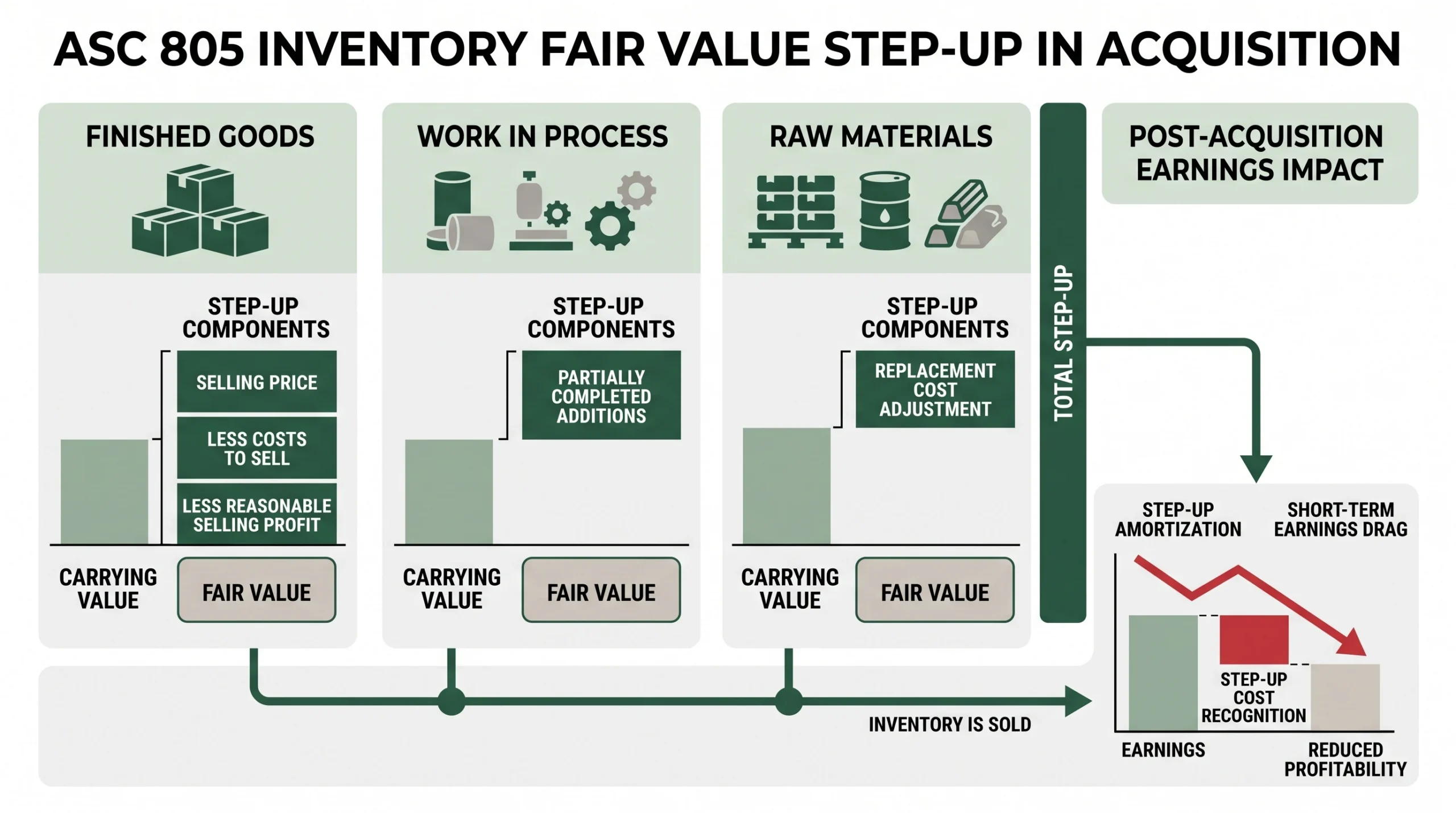
- Each class has its own method: finished goods use selling price less selling costs and profit, work-in-process adds completion costs, and raw materials use replacement cost.
- Margins dip after the deal: the step-up flows into cost of goods sold as the inventory sells, so early gross margin looks weaker than the business really is.
- The effect is temporary: once the stepped-up stock clears and normal-cost inventory replaces it, reported margin returns to its true level.
- Tax can differ from book: a tax basis step-up depends on deal structure and may need a Section 338 election, so the book and tax results can diverge.
Each takeaway connects to the wider purchase price allocation. The sections below work through them one at a time.
Why Does an Inventory Step-Up Matter in an Acquisition?
An inventory step-up matters because ASC 805 makes it mandatory, and the adjustment lands directly in early post-deal earnings. The buyer records acquired inventory at fair value, not the seller’s cost. When that inventory sells, the higher value becomes cost of goods sold. So the first quarters after a deal can show a gross margin that looks weak, even when the underlying business is healthy.
This is part of the purchase price allocation, the process of spreading the purchase price across the assets acquired. Inventory is one line in that allocation. Get it wrong and the error moves into goodwill, since goodwill is the residual left after every other asset is valued. A clean inventory number keeps both figures honest. It also gives management a clear story to tell lenders and boards. You can see how the pieces fit in our guide to purchase price allocation under ASC 805.
How Is Acquired Finished Goods Inventory Valued?
Finished goods are valued at their estimated selling price, less the costs still needed to sell them and a reasonable profit on that selling effort. The logic is simple. The buyer did no work to make these goods, so it should not claim the full production profit as its own. It keeps only the margin tied to selling and distributing what it bought. Appraisers call this the comparative sales, or top-down, method.
Start with the price a market participant would pay for the finished units. Subtract the remaining selling costs, such as freight, commissions, and warehousing. Then subtract a normal profit for the selling and distribution work the buyer still has to do. What is left is the fair value. Note that the seller’s costing method does not change the answer. Whether the records used FIFO, LIFO, or average cost, fair value starts from selling price, not from recorded cost.
How Are Work-in-Process and Raw Materials Measured?
Work-in-process uses the same selling-price starting point as finished goods, with two extra subtractions. The buyer deducts the costs to complete the units, the costs to sell them, and a profit on both the completion and the selling effort. Raw materials are different. They are usually measured at replacement cost, the price a market participant would pay to buy the same materials today.
The split follows how much work remains. Raw materials sit at the start of the line, so little value has been added, and replacement cost is a fair proxy. Work-in-process sits in the middle, so it carries part of the completion profit but not all of it. Finished goods sit at the end and carry the full selling margin deduction. Appraisers value finished goods and work-in-process from the top down, and raw materials from the bottom up. Our guide to the ASC 820 fair value hierarchy explains the market participant lens these measures rely on.
How Does the Step-Up Drag Down Post-Deal Gross Margin?
The drag happens because the stepped-up value flows into cost of goods sold as the acquired inventory sells. Fair value sits above the old cost, so each unit sold carries a higher charge than it would have before the deal. Reported gross margin falls for as long as that inventory is on the shelves. Once it clears and normal-cost stock replaces it, margin returns to its true level.
The size of the dip depends on two things: how large the step-up is and how fast inventory turns. A business that turns inventory in 60 days clears the markup quickly, so the hit is sharp and brief. A year of stock spreads a smaller hit over several quarters. Management that explains it up front keeps analysts from reading a one-time accounting effect as an operating problem. It also matters for valuation, since a forecast built on the depressed margin would understate the business.
A defensible inventory step-up starts with the right data and an independent eye. The team at Sofer Advisors builds purchase price allocation and financial reporting valuations that hold up when auditors test the margin story.
What Is the Tax Side of an Inventory Step-Up?
The tax result does not always match the book result. For financial reporting, ASC 805 steps up inventory in every acquisition. For tax, a step-up in basis depends on deal structure. An asset purchase gives the buyer a stepped-up tax basis in the inventory. A plain stock purchase usually does not, so the book step-up and the tax basis can diverge.
Parties can bridge that gap with an election. A Section 338 election lets a qualifying stock purchase be treated as an asset purchase for tax, which can deliver the higher basis. Because inventory usually sells fast, a tax step-up turns into a deduction quickly, lowering the taxable gain on the sale of those goods. The allocation rules in Section 1060 govern how the price is spread across assets in an applicable asset acquisition. The book and tax teams should work from the same valuation so the two records reconcile.
Who Values Acquired Inventory, and How Do the Options Compare?
Buyers choose a valuation partner based on deal size, audit exposure, and how specialized the inventory is. Large national firms such as Alvarez & Marsal, Stout, and Kroll serve big public filers with broad teams. Specialized firms focus on defensible, partner-led work for middle-market deals. Generalist appraisers sometimes default to replacement cost for every class, which is wrong for finished goods and can trigger audit questions.
| Provider | Typical role | Best for |
|---|---|---|
| Specialized valuation firm (e.g. Sofer Advisors) | Measures each inventory class under ASC 805 and documents the step-up as audit-ready support | Middle-market buyers who need a defensible margin story |
| Large national firm | Broad transaction advisory plus valuation at enterprise scale | Large public filers with complex, multi-entity deals |
| Generalist appraiser | Often applies a single method, such as replacement cost, to every class | Simple asset lists where finished goods are not material |
Sofer Advisors runs each engagement through a four-step process it calls The Sofer Difference, moving from Discovery to Diligence to Analysis to Delivery. That order keeps every inventory value tied to the facts and the market data behind it. It reflects a Heart of a Teacher approach, which means explaining why a number moves rather than just handing over a figure. With expert witness testimony in 11+ cases and 180+ five-star Google reviews, the team builds reports that a buyer can defend to auditors and to the board.
Frequently Asked Questions
What is an inventory step-up in an acquisition?
An inventory step-up is the increase from an acquired company’s book cost to the fair value recorded on the buyer’s opening balance sheet. ASC 805 requires it for every business combination, so the inventory reflects what a market participant would pay at the deal date, not old historical cost. Sofer Advisors measures each inventory class and documents the step-up so the opening balance sheet survives an audit.
How is acquired finished goods inventory valued under ASC 805?
Finished goods are measured at their estimated selling price, less the costs still needed to sell them and a reasonable profit on that selling effort. The buyer did not make the goods, so it keeps only the margin tied to selling them, not the full production profit. The seller’s FIFO or LIFO method does not change the result. Sofer Advisors documents each deduction so the fair value holds up under review.
How are work-in-process and raw materials valued in an acquisition?
Work-in-process starts from the finished selling price, then subtracts the costs to complete the units, the costs to sell them, and a profit on both efforts. Raw materials are different. They are usually recorded at replacement cost, the price to buy the same materials today. Little value has been added yet, so replacement cost is a fair proxy. Sofer Advisors values each class on the right basis and reconciles the total.
Why does an inventory step-up lower gross margin after a deal?
Gross margin falls because the stepped-up value flows into cost of goods sold as the acquired inventory sells. Fair value sits above the old cost, so each unit sold carries a higher charge than before the deal. The effect lasts until that inventory clears and normal-cost stock replaces it. It is temporary, not an operating decline. Sofer Advisors models the timing so management can explain the dip to lenders and the board.
Is an inventory step-up required for every business combination?
Yes. ASC 805 requires acquired inventory to be recorded at fair value in every business combination where the buyer gains control. The size of the deal and the reporting framework do not remove the requirement. A step-up or a step-down can result, depending on the facts. Sofer Advisors documents the measurement for each inventory class so the purchase price allocation satisfies the auditors who review the opening balance sheet.
Can acquired inventory be stepped down instead of up?
Yes. A step-down happens when the acquired inventory’s book cost is higher than its fair value, which is common with obsolete or slow-moving goods. The buyer records the lower fair value so the opening balance sheet is not overstated. The same selling-price and replacement-cost methods apply to find that value. Sofer Advisors flags these cases early so the team does not carry stale inventory at an inflated amount into the new records.
Does an inventory step-up change the buyer’s tax basis?
Not by itself. The book step-up under ASC 805 always happens, but the tax basis depends on structure. An asset purchase gives the buyer a higher tax basis in the inventory. A plain stock purchase usually does not, unless the parties make a Section 338 election to treat the stock deal as an asset deal for tax. Sofer Advisors supplies one valuation that both the book and tax teams can use.
How long does the margin impact of an inventory step-up last?
It lasts as long as the acquired inventory stays on the shelves, which ties to the turnover cycle. A business that turns inventory every 60 days clears the markup fast, so the margin hit is sharp and short. A year of stock spreads a smaller hit over more quarters. Once the stepped-up goods sell, the dip ends. Sofer Advisors analyzes turnover rates so owners can forecast when the impact rolls off.
How much does an inventory step-up valuation cost?
Most inventory step-up work is part of a purchase price allocation, which runs from $15,000 to $50,000 and takes about six to twelve weeks, depending on the supply chain and the number of locations. The range covers the market data and the margin support auditors expect. Sofer Advisors scopes the engagement first, then quotes a flat fee. Request a free estimate for your situation.
Related Case Studies
- Deferred Revenue Fair Value in an Acquisition
- Calculating Goodwill in an Acquisition: Formula Explained
- Cost Approach Valuation: When Replacement Cost Applies
Executive Summary
An inventory step-up records acquired inventory at fair value under ASC 805, replacing the seller’s historical cost. Finished goods are valued at selling price less selling costs and a reasonable selling profit. Work-in-process adds the costs to complete and a completion profit, while raw materials sit at replacement cost. As the stepped-up inventory sells, the markup flows into cost of goods sold, so gross margin dips for one turnover cycle, then recovers. For tax, a basis step-up depends on deal structure and may need a Section 338 election, so the book and tax records can differ on a purchase price allocation that typically runs $15,000 to $50,000.
What Should You Do Next?
Start by pulling the target’s inventory records: aging reports, recent cost of goods sold, and the standard cost build for each product line. Confirm your inventory turnover so you can model how long the margin dip will run. Then line those numbers up against the ASC 805 fair value rules before the audit begins. This guide was prepared by David Hern CPA ABV ASA, founder of Sofer Advisors, an Inc. 5000 firm that provides independent financial reporting valuations. Schedule a free consultation at the Sofer Advisors contact page to discuss your specific situation.
People Also Read
- What Is PPA in Accounting? Purchase Price Allocation Explained
- Valuing Developed Technology in an Acquisition
About the Author
This guide was prepared by David Hern CPA ABV ASA, founder of Sofer Advisors, a business valuation firm headquartered in Atlanta, GA serving clients across the United States. David holds dual accreditations as an Accredited Senior Appraiser (ASA) and is Accredited in Business Valuation (ABV), credentials recognized by the IRS, SEC, and FINRA. He also holds the Certified Exit Planning Advisor (CEPA) designation. With 15+ years of valuation experience, David has served as an expert witness in 11+ cases across multiple jurisdictions and built Sofer Advisors into an Inc. 5,000-recognized firm with 180+ five-star Google reviews. Its full W2 employee team maintains subscriptions to all major valuation databases and operates under a next business day response policy.
For professional business valuation services, visit soferadvisors.com/about-us/ or contact Sofer Advisors at soferadvisors.com/contact-us/.
This content is for informational purposes only and does not constitute professional valuation advice. Business valuation conclusions depend on specific facts and circumstances. Contact Sofer Advisors for guidance regarding your specific situation.









