


Last Updated: October 2026
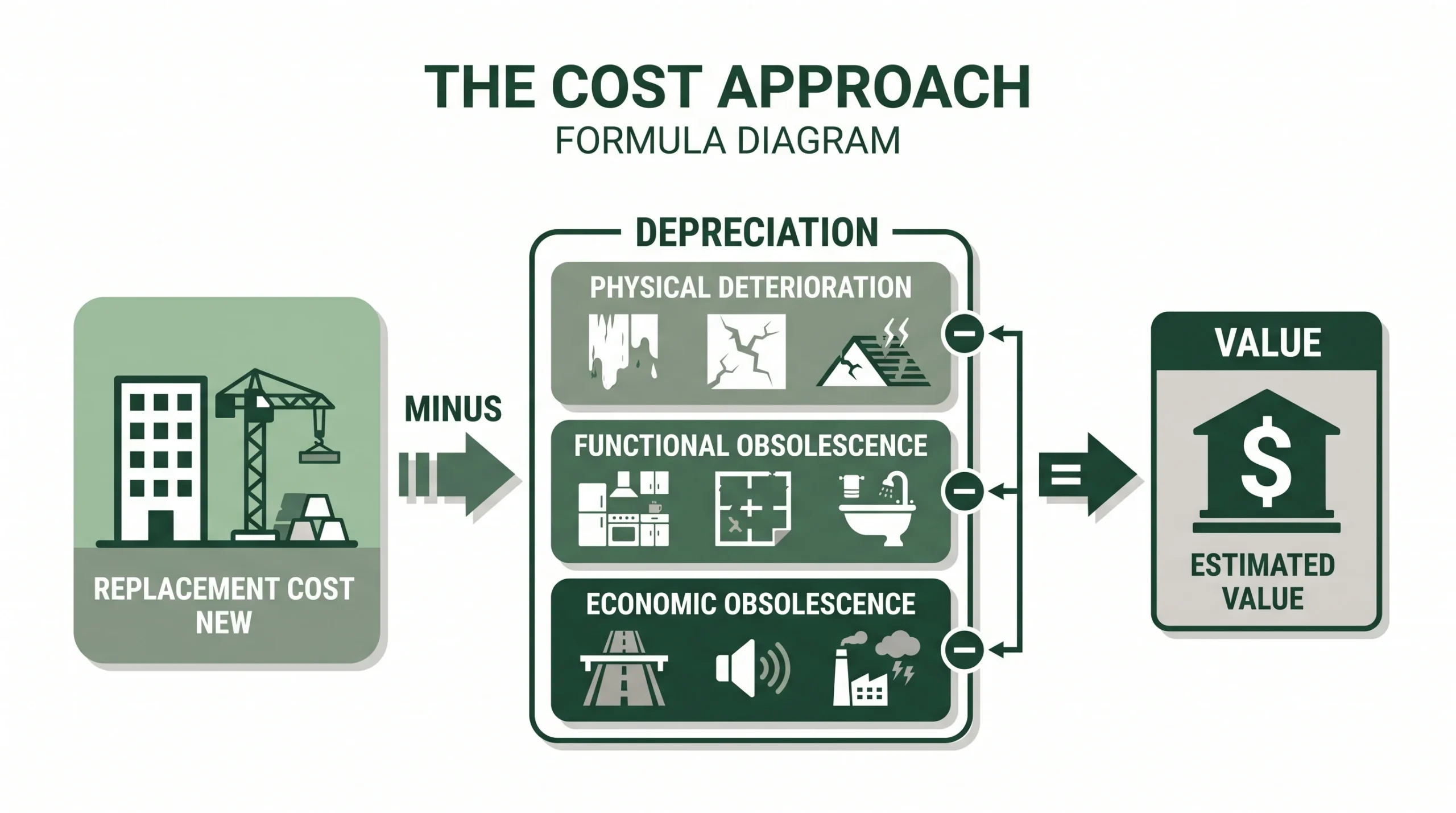
A cost approach valuation estimates value by asking what it would cost to replace an asset with an equivalent one. It rests on the principle of substitution: a buyer will not pay more for an asset than the cost of a comparable substitute. The analyst finds the current cost to replace the asset, then subtracts an allowance for wear and obsolescence. The core formula is simple, since value equals replacement cost new minus three forms of depreciation.
The team at Sofer Advisors prepares cost approach valuations for owners, lenders, and auditors, backed by Inc. 5000 recognition in both 2024 and 2025. This method fits businesses where tangible assets drive most of the value, such as manufacturers and property holding companies. It gives a logical, grounded floor for buyouts, asset sales, and lending decisions.
This guide explains the core principle, how replacement cost new is found, the forms of depreciation that reduce it, and when the cost approach is the right tool. It also covers the method’s limitations and its role in a purchase price allocation.
Key Takeaways
- Substitution: a buyer will not pay more than the cost to build or acquire an equivalent asset.
- Core formula: value equals replacement cost new minus physical, functional, and economic depreciation.
- Best fit: asset-heavy firms such as manufacturers and real estate holding companies; weak for service and technology firms.
- Blind spot: the method usually misses goodwill and future earning power.
- Cross-check: most analysts use it alongside the market and income approaches, not alone.
Each point below builds on the one before it, from the governing principle to the records the analysis needs. The sections that follow examine each in detail.
Why Is the Cost Approach Important to Understand?
The cost approach decides the floor value in many engagements, and the standards shape how it is applied. USPAP governs how an appraiser develops and reports a cost-based conclusion, keeping the analysis objective and documented. In a purchase price allocation under ASC 805, the cost approach values assets with no clear income stream, such as an assembled workforce. For a tax-driven valuation, the IRS expects the method to align with Revenue Ruling 59-60 when it supports a closely held interest. A weak cost analysis can understate or overstate the asset base and undermine the whole report.
What Is the Core Principle of the Cost Approach?
The core principle is substitution. A prudent buyer will not pay more for an asset than the cost to build or buy a duplicate of equal utility. That sets a logical ceiling on value for tangible assets. The method works in two steps. First, the analyst finds the replacement cost new, the current cost to build an asset of equal utility. Second, the analyst subtracts all forms of accrued depreciation. The result is a transparent, cost-based view of the asset’s current worth. It reflects both what it would cost today and how much value it has lost.
How Is Replacement Cost New Calculated?
Replacement cost new is the current cost to build or acquire an asset of the same utility, using modern materials and methods. It differs from reproduction cost, which recreates an exact physical replica with the original design. Analysts build the figure from real cost data. They use direct quotes from manufacturers, engineering specifications, and published cost-estimating manuals for equipment and construction. Comparing the current market price for similar items gives a reliable baseline. The key judgment is whether to price an exact copy or a functional substitute. For most business assets, the functional substitute is the right basis.
What Forms of Depreciation Are Subtracted?
Three forms of depreciation come out of the replacement cost new. The first is physical deterioration, the loss from wear and age, such as a roof near the end of its life. The second is functional obsolescence, the loss from an outdated design or technology, such as an inefficient layout that raises labor costs. The third is economic obsolescence, the loss from external factors, such as a new zoning law that limits allowed uses. Physical deterioration is the easiest to measure, since it tracks observable condition. The other two need more judgment, and the analyst must support each deduction with evidence, since these estimates drive the final number.
How Does the Cost Approach Compare to Other Methods?
The cost approach is one of three main methods, and its fit depends on the asset type and the purpose of the valuation. It values the physical parts of a business, while the income and market approaches value the business as a whole. Most analysts use the methods together to reach a defensible conclusion. The table below contrasts the three.
| Approach | Basis of value | Best for |
|---|---|---|
| Cost | Cost to replace assets, less depreciation | Asset-heavy firms, insurance, property tax, liquidation |
| Market | Prices of comparable companies or assets | M&A, common stock, industries with many comparables |
| Income | Present value of expected future cash flow | Profitable firms with predictable earnings |
Firms choose a valuation partner based on the asset base and the audit stakes. Larger national firms such as Alvarez & Marsal, Stout, and Kroll serve big public companies with broad advisory teams. Sofer Advisors focuses on defensible, partner-led valuations for closely held and middle-market businesses, with expert witness testimony in 11+ cases behind its reports. It works through a four-phase process it calls The Sofer Difference, moving from Discovery to Diligence to Analysis to Delivery. That structure reflects the Heart of a Teacher approach, explaining how each deduction was reached so a lender or auditor can follow it.
Choosing and weighting the right approaches is where an experienced appraiser earns their keep. Talk to a Sofer Advisors valuation specialist about the method that fits your assets.
What Are the Main Limitations of This Method?
The biggest limitation is intangible value. The cost approach centers on physical assets, so it often misses brand reputation, customer lists, and goodwill, which drive earnings for a profitable company. Relying only on physical assets can badly understate true enterprise value. The method is also poorly suited to service firms with few tangible assets. Its depreciation estimates are partly subjective too, so two analysts can reach different conclusions on functional or economic obsolescence. That is why the cost approach is usually a cross-check, not the sole method. Used alongside the income and market approaches, it anchors the floor while they capture the upside from earnings.
How Does the Cost Approach Fit a Purchase Price Allocation?
The cost approach plays a specific role in a purchase price allocation under ASC 805. After an acquisition, the buyer must assign the price across the assets acquired, and tangible assets and certain intangibles are often valued with a cost method. An assembled workforce, for example, is commonly valued at the cost to hire and train a replacement team. Identifiable intangibles with a cash flow, such as customer relationships, use income methods instead. Goodwill is the residual after everything else is valued. So the cost approach sets the value of the assets that have no clear income stream of their own, which keeps the whole allocation defensible.
Frequently Asked Questions
What are the cost valuation approaches?
The two methods within the cost approach are reproduction cost and replacement cost. Reproduction cost estimates the price to build an exact replica, using the original design and materials. Replacement cost estimates the price to build an asset of equal utility with modern materials and current methods. Both then subtract physical, functional, and economic depreciation to reach a final value. Sofer Advisors selects the method that fits the asset and documents each deduction so the conclusion holds up.
What is a disadvantage of the cost approach?
Its main weakness is ignoring intangible assets like brand value, customer relationships, and goodwill. Because it focuses on physical property, it can miss the going-concern value that makes a profitable business worth more than its parts. That gap can badly undervalue a service-oriented or technology company. The method’s depreciation estimates are partly subjective, so two analysts can reach different conclusions. Sofer Advisors pairs the cost approach with the income and market approaches, which captures the earning power it leaves out.
Does Fannie Mae require a cost approach?
Fannie Mae generally requires it for certain property types, such as new construction or unique homes, where comparable sales data is thin. The goal is a second, independent measure of value when the market approach alone is not reliable. The broader lesson, using more than one method, applies to business appraisals just as much as to real estate. Sofer Advisors follows that principle, weighting the cost, income, and market approaches so the final value rests on more than one foundation.
What are the three main approaches to valuation?
They are the income, market, and cost approaches. The income approach values the present worth of future earnings, often through a discounted cash flow model. The market approach compares the business to similar companies that have sold or trade publicly. The cost approach estimates the cost to recreate the tangible assets, less depreciation. Used together, they give a complete view of value, since each captures something the others miss. Sofer Advisors weights all three to reach a defensible conclusion.
How is the cost approach used for intangible assets?
It is rarely the primary method for intangibles, since it struggles to quantify goodwill or future earning power. It can value software or proprietary technology by estimating the cost to recreate the development work. An assembled workforce is another case, valued at the cost to hire and train a replacement team. Even then, the result is limited, so income methods usually lead for intangibles with a cash flow. Sofer Advisors matches each intangible to the method that values it best.
Is the cost approach used in business valuation or just real estate?
Both. In business valuation, it values machinery, facilities, and equipment for asset-heavy firms such as manufacturers and holding companies. In real estate, it benchmarks the land and structure value when comparable sales are scarce. The application differs, but the principle of substitution, that a buyer will not pay more than the cost of an equivalent, is the foundation in each case. Sofer Advisors uses the cost approach across both settings, always as part of a broader, cross-checked analysis.
What is the difference between reproduction cost and replacement cost?
Reproduction cost is the price to create an exact duplicate, with the original design and materials. Replacement cost is the price to acquire an asset of equal utility, often with modern and more efficient methods. Replacement cost fits most functional business assets, since a buyer cares about utility rather than an exact copy. Reproduction cost fits historical or specialized property where the exact design matters. Sofer Advisors chooses the right basis for each asset and documents the choice.
How much does a cost approach valuation cost?
A standard business valuation ranges from $7,500 to $25,000. The fee depends on the number and complexity of the assets and the time the analysis requires. A flat scope is quoted up front, so the cost is clear before any work begins, with no hourly surprises. For an asset-heavy company with many locations, the engagement sits toward the upper end. Sofer Advisors sets the scope first, then quotes a fixed price. Request a free estimate for your asset base.
Related Case Studies
- Control Premium in Business Valuation: When It Applies
- When the Cost Approach Wins: Valuing Asset-Heavy Businesses
- Cost Approach vs Income Approach: Complete Guide
Executive Summary
The cost approach estimates value as replacement cost new minus physical, functional, and economic depreciation, grounded in the principle of substitution. It fits asset-heavy businesses such as manufacturers and real estate holding companies, and it supports insurance, property tax, and purchase price allocation work under ASC 805. Its blind spot is intangible value, so it usually serves as a cross-check alongside the income and market approaches, the three recognized methods. Depreciation estimates follow USPAP and must each be documented. Most cost approach valuations run $7,500 to $25,000. The first step is to assemble a fixed asset register with the age and condition of every major asset.
What Should You Do Next?
Match the method to your company’s profile and the purpose of the report, since a single approach often misses part of the value. Document your physical assets in a fixed asset register, confirm the method satisfies any IRS or regulator requirement, and decide how to weight the cost, market, and income approaches. This guide was prepared by David Hern CPA ABV ASA, founder of Sofer Advisors, an Inc. 5000 firm specializing in neutral third-party business valuations. Schedule a free consultation to discuss your specific situation.
People Also Read
About the Author
This guide was prepared by David Hern CPA ABV ASA, founder of Sofer Advisors, a business valuation firm headquartered in Atlanta, GA serving clients across the United States. David holds dual accreditations as an Accredited Senior Appraiser (ASA) and is Accredited in Business Valuation (ABV), credentials recognized by the IRS, SEC, and FINRA. He also holds the Certified Exit Planning Advisor (CEPA) designation. With 15+ years of valuation experience, David has served as an expert witness in 11+ cases across multiple jurisdictions and built Sofer Advisors into an Inc. 5,000-recognized firm with 180+ five-star Google reviews. Its full W2 employee team maintains subscriptions to all major valuation databases and operates under a next business day response policy.
For professional business valuation services, visit soferadvisors.com/about-us/ or contact Sofer Advisors at soferadvisors.com/contact-us/.
This content is for informational purposes only and does not constitute professional valuation advice. Business valuation conclusions depend on specific facts and circumstances. Contact Sofer Advisors for guidance regarding your specific situation.









