


Last Updated: October 2026
The deferred revenue haircut erases revenue the buyer will never report, and it surprises almost every first forecast. When one company buys another, the target’s deferred revenue is cut to its fair value under ASC 805. Deferred revenue is cash a customer paid up front for work not yet done. The seller booked the full amount. The buyer may carry only what the remaining work is worth. The gap vanishes from the income statement.
Sofer Advisors values deferred revenue and other acquired items for CFOs, controllers, and their auditors, backed by Inc. 5000 recognition in both 2024 and 2025 and 180+ five-star Google reviews. This one number drives the opening balance sheet and the first year of reported results. Price it wrong and the post-deal revenue line looks broken. Price it well and the statements tell the real story.
This guide explains what deferred revenue is, how ASC 805 treats it, and how its fair value is built. It covers the haircut, the tax interplay, the hit to post-deal statements, IFRS 3, and how ASU 2021-08 changed the rule for revenue contracts.
Key Takeaways
- What the haircut is: it is the write-down from a target’s recorded deferred revenue to its fair value on the acquisition date.
- Fair value is a cost build-up: the liability is measured as the cost to finish the remaining work plus a normal profit margin, not the price the customer paid.
- Revenue drops after closing: the buyer reports only the fair value, so the first post-deal year shows less revenue even though cash has not changed.
- ASU 2021-08 shifted the rule: for ASC 606 contracts the buyer now carries the balance over rather than remeasuring it, which shrinks but does not erase the adjustment.
- It is a book item, not tax: the haircut is non-cash and does not change the target’s tax return or the cash a customer already paid.
Each piece ties back to the opening balance sheet. The sections below take them one at a time.
Why Is the Deferred Revenue Haircut Important to Understand?
The haircut decides how much revenue a buyer can report after a deal. Owners, buyers, and finance teams build forecasts off the target’s past revenue. The haircut lowers that figure for accounting, so the first-year statements show less revenue than the business earned in cash. Miss it, and a board sees a revenue drop that looks like decline. Model it early, and the forecast matches the accounting. The number also feeds earnouts, covenants, and goodwill, so a careful measurement protects the whole deal.
What Is Deferred Revenue and How Does ASC 805 Treat It in an Acquisition?
Deferred revenue, also called unearned revenue or a contract liability, is money collected before the work is done. A software company that bills a year of access up front books most of it as deferred revenue. It is a liability because the company still owes the service. As the work is delivered, the balance moves into earned revenue.
ASC 805 governs business combinations. It requires the buyer to record every acquired asset and liability at fair value on the closing date. Deferred revenue is one of those liabilities. The seller’s recorded balance reflects the price the customer paid. Fair value reflects something narrower: what it costs to finish the promised work. The source rules sit in the FASB Codification at ASC 805.
How Is the Fair Value of Deferred Revenue Determined?
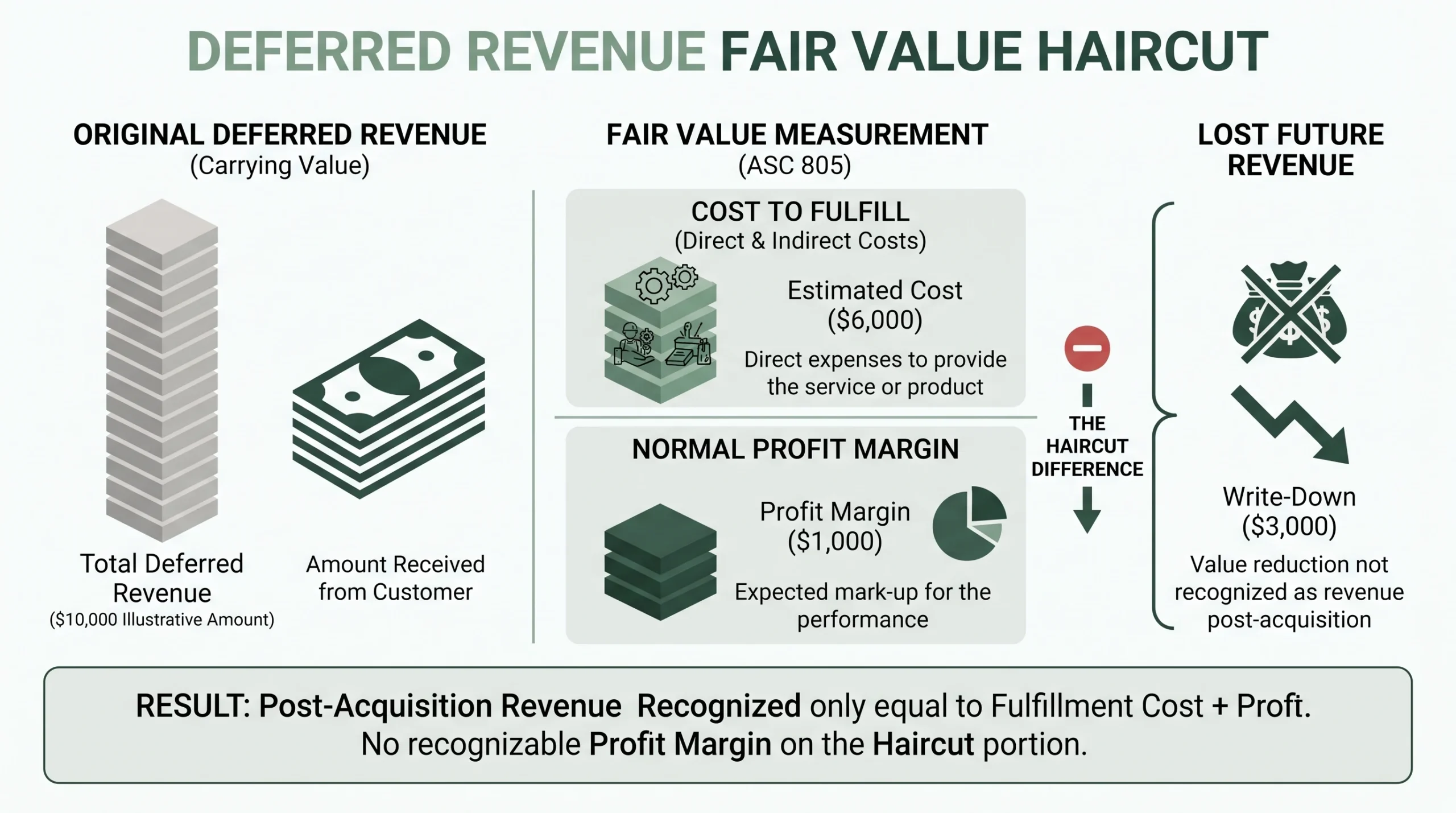
Fair value is built from the bottom up, from the legal obligation the buyer inherits. The method is often called the cost build-up or bottom-up approach. It asks a simple question. What would it cost a third party to take over and finish the remaining work, plus a normal profit for doing it?
The build starts with direct costs. These are the labor, hosting, and support needed to serve the remaining contract. Next comes a fair share of indirect overhead. Last comes a normal profit margin on those fulfillment costs, since any outside vendor would expect a return. The total is the fair value of the obligation.
Note what is left out. The selling and marketing effort that won the contract is already spent, so it is not part of the remaining obligation. The seller’s original profit on that sale is gone too. That exclusion is the main reason fair value lands well below the recorded balance.
What Is the Haircut, and Why Is It Applied?
The haircut is the write-down from the recorded balance to the fair value. Say a target booked $1,000,000 of deferred revenue, but the remaining work costs $600,000 to deliver with a normal margin. The fair value is $600,000. The $400,000 difference is the haircut. It is applied because the seller’s balance included profit the seller already earned by signing the customer. The buyer did not earn that profit, so the buyer cannot report it.
That is why acquired revenue looks smaller than the target’s stand-alone numbers. A clear measurement keeps the surprise off the first board forecast and ties the adjustment to a documented cost. You can see how Sofer Advisors handles financial reporting valuations for acquisitions.
How Does the Adjustment Hit Post-Acquisition Statements and Tax?
After closing, the buyer recognizes only the fair value as it delivers the service. So reported revenue for the acquired unit falls in the first year, often sharply for subscription businesses. Gross margin and EBITDA follow it down. The cash and the customer base have not changed, but the GAAP top line reads weaker. This is why acquirers often show a non-GAAP revenue bridge to explain the gap to investors.
Tax runs on a separate track. The haircut is a book adjustment and does not touch the target’s tax return. The purchase price is allocated among asset classes for tax under its own residual rules. Advance payments the customer already made follow their own timing under IRC Section 451, not the book fair value. Keeping the two views side by side avoids confusion when book revenue drops but taxable income does not.
How Did ASC 606 and ASU 2021-08 Change This, and What About IFRS 3?
For years, every acquired deferred revenue balance was remeasured to fair value, which produced the classic haircut. Then ASU 2021-08 changed the rule for contracts that fall under ASC 606, the revenue-from-contracts-with-customers standard. For those contracts, the buyer now carries over the balance as if it had signed the customer itself, using ASC 606 rather than a fresh fair value measurement.
The practical effect is smaller, not zero. The carried-over balance can still differ from what the seller recorded, and contracts outside ASC 606 are still measured at fair value. So a reduced balance and a revenue step-down remain common. The core idea holds. The buyer reports the remaining performance obligation, not the cash the seller collected.
IFRS 3 is the international version of ASC 805. It also records acquired liabilities at fair value and historically produced a similar haircut, with IFRS 15 now shaping how acquired contract liabilities are measured. A company that reports under both US GAAP and IFRS should expect close results, though the two paths are not identical.
Who Values Deferred Revenue, and How Do the Options Compare?
Buyers pick a valuation partner based on deal size, audit exposure, and budget. Large national firms such as Alvarez & Marsal, Stout, and Kroll serve big public filers with broad advisory teams. Sofer Advisors focuses on defensible, partner-led valuations for middle-market and closely held acquisitions, with expert witness testimony in 11+ cases behind its reports and 180+ five-star Google reviews. The table below sets out the common options.
| Provider | Typical role | Best for |
|---|---|---|
| Specialized valuation firm (e.g. Sofer Advisors) | Builds the fair value of deferred revenue and documents the haircut for audit | Middle-market and closely held deals needing defensible support |
| Large national firm | Broad transaction advisory plus valuation at enterprise scale | Large public filers with complex, multi-entity reporting |
| Internal finance team | Prepares first-pass estimates for the close | Smaller deals where the auditor accepts an internal model |
Sofer Advisors runs each engagement through a four-phase process it calls The Sofer Difference, moving from Discovery to Diligence to Analysis to Delivery. That structure ties every number to a documented cost and a source. It reflects the Heart of a Teacher approach, which means explaining why the haircut lands where it does rather than just handing over a figure. For a measurement that survives an audit, an independent valuation supplies both the number and the record behind it.
Frequently Asked Questions
What is deferred revenue in an acquisition?
Deferred revenue is cash a company collected before it delivered the service. It sits on the balance sheet as a liability, a promise of future work. In an acquisition, the buyer inherits that promise. Under ASC 805, the buyer records the obligation at fair value, not at the seller’s recorded amount. Sofer Advisors measures that fair value so the opening balance sheet reflects the real cost of the work still owed to customers.
What is the deferred revenue haircut under ASC 805?
The haircut is the gap between a target’s recorded deferred revenue and its fair value. ASC 805 measures the liability as the cost to fulfill the remaining work plus a normal profit margin. That figure is usually smaller than the booked balance, because the seller’s price already included profit earned. The difference is written off. Sofer Advisors documents each input so the haircut holds up under audit and SEC review.
How is the fair value of deferred revenue measured?
Fair value is built from the bottom up. An analyst totals the direct costs to deliver the remaining service, adds a share of overhead, then adds a normal profit margin for that work. The result is what a third party would charge to assume the obligation. Only future work counts, not effort already spent. Sofer Advisors prepares this cost build-up with the backup that auditors and the SEC expect to see.
Why does acquired revenue drop after a deal closes?
The buyer can recognize only the fair value of the deferred revenue, which is lower than the seller’s recorded balance. So the revenue the haircut erased is never reported by the buyer. The reported top line falls in the first year after closing, even though cash and customer activity have not changed at all. Sofer Advisors helps teams model this drop early, so the first post-deal forecast is not a surprise.
Did ASU 2021-08 eliminate the deferred revenue haircut?
No. ASU 2021-08 changed how acquired contract liabilities are measured, not whether an adjustment happens. For revenue contracts under ASC 606, the buyer now carries over the balance as if it had originated the contract, rather than remeasuring it to fair value. Many deals still show a reduced balance. Sofer Advisors checks which rule applies to each contract so the opening balance sheet follows current guidance.
How does IFRS 3 treat deferred revenue?
IFRS 3 is the international counterpart to ASC 805, and it also records acquired liabilities at fair value. Historically it produced a deferred revenue haircut much like US GAAP. Under IFRS 15, acquired contract liabilities are measured in a similar contract-based way. A company reporting under both frameworks should expect close but not identical results. Sofer Advisors prepares valuations that meet the standard your auditor applies to the deal.
Does the haircut change the target’s tax or cash flow?
No. The haircut is a non-cash book adjustment for financial reporting. It does not change the cash a customer already paid or the work still owed. For tax, the purchase price is allocated under IRC rules, and advance payments follow their own timing under IRC Section 451, separate from the book fair value. Sofer Advisors keeps the book and tax views aligned so owners can see both clearly.
How does the haircut affect earnouts and debt covenants?
Because the haircut lowers reported revenue and EBITDA, it can shrink an earnout payout or trip a debt covenant that relies on GAAP figures. The business performs the same, but the statements read weaker in year one. Many agreements add fair-value adjustments back to prevent this. Sofer Advisors quantifies the haircut before closing so buyers and sellers can draft definitions that reflect real performance.
How much does a deferred revenue fair value valuation cost?
Cost depends on the number of contracts, the service mix, and the reporting deadline. Most deferred revenue work is scoped inside a wider purchase price allocation, and the fee is quoted as a flat amount once the work is scoped. That way the price is clear before the work starts. Sofer Advisors scopes the engagement first, then quotes a fixed price. Request a free estimate for your situation.
Related Case Studies
- Purchase Price Allocation ASC 805 and IFRS 3: Complete Guide for Business Leaders
- Valuing Customer Relationships in a Purchase Price Allocation
- ASC 805 Measurement Period Adjustments Explained
Executive Summary
A deferred revenue haircut cuts a target’s recorded deferred revenue to its fair value on the acquisition date under ASC 805. Fair value is built from the bottom up: the cost to finish the remaining work plus a normal profit margin, not the price the customer paid. The write-down is the haircut, and it removes profit the seller already earned. After closing, the buyer reports only the fair value, so revenue, gross margin, and EBITDA drop in year one while cash stays the same. ASU 2021-08 now has buyers carry over ASC 606 contract balances rather than remeasure them, which shrinks the adjustment without erasing it. IFRS 3 reaches a similar result. The haircut is a book item, not tax, but it still moves earnouts, covenants, and goodwill. The first step is a documented fulfillment cost for each remaining contract.
What Should You Do Next?
Pull the remaining contracts in the target’s deferred revenue and estimate the cost to finish each one, since that cost drives the fair value. Confirm which contracts fall under ASC 606, because ASU 2021-08 changes their treatment. This guide was prepared by David Hern CPA ABV ASA, founder of Sofer Advisors, an Inc. 5000 firm specializing in neutral third-party valuations for financial reporting. Schedule a free consultation to discuss your specific situation.
People Also Read
- SaaS Valuation: Complete Guide to Software Company Value
- Valuing Developed Technology in an Acquisition
About the Author
This guide was prepared by David Hern CPA ABV ASA, founder of Sofer Advisors, a business valuation firm headquartered in Atlanta, GA serving clients across the United States. David holds dual accreditations as an Accredited Senior Appraiser (ASA) and is Accredited in Business Valuation (ABV), credentials recognized by the IRS, SEC, and FINRA. He also holds the Certified Exit Planning Advisor (CEPA) designation. With 15+ years of valuation experience, David has served as an expert witness in 11+ cases across multiple jurisdictions and built Sofer Advisors into an Inc. 5,000-recognized firm with 180+ five-star Google reviews. Its full W2 employee team maintains subscriptions to all major valuation databases and operates under a next business day response policy.
For professional business valuation services, visit soferadvisors.com/about-us/ or contact Sofer Advisors at soferadvisors.com/contact-us/.
This content is for informational purposes only and does not constitute professional valuation advice. Business valuation conclusions depend on specific facts and circumstances. Contact Sofer Advisors for guidance regarding your specific situation.









