


BDIT Business Sale Valuation: A Complete Guide
Last Updated: September 2026
A BDIT business sale valuation sets the fair market value of a business interest that an owner sells to a beneficiary defective inheritor’s trust. The trust buys the interest at that price and pays with a promissory note. The goal is to freeze the owner’s value now and move future growth to heirs. Because the buyer and seller are related, the price needs an independent report. That report is the record the IRS reviews if it ever questions the sale.
This planning has become more common since the 2025 tax law made the federal estate and gift tax exemption permanent at $15 million per person and $30 million per married couple. The value that matters is the price on the day of the sale. A defensible number lets owners lock in that value and pass later growth to the next generation without a gift.
Sofer Advisors prepares neutral, third-party valuations for trust and estate planning. The firm works with a Heart of a Teacher, so owners and their advisors understand every number in the report. Its team holds the credentials the IRS looks for and applies recognized standards to each engagement. That approach gives estate planners a price they can defend if the transfer is ever reviewed.
Key Takeaways
- The sale freezes value: the owner sells at today’s price and moves future growth to heirs, out of the taxable estate.
- Fair market value rules: the price must reflect what an unrelated buyer would pay, or the IRS may treat the transfer as a gift.
- The note needs real terms: the interest rate must meet or exceed the Applicable Federal Rate, and repayment must look commercial.
- Discounts often apply: a minority interest can support a discount for lack of control and lack of marketability, with data behind each figure.
- Independence protects the plan: a report from a credentialed, outside appraiser is the main defense against a later challenge.
Each point below shapes whether the sale holds up. The sections that follow walk through the price, the discounts, the note, the report, and how to pick the right appraiser.
What is a BDIT, and why does the valuation matter?
A beneficiary defective inheritor’s trust is an estate planning tool that lets an owner sell a business interest to a trust set up for their heirs. The structure freezes the current value in the owner’s estate and moves later growth to the trust. The owner can still keep certain benefits from the trust. The sale only works when the price reflects fair market value.
The valuation matters because the buyer and seller are related. If the price is too low, the IRS can treat the gap as a gift and undo the tax benefit. A sale to a BDIT works much like a sale to an intentionally defective grantor trust; our guide on selling a business interest to an IDGT covers that sibling structure. In both cases, a credible, independent report is what turns the transfer into a real, arm’s-length sale.
How is the sale price set when you sell to a BDIT?
The sale price is set at fair market value, the price a willing buyer would pay a willing seller when neither is forced to act, and both know the facts. That standard comes from IRS Revenue Ruling 59-60, the long-standing guide for valuing closely held stock. An appraiser applies it to the specific interest being sold, not to the whole company.
Appraisers use three methods to reach the value. The income approach discounts expected cash flow to a present value. The market approach compares the business to similar companies and past deals. The asset approach weighs the net value of what the business owns. The appraiser weighs the results and explains the final number. That written support is what makes the price hold up under review.
What discounts apply to the interest sold?
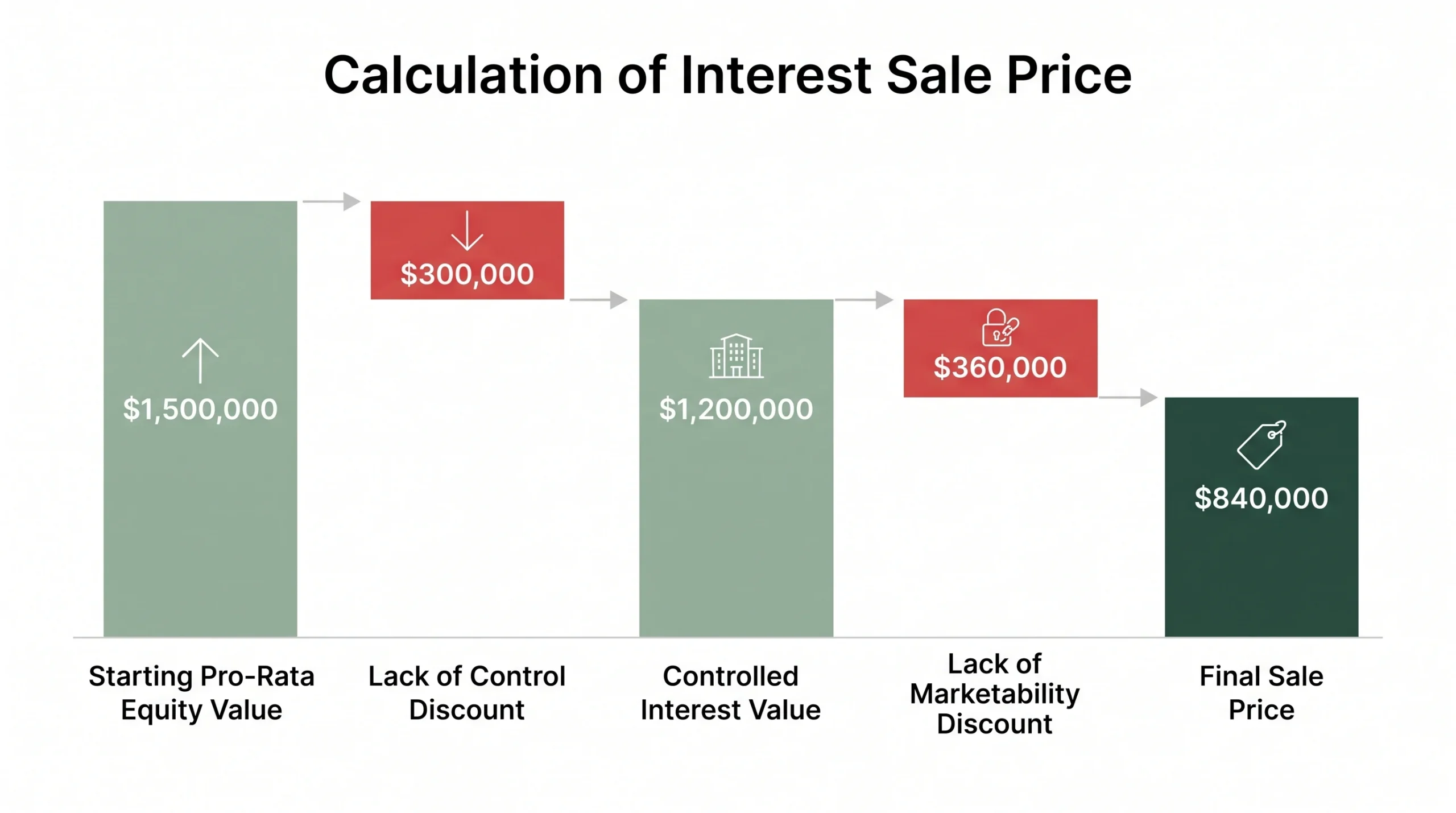
Two discounts often apply when an owner sells a minority stake to a BDIT. The discount for lack of control lowers the value because a minority owner cannot set policy or direct the business. The discount for lack of marketability lowers it again because private shares are hard to sell fast. Together they can reduce the price of the interest by a meaningful amount.
These discounts only survive review when the data backs them. An appraiser ties each figure to studies and to the facts of the company, such as its size, its cash flow, and any transfer limits in the operating agreement. A discount pulled from a rule of thumb invites a challenge. Our work in tax and estate valuation documents every percentage so the number stands on its own.
How do the promissory note terms support the sale?
The promissory note terms decide whether the sale looks like a real transaction. The trust pays the owner with a note instead of cash, so the note has to read like one a bank would write. It needs a set term, a repayment schedule, and a stated interest rate. Weak terms let the IRS argue the sale was really a gift.
The rate is the key term. It must meet or exceed the Applicable Federal Rate, the minimum the IRS publishes each month. A rate below that floor creates imputed interest, which the IRS can treat as a taxable gift from the owner to the trust. The valuation and the note work as a pair. The appraisal sets a defensible price, and the note carries commercial terms, so the two together show an arm’s-length deal.
What does a defensible BDIT valuation report include?
A defensible report is a full appraisal from a credentialed appraiser, not a short calculation. It should come from someone who holds the Accredited Senior Appraiser (ASA) or Accredited in Business Valuation (ABV) credential. The report lays out the methods, the assumptions, and the data behind the value. It also explains each discount in plain terms. That detail is what an examiner looks for first.
The report should follow recognized rules, including the Uniform Standards of Professional Appraisal Practice, or USPAP, and the standards of the American Society of Appraisers. Sofer Advisors builds each report on a clear four-step method, The Sofer Difference: Discovery to learn the business, Diligence to test the records, Analysis to apply the methods, and Delivery to explain the result. Owners and their attorneys get a number they can stand behind.
Which valuation provider should you choose?
Choose an independent firm whose only job is the appraisal, not the deal or the legal work. Large national firms like Alvarez & Marsal, Stout, and Kroll serve the biggest estates and corporate matters. Estate attorneys draft the trust and the note but rely on an outside appraiser for the price. A generalist CPA may run a quick calculation that cannot carry the weight of an IRS review. The table below sorts the options.
| Provider type | What they do | Defense under review |
| Independent valuation firm | Full fair market value report with supported discounts and note review | High; built by credentialed appraisers for tax and estate use |
| Estate attorney | Drafts the trust and the sale documents | Depends on the outside appraiser they engage |
| Generalist CPA or DIY | Book value or a simple multiple, with little support for discounts | Low; unlikely to meet the standard for a qualified appraisal |
The right choice depends on the size of the interest and the owner’s tolerance for risk. Most owners pair an estate attorney for the trust with an independent firm for the price. A standard business valuation for a tax-sensitive sale like this runs $7,500 to $25,000, based on the size and the timeline. Sofer Advisors keeps the appraisal separate from any deal, so the number reflects the real value of the interest and nothing else.
The questions below cover what owners and advisors ask most about these sales.
Frequently Asked Questions
How do you value a business interest sold to a BDIT?
You value the interest at fair market value, the price an unrelated buyer would pay for that same stake. An appraiser applies the income, market, and asset approaches, then weighs the results. The analysis also studies company-specific risk and current market conditions. The written support is what makes the final price defensible if the IRS reviews the sale.
What is the simplest way to set the sale price for a BDIT transaction?
The simplest reliable way is an independent appraisal from a credentialed valuation professional. A formal report gives the transaction one clear, supported number instead of a guess. That removes the ambiguity that tends to trigger tax disputes later. It is also faster than defending an unsupported figure during an audit.
What discounts apply to a business interest sold to a BDIT?
A minority interest often supports a discount for lack of control and a discount for lack of marketability. The first reflects that a minority owner cannot direct the business. The second reflects how hard it is to sell private shares. Each discount must rest on empirical studies and the specific facts of the company to hold up.
How is the arm’s-length price supported when selling a business to a BDIT?
The price is supported by a full appraisal report that documents the methods, assumptions, and market data used. The report shows that the price matches what a hypothetical buyer would pay for the interest. It also explains every discount with data. This record meets the burden of proof the taxpayer carries under Revenue Ruling 59-60.
How do the promissory note terms affect the value of the sale?
A note that falls below the Applicable Federal Rate, or that skips normal repayment terms, can be viewed as an indirect gift. The note has to read like one a commercial lender would write. Reviewing the note terms during the valuation keeps the whole transfer consistent. The appraisal and the note together show a genuine sale.
Why is an independent valuation required for a BDIT sale?
An independent valuation gives a neutral record that the transfer is a real sale, not a disguised gift. Because a BDIT sale is between related parties, the level of scrutiny is higher than in an open-market deal. An outside, credentialed appraiser removes the conflict that an internal estimate carries. That independence is the main line of defense.
Can I use a formula from my buy-sell agreement for a BDIT sale?
Using a buy-sell formula is generally discouraged for a BDIT sale. These formulas favor simplicity over the fair market value standard that tax rules require. They are built for partner transitions, not estate tax compliance. A standalone valuation that meets the tax standard gives a price that satisfies the IRS, not just an internal document.
How much does a valuation for a BDIT transaction cost?
A valuation for a tax-sensitive transaction like a BDIT sale usually costs $7,500 to $25,000. The price depends on the size of the business, the complexity of the interest, and the timeline. A sale structured in tranches over time can sit at the higher end. The fee covers the analysis of market conditions and the applicable discounts.
How often should the valuation be updated for a staged BDIT sale?
Update the valuation whenever a new tranche is sold or the business changes in a material way. Each transfer should occur at current fair market value to keep the arm’s-length standard intact. A fresh number is wise after a strong or weak year, a new contract, or a shift in the market. Regular updates keep the estate records accurate.
Related Case Studies
- Selling a Business Interest to an IDGT: Mechanics and Valuation
- How Family Limited Partnerships Are Valued for Gift and Estate Tax
- Valuation Discounts (DLOC and DLOM) on Estate and Gift Tax Returns
Executive Summary
A sale to a beneficiary defective inheritor’s trust freezes an owner’s value today and moves future growth to heirs. The trust buys the business interest at fair market value and pays with a promissory note. The price must reflect what an unrelated buyer would pay under Revenue Ruling 59-60, and the note rate must meet or exceed the Applicable Federal Rate. A minority interest often supports a discount for lack of control and lack of marketability, with data behind each figure. A full report from a credentialed appraiser, priced at $7,500 to $25,000, is the main defense if the IRS reviews the transfer.
What Should You Do Next?
Start by gathering three years of financial statements and tax returns, plus your operating or shareholder agreement and any prior valuations. Confirm the exact interest you plan to sell and the timing of the sale. Then bring in your estate attorney to draft the trust and note while an independent appraiser sets the price, so both pieces are ready at once.
David Hern CPA ABV ASA, founder of Sofer Advisors, provides neutral, defensible valuations for trust and estate planning. Schedule a consultation to discuss your situation.
People Also Read
- Estate Freeze Strategies: How Valuations Lock In Today’s Value
- Chapter 14 Rules: How IRC 2701 and 2703 Affect Family Transfers
About the Author
This guide was prepared by David Hern, CPA ABV ASA, founder of Sofer Advisors, a business valuation firm headquartered in Atlanta, GA, serving clients across the United States. David holds dual accreditations as an Accredited Senior Appraiser (ASA) and is Accredited in Business Valuation (ABV), credentials recognized by the IRS, SEC, and FINRA. He also holds the Certified Exit Planning Advisor (CEPA) designation. With 15+ years of valuation experience, David has served as an expert witness in 11+ cases across multiple jurisdictions and built Sofer Advisors into an Inc. 5000-recognized firm with 180+ five-star Google reviews. Its full W2 employee team maintains subscriptions to all major valuation databases and operates under a next-business-day response policy.
For professional business valuation services, visit soferadvisors.com/about-us/ or contact Sofer Advisors at soferadvisors.com/contact-us/.
Disclaimer: This content is for informational purposes only and does not constitute professional valuation advice. Business valuation conclusions depend on specific facts and circumstances. Contact Sofer Advisors for guidance regarding your specific situation.









