

Last Updated: August 2026
An RV dealership valuation is the process of setting a fair market value for a business that sells and services recreational vehicles. It weighs tangible assets like inventory and real estate against goodwill, the intangible worth known as blue sky. The market frames that value. RV wholesale shipments reached 342,220 units in 2025, a 2.5 percent gain over 2024, per the RV Industry Association. Sofer Advisors grounds each valuation in that context.
This value matters most at moments of change. Owners need it for a sale, an estate plan, a tax filing, or a partner buyout. RV demand rises and falls with interest rates and buyer confidence, so timing sways the number. A defensible figure rests on set standards, not a broker’s quick guess. It gives owners, buyers, and lenders a number they can trust.
Key Takeaways
- Two value layers: A dealership blends tangible assets with blue sky, the goodwill above those assets.
- Floorplan is debt: Inventory financing counts as debt and lowers the equity value.
- Blue sky is a multiple: Goodwill equals a multiple of adjusted pre-tax earnings.
- Departments drive value: Parts, service, and F&I add steady, high-margin income.
- Standards apply: Credible reports follow IRS Revenue Ruling 59-60 and AICPA SSVS.
These points connect assets, debt, and earnings. The sections below show how each one shapes the price. They also explain how a professional builds a number that holds up under review.
What is an RV dealership valuation?
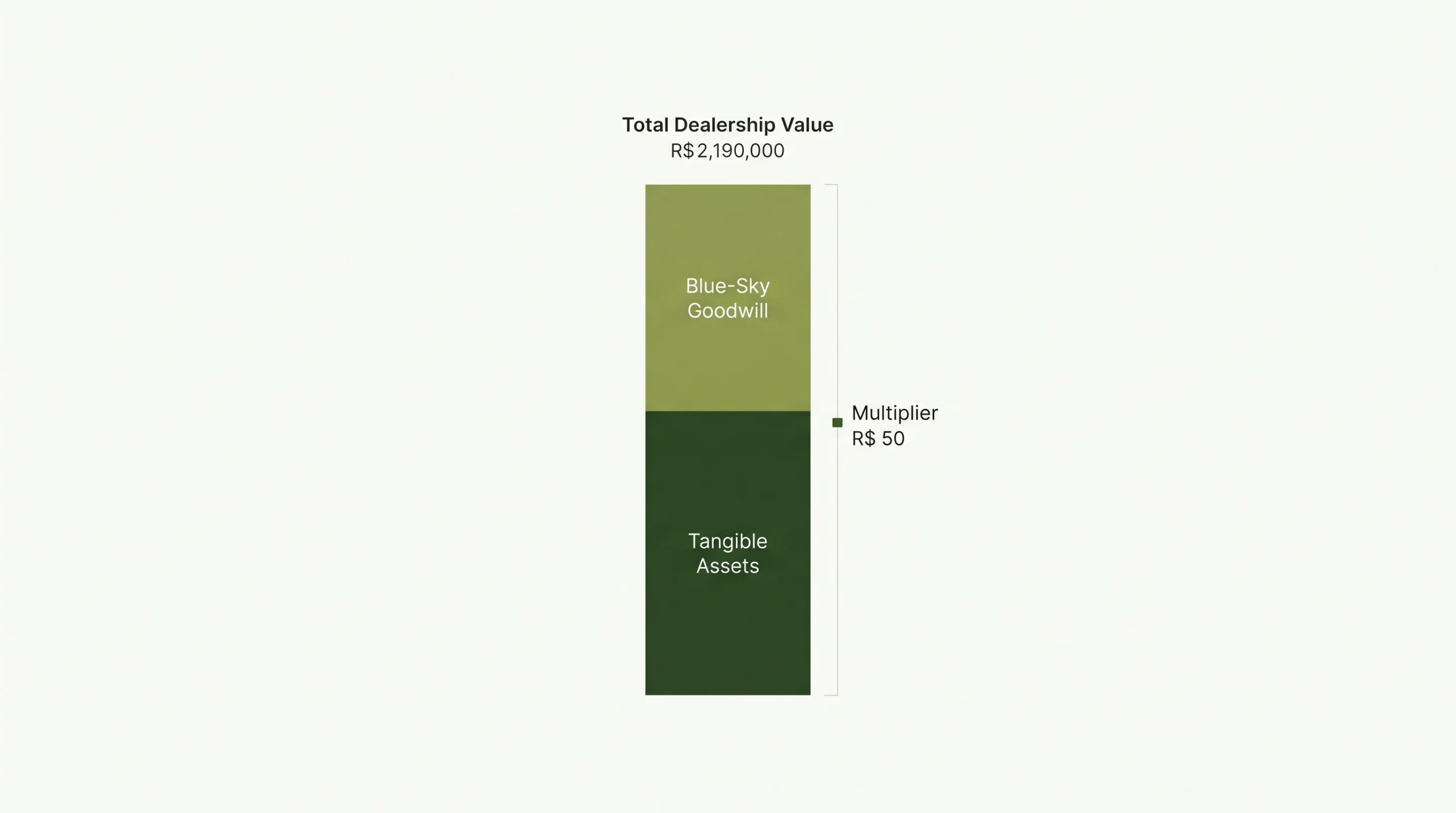
An RV dealership valuation measures what the whole business is worth to a buyer. It starts with tangible assets, then adds the goodwill a strong dealership earns over time. Tangible items include new and used inventory, parts, shop tools, and any owned real estate. Goodwill covers the brand, the customer base, and the franchise rights a maker grants. The final number reflects both the physical assets and the future cash flow the business can produce.
Most credible reports lean on the income approach. This method turns adjusted earnings into value, since a buyer pays for future profit. The market approach checks that figure against recent dealership sales. The asset approach sets a floor, the value if the business closed and sold its parts. A skilled analyst blends these views. That blend keeps the result realistic and ready to defend.
How does floorplan financing affect value?
Floorplan financing is a short-term loan that funds new RV inventory. It acts as debt, so it lowers the equity value of the dealership. An analyst first finds the enterprise value, the worth of the whole operation. Then the floorplan balance is subtracted to reach the equity value, the money the owner would keep. Because the loan tracks inventory, its balance swings with sales and restocking through the year.
This debt also ties up working capital, the cash a dealership needs to run. Rates matter here. High interest rates raise the carrying cost of unsold units, and that pressure grew as rates stayed high through 2025. Many makers offer floorplan help that offsets part of the interest. When that helps lower costs, it can lift normalized earnings and the final value. A careful review reflects both the debt and the true cash strain.
How is blue sky value calculated?
Blue sky is the goodwill a buyer pays above the value of hard assets. It equals a multiple applied to the dealership’s adjusted pre-tax earnings. According to Haig Partners, blue sky reflects what a buyer will pay above hard assets based on expected future earnings. So the figure captures the premium for an ongoing, profitable business. It sits on top of inventory, equipment, and real estate, not inside them.
The multiple itself rests on a few clear drivers. Strong maker relationships and steady past profit push it higher. A weak brand or shaky earnings pull it lower. Analysts also weigh customer loyalty and how well the shop runs. First, they normalize the earnings to strip out one-time and owner costs. Then they apply a market-backed multiple. That two-step method keeps the goodwill grounded in real evidence.
| Value component | What it covers | Effect on price |
|---|---|---|
| Tangible assets | Inventory, parts, equipment, real estate | Sets the floor value |
| Blue sky | Goodwill, brand, franchise rights | Adds a premium above assets |
| Floorplan debt | Inventory financing balance | Reduces the equity value |
| Parts and service | Recurring, high-margin work | Lifts the earnings multiple |
The table shows why one number never tells the full story. Each layer moves on its own. A rich asset base means little if earnings are thin. Strong goodwill fades if debt runs high. A sound valuation weighs all four together, then reconciles them into a single figure a buyer and a lender can both accept.
Why do the new and used mix matter?
The mix of new and used units shapes both margin and risk. Both sides count. New RVs carry lower margins and depend on maker terms and floorplan debt. Used units often earn higher margins and reflect the skill of the buying team. A dealership that fixes up and sells used stock well can boost overall profit. That profit quality feeds directly into the blue sky multiple times.
Inventory age matters just as much as the mix. Fresh units move fast and hold value. Aged units tie up floorplan debt and risk markdowns. In a soft year, stale inventory can erase a season’s profit. An analyst reviews the aging report to gauge this risk. A clean, current mix supports a stronger and steadier value.
How are parts, service, and F&I valued?
Parts, service, and finance and insurance form the back end of a dealership. These lines earn steady, high-margin income that a buyer prizes. Service and parts bring customers back long after the sale. The F&I office adds profit on loans, warranties, and protection plans. Together they lower risk because they do not swing as hard as unit sales. That stability supports a higher earnings multiple for the whole business.
One key gauge is the fixed absorption rate. It measures how much of a dealership’s overhead the parts and service departments cover on their own. A high rate means the shop pays the bills even when RV sales slow. That cushion is exactly what buyers look for in a cyclical market. A strong back end can separate a top dealership from an average one and justify real added value.
What blue sky multiples apply now?
Blue sky multiples for dealerships shift with the market cycle and interest rates. RV dealerships sit at the cyclical end of retail, so their multiples run modest. Recent transaction data places typical RV dealership earnings multiples in a low single-digit range. The exact figure depends on brand strength, profit trend, and the health of the back end. A high-performing store with strong service income earns the top of the range.
Rates and demand set the mood for these deals. As the RVIA notes, shipments held near flat in 2025 after a sharp drop. That cooling trims buyer appetite and caps multiples for weaker stores. Yet well-run dealerships with loyal customers still draw solid interest. A current value must reflect today’s rates and demand, not a peak-year mark that no longer holds.
How does Sofer Advisors value dealerships?
Sofer Advisors treats each dealership as its own case, not a formula. Founder David Hern CPA ABV ASA leads the work under The Sofer Difference, a four-phase process of Discovery, Diligence, Analysis, and Delivery. First the team gathers financials, franchise terms, and floorplan schedules. Then it normalizes earnings, tests the blue sky multiple against market data, and reconciles the approaches. Every report meets IRS Revenue Ruling 59-60 and AICPA SSVS. That rigor makes the number solid for tax, court, or a sale.
Large firms such as Alvarez and Marsal or Kroll aim their work at enterprise clients. The firm brings that same senior-level care to middle-market dealership owners. Unlike a solo practitioner, it backs each conclusion with a full W2 team of 14 and paid database access. The firm also works in the Heart of a Teacher spirit. It shows owners the math behind the value, so they can act with real confidence.
Frequently Asked Questions
How do you value an RV dealership?
You value an RV dealership by joining the income approach with a close look at its assets. An analyst studies past cash flow, floorplan debt, and maker relationships. The firm normalizes earnings to show true profit, then applies a market-backed multiple. The team also checks the result against recent dealership sales. This blend produces a fair market value that owners and lenders can defend.
What is blue sky in an RV dealership sale?
Blue sky is the goodwill value of a dealership above its tangible assets. It covers the brand, the customer base, and the territory rights a maker grants. Buyers pay this premium for a business that already earns steady profit. The firm measures blue sky as a multiple of adjusted pre-tax earnings. This shows owners how their track record and market spot add to total value.
How does floorplan financing affect RV dealership value?
Floorplan financing is debt tied to new RV inventory, so it lowers equity value. An analyst subtracts the outstanding balance from enterprise value to find what the owner keeps. Because the loan carries interest, high rates raise its true cost. The firm audits these schedules closely. This keeps the debt and its cash strain from distorting the owner’s real proceeds.
What multiple does an RV dealership sell for?
RV dealerships tend to trade at low single-digit multiples of adjusted earnings. The exact figure shifts with brand strength, profit trend, and back-end income. Stores with strong service and loyal customers sit near the top of the range. The team weighs your specific earnings quality against current market data. This gives you a realistic view of where your dealership stands today.
How do parts and service departments affect value?
Parts and service departments add steady, high-margin income that buyers value. They bring customers back long after a sale and cushion slow selling seasons. A high fixed absorption rate shows the shop can cover overhead on its own. The firm measures this rate to gauge stability and risk. A strong back end often supports a higher multiple for the whole business.
How do interest rates affect an RV dealership valuation?
Interest rates shape RV values from two directions at once. Higher rates raise floorplan carrying costs and squeeze working capital. They also cool consumer demand, since many buyers finance their purchase. Both effects can trim earnings and the blue sky multiple. The firm reflects the current rate climate in every model, so the value fits today’s market rather than a past peak.
What financial documents does a valuation need?
A valuation needs at least three years of tax returns, profit and loss statements, and current balance sheets. The analyst also reviews floorplan schedules, franchise agreements, and inventory aging reports. The team gathers these during the Discovery phase of its process. Complete records let the team account for every asset and debt before the analysis begins, which keeps the final number sound.
How does real estate ownership affect the value?
Owned real estate is valued apart from the dealership operation. This split shows the true cash flow of the business on its own. The firm adjusts the statements for market-rate rent, so the operating value stands alone. Owners who hold their land may also gain from rent income or a rise in value. Separating the two gives a clearer, more solid picture of each asset.
How much does a business valuation from Sofer Advisors cost?
Business valuations from Sofer Advisors usually run from 7,500 to 25,000 dollars. The price depends on how complex your financials are and the purpose of the report. Simpler jobs for planning or tax sit toward the lower end. Deals and court support need deeper work, so they fall higher. Contact the firm for a fee quote matched to your dealership and goals.
Related Case Studies
- How to Value an Auto Dealership: Blue Sky 2026
- Construction and Contractor Multiples: 2026 by Trade
- When the Cost Approach Wins: Valuing Asset-Heavy Businesses
Executive Summary
An RV dealership valuation blends tangible assets with blue sky goodwill. Floorplan financing counts as debt and lowers equity value, while high rates raise its cost and squeeze working capital. Blue sky equals a multiple of adjusted pre-tax earnings, and RV stores tend to trade at low single-digit multiples. Parts, service, and F&I income lift that multiple by adding steady margin. With 2025 RV shipments near flat at 342,220 units, timing matters. Sofer Advisors builds each report under IRS Revenue Ruling 59-60 and AICPA SSVS, so the value holds up for tax, court, or sale.
What Should You Do Next?
Start by gathering three years of financials, your floorplan schedules, and current franchise agreements. Confirm the purpose of the valuation, since a number for planning may not survive IRS or court review. Then test your blue sky multiple against real market evidence, not a peak-year rule of thumb.
For a valuation you can stand behind, work with David Hern CPA ABV ASA. His team has given expert witness testimony in 11+ cases across Georgia, Florida, California, and New Mexico. Schedule a consultation to discuss the value of your dealership.
People Also Read
- Debt Capacity: How Much Leverage a Business Supports
- EBITDA Add-Backs: What Buyers Accept and What They Reject
About the Author
This guide was prepared by David Hern CPA ABV ASA, founder of Sofer Advisors, a business valuation firm headquartered in Atlanta, GA serving clients across the United States. David holds dual accreditations as an Accredited Senior Appraiser (ASA) and is Accredited in Business Valuation (ABV), credentials recognized by the IRS, SEC, and FINRA. He also holds the Certified Exit Planning Advisor (CEPA) designation. With 15+ years of valuation experience, David has served as an expert witness in 11+ cases across multiple jurisdictions and built Sofer Advisors into an Inc. 5000-recognized firm with 180+ five-star Google reviews. Its full W2 employee team maintains subscriptions to all major valuation databases and operates under a next business day response policy. For professional business valuation services, visit soferadvisors.com/about-us/ or contact Sofer Advisors at soferadvisors.com/contact-us/.
Disclaimer: This content is for informational purposes only and does not constitute professional valuation advice. Business valuation conclusions depend on specific facts and circumstances. Contact Sofer Advisors for guidance regarding your specific situation.