


Last Updated: August 2026
An Amazon FBA business valuation is the process of estimating what a brand that sells through Fulfillment by Amazon is worth. Appraisers study its earnings, its risk, and recent sales of similar brands. Most FBA brands now trade near a Seller Discretionary Earnings multiple of 2.5x to 4x. That range fell from the 4x to 6x prices buyers paid in 2021. Sofer Advisors values these brands with current market data, not old benchmarks.
The number matters most when an owner plans to sell, raise money, or settle a tax or legal matter. Value here rests on more than sales. Buyers weigh how steady the earnings are, how many products carry the brand, and how exposed the account is to Amazon’s rules. Each of these drivers can move the final multiple by a wide margin.
Key Takeaways
- SDE sets the base: Most FBA brands are priced on a multiple of Seller Discretionary Earnings, not raw revenue.
- Multiples have cooled: Typical multiples sit near 2.5x to 4x today, down from the 2021 aggregator peak.
- Inventory is added on: The price is usually the earnings multiple plus saleable inventory at cost.
- Platform risk lowers value: Account suspension, one hot product, or a single supplier all pull the multiple down.
- Clear drivers lift value: Brand Registry, deep reviews, and off-Amazon sales support a higher multiple.
These points tie earnings to risk. The sections below show how the firm builds each figure, how the market sets the multiple, and how to defend the result for a sale, tax filing, or dispute.
What multiple does an FBA business sell for?
Most Amazon FBA brands sell for a Seller Discretionary Earnings multiple of about 2.5x to 4x. Larger, cleaner brands reach the top of that band. Smaller or single-product brands sit near the bottom. Data from CT Acquisitions’ 2026 ecommerce multiples shows Amazon-only catalogs trade below diversified brands at the same revenue. Channel mix drives price more than sales alone.
Size also shifts the method. Brands earning a few million dollars or more are often priced on an EBITDA multiple instead of SDE. At that level, buyers look at adjusted EBITDA and enterprise value, the worth of the earning engine before cash and debt. The EBITDA multiple for business valuation by industry guide shows how those ranges vary. Smaller brands stay on SDE because a single owner still runs the work.
How do you calculate FBA business value?
To value an FBA business, you multiply its trailing twelve month SDE by a fair multiple, then add inventory at cost. The formula reads: value equals SDE times multiple, plus inventory. The SDE times multiple part is the enterprise value. Inventory is a dollar for dollar asset, so a buyer pays for it on its own at closing.
Clean inputs matter as much as the multiple. An appraiser recasts past statements to strip out owner pay, personal costs, and one-time items. That step, called normalization, shows the true earning power. Working capital also affects the deal, since a buyer needs cash to keep the brand stocked. This reflects the Heart of a Teacher approach the firm brings to each job: show the owner the math, not just the answer.
What is SDE and why does it drive value?
Seller Discretionary Earnings is the yearly profit a single owner takes from the business. It starts with net profit. Then it adds back the owner’s salary, benefits, and any cost that would not carry over to a buyer. The result shows the real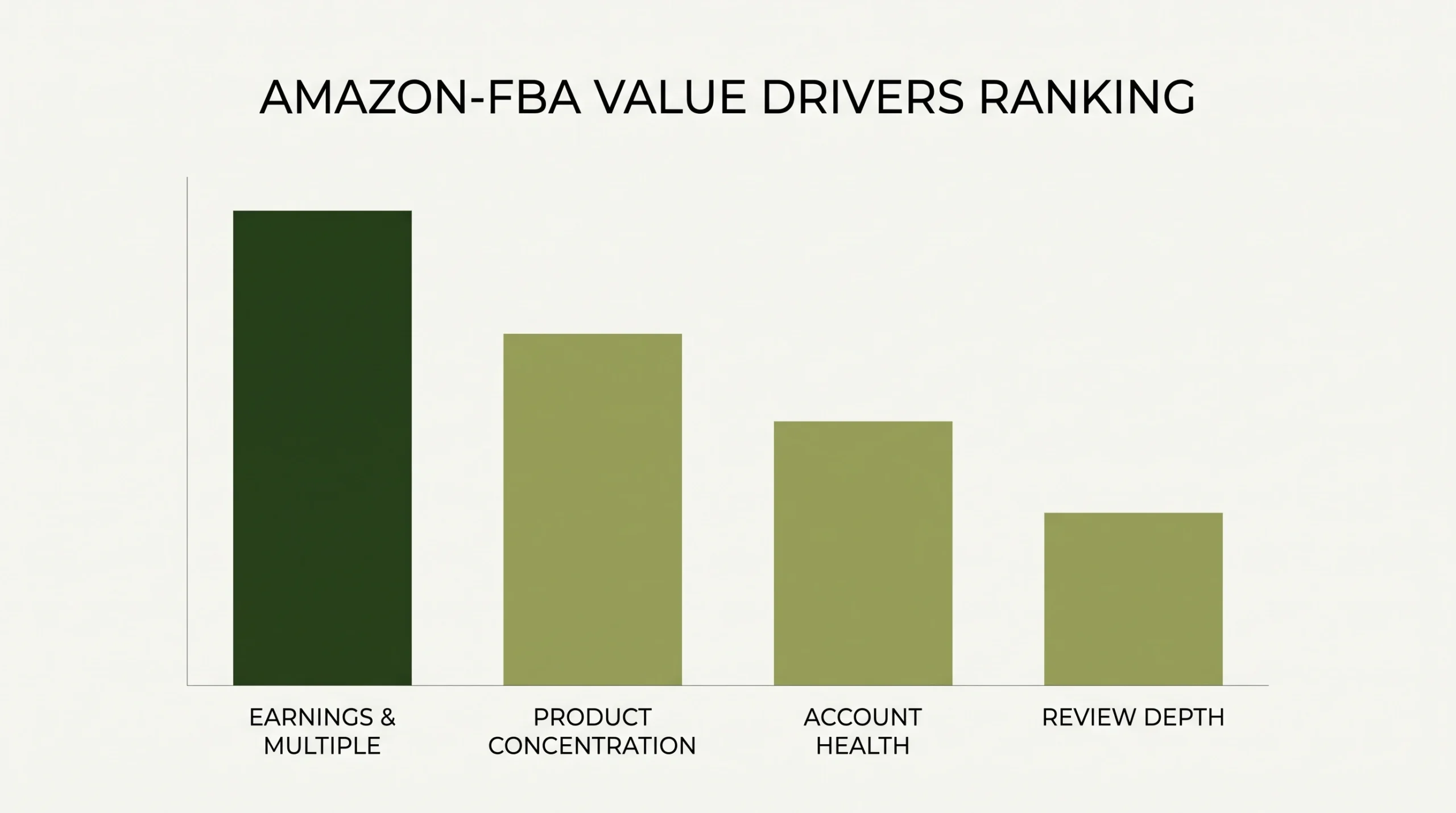 cash a new owner could earn. For brands under a few million dollars in earnings, SDE is the base an appraiser trusts.
SDE and normalized earnings feed both the income approach and the market approach. The income approach turns steady earnings into value. The market approach compares the brand to real deals for similar companies. Both are named methods under IRS Revenue Ruling 59-60 and the AICPA SSVS standard. Using them together gives a number that holds up in an audit or a court.
Why have FBA multiples cooled since 2021?
FBA multiples fell because the aggregator boom ended. From 2020 to 2021, dozens of buyers raced to buy Amazon brands and paid rich prices. Marketplace Pulse reports these aggregators raised 12.3 billion dollars in 2021, then just 2.7 billion in 2022 as debt terms tightened. The easy money that pushed multiples to 6x or 7x dried up fast.
The fallout reset the market. Thrasio, the best known buyer, filed for bankruptcy in early 2024 and came back smaller. Today’s buyers are fewer and far more careful. They price on real margin and channel risk, not on headline growth. For an owner, this means a defensible valuation now depends on proof, not hype. A clean set of books and a diverse sales base carry more weight than they did five years ago.
What risks lower an FBA valuation?
The largest risk is the platform itself. A suspension can freeze sales overnight and drop earnings to zero. Amazon’s own account health and policy compliance guide explains that a poor Order Defect Rate or repeat policy breaches can deactivate an account. Buyers read that account health as a direct signal of how safe the future income is.
Concentration is the next concern. When one product drives most of the profit, a single competitor or stockout can sink the brand. The same holds when one factory supplies nearly all the goods. A supply chain break then threatens the whole operation. Thin or falling review counts hurt as well, since reviews drive search rank and sales. Sofer Advisors measures each of these risks and adjusts the multiple to match, so the value reflects the real business rather than a rosy average.
What lifts an FBA valuation multiple?
Strong, defensible features lift the multiple by lowering a buyer’s risk. Amazon Brand Registry protects listings from copycats and gives the owner more control. A deep base of positive reviews signals steady demand that is hard to copy. Sales outside Amazon, such as a direct website or another marketplace, prove the brand does not live or die by one channel.
Clean operations also raise value. Written procedures let a buyer step in without the founder. Owned intellectual property, like a patent or trademark, builds a moat and supports goodwill in the final number. Each of these features can move a brand from the bottom of the multiple range toward the top, often adding six figures to the price.
How does FBA valuation differ from other ecommerce?
FBA valuation differs from other ecommerce mainly in platform risk and inventory weight. An FBA seller depends on one marketplace for traffic and payment, so a policy change carries real danger. A direct store owner keeps the customer list and the site, which lowers that risk. A software business earns recurring revenue, which buyers prize above one-time product sales.
| Business model | Typical value base | Main risk | Multiple pressure |
|---|---|---|---|
| Amazon FBA brand | SDE 2.5x to 4x | Platform concentration | Lower than diversified peers |
| Direct / Shopify brand | SDE 2.5x to 4.5x | Traffic and ad cost | Higher with an owned audience |
| Software / SaaS | Revenue or EBITDA | Customer churn | Highest, recurring revenue |
The gap between a quick broker estimate and a defensible valuation is real. A broker opinion helps set a listing price. A tax filing, a shareholder dispute, or a bank deal needs more. This is where The Sofer Difference matters, a four-phase process of Discovery, Diligence, Analysis, and Delivery that ends in an audit-ready report. Large firms such as Alvarez and Marsal or Kroll serve enterprise clients. Sofer Advisors brings that same senior-level rigor to middle-market owners, and unlike a solo practitioner, backs each conclusion with a full W2 team of 14 and every major valuation database.
Frequently Asked Questions
What is a good SDE multiple for an FBA business?
A good SDE multiple for an FBA brand now runs from about 2.5x to 4x. A brand reaches the high end when it has a long record, several strong products, and sales beyond Amazon. It sits near the low end when one product or one supplier carries the risk. The firm tests your multiple against current deal data for similar brands, so the figure fits your real profile.
Do you include inventory in an FBA business sale price?
Yes, inventory is almost always added to the price as a separate asset. Because stock levels rise and fall with shipping and season, it rarely sits inside the earnings multiple. A buyer pays for saleable goods at cost at closing. The firm reviews your stock to split healthy inventory from slow or dead items, so the count in the deal reflects only what a buyer can truly sell.
How does Amazon account health affect value?
Account health works as a direct risk signal to buyers. Metrics like the Order Defect Rate and late shipment rate show how stable your operation is. A weak score raises the odds of a suspension, which can freeze income overnight. That threat pushes the multiple down. The firm reviews your account history in each engagement, since a clean record is real evidence that future sales can continue.
Is an Amazon FBA business still worth buying in 2026?
Many FBA brands remain sound buys, but the market rewards discipline now. Buyers pay fair multiples for brands with strong margins, real reviews, and sales across more than one channel. Brands that lean on a single product or rising ad costs face pressure. The firm reviews your cost structure and inventory turnover to judge whether the model can hold its earnings as a going concern.
How is SDE different from EBITDA?
SDE and EBITDA both measure earning power, but they fit different sizes. SDE adds back the owner’s pay and assumes one owner runs the work. It suits smaller, owner-operated brands. EBITDA does not add back a market-rate salary, so it fits larger brands with a hired team. The firm picks the right base for your size, since using the wrong one can distort the multiple and the final value.
Why did aggregator multiples fall after 2021?
Aggregator multiples fell because cheap capital ran out. In 2021, many buyers used borrowed money to chase Amazon brands and paid 6x or more. When debt terms tightened in 2022, that buying slowed sharply, and several large buyers restructured. Prices settled back toward 2.5x to 4x. The market now prices on proven margin and channel spread, not on fast revenue growth.
What documents do you need to value an FBA business?
A sound valuation starts with trailing twelve month profit and loss statements, business tax returns, and a current inventory list. Seller Central reports on sales, fees, and account health add needed detail. Add-back support, like proof of one-time costs, helps confirm true earnings. The firm reviews these records together to build normalized earnings, then applies a market-backed multiple to reach a defensible value.
How does Sofer Advisors make an FBA valuation defensible?
The firm follows recognized standards and shows its work. Each report ties earnings, risk, and comparable deals to named methods under IRS Revenue Ruling 59-60 and the AICPA SSVS standard. David Hern CPA ABV ASA leads the analysis and has served as an expert witness in 11+ cases across Georgia, Florida, California, and New Mexico. That record means the value can stand up in a deal, an audit, or a dispute.
How much does a business valuation from Sofer Advisors cost?
A business valuation from Sofer Advisors typically runs from 7,500 to 25,000 dollars. The price depends on how complex your records are and the purpose of the report. Simpler jobs for planning or tax sit toward the lower end. Deals, financing, and litigation support call for deeper work, so they fall higher. Contact Sofer Advisors for a fee quote matched to your situation.
Related Case Studies
- DTC Ecommerce Valuation: Why Multiples Compressed in 2026
- Customer Concentration: Why It Cuts Sale Price 10 to 30 Percent
- EBITDA Add-Backs: What Buyers Accept and What They Reject
Executive Summary
An Amazon FBA business valuation prices a brand on a Seller Discretionary Earnings multiple, plus inventory at cost. Most brands now trade near 2.5x to 4x, down from the 4x to 6x peaks of 2021, after the aggregator boom ended and buyers grew careful. Where a brand lands depends on account health, product and supplier concentration, review depth, and off-Amazon sales. Larger brands shift to an adjusted EBITDA basis. Sofer Advisors builds each value under IRS Revenue Ruling 59-60 and the AICPA SSVS standard, with a full W2 team of 14 and 180+ five-star Google reviews behind every report.
What Should You Do Next?
Start by pulling your trailing twelve month profit and loss statements and a clean inventory list. Then confirm the purpose of the valuation, since a report for a sale differs from one for a tax filing. Finally, match your earnings and multiple to real deal evidence, not a generic rule of thumb.
For a value you can stand behind, work with David Hern CPA ABV ASA. His Inc. 5000 firm, named in both 2024 and 2025, answers by the next business day. Schedule a consultation to discuss the multiple that fits your Amazon brand.
People Also Read
- Negotiating Earnouts: 4 Seller-Friendly Structures Beyond the Basics
- Owner Compensation Normalization: Why Salary Affects Sale Value
About the Author
This guide was prepared by David Hern CPA ABV ASA, founder of Sofer Advisors, a business valuation firm headquartered in Atlanta, GA serving clients across the United States. David holds dual accreditations as an Accredited Senior Appraiser (ASA) and is Accredited in Business Valuation (ABV), credentials recognized by the IRS, SEC, and FINRA. He also holds the Certified Exit Planning Advisor (CEPA) designation. With 15+ years of valuation experience, David has served as an expert witness in 11+ cases across multiple jurisdictions and built Sofer Advisors into an Inc. 5000-recognized firm with 180+ five-star Google reviews. Its full W2 employee team maintains subscriptions to all major valuation databases and operates under a next business day response policy. For professional business valuation services, visit soferadvisors.com/about-us/ or contact Sofer Advisors at soferadvisors.com/contact-us/.
Disclaimer: This content is for informational purposes only and does not constitute professional valuation advice. Business valuation conclusions depend on specific facts and circumstances. Contact Sofer Advisors for guidance regarding your specific situation.