


Last Updated: August 2026
Valuing a staffing agency means measuring what its earnings and client base are truly worth. The value comes from gross profit, not top-line billings, since payroll passes straight through the firm. Most agencies trade near 4x to 6x EBITDA, or 1.5x to 2.5x gross profit. One large client can swing that figure by a wide margin. Sofer Advisors treats client mix and margin as the two biggest calls in any staffing job.
Why does this matter to an owner? A staffing firm holds few hard assets, so its worth lives in client ties, recruiter tenure, and signed contracts. Those can shift fast. Owners often need a valuation before a sale, a partner buyout, or a move to new ownership, and a small change in client mix can move the price by a wide margin.
Key Takeaways
- Margin over revenue: Value rests on gross profit and adjusted EBITDA, not total billings.
- Typical multiples: Staffing firms trade near 4x to 6x EBITDA, or 1.5x to 2.5x gross profit.
- Client concentration risk: One client above 15 percent of revenue tends to lower the multiple.
- People are the asset: Recruiter tenure, client ties, and signed contracts hold most of the value.
- Normalize first: Clean statements that strip owner perks give a fair, defensible number.
These drivers set the tone for the whole appraisal. The sections below show how margin, client mix, contracts, and cash timing shape the price a buyer will pay.
How do you value a staffing agency?
You value a staffing agency by normalizing its earnings, then applying a market multiple to gross profit or adjusted EBITDA. Analysts weigh three lenses: the market approach, the income approach, and the asset approach. The market approach usually leads, since recent sales of similar firms show what buyers really pay. The income approach models future cash flow. The asset approach sets a floor and often misses the people-based value.
Cleanup comes first. An analyst recasts past results to strip out one-time items and owner perks. That shows the true earning power a buyer would take on. The result is fair market value, a figure that must hold up for a sale, a tax filing, or a dispute. Sofer Advisors builds each conclusion on standards like IRS Revenue Ruling 59-60, so the number survives outside review.
Why does gross margin drive value?
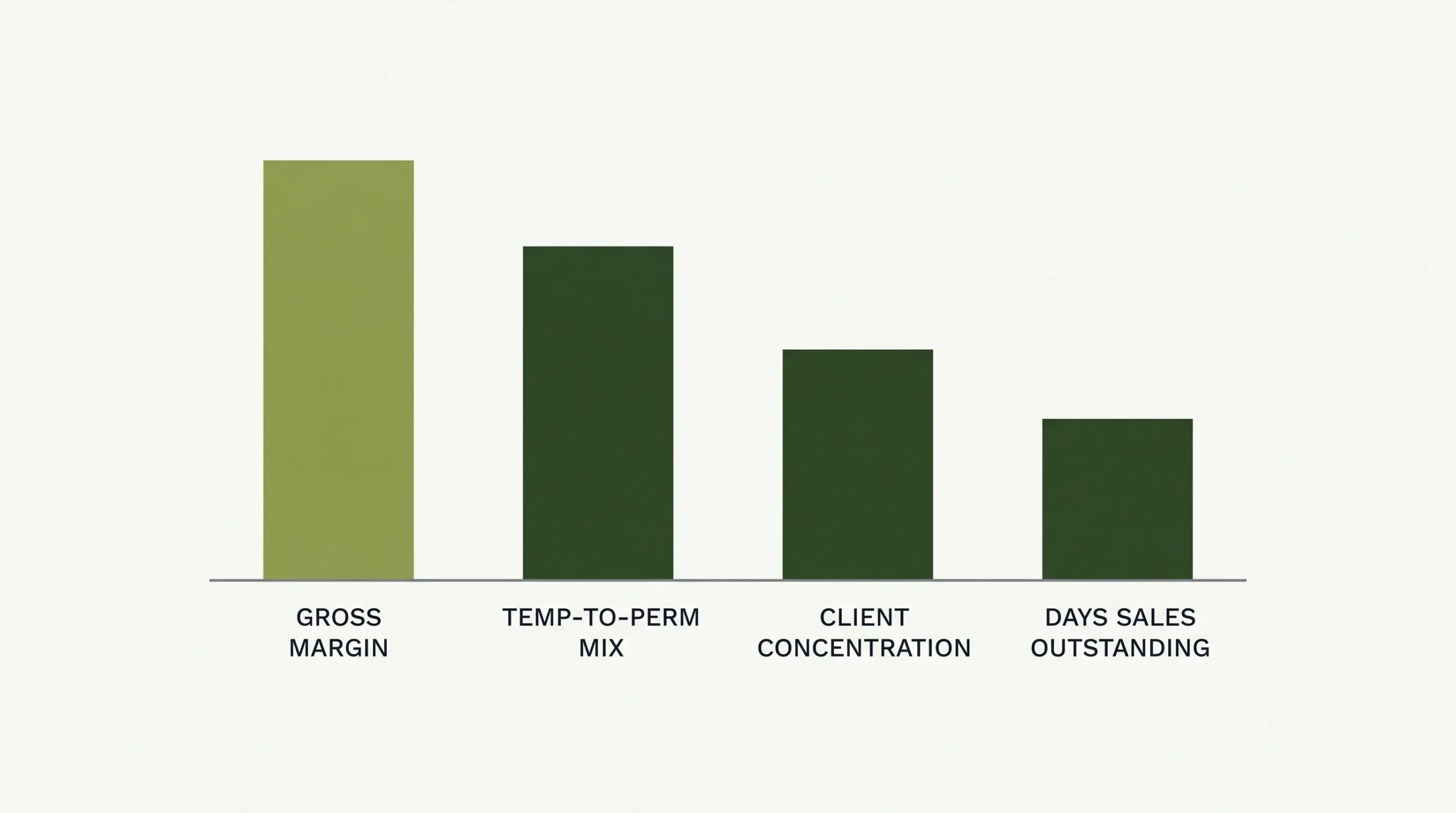
Gross margin drives value because top-line revenue hides the pass-through payroll a staffing firm never keeps. A big share of billings goes straight to temporary workers and payroll burden, and staffing industry data counts nearly 2.2 million temporary and contract workers on assignment in an average week. So high revenue can mask thin real earnings. Analysts focus on gross profit, which is billings minus the cost of placed labor. That figure shows how much value the agency actually captures.
The placement mix matters too. Temporary staffing brings steady, recurring revenue, but the spread per hour stays narrow. Permanent placement earns a one-time fee at a higher margin, yet the income is lumpy. A blend of both tends to read as stable and lowers risk. Sofer Advisors applies the chosen multiple to gross profit, not to inflated billings. That keeps the answer honest and in line with how the market prices these firms.
How does client concentration affect value?
Client concentration hurts value when one account supplies more than 10 to 15 percent of revenue. That single tie makes the whole firm fragile. If the client leaves or renews on worse terms, the earnings fall fast. Buyers price that danger into the deal, so a concentrated book usually earns a lower multiple.
A broad client base does the opposite. Many accounts spread the risk and smooth out cash flow, which supports a stronger price. Analysts measure the top-client share, then adjust the risk premium in the model. They also study contract length and how long clients have stayed. With U.S. staffing sales near $28.1 billion in the third quarter of 2025, Sofer Advisors tests how income spread shapes each firm’s risk profile against current market data. The goal is a rate that reflects the real book, not a generic average.
What multiples fit a staffing firm?
Staffing firms are valued on three main measures: Seller’s Discretionary Earnings, adjusted EBITDA, and a gross profit multiple. Smaller agencies often use SDE, which suits owner-run shops. Larger firms use EBITDA once management runs the day-to-day. The gross profit multiple works as a quick cross-check, since it sidesteps the pass-through payroll that distorts revenue.
| Measure | What it captures | Typical range | Best suited to |
|---|---|---|---|
| SDE multiple | Owner earnings plus one salary | 2.0x to 4.5x | Smaller, owner-run agencies |
| EBITDA multiple | Earnings before interest, tax, and non-cash items | 4.0x to 6.0x | Larger, manager-run firms |
| Gross profit multiple | Value against margin, not billings | 1.5x to 2.5x | A cross-check on either method |
No single multiple settles the price on its own. An analyst picks the measure that fits the firm’s size and management depth, then lines up all three for a sanity check. A niche agency in healthcare or technology often earns the high end, since skilled placement carries a stronger margin. Sofer Advisors lines up the measures under AICPA SSVS. So one solid number comes out, not three loose guesses.
How do contracts and key people change risk?
Contracts and key people change risk because a staffing firm’s value walks out the door each night. Signed service contracts with clients lower risk, since they lock in revenue a buyer can count on. At-will relationships do the reverse and leave earnings exposed. Non-compete agreements with top recruiters protect the client ties that hold most of the value.
Key-person risk sits at the center of every staffing deal. If one owner or lead recruiter drives the placements, the business leans on a single person. That dependency raises the discount rate and trims the price. A deep bench, long recruiter tenure, and written agreements all point the other way. Large firms such as Alvarez and Marsal or Kroll focus on enterprise clients. Sofer Advisors brings that same senior-level rigor to middle-market owners, and unlike solo practitioners, it backs every finding with a full W2 team of 14.
Why do working capital and DSO matter?
Working capital and days sales outstanding matter because a staffing firm funds payroll long before clients pay. Temporary workers get paid weekly. Clients often pay in 30 to 60 days. That gap forces the agency to carry the float, which ties up cash and strains growth. A high DSO signals slow collections and weak billing discipline.
Buyers study this cash cycle closely during due diligence. A firm that collects fast needs less working capital and returns cash to the owner sooner. Slow collections do the reverse and drag on value. Analysts fold a normal working-capital level into the deal terms. So the price reflects the cash a buyer must leave in the firm. This care reflects the Heart of a Teacher approach at Sofer Advisors: show the owner the math behind each risk, not just the final figure. The work also follows USPAP, the rulebook set by The Appraisal Foundation.
Frequently Asked Questions
What multiple does a staffing agency sell for?
Most staffing agencies sell for 4x to 6x adjusted EBITDA, or 1.5x to 2.5x gross profit. Smaller owner-run shops often use an SDE multiple of 2.0x to 4.5x instead. The exact figure depends on client mix, margin, and how much the firm leans on one owner. Sofer Advisors reviews each of these drivers before settling on a defensible multiple for your agency.
Is gross profit or revenue used to value a staffing firm?
Gross profit drives the value, not revenue. Total billings include the pass-through payroll paid to placed workers, which never becomes owner earnings. So a firm can post high revenue yet keep little of it. Analysts apply the multiple to gross profit to show the true income the agency captures. That approach prevents an inflated price built on payroll volume rather than real profit.
How does client concentration lower value?
Client concentration lowers value when one account brings in more than 10 to 15 percent of revenue. That single tie makes earnings fragile, since losing the client would cut deep. Buyers treat the risk as real and price it in, so the multiple drops. A wide, diversified client base does the opposite and supports a firmer, more stable price during a sale.
What is a good EBITDA margin for a staffing agency?
An EBITDA margin between 5 and 12 percent is usually strong for a staffing firm. Margins above that range often point to niche placement or tight cost control. Margins below it may signal pricing pressure or heavy overhead. Sofer Advisors cleans your EBITDA first, stripping non-operating costs and owner perks. That way the margin shows real recurring earnings, not accounting quirks.
How does the temp and permanent placement mix affect value?
The placement mix shapes both stability and margin. Temporary staffing brings recurring revenue but a thin spread per hour. Permanent placement earns a higher one-time fee, though the income arrives in lumps. A firm that blends both tends to read as steady, which lowers risk and supports a stronger multiple. Analysts study this mix to judge how reliable next year’s earnings really are.
Do employee non-compete agreements raise value?
Well-written non-compete agreements tend to raise value. They protect the client ties and recruiter know-how that make up most of a staffing firm’s worth. With those protections, a buyer worries less that key people will leave and take accounts with them. Without them, that execution risk can trim the multiple. Sofer Advisors weighs these agreements while pricing the intangible assets during an engagement.
How does days sales outstanding affect the price?
Days sales outstanding measures how fast clients pay their invoices. A staffing firm pays workers weekly but may wait 30 to 60 days for client payment. A high DSO ties up cash and raises the working capital a buyer must fund. Faster collections free up cash and lift value. Analysts fold a normal collection cycle into the deal, so the price reflects the real cash a firm needs.
How much does a business valuation from Sofer Advisors cost?
Detailed business valuations usually run from $7,500 to $25,000. The price depends on how complex your statements are and the purpose of the report. Simpler work for planning or tax filing falls toward the lower end. Deal support and litigation need deeper analysis, so they land higher. Contact Sofer Advisors for a fee quote matched to your agency and timeline.
Related Case Studies
- How to Value a Commercial Cleaning Company for Sale
- How to Value an IT Managed Services (MSP) Business
- How to Value an Engineering or Architecture Firm
Executive Summary
A staffing agency draws its value from gross profit and adjusted EBITDA, not top-line billings. Most firms trade near 4x to 6x EBITDA, or 1.5x to 2.5x gross profit, with smaller shops priced on SDE at 2.0x to 4.5x. Client concentration above 15 percent, at-will contracts, and key-person reliance all pull the multiple down. Steady margins, signed contracts, and fast collections push it up. The market approach usually leads, checked against income methods. Every conclusion must stand under IRS Revenue Ruling 59-60, AICPA SSVS, and USPAP to survive a sale, tax filing, or dispute.
What Should You Do Next?
Start by gathering three years of profit and loss statements, balance sheets, and tax filings. Pull your top-client revenue share and recruiter tenure, since those numbers drive the risk assessment. Then normalize earnings so owner perks and one-time costs do not distort the margin a buyer sees.
For a value you can stand behind, work with David Hern CPA ABV ASA. His team has given expert witness testimony in 11+ cases across Georgia, Florida, California, and New Mexico. Schedule a consultation to discuss the multiple that fits your staffing agency.
People Also Read
- Customer Concentration: Why It Cuts Sale Price 10 to 30 Percent
- Owner Compensation Normalization: Why Salary Affects Sale Value
About the Author
This guide was prepared by David Hern CPA ABV ASA, founder of Sofer Advisors, a business valuation firm headquartered in Atlanta, GA serving clients across the United States. David holds dual accreditations as an Accredited Senior Appraiser (ASA) and is Accredited in Business Valuation (ABV), credentials recognized by the IRS, SEC, and FINRA. He also holds the Certified Exit Planning Advisor (CEPA) designation. With 15+ years of valuation experience, David has served as an expert witness in 11+ cases across multiple jurisdictions and built Sofer Advisors into an Inc. 5000-recognized firm with 180+ five-star Google reviews. Its full W2 employee team maintains subscriptions to all major valuation databases and operates under a next business day response policy. For professional business valuation services, visit soferadvisors.com/about-us/ or contact Sofer Advisors at soferadvisors.com/contact-us/.
Disclaimer: This content is for informational purposes only and does not constitute professional valuation advice. Business valuation conclusions depend on specific facts and circumstances. Contact Sofer Advisors for guidance regarding your specific situation.









