


Last Updated: July 2026
An engineering firm valuation is the expert study used to find what an engineering business is worth, weighing the firm’s past financial health, current service contracts, and owned technical know-how. Sofer Advisors offers independent valuation work for the choices in this article. The U.S. engineering services market is large, with total industry revenue now topping $450 billion, per IBISWorld (2024). Because the sector is that big, owners need clear, solid numbers during major events like mergers, tax planning, or share transfers.
This kind of clarity takes both industry skill and technical care. Sofer Advisors has worked in this field for 7 years, earning 180+ five-star Google reviews. Its team has also given expert witness testimony in 11+ business valuation court cases nationwide, a record that brings real steadiness to hard financial reports.
For an owner or advisor, real value lives below top-line sales, in the assets that make steady profit. Maybe you run an engineering practice getting ready to sell, or maybe you are a CPA handling an estate. Either way, picking the right numbers is the first key step, and the guide below shows how to judge these firms while meeting professional rules.
Key Takeaways
- Intangible Asset Focus: An engineering firm’s worth comes from its contract backlog, client ties, and team skill. It does not come from gear.
- Valuation Multiples: Larger firms often range from 4-6x EBITDA, while smaller firms often see 2-3x SDE, and revenue multiples act as a backup check.
- Goodwill Identification: You must split personal goodwill from enterprise goodwill, which matters for tax planning and helps a sale go smoothly.
- Defensible Data Requirements: A solid appraisal needs 3-5 years of statements, plus engineering data like Work-in-Progress and backlog reports.
- Professional Standard Compliance: Tax, M&A, and legal needs call for certified experts who follow The Appraisal Foundation (USPAP) rules, so a broker guess will not do.
Each factor shapes what an engineering firm is worth. The sections below show how to weigh these signs in your own business.
What Are Key Valuation Drivers for Engineering Firms?
The main value drivers are intangible assets: steady revenue from set clients, the size and profit of the project backlog, and the strength of the team holding Professional Engineer (PE) licenses. A strong backlog points to stable future cash, which often earns a higher multiple in a deal. But client concentration risk can cut value when one client or project drives most earnings.
PE licenses are the top human asset for delivery and compliance, since these credentials keep out weak rivals while setting the limit for revenue growth. Key person risk can hurt value too, whether a lead holds the main client contacts or rare skills stay locked in one person’s head. When the founding principal is also the rainmaker, a buyer sees fragility rather than a durable enterprise.
Goodwill mirrors the firm’s name and long record of quality, and that good name helps win high-margin work. Contract structure matters as well: firms with long-term master service agreements command steadier valuations than those that chase one-off design bids.
How Do Valuation Multiples Work for Engineering Firms?
Firms are mostly valued with multiples of Seller’s Discretionary Earnings (SDE). This fits smaller practices, while larger, set firms use EBITDA instead. Knowing the difference between SDE and EBITDA is the starting point, since the wrong base metric can distort a firm’s apparent worth. These valuation multiples get checked against market deal data, which analysts pull from bases like DealStats. A common rule of thumb sits at 4-6x EBITDA, but that number shifts with firm size and location.
The type of work matters too, since civil work differs from software work. Some buyers eye revenue multiples of 0.8x-1.2x for a quick sense of value, yet those numbers are weaker for exact reports. Real valuations need a close look at normalized earnings, adjusting for owner pay and one-off costs so the figure reflects true operating power. With these benchmarks, an expert builds a baseline and weighs the firm against like deals.
What Valuation Methods Are Used for Engineering Firms?
Valuators mainly use the Market Approach and the Income Approach. These methods catch both future earnings and intangible worth, which often make up most of a firm’s value. The Market Approach compares the firm to similar sold businesses, with analysts seeking deal data from Business Valuation Resources (BVR / DealStats) to set multiples for like companies.
The Income Approach looks at the firm’s power to make cash later. Experts often use a Discounted Cash Flow (DCF) model, which projects earnings from expected work volume and overhead. The model weighs the time value of money by applying a risk-based rate to future numbers, and that rate rises when backlog is thin or key staff could walk. The Asset Approach is a backup check, rare for firms that turn a profit and used mainly if the firm is not a going concern.
The right method depends on your deal type, industry, and the standard of value you need.
How Does Goodwill Impact an Engineering Firm’s Value?
Goodwill is the part of value above the worth of hard assets like gear and office space, growing instead from name, client lists, and set processes. For many service firms, this premium is the biggest driver of total value.
You must split personal goodwill from enterprise goodwill. Personal goodwill rests on one owner’s name, skill, or repute. Meanwhile, enterprise goodwill belongs to the business itself and stays even if the owner leaves. This split drives tax treatment in a sale, and it sits at the heart of many partner fights. Non-compete deals help clear this up, since they guard enterprise value by stopping owners from taking clients. Documented systems and transferable client ties shift value into the enterprise column, which is what a buyer wants to pay for. Getting these assets right is key for solid Tax & Estate Valuation.
What Financial Statements Are Needed for a Valuation?
A credible valuation needs three to five years of past statements. That means income statements, balance sheets, and cash flow statements. Rules like those from the AICPA say a valuator must study these records to set a true baseline for firm performance and risk. These records show whether revenue grew steadily, and they flag years that need fixing due to odd events.
These records let an expert make normalization adjustments so earnings show true operating power. For engineering firms, the valuator also asks for Work-in-Progress schedules and backlog reports. A clear view of project margins and cash cycles is vital, since it helps judge future revenue streams.
Why Hire a Certified Appraiser for a Firm Valuation?
A certified appraiser makes sure a valuation meets strict rules for tax reports, lawsuits, and share deals. Experts with the Accredited Senior Appraiser (ASA) tag give real independence, as do those with a CPA/ABV credential, and that independence yields a truly defensible valuation. These experts follow the Uniform Standards of Professional Appraisal Practice (USPAP), published by The Appraisal Foundation, which keeps each study fair and open. A broker may give a loose view aimed at a fast sale, while a certified appraiser instead logs every assumption to hold up under review.
Tax offices often push back on valuations without formal certification, and they doubt work that lacks a documented method. Using a certified expert gives owners a clear record that meets the proof the IRS demands. This shield matters in hard cases, such as setting fair market value for gift tax or settling a court fight. Sofer Advisors makes these detailed, compliant reports to help owners meet their reporting needs.
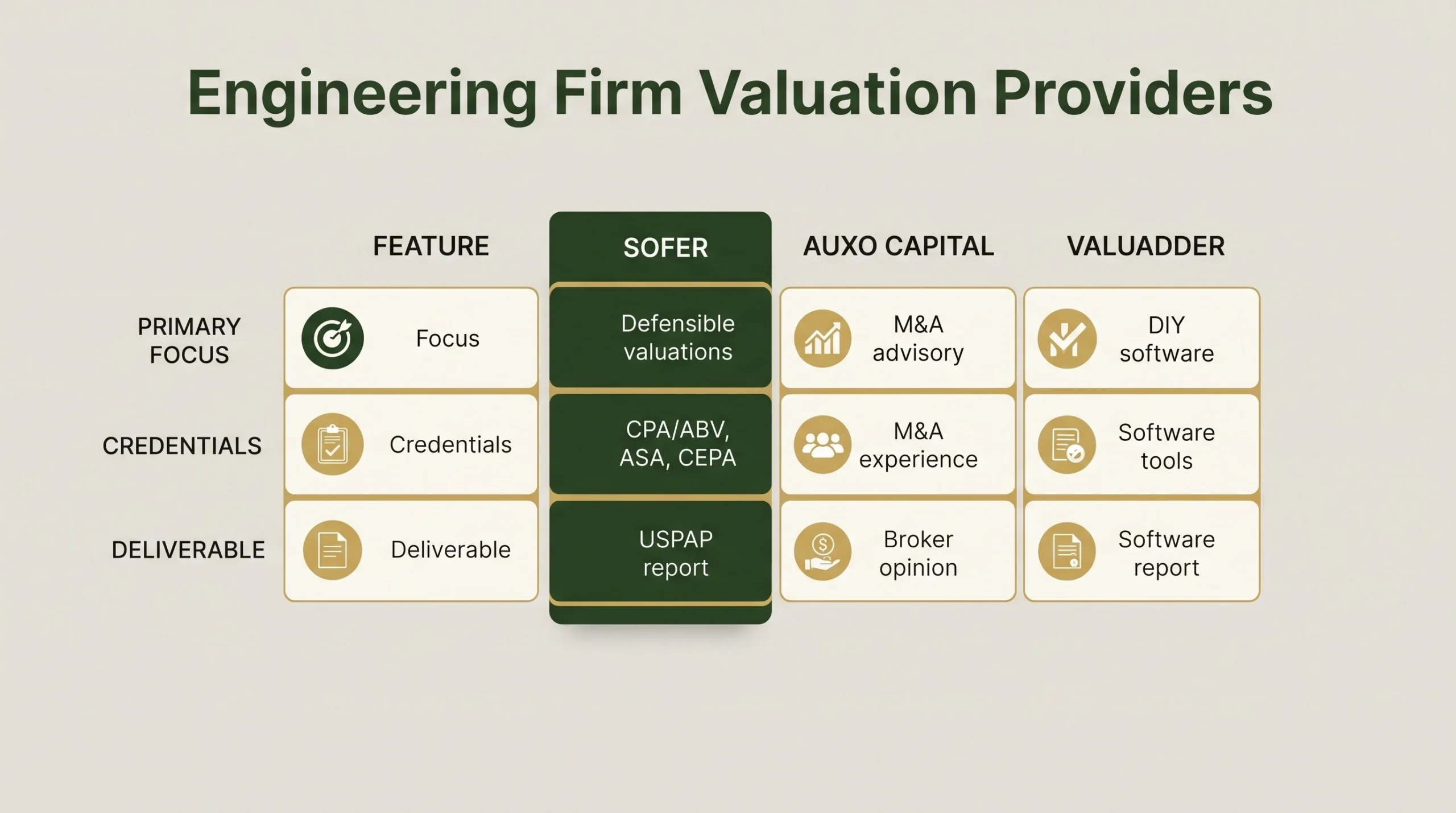
| Feature | Sofer Advisors | Auxo Capital Advisors | ValuAdder |
|---|---|---|---|
| Primary Focus | Defensible valuations for transactions, tax, and litigation by W-2 employee team | M&A advisory and transaction support for business owners | DIY valuation software and rule-of-thumb data for business owners |
| Credentials | CPA/ABV, ASA, CEPA certified experts | Focus on M&A transaction experience | Software-based tools, not a credentialed advisory service |
| Deliverable | Comprehensive, USPAP-compliant valuation report | Broker Opinion of Value or transaction-focused analysis | User-generated report based on software inputs |
Picking a valuation firm means weighing two needs: meeting rules and wanting a quick estimate. A formal report from a credentialed expert gives the scrutiny the IRS wants, while software tools and broker views often miss that rigor and lack the depth for lawsuits or hard tax work.
What should the valuation review compare?
A solid analysis ties each big judgment to the records at hand and to market proof from the valuation date. The points below sum up the core choices.
| Decision area | Evidence and review focus |
|---|---|
| What Are Key Valuation Drivers for Engineering Firms | The primary value drivers for engineering firms are intangible assets such as recurring revenue from established clients, the size and profitability of the project backlog, and the strength of the technical team holding Professional Engineer (PE) licenses. |
| How Do Valuation Multiples Work for Engineering Firms | Engineering firms are primarily valued using multiples of Seller’s Discretionary Earnings (SDE) for smaller practices or EBITDA for larger established entities. |
| What Valuation Methods Are Used for Engineering Firms | Valuators determine the value of engineering firms by primarily using the Market Approach and Income Approach. |
The final report should tie these areas together rather than treat any method alone.
Frequently Asked Questions
How much is a business worth with $500,000 in sales?
Revenue alone rarely shows what a company is worth. Profit margins and asset bases sway the final number a lot. A business with $500,000 in sales might be worth just a slice of that if it carries heavy debt. Meanwhile, a high-margin company could earn a bigger multiple. Sofer Advisors weighs your earnings and industry risk, then gives an estimate that reflects your balance sheet strength.
How much do engineering firms sell for?
Engineering firms often sell for four to six times EBITDA. But the exact value hinges on the firm’s size and profit. And smaller firms may see closer to two or three times seller-discretionary earnings. Sofer Advisors uses market deal data to benchmark your firm against like sales. Meanwhile, also weighing your unique backlog and team strength.
What is the typical rule of thumb for valuing engineering firms?
Rules of thumb give a fast start. But they often miss the full picture of a practice. These firms are commonly valued as a multiple of earnings, yet the exact ratio shifts with client concentration and past growth. Sofer Advisors puts custom analysis over generic shortcuts. This helps the report hold up to the IRS or other tax bodies.
Is a business worth 3 times profit?
Simple multipliers often give wrong results, since they skip capital structure, debt, and future earnings. Some small, steady businesses might trade at three times profit. But the right multiple for your firm depends on industry norms and your documented growth trends. Sofer Advisors uses standard appraisal methods, which yields a defensible number that reflects your true operating power.
How much does an engineering firm valuation cost?
Price depends on the purpose, the firm’s complexity, and the timeline. Fees typically range from $7,500 to $25,000, which covers standard appraisals for tax reporting or internal planning.
What drives the value of an engineering firm?
Most of an engineering firm’s value comes from intangible assets, not gear. These include recurring revenue from set clients, the size and profit of the project backlog, and the strength of a team holding Professional Engineer (PE) licenses. Client concentration risk and key person risk can cut value. Sofer Advisors weighs each driver to build a defensible number.
What is the difference between personal and enterprise goodwill?
Personal goodwill rests on one owner’s name, skill, or repute. Enterprise goodwill belongs to the business itself and stays even if the owner leaves. This split drives tax treatment in a sale and often sits at the heart of partner fights. Non-compete deals help guard enterprise value. Sofer Advisors identifies each type to support solid tax and estate valuation.
What financial statements are needed for a valuation?
A credible valuation needs three to five years of past statements: income statements, balance sheets, and cash flow statements. Rules like those from AICPA say a valuator must study these records to set a true baseline for performance and risk. They also let an expert make normalization adjustments so earnings show true operating power. Sofer Advisors reviews these before judging value.
Why hire a certified appraiser instead of a broker?
A certified appraiser makes sure your valuation meets strict rules for tax reports, lawsuits, and share deals. Experts with an ASA or CPA/ABV credential follow USPAP and log every assumption, so the study holds up under review. A broker may give a loose view aimed at a fast sale. Tax offices often push back on work that lacks a documented method.
Related Case Studies
- How to Value Construction Company: Expert business valuation Guide
- Manufacturing Company Valuation Georgia Industry Guide
- How to Value a CPA or Accounting Firm: Beyond the 1x Revenue Rule
Executive Summary
An engineering firm valuation measures worth through intangible assets rather than physical gear, focusing on contract backlog, client relationships, and the licensed Professional Engineer team. Larger firms are typically valued at 4-6x EBITDA, while smaller practices trade near 2-3x seller’s discretionary earnings, with revenue multiples of 0.8x-1.2x as a rough cross-check.
Valuators lean on the Market and Income Approaches, often building a Discounted Cash Flow model and testing it against comparable deal data. Splitting personal goodwill from enterprise goodwill is central to both tax treatment and a clean sale. A credible study requires three to five years of statements plus engineering records like Work-in-Progress and backlog reports, and only a certified, USPAP-compliant appraiser delivers a number defensible before the IRS and the courts.
What Should You Do Next?
Start by gathering three to five years of financial statements along with current backlog and Work-in-Progress schedules. Next, define your purpose clearly, whether a sale, a partner buyout, gift or estate tax, or litigation, since the intended use shapes the standard of value. Then engage a credentialed appraiser early so the analysis fits your timeline and holds up under scrutiny.
David Hern CPA ABV ASA, founder of Sofer Advisors provides neutral, defensible valuations for engineering firms. Schedule a free consultation to discuss your situation.
People Also Read
- Law Firm Valuation Atlanta Attorney’s Guide 2026
- Business Valuation Services United States: Expert Guide 2025
About the Author
This guide was prepared by David Hern CPA ABV ASAc, founder of Sofer Advisors, a business valuation firm headquartered in Atlanta, GA serving clients across the United States. David holds dual accreditations as an Accredited Senior Appraiser (ASA) and is Accredited in Business Valuation (ABV), credentials recognized by the IRS, SEC, and FINRA. He also holds the Certified Exit Planning Advisor (CEPA) designation. With 15+ years of valuation experience, David has served as an expert witness in 11+ cases across multiple jurisdictions and built Sofer Advisors into an Inc. 5000-recognized firm with 180+ five-star Google reviews. Its full W2 employee team maintains subscriptions to all major valuation databases and operates under a next business day response policy.
For professional business valuation services, visit soferadvisors.com/about-us/ or contact Sofer Advisors at soferadvisors.com/contact-us/.
Disclaimer: This content is for informational purposes only and does not constitute professional valuation advice. Business valuation conclusions depend on specific facts and circumstances. Contact Sofer Advisors for guidance regarding your specific situation.