

Last Updated: August 2026
A pest control company valuation is a formal estimate of what a pest control business is worth. It rests on recurring route revenue, contract quality, and customer retention. These steady cash flows form the core of the price. Private equity roll-ups have pushed strong operators toward 5x to 7x EBITDA, per recent pest control M&A multiple data. Sofer Advisors builds each number on that market evidence.
Why does this matter to an owner? A pest control firm sells mostly on the strength of its route book, so a few points of retention can swing the price by a wide margin. Dense routes, signed contracts, and low churn all raise the number. Owners usually need a valuation before a sale, a buy-in, or estate planning.
Key Takeaways
- Recurring routes lead: Signed monthly and quarterly routes set most of the value. Predictable cash flow lowers buyer risk.
- Density lifts margins: Tight routes cut drive time and fuel. More stops per hour means higher profit.
- Contracts beat handshakes: Auto-renewing, transferable contracts hold value. Verbal or month-to-month accounts do not.
- Multiples track size: Small firms price on SDE, often 2.5x to 4.5x. Larger firms price on EBITDA, often 5x to 7x.
- Risk cuts the price: Customer concentration, technician turnover, and owner reliance pull the multiple down.
These drivers work together on your own numbers. The sections below show how each one moves the final price.
What drives a pest control company’s value?
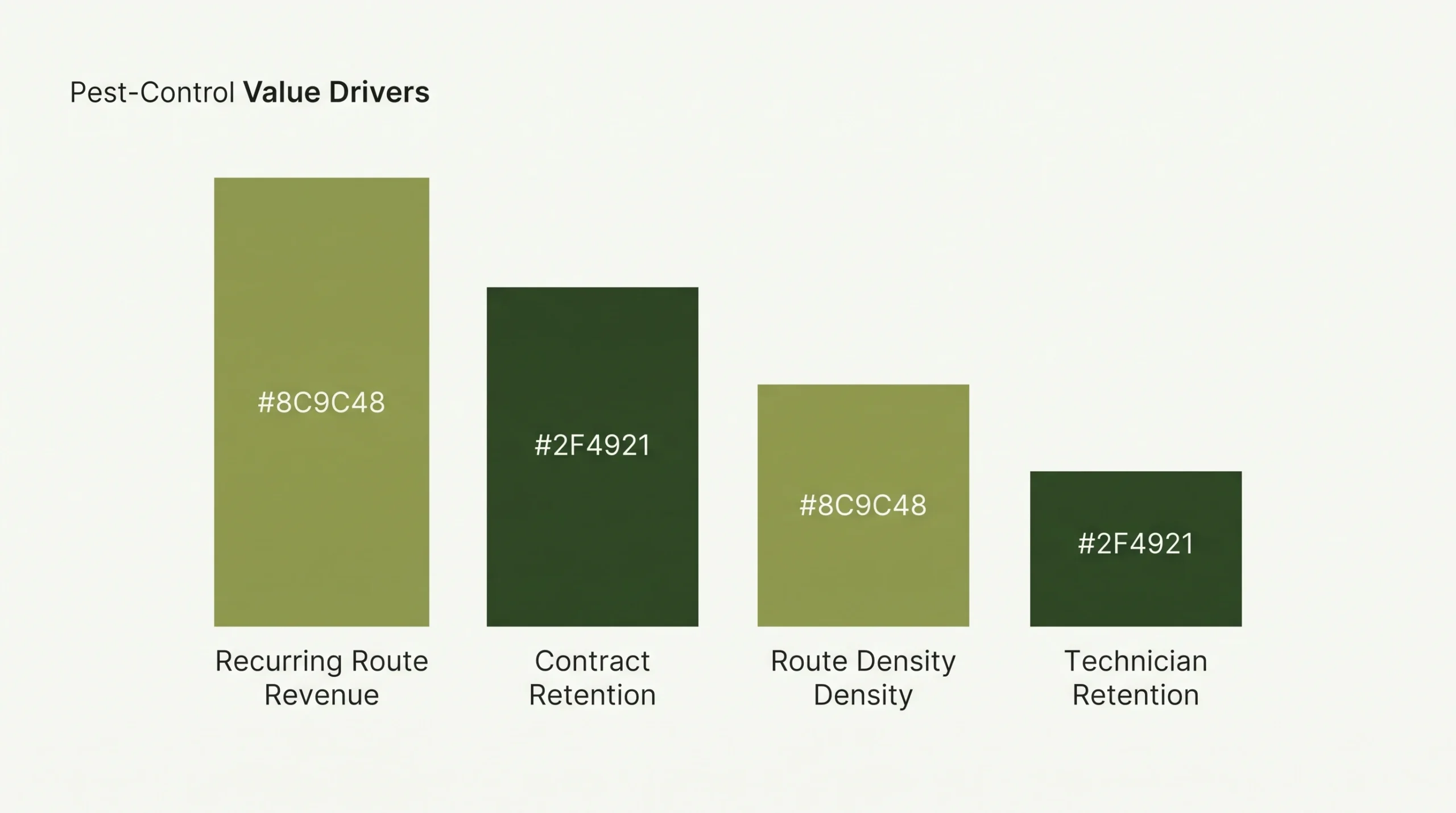
The main value driver is recurring route revenue from signed accounts. This income arrives month after month, so buyers treat it as low risk. A firm with dense routes and long client tenure earns a higher multiple. One-time jobs bring cash but no promise of repeat work, so they carry far less weight when a buyer sets the price. Route density, service mix, and retention all shape the outcome. Sofer Advisors measures each driver against real deal data.
The service mix also tilts the number. Termite bonds and commercial accounts often renew for years, so they add stable value. Wildlife removal and one-off treatments swing with the season. Buyers look closely. They want to see where the money truly comes from, not just the top-line sales figure a seller likes to quote. The table below sums up how the main drivers push value up or down.
| Value driver | Effect on value | Why buyers care |
|---|---|---|
| Recurring route revenue | Raises it | Predictable monthly cash |
| Route density | Raises it | More stops, lower cost |
| Signed contracts | Raises it | Locked-in future income |
| Customer concentration | Lowers it | Few accounts, big risk |
| Technician turnover | Lowers it | Higher hiring cost |
No single line in that table sets the price on its own. A valuator reads them as a group, then weighs them against your industry and size. A dense route base with weak contracts still carries risk. A strong contract book with heavy customer concentration does too. This is the Heart of a Teacher approach the firm brings to every job. We show owners how each factor moves the number, not just the final figure. That way the value holds up when a buyer or the IRS looks closer.
How much do recurring routes matter?
Recurring routes matter more than any other factor here. A high recurring revenue share signals steady income a new owner can trust. Firms where routes drive most of sales earn the top multiples. Route density adds to this effect. Dense clusters cut fuel and drive time, so each technician serves more stops, and that gain flows straight to the profit line. Density pays. Buyers study both the recurring share and the route map before they bid.
Retention seals the case. Low customer churn shows the service is worth keeping year after year. A firm that holds 90 percent of accounts looks far safer than one losing a quarter each year. Sofer Advisors reviews churn history alongside route data. So the value reflects real staying power, not a single strong season.
How do you apply SDE and EBITDA multiples?
Most pest control deals price on a multiple of earnings. Smaller firms use Seller’s Discretionary Earnings, or SDE. This figure adds back owner pay and personal costs. Multiples often run 2.5x to 4.5x of SDE. Larger firms price on EBITDA, and multiples often reach 5x to 7x. The exact figure tracks recurring share, size, and growth rate. First the analyst normalizes earnings, then applies the multiple.
Normalizing means stripping out one-time and personal items. Owner vehicles, above-market salary, and one-off legal fees all come out. This shows the true cash-generating power of the business. The work follows the income approach and market approach, tested against comparable sales. It is grounded in IRS Revenue Ruling 59-60 and the AICPA SSVS standard. Those rules keep the number defensible for tax, court, or a sale, which is exactly what a serious buyer will expect to see.
How do contracts and retention change value?
Contracts define how sure that future income really is. Auto-renewing, transferable agreements let a buyer step into a set revenue base. That lowers the risk of a sudden drop after the sale. Month-to-month or verbal accounts leave more room for churn. So they earn a lower multiple. Termite bonds count as a separate, high-value class. These long-term deals renew for years and add real stability to the price.
Strong contracts also cut the cost of winning new work. When accounts renew on their own, the firm spends less to replace them. Lower acquisition cost means fatter margins, and buyers reward that. Sofer Advisors reads your contract terms and renewal rates line by line. This confirms the value reflects the legal strength of the revenue, not just its size.
Why does private equity pay more?
Private equity has poured into the pest control space. The U.S. market reached about $29.7 billion in 2026, and roughly 78 percent of it is privately held, per pest control valuation data. Backed buyers roll up small firms into regional platforms. Each add-on gains route density and shares overhead across a bigger base. So a strategic buyer often pays above the normal small-firm range. Large advisors such as Alvarez and Marsal or Kroll serve these funds on the biggest deals. Sofer Advisors brings that same senior-level rigor to middle-market owners.
This roll-up interest is why preparation pays off. A seller who meets a fund with clean books, a clear number, and documented route retention holds a far stronger hand at the table. The Sofer Difference guides that prep through four phases: Discovery, Diligence, Analysis, and Delivery. The result is an audit-ready report a buyer’s team cannot easily pick apart. It puts an owner on equal footing with a well-funded acquirer.
What risks pull the value down?
Several risks can lower the value fast. Customer concentration is the main one, since losing a few big accounts can gut cash flow. Technician turnover is another, because labor retention drives both cost and service quality. High turnover raises hiring bills and can push clients away. Owner reliance, or key person risk, also weighs on the price. A firm that stalls when the founder leaves is harder to sell. Weak licensing compliance can bring fines or a shutdown.
Heavy reliance on one-time jobs adds risk too. That revenue is hard to predict, so buyers discount it. A valuator flags each of these traps early, before they surface in due diligence. Sofer Advisors runs that review the way a court or the IRS would. So owners can fix the gaps before a buyer ever finds them. Catching a concentration problem or a licensing lapse in advance can protect a large share of the final price. This is where careful, standards-based work separates a real valuation from a quick online estimate.
Frequently Asked Questions
How do you value a pest control company?
You start with the recurring route revenue and how well the firm keeps it. Analysts normalize earnings to SDE or EBITDA, then apply a market multiple. They weigh route density, contract quality, and customer churn. Sofer Advisors reviews your client base and route map against real deal data. The result is a value that fits current market conditions and stands up to review.
What is a good EBITDA multiple for a pest control business?
Strong, contract-heavy pest control firms often trade near 5x to 7x EBITDA. Size, growth, and recurring share can move that range either way. The premium reflects the steady cash flow tied to signed service routes. Smaller firms may price on an SDE multiple instead. Sofer Advisors applies defensible methods to find the multiple that fits your risk profile and financial health.
How does route density affect value?
Route density sets how much time technicians spend working versus driving. Tight, clustered routes let a firm serve more stops with fewer hours. That cuts fuel and labor cost, so profit margins rise. Higher margins lift the valuation directly. Sofer Advisors studies your route data to show how density drives enterprise value. Dense operations also look more attractive to a roll-up buyer.
Are customer contracts important to the value?
Yes, contracts are the clearest proof of recurring revenue. Auto-renewing, transferable agreements give a buyer income they can count on. Month-to-month or verbal accounts carry more churn risk, so they earn less. Termite bonds hold special weight as long-term deals. Sofer Advisors reviews your contract terms and renewal history. This makes sure the value reflects the legal strength of each revenue stream.
How profitable is a pest control company?
Profit depends on labor cost against the density of service stops nearby. Well-run firms often reach margins in the mid-teens to mid-twenties by percent. They do it by tight scheduling and a focus on high-margin work like termite bonds. Sofer Advisors examines your normalized earnings to see how your margins compare. That reading shows where efficiency gains could lift both profit and value.
What is SDE and why does it matter?
SDE stands for Seller’s Discretionary Earnings. It shows what a full-time owner-operator keeps in a year. The figure adds back owner pay, personal costs, and one-time items. Small business deals lean on SDE because most owners run costs through the company. Sofer Advisors normalizes these numbers so the earnings reflect true operating profit. A clean SDE base leads to a fair and defensible multiple.
Does commercial or residential focus change value?
Yes, the mix can shift the multiple. Commercial accounts often sign longer contracts and churn less than homes. That stability can support a higher value in many markets. Commercial work also demands more technical skill, which keeps small rivals out. Residential routes add density and volume. Sofer Advisors weighs your revenue mix to show how the balance affects long-term risk and saleability.
What risks lower a pest control valuation?
Customer concentration tops the list, since a few lost accounts can hurt cash flow. High technician turnover raises cost and can dent service quality. Owner reliance makes the firm hard to run after a sale. Weak licensing compliance risks fines or a shutdown. Heavy reliance on one-time jobs adds uncertainty. Sofer Advisors flags each risk early so owners can address it before due diligence.
How much does a business valuation from Sofer Advisors cost?
Full business valuations typically run from 7,500 to 25,000 dollars. The price depends on how complex your financials are and the purpose of the report. Simpler jobs for planning or tax fall toward the lower end. Deals and litigation support need deeper work, so they land higher. Contact Sofer Advisors for a fee quote matched to your situation. The firm holds a next business day response policy.
Related Case Studies
- How to Value a Commercial Cleaning Company for Sale
- How to Value a Self-Storage Facility: Cap Rates and Operations
- Customer Concentration: Why It Cuts Sale Price 10 to 30 Percent
Executive Summary
A pest control company valuation turns recurring route revenue into a defensible price. Buyers reward dense routes, signed contracts, and low churn, since those cut future risk. Small firms price on SDE at roughly 2.5x to 4.5x. Larger firms price on EBITDA, often 5x to 7x, per DealStats deal evidence. Private equity roll-ups can push strong operators higher still. Customer concentration, technician turnover, and owner reliance pull the number back down. Sofer Advisors builds each figure under IRS Revenue Ruling 59-60 and AICPA SSVS. The firm has earned 180+ five-star Google reviews and Inc. 5000 honors in 2024 and 2025.
What Should You Do Next?
Gather three to five years of financial statements and a full list of active routes and contracts. Note any owner-discretionary costs so the earnings can be normalized with care. Then flag any account that makes up a large share of your revenue.
For a value you can stand behind, work with David Hern CPA ABV ASA. His team has given expert witness testimony in 11+ cases across Georgia, Florida, California, and New Mexico. Schedule a consultation to discuss your pest control business.
People Also Read
- Owner Compensation Normalization: Why Salary Affects Sale Value
- EBITDA Add-Backs: What Buyers Accept and What They Reject
About the Author
This guide was prepared by David Hern CPA ABV ASA, founder of Sofer Advisors, a business valuation firm headquartered in Atlanta, GA serving clients across the United States. David holds dual accreditations as an Accredited Senior Appraiser (ASA) and is Accredited in Business Valuation (ABV), credentials recognized by the IRS, SEC, and FINRA. He also holds the Certified Exit Planning Advisor (CEPA) designation. With 15+ years of valuation experience, David has served as an expert witness in 11+ cases across multiple jurisdictions and built Sofer Advisors into an Inc. 5000-recognized firm with 180+ five-star Google reviews. Its full W2 employee team maintains subscriptions to all major valuation databases and operates under a next business day response policy. For professional business valuation services, visit soferadvisors.com/about-us/ or contact Sofer Advisors at soferadvisors.com/contact-us/.
Disclaimer: This content is for informational purposes only and does not constitute professional valuation advice. Business valuation conclusions depend on specific facts and circumstances. Contact Sofer Advisors for guidance regarding your specific situation.









