

Last Updated: August 2026
A dermatology practice valuation is a formal estimate of what a skin-care practice is worth. It weighs cash flow, assets, payor mix, and sales of similar clinics. Size shapes the result. A small solo office often sells near 3 to 5 times EBITDA. A large group can reach 12 to 15 times, based on 2026 FOCUS data. Sofer Advisors builds each opinion on that kind of market proof.
Why is the range so wide? Private equity changed how these clinics trade. Buyers now roll many offices into big groups called an MSO, or management services organization. A single office, folded into a platform, can be worth far more. The mix of work, staff depth, and Mohs surgery all move the price.
Key Takeaways
- Size sets the multiple: Small offices trade near 3 to 7 times EBITDA. Large platforms reach 12 to 15 times.
- MSO roll-ups add value: Private equity pays more for scale, so folding a clinic into a platform can lift its price.
- Income mix matters: Steady medical visits anchor value. High-margin cosmetic work can push the multiple higher.
- Staff drive earnings: Physician assistants, nurse practitioners, and in-house Mohs surgery raise output and profit.
- Standards guard the number: A sound report follows IRS Revenue Ruling 59-60 and AICPA SSVS. It holds up in a deal or an audit.
These drivers explain why two offices can carry very different prices. The sections below show how each one works.
What multiples do dermatology practices sell for?
Dermatology practices sell for a multiple of EBITDA, and that multiple rises with size. A solo office often trades near 3 to 5 times earnings. A small group runs 4 to 7 times. A regional platform reaches 8 to 10 times. A large platform can hit 12 to 15 times, per FOCUS Investment Banking. Small deals sometimes price off Seller’s Discretionary Earnings, which adds back the owner’s pay.
| Practice type | Typical revenue | EBITDA multiple | What buyers reward |
|---|---|---|---|
| Solo practice | Under $2M | 3x to 5x | One owner, local reach |
| Small group | $2M to $15M | 4x to 7x | More staff, mixed services |
| Regional platform | $15M to $50M | 8x to 10x | In-house Mohs, central admin |
| Large platform | $50M or more | 12x to 15x | Multi-state scale, systems |
The jump from one row to the next is not luck. It reflects lower risk and easier growth. A solo office leans on one doctor, so its earnings can fade if that doctor leaves. A large group spreads risk across many sites. Sofer Advisors tests where a practice sits, then backs the figure with recent deal data.
How do MSO and PE roll-up deals work?
An MSO is the structure that lets a PE firm own the business side of a practice. Doctors keep clinical control through a friendly professional corporation. The MSO runs billing, staffing, and back-office work. A buyer takes a large anchor practice first, called the platform. It then adds smaller clinics, called tuck-ins, at lower prices.
The roll-up math is simple. The platform earns a high multiple because of its size. Each tuck-in joins at a lower price. Once absorbed, it trades up to the platform’s multiple. That spread creates value for the seller and the firm share. More than 35 PE-backed platforms now run across the country, per Scope Research and FOCUS. Platform-ready practices, often above $5M in EBITDA, tend to see 70 percent or more cash at close plus rollover equity.
| Buyer | Typical target | Deal structure | Key focus |
|---|---|---|---|
| Platform creation | $5M or more EBITDA | 70 to 80% cash plus rollover | Management depth, scale |
| Existing add-on | $1M to $5M EBITDA | Cash plus rollover, earnouts | New territory, density |
| Health system | Multi-specialty group | Often all cash | Coverage, referrals |
For an owner, the structure matters as much as the headline price. A high multiple can hide a large equity rollover, so part of the payout rides on the platform’s next sale. Sofer Advisors helps owners read these offers. They can then weigh gross enterprise value against the cash they keep after debt.
How is cosmetic versus medical revenue valued?
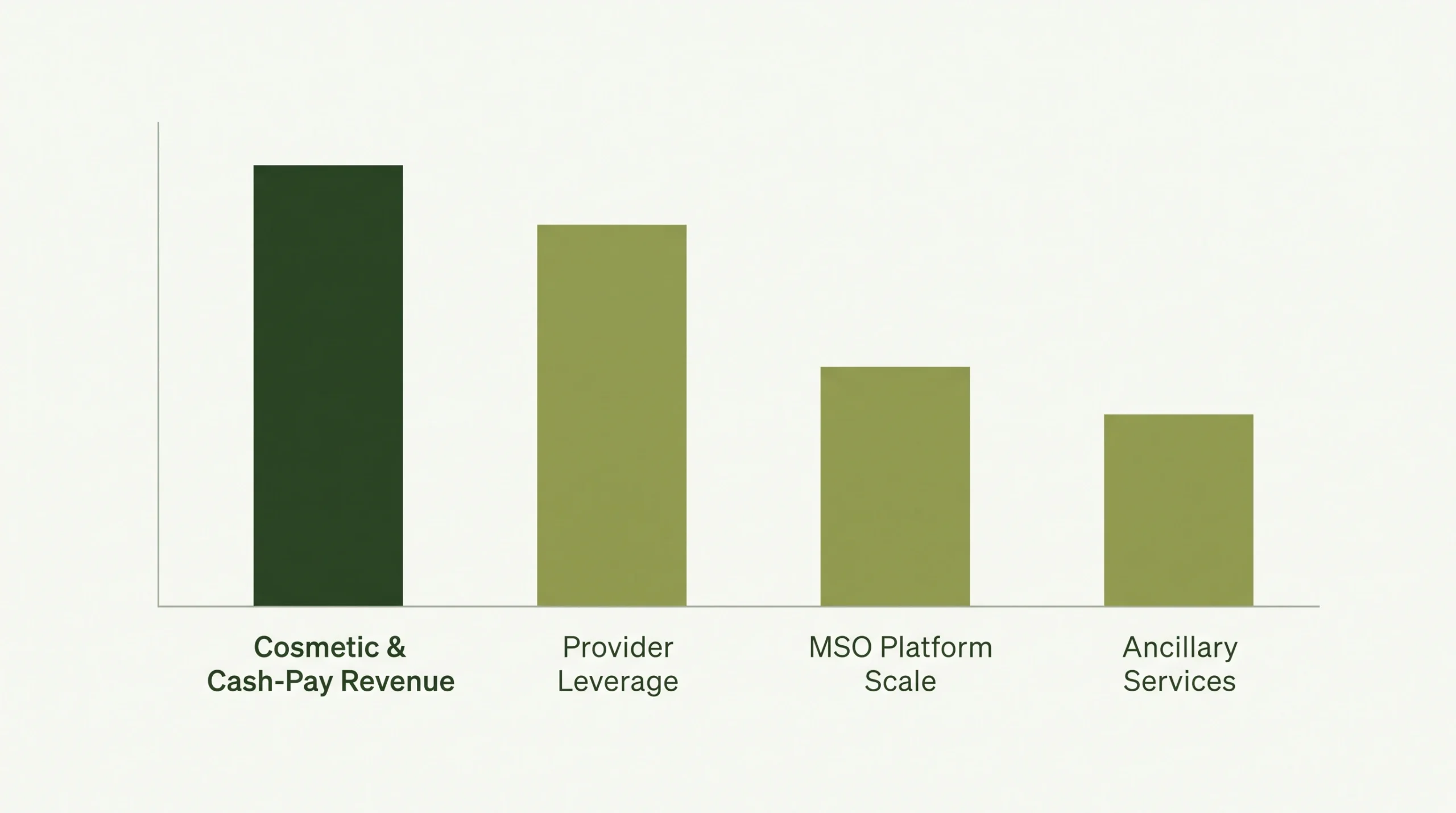
Buyers value cosmetic and medical work differently because each carries different risks. Medical care, such as skin exams and cancer work, runs on insurance and steady patient needs. Cosmetic work, like injectables and laser care, is cash-pay and high-margin. Yet it swings more with the economy. A balanced mix tends to earn the best multiple.
The numbers show why. FOCUS puts medical work near $1.3M in sales per doctor. That is about a 25 percent margin. Cosmetic work runs closer to $1.8M at 27 percent or more. Practices with over 70 percent commercial or cash-pay income draw the most buyers. That mix collects faster and lowers rate-cut risk. Sofer Advisors weighs each stream before it sets a blended value.
A heavy cash-pay tilt is not always better. Elective spending falls when the economy slows, so a cosmetics-only practice carries real swing risk. A purely medical office may face insurance rate cuts, like the Medicare change set for 2026. The goal is a durable blend, weighted by how steady each stream has been.
What drives a dermatology practice’s value?
Beyond size and mix, a few factors move the multiple most. Staff depth comes first. A practice that spreads work across physician assistants and nurse practitioners earns more per doctor. It also leans less on any one person. In-house work like Mohs surgery and pathology keeps high-margin cases inside. Together these traits raise earnings and cut risk. That is what buyers pay a premium to see.
The traits buyers reward most include:
- Staff depth, so no single doctor holds the whole patient base
- In-house Mohs surgery and pathology, which keep profit inside
- A commercial-heavy payor mix that collects fast
- Multi-site operations that prove the model can grow
- Clean books and signed provider non-compete deals
Skin cancer keeps this field busy, with about 850,000 Mohs surgeries done each year. A practice that handles those cases itself keeps income it would otherwise refer away. Sofer Advisors scores each driver during diligence. They explain most of the gap between a low and a high multiple.
Which valuation methods and standards apply?
Appraisers lean on two methods for a profitable practice: the income approach and the market approach. The income approach, often a discounted cash flow model, projects future earnings. It then discounts them to today at a rate that reflects risk. The market approach compares the practice to real sales of clinics. The asset approach shows up mainly for tax or wind-down cases. EBITDA sits at the center of all three.
Method choice must follow set rules. A sound report meets IRS Revenue Ruling 59-60. It lists the fair market value factors courts and the IRS expect. It also follows AICPA SSVS and, for appraisal work, USPAP from The Appraisal Foundation. These rules make the analyst normalize earnings, log add-backs, and show the math. Sofer Advisors builds each file to that bar. So it survives review by a buyer, a court, or the IRS.
Normalization is where much of the work sits. The analyst recasts past books to strip out one-time costs and the owner’s personal spending, which reveals true earning power. The team also weighs enterprise value against any personal goodwill tied to one doctor, since that value can walk out the door. For a private, minority stake, a discount for lack of marketability may apply. Each change needs proof, not a guess.
How do you prepare a practice for sale?
Prep starts long before a buyer calls. Clean, separate books come first, so personal and business costs never blur. Owners should document normal earnings and gather three to five years of statements, tax returns, and provider contracts. A quality of earnings review can confirm the numbers early. That step removes surprises that shave a price late in a deal.
Good prep also proves the business can run without its founder. Here The Sofer Difference guides the work, through its four phases: Discovery, Diligence, Analysis, and Delivery. The firm brings a Heart of a Teacher to each step. It shows owners the math behind every change, not a black-box number. That clarity helps owners bargain from evidence, not emotion.
Large firms such as Alvarez and Marsal, Kroll, and Stout focus mostly on big enterprise clients. Sofer Advisors brings that same senior-level rigor to middle-market owners. Unlike a solo appraiser, it backs each file with a full W2 team of 14. It also keeps every major deal database. The firm holds 180+ five-star Google reviews and Inc. 5000 status for 2024 and 2025. It answers new questions by the next business day.
Frequently Asked Questions
How do you value a dermatology practice?
You value a practice by adjusting its earnings, then applying a multiple or a cash-flow model. Sofer Advisors, led by David Hern CPA ABV ASA, uses the income and market approaches. It first normalizes owner pay and one-time costs to reach adjusted EBITDA, the figure buyers use. The team then checks the result against recent deals.
What multiple does a dermatology practice sell for?
Most practices sell between 3 and 15 times EBITDA. A solo office often lands near 3 to 5 times, a small group 4 to 7 times, and a large platform 12 to 15 times. The figure turns on staff depth, income mix, and payor quality. Cosmetic work and in-house Mohs surgery push a practice toward the top of its range.
How do MSO and private equity deals price a practice?
PE buyers price through an MSO. They buy a large platform at a high multiple, then add smaller clinics at lower ones. Each add-on trades up to the platform’s value once absorbed, and both sides share the gain. Platform-ready deals often pay 70 percent or more cash at close, plus equity in the group.
Is cosmetic or medical revenue worth more?
Neither is simply worth more; each carries different risks. Medical care brings steady, insurance-based cash flow that anchors value. Cosmetic work earns higher margins but swings more with the economy. Buyers pay the best multiple for a balanced mix. Aim for commercial and cash-pay sources above 70 percent of income.
Does a Mohs surgeon raise practice value?
Yes, an in-house Mohs surgeon often raises value. Mohs surgery treats skin cancer, and the country sees about 850,000 cases each year. Keeping that work inside captures high-margin revenue that would otherwise go to an outside specialist. It also draws referrals. Buyers reward that mix of steady demand and strong profit.
What is adjusted EBITDA in a practice valuation?
Adjusted EBITDA is earnings before interest, taxes, depreciation, and amortization, recast to show normal operations. The analyst adds back one-time costs and the owner’s personal or above-market pay. This gives a clean profit figure buyers compare across practices. It is the base most deals are priced on. Well-documented add-backs can change the final value, so each needs proof.
What is personal goodwill in a dermatology practice?
Personal goodwill is the value tied to one doctor’s name, skill, and patient following, not the business itself. It matters because that value can leave if the doctor does. Buyers split it from enterprise goodwill, which belongs to the practice and its systems. The split also carries tax weight, so an appraiser measures each part with care.
How long does a dermatology valuation take?
A valuation often takes four to eight weeks. The time turns on how clean the books are and how complex the practice is. Data gathering and normalization take the most time, then analysis and the written report. Sofer Advisors runs this through its four-phase process and keeps owners updated, with a next business day reply policy.
How much does a business valuation from Sofer Advisors cost?
Healthcare practice valuations from Sofer Advisors often run 10,000 to 30,000 dollars, based on practice size and complexity. Simple single-site work sits toward the lower end. Multi-site groups, mixed service lines, or tax and litigation needs take deeper work, so they fall higher. Contact Sofer Advisors for a quote matched to your practice and its use.
Related Case Studies
- How to Value a Healthcare Management Services Organization (MSO)
- Behavioral Health Roll-Ups: How Platform and Add-On Deals Are Priced
- Veterinary Roll-Ups: How PE Buyers Set Group Practice Multiples
Executive Summary
A dermatology practice valuation turns adjusted EBITDA into an enterprise value, using market multiples and cash-flow analysis. Size drives the range. Solo offices trade near 3 to 5 times earnings. Large PE platforms reach 12 to 15 times, per 2026 FOCUS data. Income mix, staff depth, payor quality, and in-house Mohs surgery move the multiple most. A sound report normalizes earnings and follows IRS Revenue Ruling 59-60 and AICPA SSVS. Sofer Advisors delivers that work for sales, partner buy-ins, and tax reporting in the middle market.
What Should You Do Next?
Start by cleaning your books and splitting personal costs from the business. Next, document your adjusted EBITDA and gather three to five years of statements and provider contracts. Then decide whether a full sale, a partner buy-in, or a PE deal fits your goals, since each draws a different multiple.
For a defensible figure you can act on, work with David Hern CPA ABV ASA, whose team has testified in 11+ expert witness cases across Georgia, Florida, California, and New Mexico. Schedule a consultation to discuss your dermatology practice.
People Also Read
- Owner Compensation Normalization: Why Salary Affects Sale Value
- EBITDA Add-Backs: What Buyers Accept and What They Reject
About the Author
This guide was prepared by David Hern CPA ABV ASA, founder of Sofer Advisors, a business valuation firm headquartered in Atlanta, GA serving clients across the United States. David holds dual accreditations as an Accredited Senior Appraiser (ASA) and is Accredited in Business Valuation (ABV), credentials recognized by the IRS, SEC, and FINRA. He also holds the Certified Exit Planning Advisor (CEPA) designation. With 15+ years of valuation experience, David has served as an expert witness in 11+ cases across multiple jurisdictions and built Sofer Advisors into an Inc. 5000-recognized firm with 180+ five-star Google reviews. Its full W2 employee team maintains subscriptions to all major valuation databases and operates under a next business day response policy. For professional business valuation services, visit soferadvisors.com/about-us/ or contact Sofer Advisors at soferadvisors.com/contact-us/.
Disclaimer: This content is for informational purposes only and does not constitute professional valuation advice. Business valuation conclusions depend on specific facts and circumstances. Contact Sofer Advisors for guidance regarding your specific situation.









