


Last Updated: August 2026
A chiropractic practice valuation is a formal estimate of what a clinic is worth. It applies to a sale, a partner buy-in, or a succession plan. The work weighs earnings, goodwill, patient retention, and payer mix, then applies a market multiple. Recent data from Peak Business Valuation puts most clinics near 1.75x to 2.27x Seller’s Discretionary Earnings. Sofer Advisors builds each figure on verified records, not on gross revenue.
The value matters most at a turning point. An owner may want to sell, add an associate, or hand the clinic to the family. Each path needs a number that a buyer, a lender, or the IRS will accept. A sound value also shows where the practice can grow before any deal closes.
Key Takeaways
- Definition: A chiropractic practice valuation estimates a clinic’s fair market value for a sale, buy-in, or succession, using verified records.
- Earnings multiples: Most clinics sell near 1.75x to 2.27x Seller’s Discretionary Earnings. Larger group practices trade on EBITDA.
- Goodwill split: Value divides into personal goodwill, tied to the owner, and enterprise goodwill, which a buyer keeps.
- Owner reliance: Heavy reliance on one chiropractor raises risk and lowers the multiple. A strong associate team does the opposite.
- Sale versus succession: The method holds steady. The buyer, the tax rules, and the deal terms shift with each path.
These points tie earnings to risk and to price. The sections below show what drives the number and what changes when you sell rather than hand the clinic down.
What drives a chiropractic practice’s value?
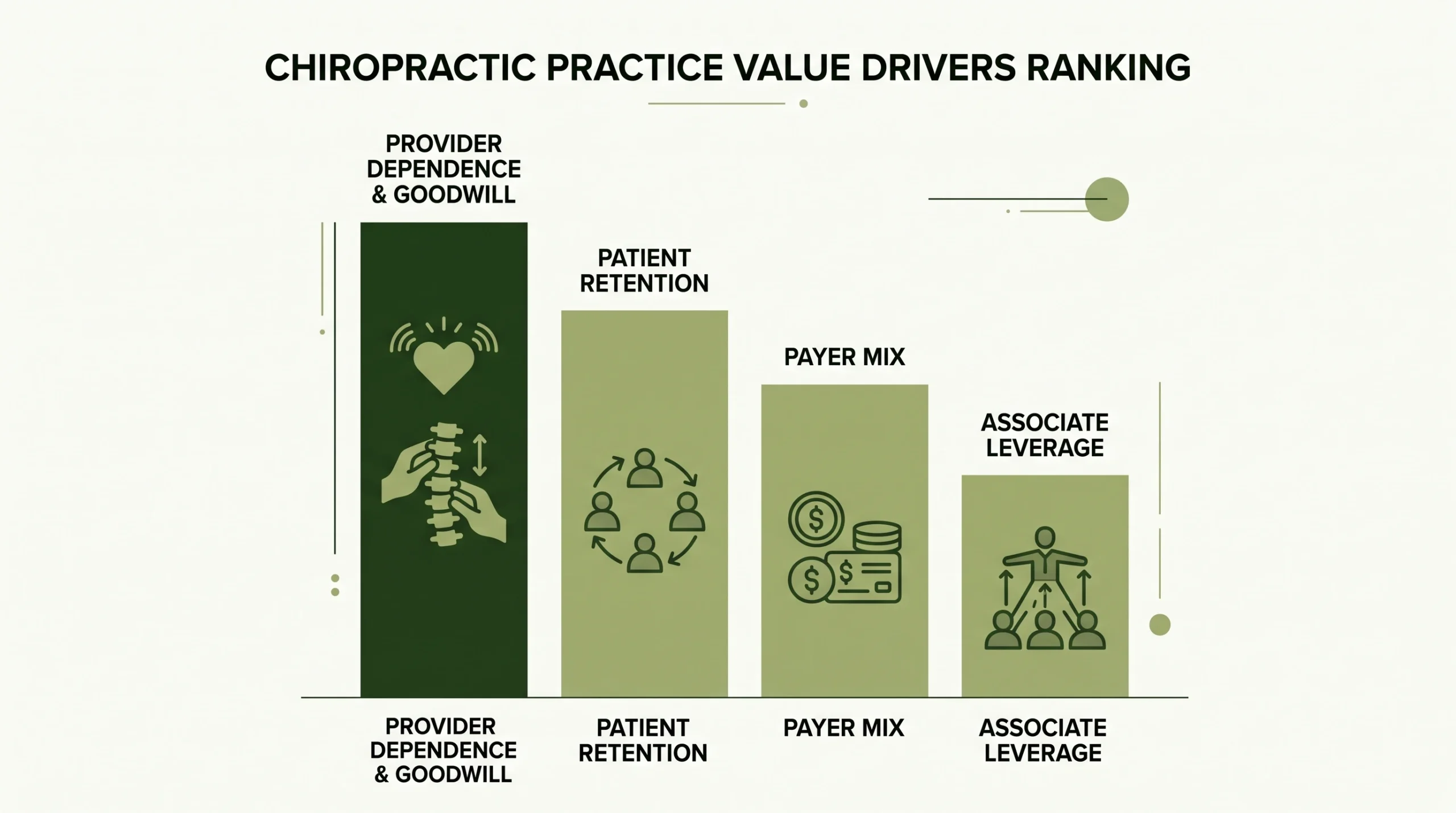
A clinic’s value rests on four things. They are earnings quality, patient retention, payer mix, and owner reliance. Steady collections and a broad patient base support a higher multiple. A clinic that leans on one chiropractor for most visits carries more risk. That risk pulls the multiple down. Care plans and strong associate coverage push it back up. Equipment and the lease add value too, though they sit below goodwill in weight.
The payer mix deserves a close look. A clinic with a healthy cash-pay share is safer than one that bills mostly through carriers. Steady care plans give a buyer cash flow they can count on. The lease matters as well. A long, transferable lease at a fair rate protects future earnings. A short or costly one can trim the price. The firm weighs these drivers against fair market value under set standards. So the final number reflects the real business.
How is chiropractic goodwill split?
Goodwill splits into two parts. Personal goodwill ties to the owner, and enterprise goodwill ties to the clinic. Personal goodwill is the value that walks out with the doctor. It covers personal reputation, referral habits, and patient loyalty to one person. Enterprise goodwill is the value a new owner keeps. It covers the brand, the location, trained staff, and proven billing systems. Buyers pay a premium only for the part that transfers.
Analysts often measure this split with the excess earnings method. It finds the earnings above a fair return on assets. It then treats that surplus as goodwill. A clinic that runs well without the founder each day shifts more value into the enterprise column. That shift is what a buyer rewards. Clean patient records, written protocols, and a capable associate all move value from personal to transferable. This is where the income approach and the asset approach meet in one clear view of worth.
What multiples apply to a chiropractic practice?
Chiropractic practices trade on a multiple of earnings. Smaller clinics use Seller’s Discretionary Earnings, or SDE. Larger ones use EBITDA. The work starts by cleaning up the books. An analyst strips out one-time costs and personal expenses. Then the analyst adds back fair owner pay. That normalized figure becomes the base. A market multiple is applied to reach a value the market can support.
The table below shows how the metric and the multiple shift with size and structure.
| Earnings metric | Typical multiple | Best fit |
|---|---|---|
| Seller’s Discretionary Earnings | 1.75x to 2.27x | Small, owner-run clinics |
| EBITDA | 2.86x to 3.83x | Larger group practices |
| Asset approach | Book value of assets | Sets a value floor |
No single multiple fits every clinic. The right one depends on earnings, growth, and risk. It must also hold up under review. A clinic with steady care plans and good associate coverage sits at the top of the range. An owner-run clinic with thin margins sits lower. Sofer Advisors tests each EBITDA multiple against current deal data. So the answer reflects what buyers really pay.
How do payer mix and care plans affect value?
Payer mix and care plans shape how steady the income is. A larger cash-pay share guards earnings from insurance rate cuts and slow pay. A clinic built on repeat care plans has income a buyer can count on. Both traits lower risk. Lower risk lifts the multiple. Heavy reliance on one insurer works the other way.
Recurring revenue is a strong sign of a durable model. It shows that patients return by plan, not by chance. That smooths cash flow across the year. A buyer values that steadiness, because it survives the sale. The firm reviews payer reports, plan retention, and how fast the clinic collects. This shows how much of the income is truly repeatable. The firm brings the Heart of a Teacher approach to this step. It shows the owner which revenue holds up and which does not.
What changes in a sale versus a succession?
The method stays the same. The buyer, the tax rules, and the deal terms change with the path. In an outside sale, a third party pays for value they can keep. So enterprise goodwill and clean systems drive the price. In a succession to an associate or family, the transfer often happens over time. The price must still meet fair market value to satisfy the IRS. A gift or a low-value transfer can trigger tax without a sound appraisal.
Succession also rewards early work. An owner who adds an associate, writes down protocols, and grows care plans moves value into the enterprise column before any handoff. That raises the price. It also eases the change. A sale often turns on deal structure instead. Common terms include earnouts or seller notes tied to patient retention. Sofer Advisors fits the analysis to the path, whether the goal is a clean exit or a slow buy-in. Each opinion rests on the same evidence.
How does Sofer Advisors value a practice?
Sofer Advisors follows a four-phase method called The Sofer Difference. The phases are Discovery, Diligence, Analysis, and Delivery. Discovery sets the purpose and the standard of value. Diligence gathers tax returns, financials, the lease, an equipment list, and payer data. Analysis cleans up earnings and applies the income, market, and asset approaches. Delivery produces a report built to hold up with a buyer, a lender, or a court. Every step ties back to verified records.
Standards keep the work sound. The firm applies IRS Revenue Ruling 59-60 for fair market value. It also follows the AICPA Statement on Standards for Valuation Services. Large firms such as Alvarez and Marsal or Kroll bring this rigor to big clients. The firm brings the same senior-level care to middle-market and healthcare owners. Unlike a solo practitioner, it backs each answer with a full W2 team of 14 and 180+ five-star Google reviews. David Hern CPA ABV ASA leads the work. He has served as an expert witness in 11+ cases across Georgia, Florida, California, and New Mexico.
Frequently Asked Questions
How do you value a chiropractic practice?
You value a chiropractic practice by cleaning up its earnings, then applying a market multiple. The analyst recasts the books to remove one-time costs and personal expenses. Then the analyst adds back fair owner pay. That base is multiplied by a rate set by risk, size, and payer mix. The result is checked against similar deals and the value of the clinic’s assets.
What multiple does a chiropractic practice sell for?
Most chiropractic practices sell near 1.75x to 2.27x Seller’s Discretionary Earnings, based on recent data. Larger group clinics often trade on EBITDA, in a range close to 2.86x to 3.83x. The exact figure depends on patient retention, payer mix, and how much the clinic relies on one chiropractor. Sofer Advisors places each practice within that range using current market evidence.
How is chiropractic goodwill valued?
Chiropractic goodwill is valued by splitting personal goodwill from enterprise goodwill. Personal goodwill ties to the owner, such as reputation and patient loyalty to one person. Enterprise goodwill transfers to a buyer, such as the brand, the location, and proven systems. Analysts often use the excess earnings method. It finds earnings above a fair return on assets, then treats that surplus as goodwill a buyer can keep.
How does owner reliance affect value?
Owner reliance lowers value because it raises risk for a buyer. When one chiropractor sees most patients, their exit can cause a sharp drop in visits and revenue. Clinics that add associates or write down clear protocols show a model a buyer can keep. Sofer Advisors adjusts the multiple to reflect this. It penalizes heavy owner reliance and rewards team-based clinics that survive a sale.
Why does payer mix matter in a valuation?
Payer mix matters because it shows how steady and how exposed the income is. A larger cash-pay share guards earnings from insurance rate cuts and slow pay. A clinic that bills mostly through one carrier faces more risk if rates change. A balanced mix supports a higher multiple. The firm reviews payer reports to see how durable the revenue really is before it sets a value.
What documents are needed for the valuation?
A credible valuation needs three to five years of tax returns, profit and loss statements, and balance sheets. The analyst also reviews the lease, an itemized equipment list, an accounts receivable aging report, and patient retention data. These records let the firm clean up earnings and confirm the quality of the revenue. Complete, clear records shorten the process and strengthen the final number.
Is a valuation needed for a family succession?
Yes, a valuation is needed even when you pass the practice to a family member. The transfer must meet fair market value to satisfy the IRS and to avoid future disputes over price. An independent appraisal protects every party by setting a sound figure. It also gives the next owner a clear starting point for financing and for planning the clinic’s growth.
How much does a business valuation from Sofer Advisors cost?
Healthcare practice valuations from Sofer Advisors typically run from $10,000 to $30,000. The fee depends on the size of the practice, how complex the financials are, and the use of the report. Simpler jobs for planning fall toward the lower end. Deals, tax filings, and litigation support need deeper work and fall higher. Contact the firm for a quote matched to your situation.
How long does a chiropractic valuation take?
A chiropractic practice valuation usually takes four to eight weeks from start to final report. The timeline depends on how fast records arrive and how complex the finances are. Discovery and diligence come first. Analysis and delivery follow. Sofer Advisors works to a next business day response policy. So owners are not left waiting between steps as the work moves forward.
Related Case Studies
- How to Value a Healthcare Management Services Organization (MSO)
- How to Value a Home Health Agency: Medicare Risk and Multiples
- Independent Pharmacy Valuation: A Guide to DIR Fees and 2026 Multiples
Executive Summary
A chiropractic practice valuation turns earnings, goodwill, and patient data into a sound price for a sale or succession. Most clinics sell near 1.75x to 2.27x Seller’s Discretionary Earnings. Larger group practices trade on EBITDA at roughly 2.86x to 3.83x. The value turns on owner reliance, payer mix, care plans, and associate coverage. Goodwill splits into personal and enterprise parts, and only the part a buyer keeps earns a premium. Sofer Advisors applies IRS Revenue Ruling 59-60 and AICPA standards through its four-phase method. The result is a report that holds up for buyers, lenders, and the IRS.
What Should You Do Next?
Start by pulling three to five years of tax returns and cleaning up your earnings so the true profit is clear. Next, look at what depends on you alone, and think about adding an associate or growing care plans before any deal. Then confirm the purpose of the valuation, since a number for planning may not survive IRS or court review.
For a figure you can stand behind, work with David Hern CPA ABV ASA. Schedule a consultation to discuss the value of your chiropractic practice.
People Also Read
- Owner Compensation Normalization: Why Salary Affects Sale Value
- Customer Concentration: Why It Cuts Sale Price 10 to 30 Percent
About the Author
This guide was prepared by David Hern CPA ABV ASA, founder of Sofer Advisors, a business valuation firm headquartered in Atlanta, GA serving clients across the United States. David holds dual accreditations as an Accredited Senior Appraiser (ASA) and is Accredited in Business Valuation (ABV), credentials recognized by the IRS, SEC, and FINRA. He also holds the Certified Exit Planning Advisor (CEPA) designation. With 15+ years of valuation experience, David has served as an expert witness in 11+ cases across multiple jurisdictions and built Sofer Advisors into an Inc. 5000-recognized firm with 180+ five-star Google reviews. Its full W2 employee team maintains subscriptions to all major valuation databases and operates under a next business day response policy. For professional business valuation services, visit soferadvisors.com/about-us/ or contact Sofer Advisors at soferadvisors.com/contact-us/.
Disclaimer: This content is for informational purposes only and does not constitute professional valuation advice. Business valuation conclusions depend on specific facts and circumstances. Contact Sofer Advisors for guidance regarding your specific situation.